⬅️ Key Arguments (MOC) · Related: West Bank · Occupation · Colonizers · International Law & Aid Organizations
One-line rebuttal
The 1949 lines were armistice lines, “not frontiers” — explicitly, at Arab insistence. The territory is legally disputed, not “occupied” (self-defense capture in 1967; prior sovereign was never recognized), and settlements are a final-status issue to be negotiated, not the cause of a century-old rejectionist war.
Core points
- “Not a frontier.” All four 1949 armistice conventions state the lines don’t prejudice final borders (Bernard Lewis, below).
- Disputed, not occupied. No recognized sovereign held the West Bank before 1967; Israel took it in self-defense (Schwebel, Stone, Rostow — “sovereignty vacuum”). → West Bank · Occupation
- Legal debate is a distraction. Peace with Egypt and Jordan happened with settlements present; the real obstacle is rejection of a Jewish state (Dore Gold, “disputed territories,” below).
- Proportion. Focusing on apartment-building over a decades-long war to destroy Israel is morally warped (opening note below).
Thoughts
Even if you came to the view that some, or even most, “settlements” are wrong, there’s something deeply warped about giving such prominence to this aspect of the conflict. It implies that the chief problem is the building of apartment buildings, houses, factories, schools—and not the unrelenting, decades-long campaign led by Arab states and then by the Palestinian movement to liquidate a free society through conventional war, subversion, shootings, bombings, suicide attacks, rockets. — location: 3533
History
- Barak secured an agreement for the dismantling of 12 new outposts in 1998, but continued expansion was occurring in existing settlements in the West Bank. This continued to hurt the Palestinian peace process.
- Netanyahu's government pushed for the construction of a new neighborhood, Har Homa, in East Jerusalem, and continued construction within existing Israeli settlements. Construction in the years following the Oslo Accords was still significantly less than prior, however.
- 1968-2023 > 1974: Gush Emunim was formally established
- “The lines dividing Israel from her neighbours were ceasefire lines, subsequently regularized as ‘Armistice Demarcation Lines’ in four con- ventions signed by the parties between February and July 1949. The wording of the conventions - ironically, on Arab insistence - makes it clear that these lines are not frontiers. Thus, the earliest of the four, the Israel-Egypt convention, signed 24 February 1949, states: ‘The Armistice Demarcation Line is not to be construed in any sense as a political or territorial boundary and is delineated without prejudice to rights, claims and positions of either Party to the Armistice as regards ultimate settlement of the Palestine question’ (Article v, sub-section 2). Similar reservations appear in two of the other conventions. The Jordanian convention, signed 3 April 1949, reads: ‘The provisions of this article shall not be interpreted as prejudicing, in any sense, an ultimate political settlement between the Parties to this Agreement. The Armistice Demarcation Lines denned in Articles v and vi of this Agreement are agreed upon by the Parties without prejudice to future territorial settlements or boundary lines or to claims of either Party relating thereto’ (vi, SS. 8, 9). The Syrian convention of 20 July 1949, is more emphatic: ‘It is emphasized that the following arrangements for the Armistice Demarcation Line between the Israeli and Syrian armed forces and for the Demilitarized Zone are not to be interpreted as having any relation whatsoever to ultimate territorial arrangements affecting the two Parties to this Agreement’ (v, SS. 1). Only the Lebanese convention, signed 23 March 1949, departs from the pat- tern: ‘The Armistice Demarcation Line shall follow the international boundary between the Lebanon and Palestine’ (v, SS. 1).” Palestine On the History and Geography of a Name Bernard Lewis
Security Concerns
Arguments For
-
Natasha Hausdorff controverts allegations regarding Israeli settlements
-
From “Occupied Territories” to “Disputed Territories” by Dore Gold
- The article “From ‘Occupied Territories’ to ‘Disputed Territories’” by Dore Gold discusses the legal and political aspects of the Israeli-Palestinian territorial dispute. Here are the key points, including the legal arguments:
- Use of “Occupation” Terminology: The article argues that the term “occupation” is used politically to describe the West Bank and Gaza Strip, aiming to justify Palestinian violence, reject territorial compromise, and delegitimize Israeli claims. This terminology is contrasted with other territorial disputes globally, where the term “disputed” is more commonly used.
- Lack of Prior Sovereignty: The article notes that before 1967, there was no recognized sovereignty over the West Bank and Gaza Strip. Jordan and Egypt’s control over these territories resulted from the 1948 war, and was not widely recognized internationally.
- Aggression vs. Self-Defense: The article distinguishes between “aggressive conquest” and territorial acquisition in self-defense, arguing that Israel’s control over the territories came as a result of self-defense in the 1967 Six-Day War.
- Israeli Rights Under International Law: The article contends that under the League of Nations Mandate for Palestine (1922) and UN Charter Article 80, Jewish national rights in these territories were recognized, which challenges the notion of Israeli occupation.
- Impact of Oslo Agreements: The Oslo Agreements, which transferred certain powers from Israel to the Palestinian Authority, are argued to have changed the legal status of the territories. Since the majority of the Palestinian population came under Palestinian jurisdiction, the article questions the continued characterization of these areas as “occupied.”
- UN Security Council Resolutions: The article interprets UN Security Council Resolution 242 as not requiring Israel to withdraw from all territories captured in 1967, but rather to secure and recognized boundaries determined through negotiations.
- Description as “Disputed Territories”: The article advocates for the use of “disputed territories” over “occupied territories” to describe the West Bank and Gaza Strip, highlighting that both Israelis and Palestinians have claims to these areas.
This summary encapsulates the main arguments and legal perspectives presented in the article, highlighting the complexities surrounding the terminology and legal status of the West Bank and Gaza Strip【19†source】.
From “Occupied Territories” to “Disputed Territories,” by Dore Gold -
- 130 settlements, two of them contain a quarter of the settlers
- Within 2000 ft of the green line
- Majority of settlements are near green line, therefore easy to do land swap
- Jerusalem, Western Wall, is a ‘settlement’ due to ceasefire line of 1949
- That won’t be given away by Israelis
- Jewish quarter is much more beautiful compared to other quarters
- Good plumbing, wifi, new building
- Due to Jordan controlling for 19 years and destroying the Jewish quarter
- Reason why you can’t give Arabs power of the area
- 25% of settlement movement are ideological and purposely attempt to prevent P. state
- 130 settlements, two of them contain a quarter of the settlers
Arguments Against
- That JNF only allows Jews to buy, mortgage or lease JNF land.
- Jewish National Fund - Wikipedia
- JNF Response: The JNF is not the trustee of the general public in Israel. Its loyalty is given to the Jewish people in the Diaspora and in the state of Israel… The JNF, in relation to being an owner of land, is not a public body that works for the benefit of all citizens of the state. The loyalty of the JNF is given to the Jewish people and only to them is the JNF obligated. The JNF, as the owner of the JNF land, does not have a duty to practice equality towards all citizens of the state.
- IsraeliSettlement-_Wikipedia.pdf (file not included in this release)
- The human rights dimensions of population transfer, including the implantation of settlers : progress report / prepared by Awn Shaw[k]at Al-Khasawneh, Special Rapporteur. | Refworld
- Four prominent jurists cited the concept of the “sovereignty vacuum” in the immediate aftermath of the Six-Day War to describe the legal status of the West Bank and Gaza: Yehuda Zvi Blum in 1968, Elihu Lauterpacht in 1968, Julius Stone in 1969 and 1981, and Stephen M. Schwebel in 1970. Eugene V. Rostow also argued in 1979 that the occupied territories’ legal status was undetermined.
- Stephen M. Schwebel made three distinctions specific to the Israeli situation to claim that the territories were seized in self-defense and that Israel has more title to them than the previous holders.
- Professor Julius Stone also wrote that “Israel’s presence in all these areas pending negotiation of new borders is entirely lawful, since Israel entered them lawfully in self-defense.” He argued that it would be an “irony bordering on the absurd” to read Article 49(6) as meaning that the State of Israel was obliged to ensure (by force if necessary) that areas with a millennial association with Jewish life, shall be forever “judenrein”.
- Israel argues that its settlement policy is consistent with international law, including the Fourth Geneva Convention, while recognising that some settlements have been constructed illegally on private land. The Israeli Supreme Court has ruled that the power of the Civil Administration and the Military Commander in the occupied territories is limited by the entrenched customary rules of public international law as codified in the Hague Regulations.
- In 1998 the Israeli Minister of Foreign Affairs produced “The International Criminal Court Background Paper”.
International law has long recognised that there are crimes of such severity they should be considered "international crimes." Such crimes have been established in treaties such as the Genocide Convention and the Geneva Conventions.... The following are Israel's primary issues of concern [ie with the rules of the ICC]: The inclusion of settlement activity as a "war crime" is a cynical attempt to abuse the Court for political ends. The implication that the transfer of civilian population to occupied territories can be classified as a crime equal in gravity to attacks on civilian population centres or mass murder is preposterous and has no basis in international law. - UN_-_International_Fact-Finding_Mission_on_Israeli_Settlements_in_the_Occupied_Palestinian_Territory.pdf (file not included in this release)
- Pages_from_Israel_Notes-15.pdf (file not included in this release) What are the Israeli Settlements? - Settlements Part 1 | History of Israel Explained | Unpacked
- Palestine, Uti Possidetis Juris, and the Borders of Israel
Are Settlements Illegal? - The American Interest
-
The article “Are the Settlements Illegal?” from The American Interest provides an in-depth analysis of the legality of Israeli settlements, examining historical, legal, and diplomatic aspects. Here’s a detailed summary:
-
Debate Context: Israeli settlements in territories controlled since the 1967 war have long sparked debate. The Obama Administration’s focus on this issue heightened attention but didn’t necessarily aid in resolving the broader Israel-Palestine conflict. The settlements are seen as obscuring more fundamental issues, such as the non-recognition of Israel by some neighboring states.
-
Settlements and Peace: Settlements exist due to elusive peace between Israel and Palestinians. Historical peace treaties with Egypt and Jordan were not hindered by settlements. Israeli readiness to relinquish settlements in hopes of peace is noted, although the West Bank settlements somewhat impede Israeli-Palestinian peace.
-
Legality Debate: The article argues that debating the legality of settlements under international law is counterproductive. If declared illegal, it could weaken incentives for peace under UN Security Council Resolution 242. If legal, it might reduce Israeli willingness to compromise.
-
International Perspectives: The International Court of Justice deemed Israel’s settlements illegal in 2004, a view not universally shared. U.S. Presidents have varied in their approach to this legality issue.
-
Historical Context: The article traces Palestine’s history from the Ottoman Empire, through the British Mandate, which endorsed a Jewish national home, to the post-1948 Arab-Israeli conflict. The unresolved legal status of the West Bank, Gaza, and Jerusalem since the British withdrawal and subsequent wars is highlighted.
-
Geneva Convention and UN Resolutions: The legality argument hinges on interpretations of the Fourth Geneva Convention and UN Security Council Resolutions 242 and 338. The Convention’s applicability to Israeli settlements is contested, and the resolutions are viewed as the framework for Arab-Israeli peace.
-
U.S. Policy: U.S. administrations have varied in their stance on settlements, from avoiding legal pronouncements to explicitly condemning them. The Reagan Administration deemed them “not illegal” but unwise, a view differing from Carter’s. Subsequent administrations focused more on policy critiques than legal judgments.
-
Legal Arguments: Various arguments for and against the legality of settlements are presented. Proponents of legality question the Geneva Convention’s applicability and cite historical Jewish claims to Palestine. Opponents argue the Convention protects people, not territories, and that Israeli settlements attempt to resolve territorial disputes by force, contrary to international law.
-
Conclusion: The article concludes that while legal arguments on both sides have merit, emphasizing legality only complicates an already challenging issue. The suggested approach is for the U.S. to promote peace and assist in resolving disputes, respecting the rights of both Israelis and Palestinians【11†source】.
The legal arguments regarding the legality of Israeli settlements are complex and multifaceted:
- Applicability of Geneva Convention: Some argue the Fourth Geneva Convention, which prohibits an occupying power from transferring its population into occupied territory, doesn’t apply here. They claim the West Bank and Gaza are not legally recognized as part of any sovereign state, thus not falling under the Convention’s purview.
- Intent of Geneva Convention: Others argue the Convention was aimed at preventing mass colonization seen during World War II and that Israeli settlements do not pose a similar threat to the native population.
- Mandate Rights: Another argument is that Jewish settlement rights in Palestine, granted under the British Mandate, persist until a final legal status of the territories is determined.
- Lawful Self-Defense: Some contend that Israel’s acquisition of territories in 1967 was a lawful act of self-defense, thus giving it better title over these areas compared to prior unlawful holders (e.g., Jordan in the West Bank).
- Historical Claims: Another perspective is based on historical claims, asserting a continuous Jewish presence in the area and a superior historical right to the land.
- Arguments for Illegality: Opponents of the settlements argue that the Geneva Convention’s primary intent is to protect people, not territories, and should apply to the West Bank and Gaza. They also suggest that Israeli settlements are an attempt to unilaterally resolve territorial disputes, contrary to the principles of customary international law, and might preclude the peace process outlined in UN Resolutions 242 and 338.
- International Court of Justice Opinion: The ICJ opined in 2004 that Israeli settlements are illegal, basing its conclusion on the understanding that the Mandate for Palestine was designed for Palestinian self-determination, hence making the occupied territories Palestinian by default【11†source】.
Are the Settlements Illegal? - The American Interest
The Iron Wall - Israel and the Arab World > ^0e8a7e
The Iron Wall - Israel and the Arab World > ^5c37ca
Misc/Notion/What Justice Demands > ^13ce5d
When this became apparent, especially with Nasser’s declaration of “three no’s” at the Arab summit in Khartoum in September 1967— no to recognition of Israel, no to negotiation with Israel, and no to peace with Israel—the land began to be viewed differently by the Israelis. The Labor-led government began to build military settlements in strategically important areas of the West Bank and Gaza. The principal consideration was security. Security, while always a preoccupation, became a more paramount consideration in the aftermath of the 1973 war. On the holiest day of the year for Jews, Yom Kippur, Israel suffered a colossal strategic surprise. The Six-Day War in 1967 had transformed the Israeli psyche, convincing many in the military and intelligence establishment that the Arabs knew and accepted that they did not have a credible military option. Indicators that should have given warning of preparations for attack were ignored. Confidence that Israel could absorb any attack—bound to be limited —and repulse it quickly became a conventional wisdom. The Missing Peace - Dennis Ross, page 57 (file not included in this release)
The Missing Peace - Dennis Ross, page 60 (file not included in this release)
What are the Israeli Settlements - Settlements Part 1 History of Israel Explained Unpacked
UN_-_International_Fact-Finding_Mission_on_Israeli_Settlements_in_the_Occupied_Palestinian_Territory.pdf (file not included in this release)
Israeli settlement - Wikipedia
Israel: The security barrier—between international law, constitutional law, and domestic judicial review (file not included in this release)
War Crimes and Crimes Against Humanity in - Christine Byron.pdf (file not included in this release)
Settlements
What are the Israeli Settlements? - Settlements Part 1 | History of Israel Explained | Unpacked
Maps
Explainer: Israel, annexation and the West Bank
West_Bank_Access_Restrictions_June_2020.pdf
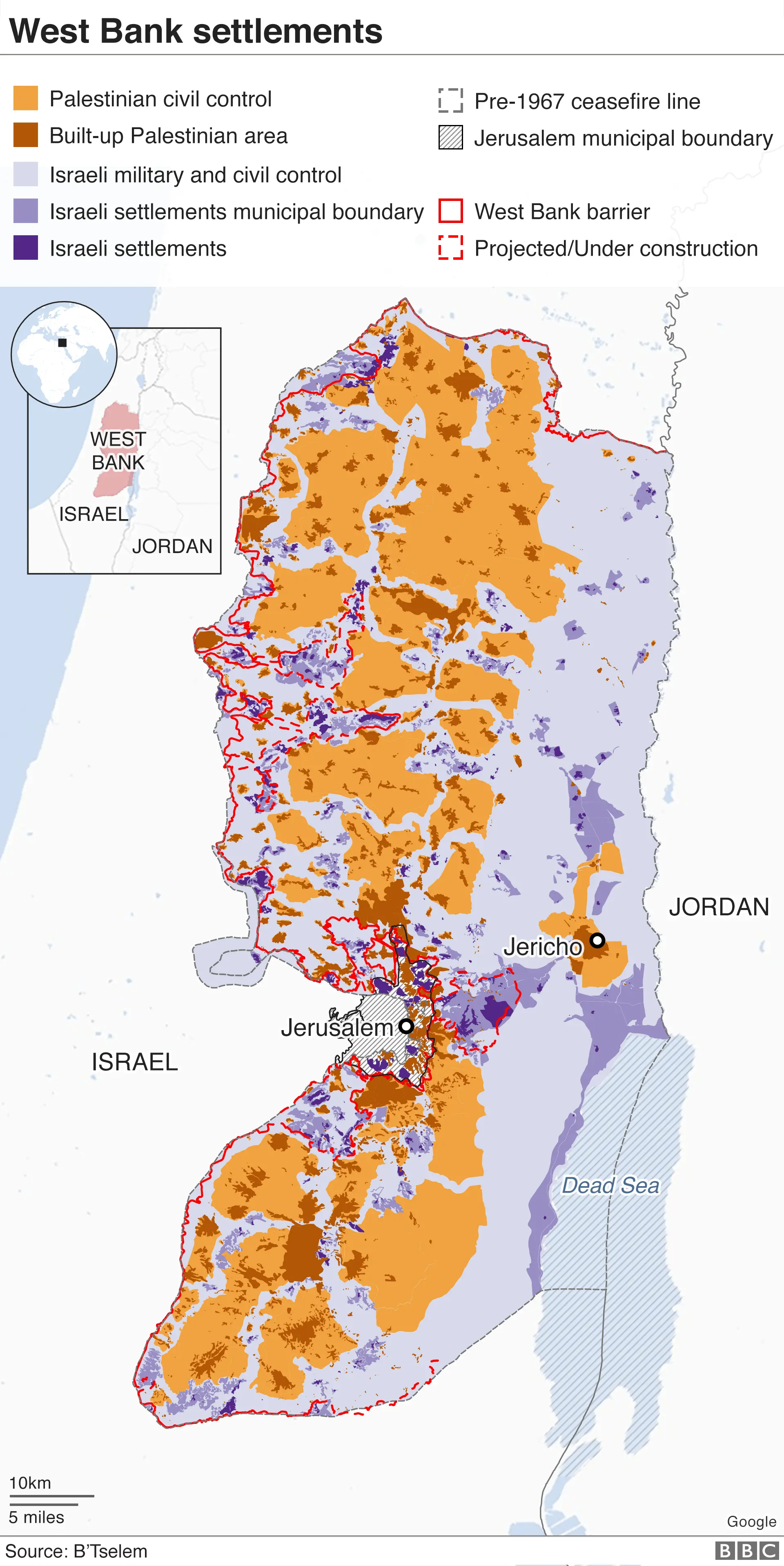
Questions and Thoughts
- Why did they expand the settlements? Was it partly religious and partly security?
- How the West Bank looks over Israel
- The Law surrounding the settlement expansion as it was annexed by Jordan and reclaimed in 67
- Is this right?
- The way every prime minister of Israel expanded (or not) settlements
- Moral argument: Is the simple expansion of buildings more important or justify suicide bombings?
- How much of the percentage of West Bank have Israel and the Arabs expanded to?