⬅️ Back to 60.11 Religion · Hubs: ✡️ Judaism · ✝️ Christianity · 🕌 Islam · Database: Attachment (file not included in this release)
Source & companion notes
📄 Full text → Attachment (file not included in this release) — sits in this same folder
📊 Scripture breakdown → Bible Passages in Nirenberg's Anti-Judaism — every biblical passage the book works with, sorted by the job Nirenberg says it was made to do
Threads out of this book → New Convenant theology or Supersessionism replacement theory (supersessionism) · Christian Violence, Persecution, and Suppression of Jews, 300–1899 (what the ideas did to real Jews) · Talmud · Antisemitism · Reading the Bible · Preservation of Religious Text
Historical case studies → The good Jew bargain - historical cases and limits — biographies of accommodation and exclusion, with conversion, ideological support, and coerced cooperation kept distinct.
Neighbouring books → Dominion - Tom Holland · The Dark Side of Christian History · The Sins of Scripture - Exposing the Bible's Texts of Hate to Reveal the God of Love ·
Chapter-by-chapter overview
Common thread: Nirenberg follows a recurring Western habit: societies turn “Judaism” into a name for whatever they want to overcome—foreignness, flesh, law, literalism, tyranny, commerce, abstraction, or failed modernity—and then use that constructed figure to understand themselves. The meaning changes from age to age, but the structure survives, often independently of actual Jews and sometimes with grave consequences for them.
Introduction — The Judaism of Thought. Nirenberg distinguishes Jews and Judaism as historical realities from “Judaism” as a conceptual tool: Western thinkers repeatedly projected disliked features of religion, politics, economics, and knowledge onto it. His method traces neither an inevitable straight line to modern antisemitism nor a set of sealed-off episodes, but the repeated transformation of inherited figures that make some ways of thinking—and acting—more available than others.
Chapter 1 — Egypt, Exodus, and Empire. Ancient Egyptian and Greco-Roman writers reverse the Exodus into a story of diseased, impious, and antisocial foreigners expelled by Egypt, adapting older memories to the pressures of empire. Jews thereby become figures for foreign domination, tyranny, lawlessness, and hatred of humanity, establishing the book’s basic mechanism: political and religious crises are projected onto “Judaism” and passed forward as reusable explanations.
Chapter 2 — Early Christianity. Paul and the gospel writers transform disputes within a largely Jewish world into durable oppositions between spirit and flesh, faith and law, truth and literal blindness. As Christianity explains why Jesus was rejected and how gentiles inherit Israel’s promises, “Judaism” becomes a portable category for interpreting error and enmity far beyond direct encounters with Jews.
Chapter 3 — The Early Church. Christians use accusations of Judaizing to negotiate their own disputes over Christ, scripture, heresy, and imperial power, so rival Christians and rulers can be labeled “Jewish” even when actual Jews are not the issue. Augustine’s witness doctrine stabilizes the paradox by preserving Jews as living proof of Christian truth while institutionalizing their defeat and subordination: excluded from Christian fulfillment, yet indispensable to Christian order.
Chapter 4 — Jewish Enmity in Islam. The Quran makes Israel both the foundation of prophetic revelation and a paradigm of resistance to prophets; later Islamic tradition turns that tension into narratives of Jewish opposition that help explain Muhammad’s authority, law, and community. The category can then migrate inward to “Judaize” hypocrites and Muslim rivals, although Nirenberg stresses that medieval Islam did not usually build political theory from it as extensively as Christianity did.
Chapter 5 — Jews and Medieval Power. Medieval rulers protect and exploit Jews as dependent instruments of taxation, credit, and expanding sovereignty, while opponents condemn those same powers as Jewish and cast violence against Jews as resistance to tyranny. Even after persecution and expulsion remove many Jewish communities, “Judaism” remains embedded in political thought as a name for fiscal oppression, private appetite, legal bondage, and corrupt rule.
Chapter 6 — Spain and the Inquisition. Mass conversion and expulsion do not settle Spain’s Jewish question; by erasing visible religious boundaries, they make Christians more anxious about where Judaism now resides. The Inquisition joins ambiguous behavior to ancestry, so the attempt to eliminate Judaism generates an expanding system of genealogy, suspicion, and purity that can discover “Judaizing” throughout Christian culture.
Chapter 7 — Reformation. Luther’s distinctions between law and gospel, works and faith, and dead letter and saving promise rearrange inherited Christian meanings of Judaism while Catholics and Protestants weaponize the charge of Judaizing against one another. A conflict over how Christians read scripture then becomes an imagined campaign by real Jews, helping Luther’s later hermeneutic anti-Judaism harden into demands for repression and expulsion.
Chapter 8 — Shakespeare’s England. The Merchant of Venice asks how a Christian society dependent on contracts, credit, law, and material signs can avoid becoming what its tradition calls “Jewish.” Because Christians cannot escape those practices, the play repeatedly confuses merchant and Jew and finally preserves Christian identity by projecting its unresolved contradictions onto Shylock as an irreducibly different outsider.
Chapter 9 — Israel and Christian Politics. The Reformation does not simply replace revelation with secular reason; confessional conflict makes ancient Israel a constitutional archive for arguments about sovereignty, prophecy, church, and resistance. Hobbes uses the Mosaic covenant to subordinate public revelation to civil authority, while Christian Hebraism expands knowledge of Jewish texts without necessarily improving attitudes toward living Jews—new learning enlarges the figure rather than dissolving it.
Chapter 10 — Enlightenment Revolts. Spinoza and the philosophes attack revelation, clerical power, and intolerance by translating Christian oppositions—spirit versus letter, freedom versus law—into secular ones such as reason versus superstition and universal humanity versus fanaticism. Enlightenment criticism is genuinely innovative, but it often leaves uncriticized the inherited figure of Judaism doing essential work inside its supposedly emancipated thought.
Chapter 11 — Revolution. The French Revolution secularizes supersession: the old regime becomes an old covenant of bondage, while citizenship promises conversion and regeneration into freedom. Jews serve as a test of universal emancipation, but suspicion of incomplete conversion can expand to all enemies of the new order; counterrevolutionaries use the same flexible Jewish vocabulary, showing how both sides map political fracture through inherited categories.
Chapter 12 — Kant to Heine. German philosophers repeatedly make Judaism signify what obstructs freedom and reconciliation—external law, materialism, abstraction, heteronomy, or stubborn particularity—even while disagreeing radically about philosophy and politics. By presenting old judgments as discoveries of reason, nation, or historical science, modern philosophy increases their authority and helps blur the distinction between symbolic “Judaism” and increasingly visible Jews.
Chapter 13 — Modernity. Industrial capitalism, finance, urbanization, socialism, and abstract knowledge produce new anxieties that thinkers such as Marx, Weber, and Sombart organize through inherited associations with Judaism. Because the category can mean capitalism or communism, materialism or abstraction, Nazi propaganda can fuse disparate crises into a single “Jewish” threat; this history does not make the Holocaust inevitable, but it helps explain why such an account of the world became imaginable and politically powerful.
Epilogue — Drowning Intellectuals. Arendt, Horkheimer, Adorno, and Auerbach show that intelligence, victimhood, and critical intent do not automatically free thinkers from inherited categories: terror may provoke self-examination or deepen familiar habits. Nirenberg therefore ends with a deliberately fallible warning—historians must avoid both false straight-line continuities and historical amnesia, exposing the conceptual past so its future uses become easier to recognize and resist.
Notebook cards (full B5)
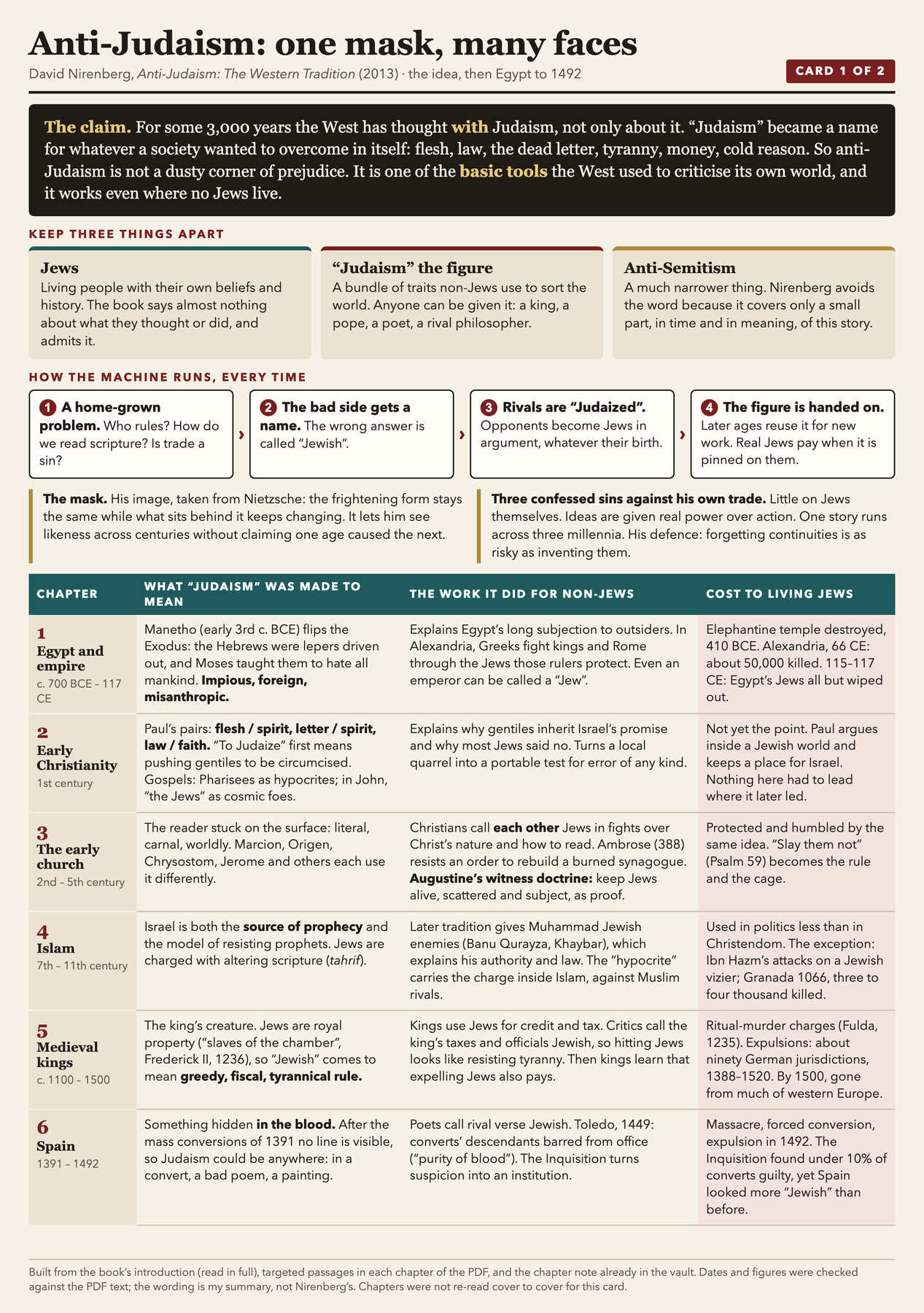
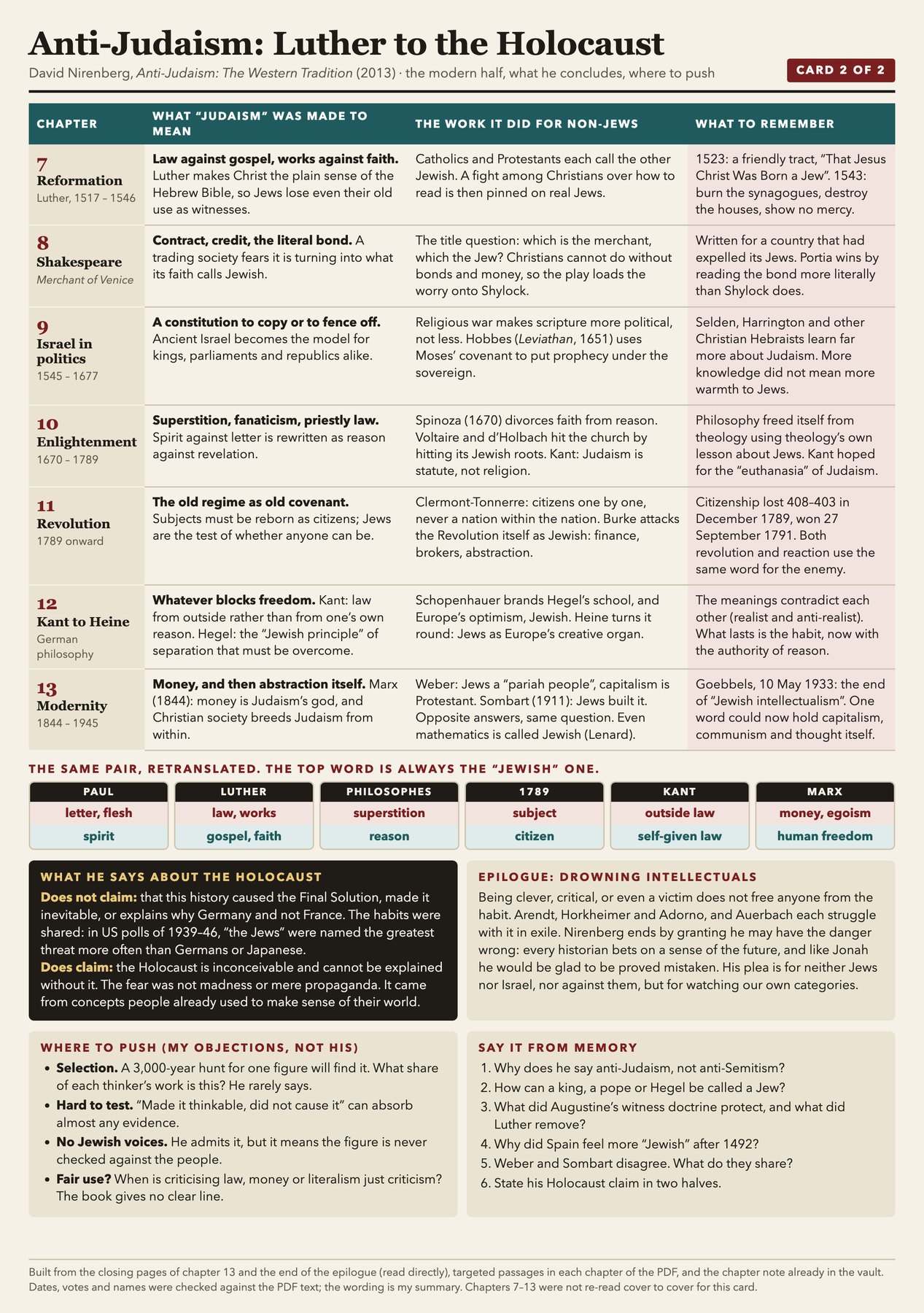
Two notebook cards (full B5), made 14 November 2026. They compress the overview above into a form to copy by hand: one table row per chapter, sorted by what “Judaism” was made to mean, what work that did for non-Jews, and what it cost living Jews.
- Card 1, one mask, many faces: the central claim and the three things to keep apart (Jews, “Judaism” as a figure, anti-Semitism), the four-step mechanism, the mask metaphor and the three confessed departures from method (Introduction), then Chapters 1–6, Egypt to Spain in 1492.
- Card 2, Luther to the Holocaust: Chapters 7–13 in the same table form, a strip showing the same opposition retranslated from Paul to Marx, what Nirenberg does and does not claim about the Holocaust, the Epilogue, four objections and six recall questions.
Caveats. The introduction, the closing pages of Chapter 13 and the end of the epilogue were read directly in the PDF; other chapters were spot-checked (every date, figure and name on the cards) and otherwise rest on the chapter notes below. The “Where to push” box on Card 2 is my own, not Nirenberg’s, as are the date ranges given for Luther (1517–1546) and Chapter 13 (1844–1945).
HTML sources: Attachment (file not included in this release) · Attachment (file not included in this release)
Thinkers and philosophers — what Nirenberg says
How to read this guide
This records Nirenberg’s interpretation of the role each figure plays in the history of anti-Judaism; it is not a neutral summary of each thinker’s whole philosophy. His recurring distinction is between living Jews and historical Judaism and “Judaism” as a figure of thought for law, flesh, materialism, abstraction, commerce, alienation, or failed reconciliation. He does not claim that every thinker below was personally antisemitic, that the meanings of “Judaism” remained identical, or that Luther, Kant, Hegel, or the Gospels mechanically caused Nazism. He argues that inherited categories made certain later explanations easier to formulate, recognize, and mobilize. Joseph Goebbels was a propagandist and Nazi political intellectual, not a philosopher; he is included because Nirenberg uses him to test how scholarly ideas, propaganda, and mass interpretation interact.
The four requested figures
Martin Luther — hermeneutics that changed the possibilities of Jewish life
Nirenberg’s Luther is first of all an interpreter of scripture. Luther’s recovery of the Bible’s literal meaning, justification by faith, and distinction between law and gospel were forged inside inherited Christian oppositions between Christianity and Judaism. To keep literal reading from appearing “Jewish,” Luther made Christ’s life the literal subject of the Hebrew Bible and redefined Paul’s “letter that kills” as law rather than textual literalness. “Judaism” could consequently name Catholic sacramentalism, works-righteousness, rival Protestant readings, or any effort to turn divine promise back into coercive law. Catholics and other Christians answered by Judaizing Luther, so the category became a weapon in Christian civil war. Detailed chapter notes · Attachment (file not included in this release)
The crucial move is from hermeneutic Jews to living Jews. Nirenberg rejects the familiar story that a generous young Luther became hostile only after actual Jews refused to convert. He argues that the “energy” of the transformation arose from Luther’s conflict over letter and law—“hermeneutics, not sociology.” Sectarian accusations of Christian Judaizing helped Luther imagine a real Jewish campaign to convert Christians, although Nirenberg finds little evidence for such proselytism. Luther’s late calls to burn synagogues, suppress teaching, confiscate books, impose forced labor, and expel Jews grew within that projected emergency. Ideas about “Judaism” thus altered what Christians believed actual Jews were doing and what could be done to them. Attachment (file not included in this release) · Attachment (file not included in this release)
Nirenberg explicitly declines the anachronistic question of whether Luther was an “architect of the Holocaust.” The point is narrower and stronger: Luther’s reconceptualization of scriptural language transformed both the meanings available to “Judaism” and the conditions of life available to Jews, without making later outcomes necessary.
Immanuel Kant — autonomy constructed against a “Jewish” law
Nirenberg gives Kant two connected roles. In the Enlightenment chapter, Kant separates universal moral religion from historical or statutory faith. He portrays Judaism as a secular political constitution based on external law, ritual, fear, self-interest, and heteronomous obedience rather than true religion. Christianity becomes universal only by denying that it owes anything essential to Jewish history. Kant therefore imagines the conversion of Jews into rational moral religion as the “euthanasia of Jews and Judaism”: Judaism disappears into one universal flock. For Nirenberg, a philosophy devoted to humanity’s emergence from intellectual tutelage leaves Judaism confined to “permanent immaturity.” Attachment (file not included in this release) · Attachment (file not included in this release)
In the German Idealism chapter, Kant’s critical philosophy tries to save freedom from material determinism by making the mind an active author of experienced order. His ethics likewise grounds obligation in reason’s self-given categorical imperative rather than externally imposed command. But the “thing-in-itself” remains beyond knowledge, and positive law remains necessary. Nirenberg calls this Idealism’s Christian problem: how can spirit overcome external law without abolishing binding obligation? Kant’s successors repeatedly classify the unresolved residues—matter, mechanism, dogma, formalism, or coercive law—as “Jewish.” Kant is therefore not merely one prejudiced voice; his system supplies a new philosophical stage on which inherited Christian contrasts can appear as discoveries of critical reason. Attachment (file not included in this release)
G. W. F. Hegel — overcoming the “Jewish principle” through reconciliation
Hegel objects that Kant leaves thought absolutely opposed to reality. He calls this dualism a version of the “Jewish principle”: a lifeless separation of reason from sense and God from world. Hegel’s proposed cure is dialectical reconciliation, modeled on Christ’s Incarnation and Passion, in which spirit becomes itself through division and the overcoming of division. In the early Spirit of Christianity and Its Fate, Abraham breaks with nature, family, and community for a remote, abstract God; Hegel makes him the founder of both the “spirit of Judaism” and the alienation he finds in Kant. Jesus, by contrast, is made to fulfill law through love rather than reproduce it as command. Detailed Hegel notes · Attachment (file not included in this release)
Nirenberg stresses the tensions rather than flattening Hegel into a label. In Hegel’s later philosophy Judaism becomes the religion of sublimity, a necessary historical negation of the finite, not simply an error. Yet the scheme treats living Jews as an awkward remainder after the historical stage assigned to Judaism has supposedly been superseded. Nor does dialectic eliminate positive law, so every reconciliation leaves a residue available for renewed Judaization. At the same time, Hegel defended Jewish civil rights and opposed nationalist efforts to revoke them. This is precisely why Nirenberg prefers asking what conceptual work Judaism performs in Hegel’s system over issuing a simple verdict about Hegel’s personal antisemitism.
Joseph Goebbels — from “Jewish intellectualism” to mass mobilization
Goebbels first appears in the Introduction beside Gospel attacks on learned, status-seeking opponents. Nirenberg says there may be a historical relation between older representations of “Jewish” learning and Goebbels’s 1933 declaration that the age of “Jewish intellectualism” had ended, but he expressly denies that Nazi teaching is implied by the Gospels or that the relation is simple, direct, unidirectional, or demonstrably causal. The comparison illustrates the book’s method: trace transformations and conditions of intelligibility without building a causal bridge heavier than the evidence can bear. Introduction notes · Attachment (file not included in this release)
In Chapter 13, Goebbels becomes a case study in the power and circulation of ideas. His 1922 dissertation blamed German Romanticism’s failure on a false synthesis of art and philosophy: matter, form, criticism, and irony supposedly enslaved creative spirit in a “Jewish” dance around the Golden Calf. A decade later Nazi propaganda translated similar contrasts into attacks on Jewish capital, liberalism, formal thought, and intellectualism. Nirenberg does not claim that the dissertation caused the propaganda, or that elite theory simply produced mass prejudice. Goebbels shows reciprocal movement among academic categories, political ideology, material interests, propaganda, and ordinary explanation. “Jewishness” could make unlike grievances—finance, abstraction, liberalism, mechanization, cultural decline—appear to be one actionable enemy. Detailed Goebbels notes · Attachment (file not included in this release) · Attachment (file not included in this release)
Other sustained or structurally important thinkers
Ancient and Christian foundations
-
Plato, Aristotle, Pythagoras, and Greek philosophy: These figures usually provide background tools rather than sustained cases of anti-Judaism. Greek accounts of divine perfection, body and soul, allegory, politics, tyranny, and misanthropy supplied languages in which Jews, Christians, and pagans could contest scripture and society. Aristotle’s association of tyranny with misanthropy helps explain one ancient route by which Jewish difference could be politicized. Origen later claims Moses’s wisdom exceeds Plato’s and treats Pythagorean rules allegorically. Nirenberg’s point is not that “Greek philosophy caused anti-Judaism,” but that its categories changed what could be thought with Jewish difference. Ch. 1 · Ch. 3
-
Philo of Alexandria: Philo is a Jewish philosopher and allegorical reader deeply engaged with Greek thought. His work matters because it shows that flesh/spirit and literal/allegorical techniques were not originally or exclusively Christian weapons against Jews. Later Christians could nevertheless appropriate those techniques to claim the Hebrew scriptures while classifying Jewish readers as trapped in their letter. Ch. 1 · Ch. 2
-
Paul: Although an apostle rather than a philosopher in the usual sense, Paul is one of the book’s most consequential conceptual architects. His contrasts—letter/spirit, flesh/promise, law/faith, old/new—make “Judaizing” a portable name for gentile and Christian error. Nirenberg repeatedly cautions that later anti-Jewish possibilities need not have been Paul’s intention; the issue is how later readers activated some potentials in his language and suppressed others. Ch. 2
-
Justin Martyr, Origen, and Augustine: Justin uses the Jew Trypho while answering pagan philosophy and Christian heresy; Origen systematizes bodily, psychic, and spiritual levels and places “Jews” at the material pole; Augustine stabilizes the paradox with the witness doctrine, preserving Jews as evidence for Christian truth while subordinating them as defeated readers. They show how arguments among Christians and against philosophers generated durable roles for both figural and living Jews. Ch. 3
-
Maimonides: Nirenberg discusses Maimonides mainly through Spinoza’s attacks. Despite Maimonides’s rationalism, Spinoza casts him as making reason and blessedness subordinate to Torah. Nirenberg thinks Spinoza’s supersessionist argumentative structure—not merely a political disagreement—pushes him to make the Jewish philosopher represent the tyranny of law. Spinoza section
Early modern and Enlightenment philosophy
-
Thomas Hobbes: Leviathan uses Israel’s covenant to solve the political problem of prophecy. Revelation becomes publicly binding through a people’s covenant with a sovereign, allowing civil authority to control competing claims to God’s word. Israel is both exemplary and exceptional: indispensable evidence for modern sovereignty, yet a unique theocracy whose law cannot simply govern modern Christians. Nirenberg therefore resists reducing Hobbes to either pro- or anti-Jewish; his allegedly secular political foundation is erected on Israel. Hobbes notes
-
Blaise Pascal: Pascal restates an Augustinian equilibrium in which Jews know the true God but remain attached to earthly things. He is important less for a new system than as evidence that the old Christian location of Judaism between pagan materiality and Christian spirit remained philosophically authoritative on the eve of Spinoza’s revolt. Spinoza opening
-
Baruch Spinoza: Spinoza frees philosophy from scriptural authority, limits prophecy to historically situated moral instruction, and treats Mosaic law as the constitution of an extinct state. Yet he represents Jews as enslaved to law, particularistic, rebellious, and resistant to reason, turning Christian supersession against scriptural religion itself. Nirenberg treats his motives as uncertain and his position as complex; the demonstrable point is the argumentative effect. Spinoza helps transform Hebraica veritas into Hebraica falsitas: Judaism becomes not only the enemy of Christian truth but an origin of superstition and an enemy of secular reason. Ch. 10
-
John Locke, Voltaire, and Paul-Henri d’Holbach: Their projects of toleration and emancipation retain Judaism as the negative boundary. Locke isolates coercive theocracy in ancient Israel; Voltaire makes Judaism both an exemplary victim of persecution and the imagined source of fanaticism that tolerant society may exclude; d’Holbach calls Europe to free itself from an alien Jewish burden. Nirenberg’s point is not that Enlightenment reason was reducible to prejudice, but that its extensive criticism left the figure of Judaism doing decisive work largely uncriticized. Philosophes · Toleration
-
Jean-Jacques Rousseau: Rousseau admires Moses as a founder who makes a people through law, myth, and collective obligation. That model helps revolutionaries imagine both the Mosaic law they must supersede and the quasi-Mosaic legislation needed to turn subjects into citizens. He illustrates the persistent paradox that emancipation from external law still requires a founding lawgiver. Moses and revolution
Revolution and German philosophy
-
Edmund Burke and Johann Gottlieb Fichte: Burke condemns revolutionary abstraction, paper money, and contractual individualism through figures of Jewish law, calculation, and finance. Fichte defends revolution by Judaizing inherited constitutionalism as dead letter, yet also treats actual Jews as a hostile state within the state. Later he maps living German spirit against French material calculation and Jewish “nonbeing.” Their opposite politics demonstrate the category’s flexibility: each can Judaize what the other defends. Burke and Fichte · Fichte
-
Saul Ascher: Ascher is one of Nirenberg’s clearest contemporary critics of the new phenomenon. He argues that Fichte and other post-Kantians clothed inherited Jew-hatred in “critical reason,” producing a modern science of hating Judaism. Nirenberg uses his diagnosis to ask why philosophies of freedom could give anti-Judaism greater epistemic authority rather than dissolve it. Ascher and Fichte
-
Friedrich Heinrich Jacobi, Friedrich Schelling, and Friedrich Hölderlin: These figures show how accusations of Judaism circulated inside Idealism. Jacobi attacks systematic critical reason as “Jewish” formalism tending toward Spinozism, pantheism, fatalism, and atheism; Fichte and Schelling try in different ways to close Kant’s gap between reason and the thing-in-itself; Hölderlin can cast Kant as either a Moses leading thought toward freedom or toward renewed slavery. Judaism becomes a sectarian accusation by which rival philosophies expel one another from reason. Idealism's Christian problem
-
Arthur Schopenhauer: Schopenhauer rejects Hegel’s progressive reconciliation and treats individual existence as an objectification of suffering will. He identifies Judaism with the opposite of ascetic release: realism, optimism, theism, free will, and affirmation of created existence. Thus Hegel can call Kant’s separation of thought and reality Jewish while Schopenhauer calls Hegel’s reconciliation and world-affirmation Jewish. For Nirenberg, the contradiction displays anti-Judaism’s adaptability, not its incoherence. Schopenhauer notes
-
Heinrich Heine: Heine refuses to treat Judaism as simply superseded. He imagines Europe’s task as a synthesis of Hebrew devotion to spirit and Greek love of beauty and embodied life, with Judaism remaining a source of prophecy and creativity. Yet his own mobile use of “Jewish” and “Greek” can still turn Jewishness into a derogatory name for failed synthesis, and dialectical reconciliation still threatens to dissolve identities that living Jews may wish to retain. Heine’s warnings about a coming German catastrophe help Nirenberg connect philosophical abstraction to its possible human stakes without claiming inevitability. Heine notes
Modern political economy, philosophy, and critical theory
-
Bruno Bauer and Karl Marx: Bauer makes emancipation conditional on both the Christian state’s and the Jews’ abandonment of religion. Marx answers that political emancipation is insufficient: alienated civil society must be transformed. But Marx names practical need, haggling, and money as worldly Judaism, so humanity’s liberation becomes emancipation “from Judaism.” Nirenberg credits Marx’s insight that society produces the Jewishness it claims to find, while criticizing his collapse of that figure back onto real Jews and economic life. Marx notes
-
Max Weber and Werner Sombart: These social theorists disagree over capitalism’s genealogy but share a Christian-Jewish conceptual field. Weber protects a Protestant origin of capitalism by separating biblical Israel from later “pariah” Judaism; Sombart makes Jewish migration and spirit the engines of capitalism, then distinguishes heroic German entrepreneurship from commercial homo Judaeus. Sociology thereby presents inherited salvation-historical boundaries as social science. Weber and Sombart
-
Ernst Cassirer and Martin Heidegger: Nirenberg reads their 1929 Davos debate carefully. Cassirer defends symbolic form as the human power to order experience and transcend immediacy; Heidegger emphasizes finitude and distrusts logic, mathematics, mediation, and “brokerage.” Heidegger did not publicly call Cassirer’s position Jewish at Davos. But neo-Kantianism, formal abstraction, and Cassirer were already being Judaized, so philosophical vocabulary could resonate with attacks on finance and “Jewish rationality” without the debate being reducible to Nazi politics. Davos and the power of ideas
-
Hannah Arendt: Arendt rightly rejects the idea that Jews were arbitrary scapegoats; ideology must explain why a target seems culturally plausible. Nirenberg argues that she then locates that plausibility too heavily in actual Jewish economic roles and speaks of Jewish co-responsibility, reproducing the commerce-Judaism association she needed to analyze. The case shows that persecution, intelligence, and critical intention do not automatically free a thinker from inherited categories. Arendt notes
-
Max Horkheimer and Theodor Adorno: They initially linked antisemitism to Jewish commercial roles but revised their account in the face of the Holocaust’s fantastic disproportions. In Dialectic of Enlightenment, the pathology is not projection itself—concepts are unavoidable—but projection without reflection, an explanatory system protected from tests that might expose the gap between image and reality. This becomes one of Nirenberg’s own models of self-critical interpretation. Horkheimer and Adorno notes
-
Erich Auerbach: Auerbach’s history of figura offers Nirenberg a method for connecting distinct historical moments without claiming a single origin or deterministic chain. An Ansatzpunkt, or limited point of departure, can make broad structures visible while preserving historical difference. Nirenberg adapts this to trace how past figures of Judaism condition later possibilities. Auerbach notes
Brief or methodological appearances
- Montaigne and Seneca warn that cutting history into ever smaller pieces can yield confusion; Nirenberg uses them against radical discontinuity, not as subjects of anti-Judaism.
- Friedrich Nietzsche supplies the metaphor of the enduring mask whose terrifying form persists while its contents change. Nirenberg’s anti-Judaism is such a mask: a recognizable pedagogical fear, not a timeless identical doctrine. Michel Foucault’s “history is for cutting” supplies the opposite warning against invented continuities. Method in the Introduction
- Walter Benjamin warns that the present can deliriously appropriate the past, yet also joins criticism to prophecy. Nirenberg invokes him to define historical work as both self-suspicious and responsible to futures that might still be prevented. Method in the Epilogue
- René Descartes, David Hume, Gottfried Wilhelm Leibniz, and Giambattista Vico appear mainly as intellectual context: mastery of nature and rational method, empiricism, early predictions about Spinozist revolution, and the possibility that rational civilization can generate a new “barbarism of reflection.” Nirenberg does not offer sustained anti-Judaism readings of them comparable to his treatments of Spinoza, Kant, or Hegel.
- Jacques Derrida appears briefly as a modern analogy for language as an “experience of circumcision” in Nirenberg’s reading of The Merchant of Venice; he is not a major historical case in the book. Shakespeare chapter
The philosophical through-line
Nirenberg’s philosophers disagree about almost everything—whether freedom lies in law or release from it, whether spirit must reconcile with the world or turn away from it, whether capitalism is Protestant or Jewish, whether abstraction liberates or alienates. Yet they repeatedly give the name “Judaism” to the relation they reject. That flexibility lets an inherited Christian distinction migrate into philosophy, political economy, sociology, and propaganda. The history does not make genocide inevitable; it helps explain why mutually contradictory crises could be gathered into a single “Jewish” account of the world and why that account could seem intelligible to people who considered themselves rational and modern.
DESCRIPTION
A powerful history that shows anti-Judaism to be a central way of thinking in the Western tradition. This incisive history upends the complacency that confines anti-Judaism to the ideological extremes in the Western tradition. With deep learning and elegance, David Nirenberg shows how foundational anti-Judaism is to the history of the West. Questions of how we are Jewish and, more critically, how and why we are not have been churning within the Western imagination throughout its history. Ancient Egyptians, Greeks, and Romans; Christians and Muslims of every period; even the secularists of modernity have used Judaism in constructing their visions of the world. The thrust of this tradition construes Judaism as an opposition, a danger often from within, to be criticized, attacked, and eliminated. The intersections of these ideas with the world of power—the Roman destruction of the Second Temple, the Spanish Inquisition, the German Holocaust—are well known. The ways of thought underlying these tragedies can be found at the very foundation of Western history.
🧒 ELI5 — the whole book in one callout
For two thousand years, whenever Western thinkers wanted to name something they thought was wrong — greed, hypocrisy, legalism, tyranny, money, literal-mindedness, cold reason — they reached for the same label: that’s Jewish.
They kept doing it in countries with no Jews in them. The arguments were nearly always Christians fighting other Christians, and “Jewish” was the insult. Two saints, Jerome and Augustine, accused each other of it. Luther used it on Rome. Spinoza used it on anyone who read scripture literally. Marx used it on capitalism.
So this is not mainly a book about people being cruel to Jews. It’s a book about a mental tool the West built out of the Bible and then couldn’t put down — one that works fine without any actual Jews, and that being clever or progressive does not protect you from. Nirenberg’s phrase: the West did not just think about Jews, it learned to think with “Judaism.”
Full breakdown of how the Bible got used to build that tool → five ELI5 callouts and the nine-class chart.
Review
Handwrite First
Use this section with the book and notes closed. The goal is retrieval, not polish.
1. Before Reading
Prime your mind before reading.
- Prediction:
- Question I want answered:
- What I already think about this topic:
- What I expect to disagree with:
2. Closed-Book Recall Dump
Close the book and notes. Reconstruct what you read from memory.
-
Main points I remember:
-
Key examples, evidence, stories, or cases I remember:
-
Terms, people, dates, or concepts I remember:
-
-
What feels fuzzy or incomplete:
3. Core Argument From Memory
- The book/section in one sentence:
- Main claim:
- Problem the author is responding to:
- Why the author thinks this is true:
- Best evidence/example I remember:
- Conclusion the author wants the reader to accept:
4. Argument Map From Memory
5. Feynman Check
Explain the idea simply, as if teaching it to someone unfamiliar with the topic.
- Simple explanation:
- Analogy or concrete example:
- Where someone might misunderstand this:
6. Pushback From Memory
- Strongest objection or weakness:
- What evidence would weaken the author’s argument?
- What a rival thinker/book might say:
- My current judgment:
7. Personal Takeaway
- What changed, clarified, or challenged my thinking?
- What am I less certain about now?
- One way I could apply this:
- One question I need to keep investigating:
Type Into Obsidian
Use this section after handwriting. The goal is long-term storage, search, linking, and spaced review.
1. Correction After Checking Notes
Reopen the book/notes. Compare them against your handwritten recall.
- I forgot:
- I misunderstood:
- I overemphasized:
- I underemphasized:
- This needs review:
2. Clean Core Argument
- The book/section in one sentence: For three thousand years the West has used “Judaism” as its all-purpose name for whatever it considers wrong, and this habit operated largely independently of actual Jews.
- Main claim: Anti-Judaism is not primarily prejudice against a people; it is a way of thinking about the world — a tool for criticising materialism, legalism, money, tyranny, hypocrisy, literal-mindedness and cold reason by labelling them Jewish. Nirenberg’s distinction: the West did not only think about Jews, it learned to think with “Judaism.”
- Problem the author is responding to: Why do the words Jew, Hebrew, Israelite, Semite appear in Western archives far more often than Jewish population numbers could explain — including in societies with few or no Jews at all? Existing accounts either treat ancient hostility as the direct cause of modern antisemitism, or treat each period as sealed off from the others. He rejects both.
- Why the author thinks this is true:
- The category outruns the population. Egypt built a “negative Exodus” before most Egyptians met Jews; England argued about “Judaizing” through its civil war after 350 years with no professing Jews — Israel · Hebrew · Jew · Moses · Jerusalem · Zion appear in ~8.6% of everything printed 1640–1660.
- The arguments are almost never with Jews. Augustine’s Cain doctrine came out of a fight with a Manichaean; his “Slay them not” came out of a fight with a Pelagian; Jerome and Augustine accused each other of Judaizing. Chrysostom’s targets were rival Christians.
- The forms persist while the content changes. Paul’s letter/spirit opposition becomes patristic typology, becomes medieval carnality, becomes Luther’s law/gospel, becomes Spinoza’s “same old song of the Pharisees,” becomes Marx’s money — each time doing new work with an inherited shape.
- Best evidence/example: Marx’s On the Jewish Question (Introduction). Marx treats Judaism as an attitude of alienation embodied in money and private property, so Christian society keeps producing “Judaism” as long as those institutions last. Nirenberg’s double move: Marx correctly sees that a society can manufacture the Jewishness it claims to discover — and then never asks why Europe associated Jews with money, using the association instead to imagine revolution as liberation from Judaism. Critique reached an answer that flattered the critic and stopped.
- Conclusion the author wants the reader to accept: Not that the West is irredeemably antisemitic, and not that the gospels caused the Holocaust — he explicitly refuses both. Rather: historical self-consciousness. We inherited conceptual tools with a group’s name stamped on them, we mostly cannot see we are using them, and being educated, critical or progressive provides no immunity. The book “pleads neither for nor against Jews, Judaism, or Israel.”
3. What Actually Matters?
- Most important idea: Figures of Judaism ≠ real Jews. Once you hold these apart, most of the history stops being about hatred of a people and starts being about a habit of thought — which is also why it survived every period in which the people were absent.
- Best quote or passage: “Enmity was a form of illiteracy.” (Ch. 2 — the gospels’ verdict on why Jesus’s opponents failed to recognise him: they read scripture wrongly.) Runner-up, on what the church fathers achieved by reading the prophets allegorically: they “deprived the Jews of their scriptures, and the scriptures of their Jews.”
- Term/concept worth remembering: Judaizing — coined at Gal 2:14, where Paul rebukes Peter. Originally a gentile error, not a Jewish one. Paul took every way of relating wrongly to the fleshy things of the world and gave it a Jewish name; the reversal of that is the engine of the whole book.
- Most useful example: Ps 59:11, “Slay them not.” Augustine’s witness doctrine. In 1146 Bernard of Clairvaux quotes it to stop crusaders massacring Rhineland Jews; in the same year Peter the Venerable quotes it to Louis VII to argue Jews should be “preserved for greater torment and reproach, in a life worse than death.” One verse, one year, both outcomes — the cleanest demonstration that the doctrine determined a status, not a fate.
- Most surprising point: The harshest anti-Jewish material in scripture was written by Israelites about Israel. Jeremiah, Isaiah and Ezekiel supply most of the ammunition; Ezek 20:25 — “I gave them laws that were not good” — is contained by exegetes for 1,500 years until Spinoza amplifies it “to the point of explosion.” A family argument, later quoted by outsiders as evidence for the prosecution.
- One sentence I want to remember: If Judaism means excessive attachment to world and word, then no one is above the accusation — which is why the category could fill the world with “Jews” and why criticism aimed at it kept landing on Christians, on rivals, and finally on modernity itself.
4. Connections
- Connects to:
- Bible Passages in Nirenberg's Anti-Judaism — the scripture-level companion: every passage sorted into nine classes by the job it was made to do
- New Convenant theology or Supersessionism replacement theory — supersessionism is the live theological form of Ch. 2–3
- Christian Violence, Persecution, and Suppression of Jews, 300–1899 — what the ideas did to actual people; its Augustine “Witness Doctrine” section is this book’s Ch. 3
- Supports:
- Christian Violence, Persecution, and Suppression of Jews, 300–1899 — supplies the intellectual genealogy behind the events catalogued there
- Preservation of Religious Text · Reading the Bible — both concern how scripture gets handled; this book is the political history of that handling
- Challenges:
- Dominion - Tom Holland — Holland’s West inherits Christian universalism; Nirenberg’s inherits Christian exclusions built from the same texts. Neither refutes the other, which is the interesting part
- — see the counter-case callout there alongside How the World Made the West - Josephine Quinn
- Reminds me of:
- Talmud — the mirror-image problem: passages quoted out of frame to indict a tradition
- Antisemitism — the modern political phenomenon Nirenberg deliberately distinguishes from anti-Judaism
- Possible future note:
- — Ch. 10’s three camps (Radicals, Moderates, Traditionists) after Spinoza
- — Jerome vs Rufinus vs Augustine → Luther → the English Civil Wars → Spinoza
5. Clean Pushback
- Strongest objection or weakness: The category may be too capacious to do work. If anti-Judaism includes Egyptian priests, Paul, Augustine, Luther, Hobbes, Spinoza, Voltaire, Kant, Hegel, Marx and Goebbels, the term risks naming a resemblance rather than a thing. Nirenberg’s own “mask” metaphor concedes that the content changes completely between periods — so what exactly is being transmitted? He asserts formal continuity while explicitly declining to demonstrate causal continuity, which lets the book accumulate rhetorical force it hasn’t strictly earned.
- What evidence would weaken the author’s argument?
- Cases where a society had the same conceptual problems (materialism, legalism, tyranny) and solved them without reaching for Judaism — if those are common, the pattern is selection, not structure.
- Demonstration that the figures were reinvented independently in each period rather than inherited, which would sever the through-line.
- A base rate: how often did these thinkers invoke other scapegoat categories (women, Muslims, peasants, the East) in the same arguments? The book rarely counts the alternatives.
- What the author might say in response: That the objection misreads his claim. He is not arguing a single idea persisted, but that a repertoire of available forms did, and that inherited forms constrain what can later be thought — “people do not invent their conceptual tools from nothing.” He builds in the disclaimer repeatedly: contingency, not causation; things “did not need to turn out as they did.”
- What a rival thinker/book would say:
- Dominion - Tom Holland — the same texts produced moral equality, the dignity of victims and universal human worth; reading the tradition through its exclusions is a choice of emphasis.
- Salo Baron’s “lachrymose conception of Jewish history” — the standing warning against narrating Jewish history as an unbroken chain of persecution. Nirenberg is not writing Jewish history, but the shape of his book invites the charge.
- How the World Made the West - Josephine Quinn — would reject the premise beneath both Nirenberg and Holland: “the Western tradition” is not a bounded thing that can inherit anything.
- My current judgment: (yours to write — but the load-bearing question is whether “the West kept reaching for this tool” is a finding about the West or an artefact of looking for the tool.)
Retrieval Questions
Answer these without looking during future reviews.
Basic Recall
- What is the author’s main thesis?
- What problem is the author responding to?
- What are the 3–5 main claims?
- What are the key terms or concepts?
- What is the best example or piece of evidence?
Argument Reconstruction
- How does the author move from evidence to conclusion?
- What assumptions does the argument depend on?
- What would the argument look like in premise-conclusion form?
- What does the author want the reader to reject?
Comparison
- How does this book compare with Dominion - Tom Holland — same texts, opposite inheritance?
- How does this support or challenge and New Convenant theology or Supersessionism replacement theory?
- Which thinker would agree with this? (Foucault on discourse; Adam Sutcliffe on Enlightenment Judaism)
- Which thinker would disagree with this? (Holland; Salo Baron on lachrymose history; How the World Made the West - Josephine Quinn on the whole “Western tradition” framing)
Book-specific recall (added — the generic prompts above don’t test this book)
- Why does Nirenberg prefer anti-Judaism to antisemitism?
- What is a “figure of Judaism” and why does it matter that they operate without Jews present?
- Why is Marx in the Introduction — what does he demonstrate twice over?
- Whose negative Exodus inverted the biblical story, and out of which older Egyptian motifs was it built?
- Where does the verb “to Judaize” come from, and who was it originally aimed at?
- What was Augustine’s disagreement with Jerome over Gal 2:14, and why did Augustine take the position he did?
- Why did Augustine need the Jews to survive, and what were his four metaphors for their condition?
- What did Spinoza do with Ezek 20:25 that 1,500 years of exegesis had avoided?
- What does Hobbes derive from Exod 20:18–19, and what political problem does it solve for him?
- What is Hebraica falsitas and what did it replace?
- What is the “mask” metaphor doing in Nirenberg’s method — and what is it protecting him from having to prove?
Criticism
- What is the strongest objection?
- What evidence would weaken the argument?
- What does the author ignore, minimize, or assume?
- Is the author’s conclusion stronger than the evidence allows?
Synthesis
- How does this change my larger framework?
- Where does this fit in the broader historical/philosophical debate?
- What question should I ask next?
- What would I write about using this idea?
Flashcards / Atomic Recall
Use only for facts, definitions, distinctions, names, dates, and compact claims.
- Q: Nirenberg’s one-phrase distinction for what the West did with Judaism?
- A: It did not only think about Jews — it learned to think with “Judaism.”
- Q: Why anti-Judaism rather than antisemitism?
- A: Antisemitism is a 19th-c. racial-political term. Anti-Judaism is broader: criticism that represents a rejected idea or condition as Jewish — it can appear in religious, philosophical, political or economic argument, and needs no hostility toward, or presence of, actual Jews.
- Q: Define “figure of Judaism.”
- A: A quality or idea attributed to Judaism and then used by non-Jews to interpret their own world. Distinct from real Jews, and usually deployed where none are present.
- Q: Which verse coined “to Judaize,” and who was the original target?
- A: Gal 2:14 (Paul rebuking Peter). Originally a gentile error — a Jew being circumcised did not Judaize.
- Q: Egyptian priest who produced the most influential negative Exodus, and its two combined stories?
- A: Manetho — foreign “Shepherds” (Hyksos memory) fused with unclean people segregated by Pharaoh Amenophis under the renegade priest Osarseph, who then becomes Moses.
- Q: Ps 59:11 — the verse and the doctrine it founded?
- A: “Slay them not, but scatter them” — Augustine’s witness doctrine: Jews destroyed spiritually but preserved in the flesh as inert proof of scripture’s truth.
- Q: The 1146 double use of that verse?
- A: Bernard of Clairvaux cites it to stop crusaders killing Rhineland Jews; Peter the Venerable cites it the same year to argue for preservation “for greater torment and reproach, in a life worse than death.”
- Q: What is the Cain analogy doing in Augustine?
- A: The Jews as marked, cursed, wandering, and deliberately not to be killed — hyper-carnal tillers who killed the flesh they were meant to cultivate. Also implicates all earthly politics: every polity’s founder is a fratricide (Romulus).
- Q: Augustine vs Jerome on Gal 2:14?
- A: Jerome (following Origen): Paul didn’t mean the rebuke; neither apostle thought the law still valid. Augustine: “Paul was indeed a Jew” — he observed the law, and every word of the old Law was literally true. Jerome’s reply: “they will not become Christian, but will make us Jews.”
- Q: Ezek 20:25 and Spinoza?
- A: “I gave them laws that were not good.” Contained by exegetes for 1,500 years; Spinoza amplifies it into the claim that the Mosaic theocracy was vengeance, not gift.
- Q: Spinoza’s three-tier sort of scripture?
- A: (1) direct divine speech — vanishingly rare; (2) prophetic moral teaching, from fallible people, moral truth only; (3) local political/ceremonial law, binding on no one but the Hebrews and only while their state stood.
- Q: Hebraica veritas → Hebraica falsitas — what changed?
- A: Bible scholarship pivoted from mining the Hebrew Bible for truths to organise a better society, toward mining it for the origins of Christian society’s present ills.
- Q: What does Hobbes get from Exod 20:18–19?
- A: Israel’s founding social contract — the people ask Moses to speak instead of God. So prophecy became law through consent, and Moses ruled as sovereign, not as prophet; the political problem of prophecy dissolves.
- Q: The English Civil Wars statistic?
- A: 1640–1660, Israel · Hebrew · Jew · Moses · Jerusalem · Zion appear in ~8.6% of everything printed — in a country with no openly professing Jews for ~350 years.
- Q: What does the OED give as the definition of Pharisee?
- A: “Hypocrite.” A religious group’s name that became a common noun for the vice.
- Q: The mask metaphor — source and function?
- A: Nietzsche. A stable outward form whose content and purpose change each period — it lets Nirenberg claim continuity of form without asserting causation.
- Q: Three things Nirenberg explicitly denies claiming?
- A: That ancient representations caused modern antisemitism; that Paul or the evangelists were antisemites; that any of it was inevitable.
Retention Check
24 Hours Later
- I can explain the main argument without notes.
- I remember the best example or evidence.
- I can define the key concept.
- I can state one objection.
24-hour recall notes:
- What I remembered:
- What I forgot:
- What needs another review:
1 Week Later
- I can summarize this in 5 sentences.
- I can reconstruct the argument.
- I can connect it to another book, thinker, or historical period.
- I can state whether I agree, disagree, or remain undecided.
1-week recall notes:
- What I remembered:
- What I forgot:
- New connection:
- Revised judgment:
1 Month Later
- I still remember the core argument.
- I can explain why this matters.
- I know whether this changed my larger framework.
- I know whether this is worth rereading, citing, or building into a permanent note.
1-month recall notes:
- What endured:
- What disappeared:
- What this changed:
- Next action:
Scratchpad
Unfiltered thoughts, questions, comparisons, argument trees, future writing ideas, or possible links.
Simplified rule
Handwrite
Use handwriting for:
- Before-reading predictions
- Closed-book recall dump
- Core argument from memory
- Argument map from memory
- Feynman explanation
- Initial pushback
- Personal takeaway
- Confusion list
These are the sections where the benefit comes from struggling to reconstruct the idea.
Type in Obsidian
Use Obsidian for:
- Corrections after checking notes
- Clean one-sentence thesis
- Clean argument summary
- Important quotes
- Key concepts
- Links to other notes
- Retrieval questions
- Flashcards
- Retention checks
- Review logs
- Scratchpad for future essays or synthesis
These are the sections where the benefit comes from searchability, linking, spaced review, and long-term organization.
Best workflow
Use this order:
1. Handwrite from memory.
2. Check the book/notes.
3. Type only the corrected, useful version into Obsidian.
4. Create retrieval questions.
5. Review those questions later without looking.
Do not type all your handwritten notes into Obsidian. That turns the system into transcription work. Only transfer what is worth preserving, linking, or reviewing.
Notes
Introduction: Thinking About Judaism, or the Judaism of Thought
Chapter Objective and Through Line
Nirenberg introduces the book’s central problem: why have so many societies thought so extensively about Judaism, including societies with few or no living Jews? Words such as Jew, Hebrew, Israelite, and Semite appear far more often in Western archives than Jewish population numbers alone would predict. Nirenberg therefore asks what intellectual work “Judaism” performed for non-Jews as they interpreted religion, politics, economics, and social crisis, and how these inherited uses affected both later thought and the lives of actual Jews (PDF pp. 1-2).
His thesis is that Judaism has functioned not only as the religion of a people but also as a conceptual category. Western thinkers repeatedly identified things they opposed - materialism, money, legalism, tyranny, excessive reason, or corrupt learning - as “Jewish.” In this broad sense, anti-Judaism is not simply hostility toward Jews. It is a way of criticizing the world by projecting Judaism into it. This is why Nirenberg prefers anti-Judaism to the historically narrower term anti-Semitism (PDF p. 3).
The introduction then explains how the book will study this pattern across three thousand years. Nirenberg rejects both the idea that ancient representations straightforwardly caused modern antisemitism and the claim that different periods must be treated as entirely disconnected. His method combines contextual interpretation with attention to inherited forms. The goal is to show how old figures of Judaism were transformed for new purposes and how their continued reuse constrained later possibilities of thought.
Chapter Structure at a Glance
- Nirenberg identifies the disproportionate importance of Judaism within Western thought and asks what work this category performed.
- Marx’s “Jewish question” demonstrates that societies can conceptually produce the “Judaism” they claim to criticize.
- Marx also shows how apparently critical thought can reinforce inherited anti-Jewish associations.
- Nirenberg explains why his history emphasizes ideas, unequal power, and long-term inheritance alongside historical context.
- The metaphor of anti-Judaism as a changing mask provides a way to study continuity without claiming inevitability.
- The introduction concludes by defending the history of ideas as a means of becoming critical of one’s own categories.
Section-by-Section Argument
The following four divisions mark shifts in Nirenberg’s argument; they are not original section titles.
1. From Jews as people to Judaism as a tool of thought
Nirenberg begins with a historical disproportion: cultures repeatedly invoked Jews and Judaism to explain matters that had little direct connection to Jewish communities. Although terms such as Jew, Israelite, and Hebrew are not interchangeable, their meanings have often overlapped. He groups them provisionally under “thinking about Judaism” in order to investigate the conceptual work they performed.
- Christian and Muslim thinkers defined religious truth through competing interpretations of Israel.
- Medieval Europeans connected Jews to famine, plague, and taxation.
- The central question is therefore not only what societies thought about Jews, but how they thought with Judaism.
This distinction prepares the move from Jewish history narrowly understood to a history of Western habits of thought.
2. Marx as insight and warning
Marx argued that converting German Jews to Christianity could not resolve the “Jewish question,” because he treated Judaism as an attitude of alienation embodied in money and private property. Christian society would continue to produce “Judaism” so long as those institutions endured. Nirenberg values Marx’s recognition that a society’s concepts can create the Jewishness they then claim to discover: if money is defined as Jewish, everyone participating in a monetary society can be represented as Judaized (PDF pp. 2-3).
Yet Marx did not investigate why Christian Europe associated Judaism with money. Instead, he used the association to imagine revolution as liberation from Judaism. His critique of capitalism therefore reinforced the categories it might have exposed. For Nirenberg, this illustrates a recurring danger: criticism can stop when it reaches an answer that supports the critic’s worldview, producing confidence in being critical while preserving inherited prejudice (PDF pp. 3-4).
3. A history of ideas across unequal relationships
Nirenberg’s book will follow transformations of anti-Judaism from ancient Egypt through Christianity, Islam, medieval and early modern Europe, modern disciplines, and the twentieth century. His claim is not that the idea remained unchanged. Different societies adapted older Jewish figures to address new problems, from religious authority and political power to property, reason, culture, and science. By the twentieth century, almost any human activity could be criticized as Jewish.
This project deliberately emphasizes three matters sometimes minimized by modern historical scholarship:
- Ideas have power: they shape perception and direct the purposes to which interests are put.
- Power is unequal: Christian representations of Judaism could affect Jewish lives more than Jewish actions affected Christian society.
- The past constrains the future: agency and contingency matter, but people do not invent their conceptual tools from nothing (PDF pp. 6-7).
Nirenberg nevertheless retains historicism: sources must first be understood within the contexts in which they were produced. His challenge is to recognize inheritance without turning it into a deterministic genealogy.
4. Anti-Judaism as a changing mask
Nirenberg uses Nietzsche’s image of a terrifying mask to describe formal continuity across changing contexts. Anti-Judaism acts as a memorable “pedagogical fear” through which societies identify errors or dangers. The mask persists, but the ideas expressed behind it continually change (PDF p. 8).
His comparison between gospel criticisms of Jewish learning and Goebbels’s 1933 attack on “Jewish intellectualism” clarifies the method. Nirenberg does not claim that the gospels contain Nazi doctrine or directly caused Goebbels. The relationship may be indirect, transformed, and multidirectional. Nevertheless, older representations may have helped make later claims culturally intelligible. Historical analysis must remain open to such connections without building causal claims stronger than the evidence allows (PDF pp. 8-9).
Key Concepts and Distinctions
- Judaism as a conceptual category: Qualities or ideas attributed to Judaism and used by non-Jews to interpret their world.
- Significance: It explains why discourse about Judaism can flourish independently of contact with living Jews.
- Anti-Judaism: Criticism that represents a rejected condition or idea as Jewish.
- Significance: It is broader than personal hostility or modern antisemitism and can appear within religious, philosophical, political, or economic critique.
- Conceptual projection: A framework produces the Jewishness it claims merely to observe.
- Significance: Marx’s association of money with Judaism shows how thought can generate its own object of criticism.
- Historicism: Reading ideas within the particular circumstances in which they were expressed.
- Significance: It protects against treating different uses of Judaism as identical across time.
- Anti-Judaism as mask: An enduring negative form whose content and purpose change between periods.
- Significance: It allows Nirenberg to study continuity without claiming direct causation, inevitability, or an unchanging essence.
Chapter Conclusion and Significance
Nirenberg concludes that anti-Judaism should not be isolated as an irrational remnant at the edge of Western culture. It has been one of the tools through which Western thinkers constructed accounts of religion, society, politics, economics, and knowledge. Because emancipatory or sophisticated criticism can also reuse these inherited categories, education and critical intention alone do not guarantee freedom from them.
The book therefore pleads neither for nor against Jews, Judaism, or Israel. It argues for historical self-consciousness. History can be misused as special pleading, including to silence present criticism, but imagining complete freedom from the past is equally dangerous. Studying how concepts were inherited and transformed cannot settle contemporary questions automatically; it can, however, reveal assumptions that would otherwise remain invisible (PDF pp. 9-10).
Questions for Reflection
- Does Nirenberg’s broad definition of anti-Judaism clarify a recurring structure of Western thought, or risk grouping together phenomena that are too different?
- Why does Nirenberg regard Marx as both an important model of critical insight and an example of critique’s failure?
- What evidence would be needed to distinguish a meaningful historical continuity from a superficial resemblance between distant uses of anti-Jewish language?
Chapter 1: The Ancient World: Egypt, Exodus, Empire
Chapter Objective and Through Line
Nirenberg uses ancient Egypt as the book’s first case study of a culture that made Judaism important to its understanding of the world. He does not claim to locate the origin of anti-Judaism. Most ancient societies cared relatively little about the distinction between Jew and non-Jew, and even intense conflicts with Israelites rarely made Jews central to how those societies understood themselves. Egypt was an early exception, though still a small one compared with the later reach of anti-Judaism (PDF pp. 1-2).
The chapter traces how Egyptians gradually recast the biblical Exodus as a negative Exodus. Rather than a divinely guided liberation, Jewish departure became an expulsion of diseased, impious, and antisocial people led by Moses. Nirenberg argues that this tradition was not the recovery of a single ancient event. Egyptian and Greek writers creatively combined older Egyptian themes - foreign invasion, impurity, neglected gods, religious rebellion, and national restoration - to interpret the political pressures of their own eras.
Under Ptolemaic and Roman rule, these stories acquired new political value. Native Egyptians could associate Jews with foreign domination, while Greek Alexandrians used Jewish difference to defend their own privileges and criticize imperial rule. Jews occupied an anomalous position: neither fully enfranchised citizens nor powerless conquered natives, and often dependent on royal protection. This made them useful targets through whom Alexandrians could attack monarchy and empire indirectly. By the chapter’s end, representations of Jewish misanthropy, impiety, lawlessness, and universal enmity had helped turn political conflict into exclusion, mass violence, and the destruction of Egyptian Jewish life.
Chapter Structure at a Glance
- Josephus directs attention to the Egyptian roots of Greco-Roman slanders against Jews.
- The Elephantine garrison reveals coexistence followed by conflict involving imperial loyalty, worship, and competing memories of the Exodus.
- Hecataeus and Manetho transform Egyptian traditions into an anti-Jewish history of Moses and Jewish origins.
- Manetho’s account becomes dominant because its accusations prove adaptable to later political and religious problems.
- Greek Alexandrians use anti-Judaism to negotiate status and represent opposition to monarchy and Rome as a defense of liberty.
- The political exception assigned to Jews becomes a logic of exclusion and eventually exterminatory violence.
Section-by-Section Argument
Nirenberg opens with Josephus, whose Against Apion traced contemporary calumnies to Egypt. Nirenberg follows him there not to find a single origin, but to study how ideas about Jews became tools for interpreting changing historical circumstances.
A Garrison on the Frontier
At Elephantine, Jewish and Egyptian soldiers defended Egypt’s southern frontier together, while a temple of YHW stood near the temple of the ram-god Khnum. This coexistence lasted roughly two centuries. Tension increased under Persian occupation, however, because the Jewish garrison remained loyal to Persian rulers during Egyptian revolts. In 410 BCE, Egyptian priests and local officials destroyed the Jewish temple, suggesting that Jews could be attacked as allies of a hated empire (PDF pp. 2-5).
Passover Problems
Political resentment may not fully explain the violence. The sacrifice of lambs at Passover may have offended Khnum’s priests, but Nirenberg proposes a broader conflict of historical meaning. For Jews, Passover celebrated liberation and monotheism’s victory over Egyptian idolatry; for Egyptians, it commemorated their country’s devastation and the defeat of its gods. The festival may therefore have encouraged an Egyptian counterhistory in which Hebrews appeared as enemies of Egyptian piety, sovereignty, and prosperity (PDF pp. 4-6).
The Emergence of an Anti-Jewish Tradition
Direct evidence for such a counterhistory appears only after Alexander’s conquest. Writing around 320 BCE, the Greek historian Hecataeus of Abdera described foreigners expelled from plague-stricken Egypt. Moses led some to Judea, founded an imageless religion, and imposed an “unsocial and intolerant” life. Hecataeus’s purpose was to weave different peoples into a history suitable for a multiethnic Greek empire. By translating Egyptian traditions into authoritative Greek historical writing, he gave the negative Exodus greater reach and new meaning (PDF pp. 6-8).
Manetho’s History of Mosaic Misanthropy
The Egyptian priest Manetho produced the tradition’s most influential form. He combined two stories: foreign Shepherds who conquered Egypt and unclean people segregated by Pharaoh Amenophis. The latter organized under Osarseph, a renegade priest who rejected Egyptian gods, sacred animals, and social customs. Allied with the Shepherds, they conquered Egypt, destroyed temples, and slaughtered sacred animals. Osarseph then became Moses. Jewish origins were thus linked to foreign domination, disease, iconoclasm, tyranny, and hostility toward other peoples (PDF pp. 8-10).
The Crafting of an Anti-Jewish Cosmology
Manetho assembled this account from older Egyptian motifs. Memories of the Hyksos supplied the model of impure Asiatic invaders; traditions of divine withdrawal explained catastrophe as punishment for impiety; and memories of Akhenaten’s assault on traditional worship supplied a model of monotheistic “anti-religion.” These motifs had originally addressed different crises. Their application to Jews made Judaism the negative image of Egyptian order and religion (PDF pp. 10-12).
Manetho’s Moses: Creative History versus Historical Memory
Nirenberg rejects attempts, including Freud’s, to treat Manetho as the resurfacing of a repressed memory proving that Moses derived from Akhenaten. Manetho’s account is better understood as creative history: inherited stories were recombined to interpret present conditions. Nor was his hostile Moses inevitable. Artapanus portrayed Moses as the founder of Egyptian and Greek culture. Competing versions circulated, especially after the Septuagint made the Jewish Exodus accessible in Greek (PDF pp. 12-15).
The Victory of Manetho’s Vision
Despite that competition, Manetho’s negative image became dominant. The resulting tradition portrayed Jews as expelled Egyptians, enemies of the gods, opponents of every people’s customs, tyrannical rulers, and misanthropes. Jewish translators responded: the Septuagint rendered biblical law as forbidding insults to other peoples’ gods, while Greek Esther intensified Haman’s accusation of universal Jewish hostility. These translations show Jews answering an already recognizable Egyptian ideology (PDF pp. 15-17).
The Politics of Difference in a Multiethnic Empire
The tradition’s success was connected to imperial politics. Persian and Ptolemaic rulers used Jewish soldiers and settlers as counterweights to native Egyptians. In Alexandria, Jews occupied an intermediate position below Greek citizens but above conquered natives, with communal privileges dependent on royal support. When Jews backed rulers during civil conflicts, Greek citizens could portray them as instruments of monarchy and threats to civic freedom. Anti-Judaism converted status anxiety and resentment of imperial power into hostility toward Jews (PDF pp. 18-21).
The Emperor Is a “Jew”: Anti-Judaism as Anti-Tyranny
The Acts of the Alexandrine Martyrs show Greek Alexandrians accusing Roman emperors of favoring Jews or being “Jewish.” This rhetoric joined three traditions: Jews endangered Egypt and its gods, Jews served monarchical power, and tyranny itself was a form of misanthropy. Calling an emperor Jewish became a way to speak against tyranny. Yet this supposed defense of freedom usually redirected anger from powerful Rome toward a vulnerable subject population (PDF pp. 21-23).
Apion’s Embassy against the Jews
After anti-Jewish riots in 38 CE, rival delegations led by Philo and Apion traveled to Rome. The central issue was whether Alexandrian Jews could possess citizenship or communal rights. Apion drew on the negative Exodus tradition to portray Jews as foreign, lawless, seditious, godless, and hostile to humanity. Claudius eventually barred Jews from Alexandrian citizenship while preserving their traditional communal rights, leaving their exceptional and contested status intact (PDF pp. 23-26).
From Exception to Exclusion and Extermination
Alexandrian Greeks defended their threatened sovereignty by excluding Jews, although Rome posed the actual threat to their privileges. Violence intensified: riots in 66 CE killed tens of thousands, and warfare from 115 to 117 largely destroyed Egypt’s Jewish population. Accounts of Jews attacking temples closely resembled Manetho’s ancient accusations, though Nirenberg cautions that the relationship between events and inherited stories cannot be firmly determined. What is clear is that those stories shaped fear and made destruction intelligible (PDF pp. 26-29).
Key Concepts and Distinctions
- Negative Exodus: An Egyptian reversal of the biblical narrative in which Jews were expelled as impure enemies rather than liberated by God.
- Significance: It turned Jewish sacred history into an explanation of Egyptian suffering and Jewish hostility.
- Mosaic misanthropy: The claim that Moses established laws opposing Jews to every other people.
- Significance: It converted particular religious differences into evidence of universal enmity.
- Creative history: The reuse and recombination of inherited motifs to interpret present conflicts.
- Significance: It explains Manetho without treating his account as accurate memory or timeless prejudice.
- Anti-Judaism as anti-tyranny: Criticism of rulers as Jewish or corrupted by Jewish influence.
- Significance: Alexandrians could imagine attacks on Jews as resistance to imperial domination.
- The Jewish exception: The Jews’ intermediate status between citizen and subject, with privileges tied to royal protection.
- Significance: Their anomalous position made them useful targets in struggles among natives, Greek citizens, monarchs, and Rome.
Chapter Conclusion and Significance
Nirenberg concludes that Egyptian anti-Judaism emerged through the transformation of older stories under new imperial conditions. Its precise causes remain conjectural, but its intellectual form is clear: Jews became figures of impiety, foreign domination, tyranny, lawlessness, and hatred of humanity. These representations traveled through Greek and Roman historical writing and remained available for later reuse.
Egypt was unusual because it made Jews central to interpreting its gods, sovereignty, and decline. The chapter therefore establishes the book’s basic mechanism: a culture projects its political and religious problems onto Judaism, transforms inherited stories to fit current needs, and then passes those conceptual tools forward. The closing reference to a new movement forming in Judea points toward Christianity, which would vastly expand the role Judaism played within Western thought.
Questions for Reflection
- How does Nirenberg distinguish creative historical reuse from both accurate memory and direct causal inheritance?
- Why did the Jews’ intermediate political status make them more useful to Alexandrian anti-imperial rhetoric than either Roman rulers or native Egyptians?
- At what point does a flexible collection of hostile stories become an ideology capable of shaping political violence?
Chapter 2: Early Christianity: The Road to Emmaus, the Road to Damascus
Chapter Objective and Through Line
Nirenberg examines how early Christian writings transformed Judaism from the religious world of Jesus and his first followers into a conceptual language for interpreting truth, error, spirit, flesh, freedom, and enmity. Because Jesus left no writings and the canonical gospels were composed decades after his death, their stories cannot be treated as direct reports of his relations with other Jews. The evangelists selected and rearranged inherited traditions to address later problems: How could a crucified man be Israel’s Messiah? Why had most Jews not accepted him? Should gentile believers observe Jewish law? What did Jerusalem’s destruction mean?
The chapter proceeds roughly chronologically, beginning with Paul’s letters and ending with the Gospel of John. Paul taught gentile believers to distinguish spiritual fulfillment from reliance on circumcision, law, and literal signs. Although he probably did not oppose Jewish observance by Jews, his alignments of Judaism, flesh, letter, slavery, and death created possibilities that later Christians expanded. The gospels then made Jewish resistance to Jesus increasingly useful for explaining Christian disappointment and defining correct interpretation.
Nirenberg’s central trajectory runs from Paul’s ambivalence to John’s cosmic polarization: from Jews as temporary, divinely appointed enemies who remain beloved through their ancestors, to “the Jews” as children of the devil and embodiments of the world’s hatred for God. This development was contingent, not inevitable. Yet the resulting figures of Judaism became more powerful than the specific first-century disputes that produced them. They taught later Christians to represent literalism, materiality, hypocrisy, intellectual blindness, and opposition to truth as “Jewish.”
Chapter Structure at a Glance
- Emmaus introduces Christian rereading of Jewish scripture as prophecy about Jesus.
- Paul addresses the gentile mission by separating faith and spirit from circumcision, law, and flesh.
- His local arguments create a transferable category of “Judaizing” as cognitive and spiritual error.
- Romans preserves Israel’s election while making Jewish enmity pedagogically necessary to salvation.
- The synoptic gospels turn Pharisees into figures of hypocrisy, literalism, and infectious misreading.
- John generalizes opposition into a cosmic struggle between Jesus and “the Jews.”
- Nirenberg concludes that these representations were historically contingent but became foundational tools of Christian thought.
Section-by-Section Argument
The Road to Emmaus
Luke’s risen Jesus teaches his disciples that Moses, the prophets, and the Psalms foretold his suffering and resurrection. Emmaus thus dramatizes a new Christian literacy: Jewish scripture is properly understood only when read as testimony to Christ. But Luke wrote around 90 CE, after Jesus’s crucifixion, the growth of gentile Christianity, and Jerusalem’s destruction. The scene retrospectively solves these later problems by making defeat part of God’s plan and distinguishing the “true” Israel from those who failed to recognize fulfillment (PDF pp. 1-3).
The Road to Damascus
Acts’ famous account of Saul’s conversion was written long after the event and differs from Paul’s sparse references to his vision. Paul’s authentic letters from the 50s CE provide earlier evidence. Written to particular communities rather than as a systematic theology, they ask how gentile followers of Israel’s Messiah should relate to Israel’s scriptures and covenant. Their fragmentary, contextual character allowed later readers to develop sharply different interpretations (PDF pp. 3-5).
”A Scandal to the Jews, to the Gentiles Foolishness”
In 1 Corinthians, Paul presents Christ’s crucifixion as a cognitive revolution that overturns worldly wisdom. Jewish demands for signs and Greek philosophy are parallel errors, both superseded by divine “foolishness.” Galatians gives Judaism a more specific role. Paul declares distinctions such as Jew/Greek and slave/free overcome in Christ, yet his universal community claims Abraham’s inheritance. Jews who retain lineage, law, and scripture could consequently be made to represent attachment to bodily particularity, although Nirenberg cautions that Paul may not have intended this conclusion (PDF pp. 5-8).
”Cast Out the Slave and Her Son”
Paul did not abandon Hebrew scripture; he reread it. His allegory of Abraham’s families associates Hagar, Sinai, present Jerusalem, flesh, and slavery, while Sarah, the heavenly Jerusalem, spirit, and freedom represent the new covenant. This reverses the conventional inheritance and gives gentiles access to Abraham’s promise.
Paul’s immediate target was probably the claim that gentile believers required circumcision, not Jewish law as practiced by Jews. Nevertheless, his opposition between letter and spirit made “Judaizing” available as a general term for mistaking material signs and literal texts for spiritual truth. A local pastoral argument thereby became a potential epistemology: Judaism could name an erroneous relationship to bodies, objects, and language (PDF pp. 8-11).
”They Are Enemies, but for Your Sake”
Paul was not a radical dualist. He affirmed the physical world, community, and continuing Jewish election, even while warning that fixation on flesh and law brought death. Romans therefore speaks in two voices. Israel possesses the covenants, worship, promises, and ancestry of Christ, and God has not permanently rejected it. Yet Jewish failure to accept Jesus is also presented as divinely imposed blindness that enables gentile salvation.
The resulting formula is deeply ambivalent: Jews are enemies regarding the gospel but remain beloved through their ancestors. Their present exclusion becomes pedagogical, like “vessels of wrath” displaying God’s plan, while their future restoration remains possible. Later readers could emphasize either love or enmity, but Paul’s recurrent association of law, letter, flesh, captivity, and death made condemnation especially easy to generalize (PDF pp. 11-16).
”As for My Enemies …”
Luke’s gospel distributes responsibility for opposing Jesus among leaders, professions, generations, Jerusalem, and sometimes the people more broadly. Writing after the Roman destruction of Jerusalem and the Temple, Luke presents that catastrophe as fulfillment of Jesus’s prophetic warning. Jewish resistance thus becomes proof that Jesus stood in the line of persecuted prophets.
Nirenberg stresses that gospel images are literary constructions rather than contemporary reports. Their authority nevertheless allowed later readers to select among incompatible possibilities, from forgiveness of Jesus’s executioners to commands interpreted as judgment against enemies. The historical question is therefore how these representations helped Christian communities explain both success and suffering (PDF pp. 16-18).
”Beware the Yeast of the Pharisees and Sadducees”
The synoptic gospels usually criticize particular Jewish groups rather than “the Jews” collectively. Matthew focuses especially on the Pharisees. Before Jesus begins preaching, John the Baptist identifies them as a poisonous “brood of vipers” whose descent from Abraham will not save them. As the narrative progresses, they become the false Israel: outwardly pious but inwardly corrupt, claiming to guard prophecy while repeating their ancestors’ persecution of prophets.
Hypocrisy gives Matthew an explanation for why truth can be mistaken for error. The Pharisees look righteous but are “whitewashed tombs”; they confuse external observance with inner truth. Their “yeast” also makes this error infectious. Even Jesus’s disciples interpret his metaphor literally as bread, demonstrating that Pharisaic attachment to material meaning can invade the Christian community. Judaism now functions as a warning about the instability of language and the danger of confusing literal signs with spiritual realities (PDF pp. 18-25).
”You Are from Your Father, the Devil”
John produces the canon’s strongest polarization. Its dualism opposes word/world, light/darkness, spirit/flesh, life/death, and Jesus/“the Jews.” The Jews appear from the beginning as agents of the world who seek Jesus’s death. Even “believing Jews” are told that their claim to descend from Abraham is false because their spiritual father is the devil.
John adapts Paul’s distinction between descent in flesh and inheritance in spirit, but removes Paul’s assurance of Jewish paternity and future restoration. Jewish scripture still testifies to Christ, while Jews become traitors to their own law for failing to recognize him. Their hatred explains Jesus’s suffering and the exclusion of believers from synagogues. They approach the status of an essential, demonic enemy rather than Paul’s temporary enemies within providence (PDF pp. 25-29).
The gospels thus function as classrooms of Christian interpretation. Acts even rewrites Paul as preaching that Jewish rejection justifies turning to the gentiles. Later writers amplified possibilities in Paul while suppressing his continued attachment to Israel, Jewish believers, and Jewish practice. Across the New Testament canon, Judaism became increasingly aligned with the dangerous carnality of texts and bodies (PDF pp. 30-32).
Key Concepts and Distinctions
- Retrospective exegesis: Reorganizing inherited scripture and memories of Jesus to address later Christian circumstances.
- Significance: It explains why gospel narratives reveal the needs of their authors’ communities as well as traditions about Jesus.
- Flesh and spirit: A hierarchy contrasting material signs and bodily particularity with higher spiritual meaning.
- Significance: Paul’s use of this distinction gave Judaism a privileged place within Christian criticism of literalism and materiality.
- Judaizing: In Paul, pressuring gentile believers to adopt Jewish practices such as circumcision.
- Significance: Later readers generalized it into any mistaken movement from spirit to letter, truth to appearance, or freedom to slavery.
- Pedagogical enmity: The use of Jewish rejection or punishment to make God’s plan intelligible.
- Significance: Jewish blindness becomes evidence for Christian truth and gentile inclusion.
- Pharisaic hypocrisy: The gap between righteous exterior and corrupt interior attributed to the Pharisees.
- Significance: It turns a Jewish group into a general figure for deceptive appearance and erroneous reading.
- Supersession: The claim that Christian believers constitute the true heirs of Israel’s scripture and promise.
- Significance: It converts Jewish nonacceptance of Jesus into justification for gentile inheritance and Jewish displacement.
Chapter Conclusion and Significance
Nirenberg does not argue that Christian anti-Judaism followed inevitably from Jesus or Paul. Paul addressed specific disputes in a predominantly Jewish world and preserved an honored place for Israel. The evangelists wrote later, after the destruction of Jerusalem and amid increasingly gentile churches and conflicts with synagogues. Their reinterpretations transformed possible meanings in Paul’s language into increasingly fixed figures of Jewish error and enmity.
The chapter establishes how Christianity made Judaism central to questions far beyond relations with actual Jews. Judaism became a conceptual instrument for distinguishing spirit from flesh, truth from appearance, proper exegesis from literalism, and divine freedom from worldly bondage. As direct Jewish-Christian conflicts changed or diminished, these figures did not disappear. Their usefulness for thinking about God, texts, knowledge, and power allowed them to grow stronger and travel far beyond their original settings.
Questions for Reflection
- Which elements of Paul’s language made later anti-Jewish readings possible despite his continued affirmation of Israel?
- How does the movement from Matthew’s hypocritical Pharisee to John’s demonic Jew change the explanatory function of anti-Judaism?
- What does Nirenberg’s distinction between historical context and later conceptual power imply about responsibility for a text’s future uses?
Chapter 3: The Early Church: Making Sense of the World in Jewish Terms
Chapter Objective and Through Line
Nirenberg argues that early Christianity did not acquire a fixed identity at its beginning and then simply oppose an already-defined Judaism. The first centuries contained competing gospels, rival teachers, divergent practices, and incompatible accounts of Christ. Within these conflicts, Christian thinkers increasingly used Judaism as a conceptual language for distinguishing truth from error. Terms associated with Jews - flesh, letter, law, literalism, carnality, and worldly power - became negative poles against which Christians defined spirit, allegory, faith, and divine truth. This development was neither inevitable nor principally caused by direct competition with actual Jews. It emerged largely from disputes among Christians and from attempts to answer pagan critics.
The central problem was the paradox of the Incarnation: how could Christ be fully human and fully divine, and how could Christianity retain the Hebrew Bible without becoming either materially “Jewish” or radically anti-materialist? Marcion and other dualists solved the problem by separating spirit from matter and rejecting the Jewish scriptures. Their opponents preserved the unity of creation, scripture, and Christ through allegorical interpretation, but did so by attributing literal blindness to Jews. The result was unstable: too much attachment to history and letter could be condemned as Judaizing, while too much separation of spirit from flesh could produce the same charge.
As Christianity gained imperial power, this interpretive structure expanded into politics. Earthly law and sovereignty could themselves be labeled Jewish whenever they resisted ecclesiastical claims. Chrysostom used Jews to attack Christian heretics; Ambrose made enforcement of imperial law on behalf of a synagogue into evidence that an emperor had “become a Jew”; Jerome and Augustine accused or risked being accused of Judaizing over biblical interpretation. Augustine finally developed the most durable synthesis: the Jewish law had once been genuinely good, and living Jews must survive as defeated witnesses to its truth and to Christianity’s supersession. This protected their existence while institutionalizing their subordination, making “Judaism” foundational to later Christian political theology.
Chapter Structure at a Glance
- Nirenberg reconstructs early Christianity as a field of competing possibilities rather than a unified church with a predetermined relation to Judaism.
- He shows that martyrdom narratives and heresiology turned Jewish persecution and “Judaizing” into explanations for internal Christian conflict.
- Debates over Christ and scripture made the Jew a diagnostic figure for literalism, carnality, and failure to perceive divine meaning.
- Origen systematized this distinction but revealed its instability: Christianity needed flesh and letter even while stigmatizing them as Jewish.
- Once Christianity became imperial, the same framework made Jewish defeat evidence of Christian truth and allowed political disagreement to be represented as Judaizing.
- Augustine responded to dualism by restoring historical value to Jewish law while recasting living Jews as protected, scattered witnesses.
- This solution preserved the tension rather than ending it, placing the figure of Judaism at the foundations of Christian ideas about law and sovereignty.
Section-by-Section Argument
Early Christian Polyphony
The surviving New Testament canon can make early Christianity appear more unified than it was. Nirenberg begins by recovering the diversity that preceded canonization to show that the later centrality of anti-Judaism was a historical outcome, not an original necessity.
- The canonical Gospel of John presents Thomas as a doubter, whereas the Gospel of Thomas claims privileged, inward teaching from Jesus. Their contrast reveals competition over authority and the nature of salvation.
- Texts such as the Gospel of Mary and the Acts of Paul and Thecla authorize women as teachers, while 1 Timothy restricts their authority.
- The Didache encourages believers to bear as much of the Law’s “yoke” as possible and tests prophets by conduct rather than by their supposed Jewishness.
These unrealized alternatives demonstrate that early Christians could regulate difference without making Judaism the universal negative category. The rest of the chapter explains why another path prevailed (PDF pp. 1-5).
The Church of Martyrs and the Threat of Judaism
Early Christians increasingly represented persecution and heresy through Jewish categories, although the evidence rarely shows Jews directing Roman persecution. Jewish enmity was useful because it made Christian suffering resemble Christ’s Passion and fulfilled scriptural expectations.
- Justin admitted that Jews lacked the power to persecute Christians, yet called them the source of calumnies against the church.
- Eusebius used the question of whether Montanist martyrs had suffered from Jews to test whether their movement was genuinely Christian.
- “Judaizers” were often other Christians, not Jews. Ignatius could contrast Christianity preached by a circumcised person with Judaism preached by an uncircumcised one.
The category therefore moved away from ancestry or practice and toward a judgment about Christian truth. That shift became especially powerful when disputes turned to Christ’s nature.
Anti-Jewish Solutions to Christological Questions
The Incarnation produced three broad positions: Christ as human but not divine, divine but not truly human, or fully both. Anti-Judaism helped defenders of the third position fight opponents on either side.
Marcion sharply divided spirit from matter. He attributed the material world and Hebrew Bible to an inferior creator and accepted a purified gospel and Pauline letters belonging to the higher saving God. This rejection of flesh produced a Christianity without Jewish scripture and helped provoke the formation of a Christian canon.
Justin Martyr opposed Marcion by arguing that the Law was carnal only when read literally. Its true spiritual meaning had always proclaimed Christ, but Jews had failed to perceive it. Justin could therefore preserve the Hebrew Bible while accusing both Jews and dualists of the same carnal reading. His Dialogue with Trypho also answered pagan critics: Christianity was neither a defective Judaism nor a novel superstition because the ancient prophets, properly understood, were already Christian. The Roman destruction of Jerusalem and Jewish exile then became visible historical proof that the covenant had passed to the “true Israel” (PDF pp. 10-15).
Origen systematized this method by dividing people and scripture into bodily, psychic, and spiritual levels. Jews and pagans occupied the material level, average Christians the psychic, and perfected Christians the spiritual. This defended Christ’s divinity against Jews, his humanity against dualists, and Christianity’s antiquity against philosophers. Yet it created a lasting contradiction: if perfection means liberation from Jewish letter and flesh, why not abandon matter and history altogether, as the dualists did? Orthodoxy required what its language taught Christians to devalue.
The “Jewishness” of Earthly Politics
Origen extended the relation between letter and spirit to church and empire. The state governed bodies; the church cultivated souls. Christians could obey Caesar, but the most spiritual life appeared to transcend taxation and political participation.
- Origen nevertheless warned against total withdrawal: even Jesus paid the tax, and living Christians remained embodied.
- He called political resistance “Zealotry” and radical denial of bodily obligation “Pharisaism,” marking opposite errors as Jewish.
This illustrates the chapter’s larger instability. Because all earthly politics operates through law, bodies, and coercion, it can always be accused of Judaizing. Under persecution, Christians mainly sought distance from worldly power; conversion of the empire made the problem unavoidable.
Christian Empire: The Danger of Judaism in the New Jerusalem
Constantine’s conversion required Christians to incorporate Caesar’s kingdom into salvation history. Eusebius portrayed Constantine’s rule as the worldly fulfillment of divine prophecy, sanctifying a power that earlier martyrs had treated with suspicion.
Jerusalem became the decisive landscape of this claim. Constantine’s construction over the supposed site of Christ’s tomb created a Christian “New Jerusalem” opposite the ruined old city. Jewish exclusion and defeat made prophecy appear materially fulfilled. The imperial church could now reinforce the theological narrative through buildings, legal restrictions, exile, and violence. Judaism’s political weakness did not diminish its conceptual importance; it made Jewish subordination a barometer of Christian sovereignty (PDF pp. 19-21).
Saint John Golden Mouth: “Bring Them Here and Slay Them”
John Chrysostom’s anti-Jewish sermons appear to respond to Christians attending Jewish festivals, but Nirenberg argues that their deeper target was Christian disagreement. John interrupted sermons against the Anomoean Arians because he considered their denial of Christ’s equality with the Father equivalent to Jewish disbelief.
- His animalizing and demonizing descriptions of Jews turned them into the image and predicted fate of Arians, pagans, and other rivals.
- The Christian empire already restricted Jews and converted synagogues into churches; the violence of John’s language therefore cannot simply be explained as fear of Jewish political strength.
- His story that God destroyed Emperor Julian’s attempt to rebuild the Temple made continuing Jewish defeat proof of Christ’s divinity.
John’s sermons show the widening slippage between actual Jews and Christian “Judaizers.” In an empire claiming to realize spiritual truth, any doctrinal or political reversal could be imagined as a Jewish victory.
Saint Ambrose: “That King Has Become a Jew”
After monks burned a synagogue at Callinicum in 388, imperial officials ordered punishment and reconstruction. Ambrose pressured Theodosius to reverse the decision, transforming a question of public law into a struggle between divine and Jewish sovereignty.
Ambrose argued that enforcing the law’s letter against church agents was itself Judaizing: a ruler who protected a synagogue could “become a Jew.” He claimed that synagogues lay outside Christ’s law and that imperial sovereignty was legitimate only when aligned with God’s will as communicated by the church. The episode demonstrates how anti-Judaism could subordinate secular law to ecclesiastical authority and place actual Jews beyond ordinary legal protection (PDF pp. 26-28).
Saint Jerome: “A Notable Hatred for the Circumcised”
Jerome’s career exposes the danger built into Christian appropriation of Jewish scripture. His Hebrew scholarship enabled the Vulgate, yet Rufinus accused him of being “captured by the Jews” and of adopting a carnal approach to God during the Origenist controversy.
Jerome defended learning from a Jewish teacher as necessary for recovering scriptural truth while proclaiming his intense hatred of “the circumcised.” The combination is revealing: Christians needed Jewish texts and knowledge, but dependence on them invited accusations of Jewishness. Anti-Jewish profession became a way to protect the scholar from the implications of his own method.
Saint Augustine: “Paul Was Indeed a Jew”
Augustine, a former Manichaean, accepted allegory but feared that separating letter from spirit too sharply reproduced dualism. Against Jerome, he insisted that scripture must remain literally true even when it also bears spiritual meaning.
Their dispute centered on Paul’s rebuke of Peter in Galatians. Jerome treated the conflict as a strategic fiction because true apostles could not have regarded Jewish law as valid. Augustine argued instead that Paul remained genuinely Jewish and that apostolic observance of inherited law was once legitimate, though no longer necessary for salvation. The Law should be honorably “closed,” not condemned as evil. This historical realism allowed Augustine to defend both the goodness of the Old Testament and the transformation introduced by Christ, even though Jerome attacked it as Judaizing.
”Outcast on the Earth”
Augustine converted this position into the witness doctrine. Like Cain after killing Abel, Jews were guilty, marked, scattered, and subordinated, but not to be destroyed. Their preservation served two Christian purposes: their scriptures refuted dualist claims that the prophecies were fabricated, while their defeated condition supposedly confirmed that Christ had superseded them.
The doctrine could restrain killing - “Slay them not” - but it did not affirm Jews as equal participants in Christian society. It preserved them as living relics, alienated from the spiritual meaning of their own texts. Later Christians could use the same logic either to protect Jewish lives or to demand a “life worse than death.”
Augustine’s solution also intensified a political problem. Christian rulers had to preserve Jews as an exceptional population under law, even though Christian thought associated Judaism with the fleshly, fratricidal earthly city founded by Cain. Thus anti-Judaism became embedded not only in biblical interpretation but in Christian reflections on sovereignty itself (PDF pp. 36-40).
Key Concepts and Distinctions
- Anti-Judaism: A conceptual system that assigns error, carnality, literalism, and worldly attachment to “Judaism,” often independently of actual Jews.
- Significance: It is the chapter’s central mechanism for explaining how Christian identity and argument were produced through internal disputes.
- Letter and spirit: The distinction between scripture’s literal, bodily surface and its spiritual or allegorical meaning.
- Significance: It allowed Christians to retain Jewish scripture while claiming that Jews could not understand it, but it also risked collapsing into dualism.
- Judaizing: A charge applied to Christians judged too attached to Jewish law, literal meaning, material representation, or earthly power.
- Significance: Its flexibility made it a weapon against mutually opposed positions, revealing that “Jew” had become a diagnostic category rather than a stable description.
- Incarnational paradox: The claim that Christ is fully human and fully divine, joining flesh and spirit without dissolving either.
- Significance: Attempts to defend this paradox generated the chapter’s interpretive problem: Christianity needed the material element it simultaneously stigmatized as Jewish.
- True Israel / supersession: The Christian claim that the church inherited Israel’s scriptures and covenant because Jews misunderstood and forfeited them.
- Significance: It made Jewish defeat and exile into historical evidence for Christian truth.
- Witness doctrine: Augustine’s teaching that Jews should survive, dispersed and subordinated, as custodians of scripture and evidence of Christian victory.
- Significance: It offered a durable alternative to destruction while formalizing Jewish exclusion and shaping later Christian law and politics.
Chapter Conclusion and Significance
Nirenberg concludes that early Christian anti-Judaism developed primarily as a method for making sense of Christian problems: Christ’s two natures, the unity of the two Testaments, relations between literal and allegorical meaning, conflicts among churches, and the legitimacy of imperial power. Actual Jews were affected by these arguments, sometimes violently, but they were rarely their original cause. The more Christianity used Jewishness to name the dangers of flesh and law, the more widely it could discover “Jews” among its own theologians, heretics, and rulers.
Augustine’s witness doctrine stabilized this system without resolving its contradictions. It kept scripture’s letter and history inside Christianity by keeping Jews alive yet separated from the spiritual truth Christians claimed as their own. This made Judaism both excluded from and indispensable to Christian order. The chapter thereby advances the book’s broader argument: anti-Judaism is not merely a prejudice directed at a minority but a foundational way Western traditions have organized thought about interpretation, materiality, law, and political power.
Questions for Reflection
- If early Christian anti-Judaism arose largely from internal theological conflict, how should that change the way we interpret apparently anti-Jewish texts by figures such as Justin or Chrysostom?
- Can a theology that associates letter and flesh with Judaism genuinely preserve the Incarnation, or does its own language continually push it back toward the dualism it rejects?
- Does Augustine’s witness doctrine function primarily as protection from violence, as a structure of domination, or as both - and what does that ambiguity reveal about ideas that assign a minority an indispensable but subordinated role?
Chapter 4: “To Every Prophet an Adversary”: Jewish Enmity in Islam
Chapter Objective and Through Line
Nirenberg argues that early Islam developed within a shared prophetic world populated by Jews, Christians, and other communities claiming access to revelation. The Quran therefore both appropriated Jewish prophecy and differentiated its own revelation from the Jews who had preserved earlier traditions. Israel acquired a double function: it represented the foundation of divine communication through figures such as Abraham and Moses, but also humanity’s paradigmatic resistance to prophecy. This combination allowed early Muslims to claim the truth of Jewish revelation while portraying contemporary Jews as people who knowingly concealed, distorted, or opposed that truth.
The chapter carefully distinguishes the Quran from the later Islamic tradition. The Quran usually presents Jewish enmity as a timeless feature of the recurring struggle between prophets and their opponents; it provides little historical narrative about Muhammad. Later biographers and traditionists filled that silence by placing Quranic verses within stories of Jewish challenges, betrayals, exiles, and defeats. In doing so, they created a prophetic biography and political history in which conflict with Jews explained the emergence of Muhammad’s authority, Islamic law, communal boundaries, and institutions of sovereignty.
This interpretive structure extended beyond actual Jews. Because Jewish opposition was associated with hypocrisy, scriptural distortion, materialism, and concealed disbelief, Muslims could “Judaize” other Muslims - rival dynasties, unreliable transmitters, heretics, and sectarian opponents. Yet the process remained unstable. Islam needed Jewish scripture and lore to establish its Abrahamic legitimacy even as it stigmatized them as corrupting. Nirenberg concludes that this tension created a powerful potential for interpreting adversity through “Judaism,” but he qualifies the comparison with Christianity: although anti-Jewish prooftexts and concepts were widely available, medieval Islamic thinkers generally did not use them to construct sweeping political theories as often as medieval Christians did. Ibn Hazm and eleventh-century Granada illustrate how destructive the potential could become when theology, political crisis, and actual Jewish power converged.
Chapter Structure at a Glance
- Nirenberg places early Islam within a diverse scriptural environment in which new revelation was understood through older Jewish and Christian traditions.
- He shows how the Quran makes Israel both the origin of prophecy and the first model of deliberate resistance to it.
- The figure of the hypocrite transfers qualities attributed to Jews into the Muslim community, explaining how apparent believers can oppose truth from within.
- Later traditionists use Jewish enmity to give the timeless Quran a chronology and Muhammad a recognizable prophetic biography.
- These narratives connect the defeat of Jewish opponents to the formation of Islamic sovereignty, law, property, and communal boundaries.
- The same logic is used to “Judaize” rival Muslims and suspect traditions, spreading the category that efforts at purification were intended to contain.
- Nirenberg closes by distinguishing this conceptual potential from its actual frequency, using Ibn Hazm as an exceptional medieval activation of anti-Judaism as political theory.
Section-by-Section Argument
Scriptural Community, Scriptural Conflict
The story of the Christian monk Bahira recognizing the young Muhammad while warning that Jews would harm him introduces the central pattern. The story comes from a later biography: earlier prophecy validates Muhammad, while anticipated Jewish enmity confirms his status as a prophet.
Nirenberg describes Muhammad’s earliest community as one of Believers, whose boundaries may have been less fixed than those of later Islam. The Quran emerged amid dialogue with multiple scriptural traditions. Rather than narrating chronologically, it speaks in the timeless voice of God through earlier prophets, especially Moses.
- God raising Mount Sinai over Israel resembles a rabbinic account in which the mountain is held over the people as a threat.
- “We hear and we disobey” reverses the biblical “we hear and obey” through Hebrew-Arabic wordplay, revealing linguistic intimacy while accusing Jews of rebellion.
- The doctrine of tahrif, or alteration of scripture, lets Islam honor the original Torah as revelation while treating the text preserved by its Jewish guardians as unreliable.
- The Quran likewise incorporates Christian traditions while rejecting the divinity of Jesus and the Trinity.
The Quran’s relationship to earlier revelation is therefore neither simple rejection nor acceptance. It establishes continuity by appropriating prophecy and establishes difference by stigmatizing previous communities’ interpretations (PDF pp. 1-6).
”Be Not First to Disbelieve”
Sura 2, “The Cow,” develops Israel’s double role on a cosmic scale. Its history explains both how God communicates with humanity and why humanity repeatedly resists divine will. The sura distinguishes open disbelievers from hidden liars, then identifies the Children of Israel as people who possessed revelation but knowingly concealed, exchanged, or opposed it.
The Israelites’ complaints in the desert, worship of the golden calf, and persecution of prophets become a recurring pattern: Jewish opposition reveals prophetic truth by attacking it. Their visible humiliation then appears to demonstrate that God punishes those who reject his messengers. Nirenberg notes the resemblance to Christian arguments that the destruction of Jerusalem proved Christianity’s supersession.
Yet Israel cannot be wholly excluded because Abraham, Moses, and the other Hebrew prophets remain models of true faith. The Quran resolves the problem by separating the prophets from later Jews. Abraham was neither Jewish nor Christian but a primordial Muslim, and biological descent grants no automatic share in his covenant. Some passages treat Jews as accurate but uncomprehending carriers of scripture; others accuse them of falsifying it.
The Quran acknowledges a righteous group among the People of the Book, but later interpreters often place it in remote or legendary locations. The exception does little to alter warnings that outward professions may conceal hostility (PDF pp. 6-10).
Zones of Confusion: Jew and Hypocrite
The Quran’s posture toward Jews is one of included exclusion. Jews and Christians may remain within Muslim society under the dhimma, paying the jizya in submission. Their protected but subordinated existence provides visible evidence of Islamic sovereignty, resembling Augustine’s preservation of Jews as defeated witnesses.
The more difficult problem lies inside the community: the discrepancy between outward belief and inner disbelief. Islam develops the hypocrite as its principal figure for this danger. Sura 2 describes People of the Book who publicly claim belief while privately concealing rejection, and the category then expands to anyone who opposes the Messenger while appearing faithful.
- A change in the direction of prayer tests who follows the Messenger and who “turns on his heels.”
- Warfare reveals what is hidden in people’s hearts by distinguishing those willing to struggle from those who cling fearfully to worldly life.
- Hypocrites can be allied with or seduced by Jews, but they need not themselves be Jewish.
The category thus makes attributes associated with Jews - deceit, envy, greed, cowardice, materialism, and concealed hostility - transferable to Muslims. It supplies a theory of why truth remains difficult to distinguish from falsehood even after clear revelation.
The Role of Jewish Enmity in the Construction of Muhammad’s Biography
Whereas the gospels place Jewish opposition within Jesus’s life, the Quran normally treats it as timeless and gives little information about Muhammad’s circumstances. Later traditionists supplied the missing history. This mattered because chronology determines which revelations supersede others and because Muhammad’s sunnah became a central source of Islamic law and conduct.
The changing qiblah illustrates the process. The Quran refers to a disputed shift in prayer without explicitly naming either Jerusalem or Mecca. Tradition identifies the old direction as Jerusalem, the new one as the Kaba, and the objectors as Jews and hypocrites. Jewish opposition thereby gives the verses a sequence, location, and reason.
Ibn Ishaq’s biography, written more than a century after Muhammad amid competing memories, arranges traditions into a coherent prophetic career. Jews become Muhammad’s principal testers: they supply questions to his Meccan opponents, conceal confirmation of his prophecy, encourage Medinan doubt, and turn some Muslims into hypocrites. Quranic revelations descend in response to their challenges.
The biography moves from verbal opposition to political conflict. It associates particular revelations with Muhammad’s siege and exile of the Banu Qaynuqa and Banu Nadir and with the execution and enslavement of the Banu Qurayza. Nirenberg reports these traditions as evidence of how later Muslims constructed the Prophet’s life; he does not treat them as unproblematic records of seventh-century events. Their intellectual function is to make the Quran and Muhammad’s biography mutually intelligible through a recurring confrontation between prophecy and Jewish enemies (PDF pp. 13-22).
The Politics of Anti-Judaism
The traditions are not marginal to Islam: they became authoritative sources for law and Quranic interpretation. They differ from the Quran, however, by using Jewish conflict more explicitly to explain sovereignty and by struggling more intensely between subjugating Jews and eliminating them.
- Stories about Jewish refusal of financial obligations mark tax resistance as opposition to prophecy.
- Traditions about hypocrites preferring Jewish or pagan judges establish Muhammad’s supreme jurisdiction.
- The Banu Nadir’s property becomes a public treasury, while the division of the Banu Qurayza’s property establishes rules governing booty and the sovereign’s fifth.
The conquest of Khaybar concentrates the ambivalence. Muhammad’s marriage to Safiya, daughter of the defeated Jewish leader, signifies mastery, but traditions also portray her as a possible threat. Zaynab, another Jewish woman, supposedly poisons Muhammad, making victory the source of his martyrdom. Jews remain as sharecroppers only at the ruler’s discretion, and the dying Muhammad reportedly wishes that two religions not remain in Arabia.
Exile promises to protect Islamic prophecy from the Jewish corruption it contains, but it cannot remove “Judaism” from a religion grounded in Jewish revelation and opposition. Eschatological traditions therefore postpone total resolution until the end of time. The enduring question is how Islam can appropriate Jewish prophecy without Judaizing and exclude Jewish falsity without severing its own Abrahamic foundations (PDF pp. 22-26).
Judaizing and De-Judaizing Islam
As Islam became an empire, simultaneous appropriation and rejection of Judaism became a general method for defining Islamic truth. Jerusalem illustrates the method. Muslim rulers reclaimed the Temple Mount from Christian control and built the Dome of the Rock, asserting fulfillment of Jewish and Christian revelation. Yet a tradition about the Jewish convert Kab portrays Caliph Umar rejecting Kab’s suggested prayer direction as an imitation of Judaism. Jewish knowledge identifies the sacred place, but inspired Muslim guidance must correct and contain it.
Kab personifies israiliyyat, Jewish lore within Islamic tradition: indispensable for recovering prophetic origins yet suspected of corrupting Islam. Islamic law follows the same movement, presenting Muhammad as removing Jewish burdens while sometimes adopting rabbinic positions as Islamic improvements.
The concept also became a weapon in Muslim political and sectarian conflict:
- Critics portrayed Caliph Uthman’s standardized Quran as corrupted by an editor educated among Jews.
- Abbasid-era traditionists linked the defeated Umayyads to Jewish ancestry or Jewish-style hostility toward Muhammad.
- The reliability of hadith depended on chains of transmission, or isnads, whose genealogies were scrutinized for Jewish ancestry or associations.
- Ibn Ishaq himself was accused of introducing Jewish material because he reported traditions through Jewish converts.
- Khawarij, Shia, and Sunni opponents each applied Quranic images of Jewish error, the golden calf, or hypocrisy to one another.
Attempts to purge Jewish influence therefore multiplied accusations of Jewishness. Because misreading and hypocrisy are human possibilities, not merely ethnic traits, nearly any Muslim could be Judaized. Anti-Judaism became a portable critical language for distinguishing valid from invalid scripture, memory, doctrine, and authority (PDF pp. 26-34).
Potential Futures
Nirenberg locates Islam’s anti-Judaism within the shared self-critical tradition of biblical prophecy. Each community claiming to be the true Israel appropriated earlier revelation while explaining rejection and internal failure through rebellious predecessors. Islam’s distinctive doctrine of tahrif differs significantly from Christianity’s treatment of Jews as reliable transmitters of scripture, but both traditions performed similar theological work. This is more than simple borrowing from Christianity: it arose from arguments common to communities competing over the same prophetic inheritance.
This genealogy does not mean Islam is “essentially anti-Semitic.” It means Islam contains concepts with which adversity can be interpreted in Jewish terms. Their historical importance depends on how and where they are activated. Nirenberg judges that medieval Islamic culture less frequently than medieval Christianity extended Judaizing criticism into a general theory of government.
Ibn Hazm provides a significant exception. When the Jewish statesman Samuel ibn Naghrila became minister in eleventh-century Granada, Ibn Hazm argued that a ruler who elevated a Jew rebelled against God’s order and would share Jewish humiliation. After Samuel’s son succeeded him, revolt in 1066 killed him and thousands of other Jews.
Ibn Hazm also constructed a history in which Jewish deceit produced Christian error and Muslim heresies. His “Jews” included Christians and Muslims rendered Jewish by the conceptual system, not merely actual Jews. Nirenberg cautions that medieval Islam produced few comparable thinkers, massacres, or expulsions. His conclusion is therefore about potential, not uniformity: the prooftexts were widespread, and particular political conditions could transform them into a comprehensive and violent explanation of the world (PDF pp. 35-40).
Key Concepts and Distinctions
- Included exclusion: Jews and Christians remain within Islamic society while being legally subordinated as evidence of Islamic sovereignty.
- Significance: The structure manages the need to preserve earlier scriptural communities while declaring their religious claims superseded.
- Tahrif: The charge that Jews and Christians displaced, concealed, or altered the words and meanings of earlier revelation.
- Significance: It enables Islam to affirm the original Torah and Gospel while denying authority to the versions guarded by existing communities.
- Prophetic supersession: The claim that Muhammad confirms and completes the revelations given to Abraham, Moses, Jesus, and other prophets.
- Significance: It incorporates Jewish prophecy into Islam while separating the prophets from later Jews who allegedly rejected their message.
- Hypocrite: A person whose outward profession of belief conceals inner disbelief, material attachment, or opposition to the Messenger.
- Significance: The concept transfers traits attributed to Jewish enemies into the Muslim community and explains internal conflict after revelation.
- Islamic tradition: The later corpus of biography, hadith, commentary, and reports about Muhammad, distinct from but authoritative alongside the Quran.
- Significance: Tradition supplies the Quran with chronology and context while turning timeless Jewish enmity into concrete prophetic and political history.
- Judaizing: Representing a Muslim person, text, dynasty, sect, or practice as infected by qualities associated with Jewish error.
- Significance: Its portability made anti-Judaism a tool for internal criticism, not only a description of relations with actual Jews.
- Israiliyyat: Jewish and Jewish-derived lore incorporated into Islamic interpretation.
- Significance: Its simultaneous necessity and suspected danger epitomize Islam’s broader inclusion and exclusion of Judaism.
Chapter Conclusion and Significance
Nirenberg concludes that early Islam made Jewish prophecy and Jewish enmity mutually dependent. The Quran used Israel to express both the origin of revelation and humanity’s recurrent refusal of it; later traditionists historicized that pattern through narratives of Muhammad’s Jewish opponents. Those narratives helped explain scripture, validate Muhammad’s authority, and organize Islamic law and politics. Because their account of Jewish falsity centered on hypocrisy and misinterpretation, however, the resulting category could migrate inward and transform Muslim rivals into “Jews.”
The chapter extends the book’s argument by demonstrating that anti-Judaism became a way of thinking within Islam as well as Christianity, although not with identical doctrines or political consequences. Its presence created possibilities rather than a single predetermined history. Medieval Islamic societies did not generally organize politics through Judaizing theories as extensively as Christian societies did, but Ibn Hazm shows how inherited concepts could become politically explosive when joined to crisis, competition, and the visible authority of actual Jews.
Questions for Reflection
- How does separating the timeless rhetoric of the Quran from the historical narratives of later Islamic tradition change the way claims about Muhammad’s Jewish opponents should be interpreted?
- Why does Islam’s need to appropriate Jewish prophecy make Jewish learning simultaneously indispensable and dangerous, and can that tension ever be fully resolved?
- What factors might explain why Judaizing political criticism was less common in medieval Islam than in medieval Christianity, even though both possessed comparable concepts and prooftexts?
Chapter 5: “The Revenge of the Savior”: Jews and Power in Medieval Europe
Chapter Objective and Through Line
Nirenberg examines how relations between Jews and rulers became central to political thought in medieval western Christendom. The chapter begins with stories of princes seduced by Jewish women and therefore neglecting Christian sovereignty. These tales were often fictional, but their purpose was serious: they represented a ruler’s attachment to Jews as excessive love of flesh, wealth, and worldly power. A prince who “kissed Jews” risked becoming Jewish himself, losing the spiritual orientation that distinguished legitimate Christian kingship from tyranny.
This criticism grew from a paradox in Christian theology. Augustine’s witness doctrine required rulers to preserve Jews in a defeated and subordinated condition, but other traditions celebrated Vespasian as Christ’s avenger who destroyed Jerusalem. The ideal prince was therefore simultaneously protector and persecutor. From about the eleventh century, Europe’s developing monarchies made this contradiction politically productive. Kings claimed Jews as specially protected dependents, servants, or even “private things.” They used Jewish moneylending, taxation, mobility, and administrative service to reach wealth and jurisdictions otherwise beyond their power.
The same relationship supplied opponents of monarchy with a language of resistance. Critics portrayed fiscal and administrative power as Jewish, rulers as Jew-lovers, and overtaxed Christian subjects as reduced to the condition of Jews. Ritual-murder and host-desecration accusations further represented royal protection as complicity with Jewish attacks on Christ, making violence against Jews appear to be legitimate resistance to tyranny. Monarchs responded by discovering that persecution and expulsion could enhance sovereignty as effectively as protection. By 1500 Jews had disappeared from much of western Europe, but Judaizing political criticism survived. In Toledo’s revolt of 1449 and eventually Shakespeare’s Richard II, materialism, legal bondage, private interest, and tyrannical rule could all be condemned as Jewish even without actual Jews. The chapter thus shows how a temporary institutional relationship gave anti-Judaism a lasting place in Western ideas about law, taxation, citizenship, and legitimate power.
Chapter Structure at a Glance
- Stories of Jewish lovers and the legend of Vespasian establish the prince’s contradictory roles as protector, exploiter, and destroyer of Jews.
- Emerging medieval rulers claim exceptional ownership and protection of Jews as signs and instruments of sovereignty.
- Jews’ legal status as royal “private things” makes their political subjection analogous to their theological role as Christianity’s “living letters.”
- Rulers turn Jewish finance and mobility into indirect taxation and expanded jurisdiction.
- Opponents recast these practices as Jewish government, using fiscal resistance and ritual accusations to justify limits on monarchy or rebellion.
- Princes increasingly use persecution and expulsion, rather than protection, to strengthen royal legitimacy and revenue.
- After Jewish communities disappear, Judaizing language continues to define tyrannical sovereignty and political bondage.
Section-by-Section Argument
The Prince as Jew-Lover
Nirenberg opens with a late legend about Alfonso VIII of Castile. The king supposedly abandoned his wife and kingdom for a Jewish mistress whose magic enslaved him. His nobles killed her, and God punished the king’s sin through military defeat and dynastic loss. Contemporary sources do not mention the affair, and the story appeared roughly 180 years after Alfonso’s death, so Nirenberg doubts the woman existed.
Its significance lies in its later political use. Sancho IV included the story in a handbook teaching his heir that kings must order their love toward God and the common good. Alfonso’s desire represents the error of Adam: allowing flesh and worldly love to rule spirit. The mistress is both female and Jewish because Judaism supplied medieval Christian thought with its most concentrated figure of carnality and distance from Christ. Similar legends about French and Polish rulers show that the motif was not uniquely Castilian. A ruler’s love for Jews could explain disaster, criticize privileges, and justify aristocratic intervention or rebellion (PDF pp. 1-4).
The Prince as Exterminator of Jews
The medieval legend known as “the revenge of the Savior” made the Roman emperor Vespasian a model of Christian kingship. After Christ miraculously cured him, Vespasian supposedly conquered Jerusalem to punish the Crucifixion. He destroyed or sold most Jewish captives but preserved 180 as protected exiles scattered across Europe.
This legend combined two conflicting duties:
- As Christ’s avenger, the ruler should punish or eliminate Jews.
- As guardian of an exiled witness people, he should protect their continued existence.
Holy Week rituals of “killing the Jews” dramatized the same tension, sometimes directing stones both at Jewish quarters and at royal officials protecting them. Such practices could stabilize an imperfect compromise by accepting Jewish survival until redemption, or encourage Christians to perfect the world by eliminating Jews. The contradiction between punishment and protection drives the rest of the chapter (PDF pp. 4-5).
The “Jewish” Foundations of Princely Power
After the western Roman and Carolingian empires fragmented, new rulers sought signs and instruments of sovereignty. Around the year 1000, claims to special power over Jews became increasingly useful. Although regional arrangements differed, rulers across Latin Europe asserted that Jews stood in an exceptional relationship to them.
- Bohemian rulers invoked Vespasian while preventing Jews from leaving with their property.
- Norman rulers in Sicily granted entire Jewish communities to favored churches or used Jews to administer monopolies.
- English, Iberian, German, and French sovereigns claimed special protection, tutelage, or ownership.
These practices did not simply continue Roman law. They helped emerging princes construct new powers from Europe’s fragmented political landscape.
The King’s “Private Things”
Medieval lawyers described Jews as the king’s servi - a word that could mean servants, serfs, or slaves - and as his possessions or chattel. Nirenberg avoids reducing this status to either abject slavery or privileged protection because each depended on the other. Jews received exceptional protection precisely because rulers claimed an exceptional proprietary interest in them.
English jurists sharpened the distinction between res publica, the common political body, and res proprie, the ruler’s private things. Ordinary subjects participated in the commonwealth, but Jews supposedly existed for another’s benefit: whatever they acquired ultimately belonged to the king. A ruler could therefore retain only Jews able to serve him and expel the rest.
This legal status mirrored Augustine’s hermeneutics. Just as Jews were “living letters” who preserved scripture for Christian interpretation, they became “living private things” whose political existence served the sovereign. Extreme literal subjection in theology became extreme political subjection in law (PDF pp. 7-10).
Judaism, Fiscality, Monarchy
The ruler’s special control of Jews proved especially useful in finance. Princes channeled Jewish activity toward interest-bearing loans to Christians and then extracted the proceeds through taxes, forced loans, and extraordinary seizures. This functioned as indirect taxation at a time when custom and competing jurisdictions restricted direct royal access to Christian wealth.
Jews became known as royal coffers, treasure, or moneybags, but their mobility mattered as much as their money. Disputes involving a ruler’s Jews created opportunities to claim authority over another lord’s territory and subjects. Louis IX’s Ordinance of Melun in 1230 allowed lords to recover “their” Jews across territorial boundaries while reserving disputes for royal judgment. Resistance could be treated as rebellion. A measure concerning Jews thus helped revive legislation, treason, and royal jurisdiction in France (PDF pp. 10-12).
Resisting “Jewish” Government: “We Would Rather Die”
Jews consequently became hyper-subjects: unusually subordinated people through whom rulers extended power over everyone else. Opponents of taxation and centralization could attack Jews as agents of monarchy, accuse rulers of becoming Jews, or claim that new fiscal demands reduced Christian subjects to Jewish servitude. Valencia’s representatives declared that a proposed tax would turn each municipality into a “Jewry” and that they would rather die than become like Jews.
The logic shaped several forms of resistance:
- Magna Carta limited royal exploitation of Jewish debts.
- Simon de Montfort expelled Jews from his lands, then led a rebellion in which attacks on Jews represented opposition to Henry III’s government.
- Parliaments and representative assemblies commonly demanded action against Jews in exchange for granting taxes, making anti-Judaism one vocabulary through which subjects negotiated the limits of royal power.
- Castilian rebels repeatedly represented rulers as puppets, descendants, or lovers of Jews.
The German imperial lands reveal the violent extreme. Frederick II claimed all Jews as servants of his chamber and protected them from a ritual-murder accusation, but later struggles among emperors, princes, cities, and popular movements made Jews targets in contests over sovereignty. During the Black Death, Charles IV granted cities the royal right over their Jews so the cities could kill them with legal immunity. Protection and massacre were therefore opposite exercises of the same proprietary power (PDF pp. 12-16).
Ritual Murders, Murderous Rituals
The Augustinian command “Slay them not” could support radically different policies. Bernard of Clairvaux invoked it to stop crusaders from killing Jews, whereas Peter the Venerable used it to demand that Jews be preserved in humiliation, in “a life worse than death.” Critics argued that princely protection had become privilege and allowed Jewish enemies of Christ to dominate Christians.
From the twelfth century, fantasies of Jewish violence gave this argument bodily form. Jews were accused of ritual child murder, host desecration, poisoning, sexual violence, and spreading disease. These stories were not merely free-floating fantasies; they represented the claim that rulers’ material greed exposed Christendom to Jewish attack.
The transformation of the Jewish-child miracle into accusations against Jews illustrates the process. An earlier story about a Jewish boy protected by Mary after receiving communion affirmed Christian truth and conversion. Later narratives made Christian children and finally the consecrated host itself victims of Jews. In the William of Norwich accusation of 1144, royal officials already appeared as obstructors who protected the murderers.
In Prague in 1389, a supposed Jewish attack on a Eucharistic procession allowed opponents of King Wenzel to portray the city as Jerusalem, themselves as Vespasian, and the king as a Jew-loving usurer. Massacre could then be represented not as rebellion but as defense of Christ and legitimate resistance to Jewish tyranny (PDF pp. 16-21).
The Sovereign’s Dilemma: Protect or Persecute?
Princes increasingly moved toward persecution, but this did not necessarily weaken monarchy. Persecution could demonstrate the ruler’s Christian virtue, reassert authority after political setbacks, confiscate Jewish property, and obtain new taxes from Christian subjects in exchange for expulsion.
- French monarchs cultivated the title of “most Christian king” through attacks and expulsions.
- Philip Augustus gained an enormous windfall by dispossessing Jews.
- Charles of Anjou replaced revenue associated with Jews with permanent Christian taxes granted in return for expulsion.
- Edward I received England’s largest medieval parliamentary tax after expelling the Jews.
The balance remained contingent. Rulers in Aragon and Hungary sometimes needed Jewish and other non-Christian administrators and taxpayers, while kings who had gained power through anti-Jewish rhetoric often protected Jews once enthroned. Nevertheless, persecution gradually prevailed. By 1500 Jews had been expelled from England, France, Spain, and many German jurisdictions. Their earlier relationship with monarchy had been brief, but it permanently gave earthly sovereignty a Jewish figure (PDF pp. 21-24).
”Thy State of Law Is Bondslave to the Law”
The political category survived the decline or disappearance of actual Jewish communities. In France in 1321, rebels targeted impoverished Jews with fabricated well-poisoning charges even though royal tax reform was their underlying grievance. Christians had learned to represent monarchy’s material burdens in Jewish terms, so Jews burned for policies they had not caused.
The 1449 revolt in Toledo shows the category moving into Christian bodies. Rebels killed descendants of Jewish converts, excluded them from office, and justified opposition to King Juan II and Álvaro de Luna through a treatise by the bachelor Marcos. Marcos divided spiritual readers fit for Christian citizenship from literal, fleshly readers allied with the “synagogue.” The latter could include the king, minister, or even pope. Their authority was tyrannical because body, letter, and private interest ruled spirit and common good.
This formulation joined Christian anti-Judaism to Aristotelian political distinctions between soul and body, common good and private appetite, sovereign and tyrant. Its novel feature was the Spanish context of mass conversion, which generated uncertainty over who counted as Jewish and helped produce the ideology of purity of blood.
Nirenberg closes with John of Gaunt’s speech in Shakespeare’s Richard II. England, once a Christian “demi-paradise,” has been leased out and bound by parchment; its king has become a landlord and “bondslave to the law.” Nirenberg reads the imagery as a Judaizing political critique: material appetite, written bonds, and legal servitude transform a Christian realm into a shamefully conquered Jew. The language functions even in an England without Jews, proving that anti-Judaism had become an autonomous way of thinking about power (PDF pp. 24-29).
Key Concepts and Distinctions
- Prince as Jew-lover: A ruler whose protection or use of Jews is represented as excessive attachment to flesh, wealth, or worldly power.
- Significance: The accusation turns political disagreement into evidence that the ruler has betrayed Christian sovereignty.
- Augustinian paradox: Jews must be punished and subordinated for rejecting Christ but preserved as witnesses to Christian truth.
- Significance: Its unresolved tension makes both royal protection and persecution appear theologically legitimate.
- Royal servi / private things: The legal characterization of Jews as servants, dependents, or possessions of the sovereign rather than full participants in the commonwealth.
- Significance: Exceptional protection and extreme exploitation arise from the same proprietary relationship.
- Fiscality: The expansion of taxation and administrative control through Jewish lending, revenue collection, and royal exactions.
- Significance: Association with Jews gives emerging monarchies access to wealth and jurisdiction while exposing them to charges of Jewish greed.
- Hyper-subject: A person subjected to sovereign power more completely than ordinary political subjects.
- Significance: Jews model the condition critics fear Christian subjects will share under excessive taxation or tyranny.
- Judaizing political critique: Representing rulers, institutions, laws, or subjects as Jewish because they privilege letter, flesh, servitude, or private interest over spirit and common good.
- Significance: It allows anti-Judaism to function independently of actual Jewish identity or presence.
- Protection-persecution dilemma: The sovereign’s choice between preserving Jews as useful dependents and attacking them as enemies of Christianity.
- Significance: Both options can expand royal authority, making persecution not the opposite of state-building but another instrument of it.
Chapter Conclusion and Significance
Nirenberg concludes that Jews became central to medieval European politics through a historically specific relationship with emerging sovereigns. Their exceptional theological status supported exceptional legal subjection; rulers then used that subjection to develop fiscal and jurisdictional powers. Critics answered by identifying these new forms of government with Judaism, turning violence against Jews into resistance to taxation, bureaucracy, or tyranny. Persecution eventually proved as useful to monarchy as protection, helping rulers claim Christian legitimacy, wealth, and new taxes.
The disappearance of Jews from much of western Europe did not end this political anti-Judaism. By then, “Judaism” had become a portable category for materialism, legalism, private appetite, servitude, and corrupt sovereignty. The chapter therefore advances the book’s broader thesis: anti-Judaism is not reducible to relations with actual Jews. It became embedded in Western political thought itself, shaping how Christians imagined the distinctions between sovereign and tyrant, public and private, freedom and bondage, and spirit and law.
Questions for Reflection
- How could the same claim that Jews belonged especially to the sovereign justify both their protection and their exploitation or destruction?
- To what extent did anti-Judaism merely express resistance to medieval taxation, and to what extent did it actively shape the political institutions and forms that resistance assumed?
- What changes when “Jewishness” becomes a description of political materialism or legal bondage rather than of actual Jews, and why does that make the category more durable?
Chapter 6: The Extinction of Spain’s Jews and the Birth of Its Inquisition
Chapter Objective and Through Line
Nirenberg investigates a paradox that becomes central to early modern anti-Judaism: western Europe became most anxious about Judaizing precisely as its Jewish population disappeared. Spain offers the clearest case. The massacres and mass conversions beginning in 1391, followed by renewed conversion campaigns and eventual expulsion, seemed to realize the medieval dream of a Christian society without Jews. Instead, conversion erased the visible religious difference through which Christians had defined themselves. The newly baptized possessed Christian rights while remaining connected to Jewish relatives, neighborhoods, property, and customs. Efforts to eliminate Judaism therefore produced uncertainty about where Judaism now resided.
The first response was to rebuild the boundary through segregation and conversion. King Joan I ordered Jews to look visibly Jewish, while Saint Vincent Ferrer sought either their complete isolation or baptism. Both strategies intensified the problem. Segregation could not sever social and familial ties, and each conversion placed another person of Jewish ancestry inside Christianity. During the first half of the fifteenth century, Spaniards consequently experimented with new uses of Judaizing. Poets treated Jewishness as a flexible metaphor for bad language or deficient poetic grace; politicians increasingly tied it to inherited blood and used it to exclude converts from power.
The Spanish Inquisition combined these approaches. It linked ambiguous conduct to Jewish ancestry and treated genealogy as evidence that a practice was secretly Judaizing. This method did not uncover a vast population of hidden Jews: inquisitors convicted nearly everyone they seriously suspected, but Nirenberg notes that this group represented less than 10 percent of converts and their descendants. Yet inquisitorial classification generated ever more “Jewish” behaviors, family trees, suspicions, and purity requirements. By trying to extirpate Judaism, Spain made nearly every field of Christian culture - poetry, politics, art, scholarship, and devotion - vulnerable to charges of Jewishness. The chapter thus explains how the disappearance of actual Jews expanded rather than diminished anti-Judaism, turning it into a genealogical and cultural system capable of Judaizing an entire Christian society.
Chapter Structure at a Glance
- The massacres and mass conversions of 1391 make a Christian Spain without Jews appear attainable.
- The disappearance of visible Jews destabilizes the boundary between Christian and Jew, provoking segregation and further conversion.
- Social, familial, and economic ties survive baptism, so conversion multiplies rather than resolves anxieties about Jewish proximity.
- Early accusations of convert Judaizing remain sporadic while writers experiment with ways of recognizing and deploying Jewishness.
- Court poets use Jewishness metaphorically to judge language and poetic grace, demonstrating that the category need not correspond to ancestry.
- Political factions combine this flexible discourse with genealogy, transforming convert descent into an inherited threat to Christian government.
- The Inquisition institutionalizes the mixture of conduct and blood, producing an expanding culture of Judaizing suspicion and purity tests.
Section-by-Section Argument
”So That No Jew Remain in the World Henceforth”
Before 1391, Iberia contained western Europe’s largest Jewish and Muslim populations. During Holy Week, followers of Archdeacon Ferrant Martinez attacked Seville’s Jewish quarter. When a second assault succeeded on June 6, violence spread to more than seventy towns and cities within three months. Jewish inhabitants were killed, enslaved, or forcibly converted.
Contemporary accounts emphasize demographic transformation but provide no reliable death total. Reuven ben Nissim claimed that 140,000 converted; later chroniclers supplied enormous numbers of dead. Nirenberg treats such figures cautiously while stressing that the events unquestionably destroyed many communities and converted a substantial portion of Iberian Jewry.
The attacks expressed more than local grievance:
- Crowds demanded that Jews “convert or die.”
- Municipal governments forced survivors into Christian instruction or expelled those who refused baptism.
- Cities resisted royal efforts to restore Jewish settlement and sought permanent bans on Jewish residence.
- Apocalyptic preaching interpreted mass conversion and destruction as signs that the world was approaching an age without Jews.
This apparent Christian triumph created a new problem. Christianity had long defined itself through contrast with living Jews. If Jews vanished through death, conversion, or expulsion, Christians would need new means of locating the Judaism against which Christian identity was constructed (PDF pp. 1-5).
The Vanishing Difference between Christian and Jew
Conversion made Jews less visible but did not erase relationships. In 1393 King Joan I complained that “natural Christians” could no longer distinguish Jews from converts. He ordered clearer Jewish clothing and badges while forbidding converts to live, eat, or converse with Jews. Boundary confusion appeared especially dangerous in sex and reproduction because religious identities could no longer be reliably read from bodies.
Saint Vincent Ferrer intensified this logic from 1411 to 1416. Convinced that Christians living near Jews could not remain good Christians, he pursued two connected goals: total segregation and mass conversion.
- Jews were to occupy enclosed neighborhoods and avoid shared food, medicine, labor, and domestic service with Christians.
- Jewish communities were compelled to hear conversionary sermons.
- Rabbis were summoned to the Disputation of Tortosa, while royal officials pressured prominent Jewish families through rewards and imprisonment.
The campaign converted tens of thousands but failed to produce clear separation. Converts gained Christian privileges while frequently remaining in Jewish neighborhoods and maintaining relationships with unconverted spouses, children, parents, and business partners. Royal policy itself was inconsistent: kings sometimes separated mixed families but also preserved inheritance, debt, and legal claims between Jewish and converted relatives.
Baptism therefore filled the social space between Judaism and Christianity with new Christians whose families and histories crossed the old boundary. Vincent’s victories increased the proximity they were intended to eliminate. Later generations responded by relocating the danger of Judaism from the remaining Jews into Christian society itself (PDF pp. 5-10).
”Many Frequently Judaize”
Converts who returned to Judaism could be prosecuted, but official concern about widespread Judaizing remained surprisingly limited for roughly fifty years after 1391. Accusations existed, yet they were scattered and lacked the standardized tests later associated with the Inquisition.
The 1407 trial of Peter Ganyiver illustrates this transitional period. Peter, a convert serving in a Christian militia, was accused of attacking the Eucharist and crucifix. His enemies drew on hostility toward converts, but they used traditional charges of host desecration rather than a developed category of convert Judaizing. The supposed eyewitness denied the allegation, and Peter was acquitted.
Such cases reveal a period of experimentation. Spaniards had not yet agreed on how Jewishness inside Christianity should be identified or punished. The resulting innovations would concern language as much as ritual, since Christian tradition had long treated Judaizing as a Christian error of reading words, God, and the world.
Putting Judaizing to Work: Poets “Stuffed Full of Jewish Sperm”
Juan Alfonso de Baena’s Cancionero, an anthology of Castilian court poetry from approximately 1390 to 1430, reveals an early creative use of Judaizing language. Its Christian poets constantly accuse one another of Jewish descent, circumcision, sexual contact with Jews, Jewish food preferences, or Jewish bodies. Scholars have often treated these insults as biographical evidence that the poets were converts, but external evidence frequently shows otherwise.
Nirenberg argues that Jewishness functioned here as a language of literary criticism. Christian theologians had long distrusted poetry because its imitation and fiction seemed bound to matter, literal meaning, and sensual deception. Baena and his colleagues defended poetry by claiming that a good poet received divine poetic grace, enabling verse to reach spiritual truth.
Within their contests:
- A bad poet was literal, graceless, ignorant, uncourtly, or beastlike and could therefore be called Jewish.
- A good poem revealed inspiration, learning, form, judgment, courtesy, and properly ordered love.
- Accusations of Jewishness were provocations intended to produce better verse rather than stable claims about ancestry.
The exchange between Baena and Villasandino, in which each calls the other pigs, apostates, or Jews, makes sense within this competitive performance. Jewishness names failed poetic language, not a hidden religious identity. A real Jew could even be praised for noble and reliable speech.
The mass conversions made this metaphor newly potent by shrinking the perceived distance between Christian and Jew. Unlike later politicians and inquisitors, however, the poets allowed the threat to end with the poem. Their Judaizing language was dangerous and creative, but it was not yet a program for fixing Jewishness permanently in bodies or lineages (PDF pp. 11-17).
Putting Judaizing to Work: Politicians of the Synagogue
Political actors sought more durable classifications. During the 1430s, cities attempted to exclude converts and their descendants from notarial, commercial, and public offices. Kings, popes, and church councils resisted, insisting that baptismal rebirth outweighed fleshly descent and granted converts full Christian privileges.
The conflict erupted in Toledo in 1449. Rebels opposing Juan II and his chief minister, Alvaro de Luna, attacked neighborhoods of “new Christians” and produced two related arguments:
- The bachelor Marcos called any ruler or institution Jewish if it read carnally and subordinated spirit and common good to letter and private interest.
- The Sentencia-Estatuto claimed that hatred of Christianity persisted biologically in descendants of Jews and barred them from exercising power over Christians.
This statute is sometimes described as Europe’s earliest racist legislation. It helped popularize raza as a category of inherited difference. Yet genealogical containment was impossible: intermarriage meant that Jewish ancestors could be found throughout Spanish society, including noble families. To remain politically useful, the threat of Jewish blood had to combine with the far more general category of Jewish interpretation and behavior. That combination did not contain Judaism; it made the possible evidence of Judaism explode (PDF pp. 17-20).
Putting Judaizing to Work: The Spanish Inquisition
The Inquisition institutionalized the demand to make accused Christians resemble the Jewish image projected onto them. It connected contested Christian practices with convert ancestry, transforming religious difference into an inquiry about both conduct and blood.
The treatment of religious images demonstrates the process. Christian tradition itself contained respected criticism of material images as spiritually dangerous. In fifteenth-century Seville, however, Hernando de Talavera attributed image criticism to new Christians and condemned it as Judaism. An edict of 1478 required every Christian household to display devotional images. Converts could then be accused either of lacking images or of mistreating them. Art became a test of Christianity, creating a new class of Judaizing offenses and new systems for licensing and inspecting painters.
The Inquisition achieved considerable success in eliminating identifiable Jewish practice, while the expulsion of 1492 removed unconverted Jews. Yet these accomplishments broadened suspicion:
- Inquisitors catalogued ambiguous actions such as wearing clean clothes on Saturday, declining food, nodding during prayer, avoiding images, or studying Hebrew and Greek.
- Because none of these actions was inherently Jewish, ancestry became the means of deciding whether they counted as Judaizing.
- Trials produced enormous genealogical archives, while institutions increasingly required candidates for office to prove purity of blood.
- Genealogies could be forgotten, fabricated, or weaponized by professional lineage investigators and blackmailers.
Once Jewish conduct and Jewish blood were linked, even old Christians became vulnerable. A remote ancestor or association could transform ordinary behavior or humanist scholarship into evidence of Judaism. Spain’s attempts to purify itself therefore convinced its European rivals that Spain itself was Jewish. Rodrigo Manrique recognized the internal consequence in 1533: intellectual culture had become so suspect that no one could possess learning without risking accusations of “heresy, error, and Judaism” (PDF pp. 20-24).
Key Concepts and Distinctions
- Conversion paradox: Baptism eliminates Jews as a visible religious group while bringing people of Jewish ancestry, memory, and relationships into Christianity.
- Significance: Conversion produces the uncertainty that later systems of genealogy and suspicion attempt to control.
- Vanishing difference: The perceived inability to distinguish Jew, convert, and old Christian after mass conversion.
- Significance: It motivates segregation, badges, restrictions on contact, and eventually inquiries into ancestry.
- Judaizing: A flexible accusation that someone practices Judaism or embodies errors associated with Jewish literalism, carnality, or falsity.
- Significance: Its flexibility lets the category move from converts to poets, rulers, artists, intellectuals, and old Christians.
- Poetic grace: Divine inspiration that supposedly enables good poetry to transcend literal or merely material language.
- Significance: It allows poets to defend their art while casting bad language and rival poets as Jewish.
- Genealogical Jewishness: The claim that Jewish hostility and error persist biologically in descendants of converts despite baptism.
- Significance: It conflicts with Christian teaching about spiritual rebirth and lays foundations for racialized exclusion.
- Purity of blood: Institutional proof that a person’s lineage contains no Jewish or converted ancestors.
- Significance: Intended to protect offices from Jewish influence, it instead expands genealogical surveillance and accusation across Spanish society.
- Inquisitorial production of Jewishness: The process by which ambiguous behavior is classified as Judaizing through interrogation and ancestry.
- Significance: The institution does not merely find existing Jewishness; its categories continually generate new practices and people that appear Jewish.
Chapter Conclusion and Significance
Nirenberg concludes that Spain’s elimination of Jews did not eliminate anti-Judaism. Massacre, conversion, segregation, and expulsion destroyed Jewish communities while dissolving the visible boundary on which Christian self-definition had depended. Poets initially exploited that instability as a flexible language for judging words. Politicians and inquisitors then joined it to descent, making Jewishness simultaneously cultural, behavioral, and hereditary.
The resulting system was self-expanding. Because practices were ambiguous and genealogies were interconnected and manipulable, no Christian could be entirely secure from Judaizing suspicion. Spain’s pursuit of religious purity thus produced its imagined opposite: a society understood by itself and its enemies as saturated with Jews. The chapter advances the book’s larger thesis by showing anti-Judaism becoming not a response to Jewish presence but an engine for classifying Christian culture, ancestry, knowledge, and identity at the threshold of modernity.
Questions for Reflection
- Why did mass conversion make the distinction between Christian and Jew more unstable rather than simply absorbing converts into Christianity?
- How did the poets’ temporary, metaphorical use of Jewishness differ from the genealogical and institutional uses developed by Toledo’s rebels and the Inquisition?
- Did inquisitorial genealogy primarily discover hidden religious difference, or did it create new forms of Jewishness by deciding how ambiguous practices should be interpreted?
Chapter 7: Reformation and Its Consequences
Chapter Objective and Through Line
Nirenberg uses Martin Luther to show how a revolution in Christian reading could transform both the conceptual meaning of Judaism and the position of living Jews. Luther’s central theological innovations - the recovery of scripture’s literal sense, justification by faith alone, and the distinction between law and gospel - were formulated through inherited Christian oppositions between Judaism and Christianity. Nirenberg’s subject is therefore narrower than the Reformation as a whole. He asks how Luther’s account of the relationship between biblical language, humanity, and God reassigned the roles of Jews within Christian thought and altered the possibilities of Jewish life (PDF pp. 1-3).
The argument begins with Luther’s discovery that God’s justice is not a legal standard satisfied by human works, but a divine gift received through faith. Yet freeing Christians from the “law” required Luther to explain why a literal reading of the Hebrew Bible was Christian rather than Jewish. He answered by making Christ’s life the literal meaning of Israel’s scriptures and reducing the Jews’ scriptural role to that of Christ’s persecutors. He then redefined Paul’s “letter that kills” as law rather than textual literalness, allowing him to defend the biblical letter while describing Catholic and rival Protestant interpretations as “Jewish.” Because Catholics answered by Judaizing Luther and his followers, accusations of Judaism became weapons in conflicts among Christians.
The final movement explains how this polemical language came to endanger living Jews. Luther interpreted Christian sectarianism as evidence of a real Jewish campaign to convert Christians, even though Nirenberg finds virtually no evidence for such a campaign. His late demands for repression and expulsion therefore did not emerge simply from social contact with Jews or disappointment at their failure to convert. They grew from a hermeneutic struggle that projected the imagined danger of Christian “Judaizing” onto actual Jewish communities. This is the chapter’s contribution to the book’s larger thesis: ideas about Judaism can shape the treatment of Jews even where few Jews are present.
Chapter Structure at a Glance
- Luther’s reading of Paul separates the law, which exposes sin but cannot save, from the gospel, through which God grants righteousness by faith.
- To protect literal scripture from association with Judaism, Luther makes Christ - not ancient Israel - the Hebrew Bible’s literal subject.
- This Christ-centered literalism removes the Jews’ Augustinian usefulness as witnesses and casts them instead as useless or dangerous persecutors.
- Luther redefines the “killing letter” as any legalistic reading, enabling him to label Catholic institutions and rival Christian interpretations “Jewish.”
- Reformation opponents exchange accusations of Judaizing, turning “Judaism” into a flexible weapon in Christian sectarian conflict.
- Luther projects that conflict onto living Jews, advocates their repression and expulsion, and gives the language of anti-Judaism powerful futures beyond biblical interpretation.
Section-by-Section Argument
The Distinction between the Law and the Gospel
Luther later represented his decisive breakthrough not as a public confrontation with pope or emperor, but as an act of interpretation. Troubled by Paul’s phrase “the justice of God,” he had understood divine justice as the active judgment by which God punishes sinners. Reading the verse in context, he came instead to understand it as passive justice: the righteousness God mercifully gives to human beings through faith. This interpretation made the gospel a promise of grace rather than an additional demand imposed on people already condemned by the law (PDF pp. 3-5).
- For Luther, no one - not even an exemplary monk performing virtuous works - can earn acquittal before divine law. Justification depends on faith and God’s gift, not human merit.
- He accused scholastic theologians of substituting philosophical reason and interpretive labor for faith. He likewise treated indulgences and other ecclesiastical practices as a system that exploited fear of judgment for institutional power and wealth.
- The Catholic Church consequently confused law with gospel and works with faith. In Luther’s polemic it had become more “Jewish” than the Jews because it reproduced the legalism Christianity claimed to overcome.
- Luther’s opponents were overwhelmingly Christians, not Jews. Nevertheless, his victory over Catholic theology was represented as a victory over law, works, Pharisaism, and therefore “Judaism.”
This created a problem within Luther’s own return to the Bible. Christian tradition had long associated literal attention to the Hebrew scriptures with Judaizing. Augustine contained this danger by assigning the Old Testament’s literal sense to an earlier historical age whose practices were appropriate before Christ. Luther went further: he attempted to remove ancient Jewish history itself from the literal center of Hebrew scripture by identifying that center with Christ.
Draining the Jews from the Letter of Scripture
Nirenberg demonstrates the consequences through Luther’s early lectures on the Psalms. Whereas Augustine could treat a psalm’s literal sense as the historical voice of David and its allegorical sense as Christ, Luther declared that Christ’s life was itself the Psalms’ literal meaning. The historical setting of the text was no longer primarily ancient Israel but Jesus’ suffering in Roman Judea. This let Luther expand literal reading without conceding interpretive authority to Jewish history or rabbinic interpretation (PDF pp. 6-9).
- In Luther’s reading of Psalm 1, the blessed man is literally Christ. The wicked, sinners, and “seat of pestilence” refer to Jews who rejected him, justified that rejection through false teaching, and spread spiritual corruption.
- This pattern dominates the Psalms lectures: among roughly one hundred psalms receiving full commentary, only two avoid polemic against Jews and the synagogue.
- Earlier Christian interpretation had also represented Jews as Christ’s enemies. Luther’s important change was to move that role into the literal sense, making it more exclusive: Jews ceased to represent the history from which Christ emerged and appeared principally as his persecutors.
The shift undermined Augustine’s witness doctrine. For Augustine, the Jews’ continued existence preserved the scriptural record and testified to the historical transformation of God’s promises. If Christ was already fully legible as the Hebrew Bible’s literal content, however, Christian interpretation no longer required Jewish witnesses. Luther retained the claim that Jews survived as testimony to the cross, but his imagery described them as useless and contaminating refuse rather than valuable guardians of the text. Nirenberg therefore locates the source of Luther’s “Jewish problem” in hermeneutics rather than sociology: the transformation begins in a theory of biblical language, before significant engagement with living Jews.
From Hermeneutic Jews to Living Ones
Luther’s reading of Paul’s statement that “the letter kills, but the spirit gives life” completed this reorganization. Traditional fourfold exegesis associated the literal or historical sense with the dead letter and allegorical meanings with the spirit. Luther rejected that equation. Paul’s “letter,” he argued, means the law - any command, teaching, or interpretation that remains external and encourages confidence in human obedience. A text may therefore be literal and life-giving if it communicates the gospel, while even an interpretation of the New Testament may be a killing letter if it teaches salvation through works (PDF pp. 9-12).
- This definition freed literal scripture for Christians while placing Catholic exegesis on the Jewish side of Paul’s oppositions: law rather than gospel, bondage rather than freedom, and letter rather than spirit.
- Luther expanded a conventional practice of comparing individual Christian sinners to Christ’s Jewish persecutors. He applied the charge to the entire structure of Catholic orthodoxy, calling the Roman Church a “synagogue” and adapting anti-Jewish imagery such as the Judensau into anti-papal propaganda.
- The polemic was reciprocal. Catholics alleged that Protestants had learned from Jews and accused Luther of denying Christian teachings. Luther’s 1523 That Jesus Christ Was Born a Jew answered such charges by arguing that Jewish resistance to conversion reflected the legalism, violence, and hypocrisy of papal Christianity.
The relative mildness of the 1523 treatise should not obscure the structure of the argument. Whether advocating gentler treatment or, by 1543, “sharp mercy,” Luther was using representations of Jews in contests with other Christians. In the earlier work, he made Jews a standard by which papists could be condemned as still more Jewish; in the later works, he attacked Protestant literalists whose interpretations differed from his own.
The consequences for actual Jews were nevertheless severe. Luther’s 1543 program included burning synagogues, destroying houses, confiscating religious books and wealth, forbidding teaching and moneylending, imposing forced labor, concentrating Jews in restricted places, and ultimately expelling them. His writings contributed to expulsions and violence in several German territories. The section therefore connects conceptual anti-Judaism to social action without reducing one to the other: language created within intra-Christian conflict acquired coercive force when applied to Jewish bodies and communities (PDF pp. 12-15).
”Jewish” Weapons in Christian Wars
Once scripture had been released from Catholic tradition and institutional consensus, Luther could not control the interpretations that followed. Reformers divided over the Eucharist, the Trinity, baptism, political authority, and Sabbath observance. Luther sought to act as the authoritative interpreter, but other readers claimed the same access to the biblical letter. This proliferation made Judaism an especially useful vocabulary for discrediting competitors (PDF pp. 15-16).
- Some rival readings founded durable confessions, as with Calvin; others, such as Oswald Glaid’s biblicist teaching, were quickly suppressed.
- Glaid’s stricter Sabbath observance was attacked as the error of ancient and modern Ebionites. His opponents argued that Sabbath observance would logically lead to circumcision and complete Jewish ritual practice.
- Thus disputes among Christians assumed the form of a struggle against Judaism. A rival did not need to be Jewish: a particular approach to scripture could make him a “Jew” within polemic.
The section prepares the chapter’s final step. When Christian readings were routinely described as Jewish infiltration, it became possible to imagine sectarian instability not merely as a metaphorical Judaizing but as the work of living Jewish missionaries.
”We Should Neither Tolerate, nor Endure Them”
Luther’s Against the Sabbatarians (1538) treated biblicist Christian groups as evidence that Jews were actively converting Christians to Sabbath observance and circumcision. This alleged missionary threat flowed into the anti-Jewish works of 1543. Yet Nirenberg finds no corresponding wave of conversion. The only documented case associated with the rumor, Katarzyna Wejglowa, was probably a Christian sectarian rather than a convert to rabbinic Judaism. The supposed Jewish offensive was therefore the projection of Christian polemics onto living representatives of Judaism (PDF pp. 16-17).
- The shift was not a necessary product of Reformation theology or social conditions. Catholic Johann Eck favored oppression but retained Augustine’s opposition to expulsion, while Luther’s student Andreas Osiander explicitly criticized one of Luther’s late anti-Jewish works.
- The older Luther abandoned meaningful hopes for Jewish conversion before the apocalypse and worked for removal instead. In 1546 he traveled to Eisleben to oppose asylum for Jewish refugees and preached that Christians should neither tolerate nor endure Jews who would not convert.
- His final sermons show the culmination of the chapter’s causal sequence: a dispute over the interpretation of letter, law, and gospel became an imagined war with Jews and then a demand for their expulsion.
Nirenberg acknowledges that Luther’s language had long and terrible afterlives, including its appropriation by modern antisemites and National Socialists. He deliberately avoids the anachronistic question of whether Luther was an “architect” of the Holocaust. His historical claim is more precise: Luther reconfigured the relationship between language, God, and creation by thinking through Jews and Judaism, thereby reducing the Jews’ usefulness within Christian thought and magnifying their imagined danger. Those ideas created possibilities that Luther could unleash but could not control (PDF pp. 17-19).
Key Concepts and Distinctions
- Law and gospel: The law commands, exposes sin, and condemns because humans cannot fulfill it; the gospel grants righteousness through God’s promise received by faith. Significance: This distinction organizes Luther’s theology and supplies the basic opposition through which rivals are Judaized.
- Passive justice: Righteousness is not a human achievement or God’s punitive standard, but the status God gives the believer by grace. Significance: Luther’s interpretation of this concept transforms scripture from a source of legal terror into a “door to paradise.”
- Literal sense: For Luther, the literal meaning of the Hebrew Bible is centered on Christ rather than confined to ancient Israel’s history. Significance: This preserves literal reading as Christian while displacing Jews from their own scriptures’ historical center.
- Killing letter: Not literal wording as such, but any legalistic teaching that remains external to the heart and makes salvation depend on obedience or works. Significance: The redefinition allows Luther to defend the text’s letter while assigning Catholic and rival Protestant readings to “Judaism.”
- Hermeneutic Jew: A figure produced by Christian interpretation and polemic, representing legalism, works, false literalism, or resistance to the gospel. Significance: The figure explains why conflicts with few Jewish participants could still be fought as wars against Judaism.
- Augustinian witness: The idea that Jewish survival and observance preserve the scriptures and testify to Christianity’s historical claims. Significance: Luther’s Christ-centered literalism diminishes this function, weakening a traditional argument for tolerating Jewish presence.
Chapter Conclusion and Significance
Luther did not merely inherit a stable anti-Judaism and apply it to Reformation enemies. By relocating Christ into the literal sense of Hebrew scripture and redefining the letter as law, he changed what Judaism could signify. Jews lost much of their older function as historical witnesses, while “Judaism” became a name for nearly any Christian reading accused of trusting works, law, or the wrong kind of literalism. The multiplication of such accusations helped convert a hermeneutic category into an imagined social threat and, in Luther’s late career, into a program directed against living Jewish communities.
The chapter thus establishes a mechanism central to Nirenberg’s broader argument: thinking about signs, texts, and salvation can reorganize political and social perceptions of Jews. Luther’s ideas did not mechanically cause their later uses, and alternative positions remained possible, but they gave anti-Jewish language new intensity and portability. Nirenberg closes by indicating where this portability leads next. The conflicts over word, law, and works spread beyond theology into politics and economics, where symbolic language and symbolic money would again invite thought through the figure of Judaism.
Questions for Reflection
- How does Nirenberg’s emphasis on hermeneutics change the usual explanation that Luther’s later hostility resulted mainly from failed hopes for Jewish conversion?
- Why did Luther’s defense of literal scripture require him to redefine both the “letter” and the Jews’ place within the Hebrew Bible, and what alternatives might his contemporaries’ positions suggest?
- At what point in Nirenberg’s argument does a metaphorical or polemical “Judaism” become a material danger to living Jews, and what evidence makes that transition convincing?
Chapter 8: “Which Is the Merchant Here, and Which the Jew?”: Acting Jewish in Shakespeare’s England
Chapter Objective and Through Line
Nirenberg reads Shakespeare’s The Merchant of Venice as an investigation of a problem created by England’s expanding commercial and theatrical culture: how can a society founded on commerce, credit, contract, and law still understand itself as Christian when Christian tradition has coded those practices as “Jewish”? The play repeatedly confuses merchant and Jew, love and profit, person and property, and spiritual meaning and material sign. Its famous question - “Which is the merchant here, and which the Jew?” - expresses a difficulty structuring the entire drama (PDF pp. 1-4).
This challenges attempts to explain the play primarily through “real Jews” in Elizabethan London. Christian culture needed no substantial Jewish population to generate Judaism from its own theological, economic, and linguistic anxieties. Nirenberg also rejects the claim that the play simply overcomes Judaism through Christian mercy. The danger of Judaizing accompanies every act of promising, exchanging, interpreting, and communicating; Christians cannot live outside the material world of signs and contracts that they call Jewish.
The argument moves through failed distinctions. Economic practice cannot reliably distinguish Antonio from Shylock; the caskets cannot distinguish spiritual worth from appearance; the court preserves Christian government only by “out-Jewing” the Jew; and the rings cannot separate loving promises from legal obligations. Love provisionally permits a flexible, Christian interpretation of signs. Yet the identities do not become interchangeable. Christians may Judaize and Jews may appear Christian, but Jewishness finally resists true conversion. Projecting the dangers of exchange onto an irreducibly different Jew relieves Christian society from recognizing those dangers in itself.
Chapter Structure at a Glance
- Nirenberg relocates the play’s Jewish context from the presence of actual Jews to Christian anxieties about commerce, signs, interpretation, and exchange.
- Shakespeare makes Antonio and Shylock disturbingly similar, exposing the difficulty of distinguishing Christian friendship from Jewish contract or profit.
- The casket test and Jessica’s elopement fail to separate inner worth from outward value, showing that Christians repeatedly commit the errors they identify as Jewish.
- The pound-of-flesh bond turns contract into a legal limit case: society requires binding agreements, but their literal enforcement can become tyrannical.
- Portia saves Antonio by enforcing the bond with greater literalism than Shylock, preserving law and Christian sovereignty without solving the underlying problem.
- The final acts extend contractual danger into language and marriage, offering love as a guide to interpretation while restoring an exclusionary difference between Christian and Jew.
Section-by-Section Argument
Commerce, Theater, and Other Judaizing Exchanges
Nirenberg begins by placing The Merchant of Venice within a long Christian tradition that associated attention to earthly wealth, usury, and material exchange with Judaism. Antonio’s melancholy therefore carries a religious implication. His friends interpret his sadness either as anxiety about his investments or as an outward performance of wisdom concealing inner emptiness. Materialism and Pharisaic hypocrisy offer two different ways in which the Christian merchant can “look like a Jew.”
- Medieval moralists had long warned that Christians who pursued wealth or charged interest acted as Jews. This vocabulary remained powerful even after Jews had largely disappeared from England.
- England legalized lending at interest in 1571 while continuing to condemn excessive rates as usury. The resulting need to distinguish legitimate Christian credit from cruel Jewish usury made the older opposition increasingly unstable.
- Merchants and commercial theaters shared these anxieties. Both might benefit the commonwealth, but both generated profit through exchange; playwrights also sold potentially deceptive words and appearances.
Theater was not merely representing an economic problem from the outside. As a commercial exchange built on potentially deceptive signs, it was implicated in the same problem. This connection between market value and linguistic truth prepares Shakespeare’s systematic confusion of the Christian merchant, the Jew, and the playwright (PDF pp. 4-8).
Scenes of Confusion
The play initially appears to offer two contrasting businessmen: Antonio lends without interest, while Shylock profits from loans. Shakespeare immediately disrupts this contrast. Bassanio describes marrying Portia through the vocabulary of value, means, thrift, debt, and fortune; romantic pursuit already resembles a business venture. Antonio enables it through credit, pledging his own flesh to obtain money for his friend.
- Shylock interprets Jacob’s multiplication of Laban’s sheep as biblical authorization for profit. Antonio answers that the devil can cite scripture, accusing Shylock of disguising a corrupt interior with a holy exterior.
- Antonio condemns interest as breeding profit from “barren metal,” yet his bond exchanges Shylock’s ducats for the security of his body. His apparently selfless friendship also seeks Bassanio’s love in return.
- Shylock offers an interest-free loan and asks, supposedly in jest, for a pound of flesh upon default. Antonio interprets these terms as charity and announces that the Jew is becoming Christian, while Bassanio suspects that their fair appearance conceals a hostile intention.
The scene therefore makes conversion reversible. A charitable contract can appear to turn Shylock Christian, while a Christian’s dependence on credit, surety, and exchange can make him Jewish. The distinction depends on interpretation, but the material and spiritual meanings of the bond cannot yet be separated with confidence (PDF pp. 8-10).
Diagnostic Failures
The test of Portia’s three caskets appears to provide a Christian method for distinguishing spiritual value from material appearance. The correct suitor must reject gold and silver for lead, refusing outward splendor in favor of hidden worth. Nirenberg argues that the test fails because those administering and passing it cannot consistently practice the distinction it teaches.
- The Prince of Morocco chooses gold because he believes Portia’s inner and outer excellence should correspond. The casket condemns this as the Pharisaic error of being deceived by a glittering exterior.
- Portia nevertheless judges Morocco by his complexion. Her preference for Christian-looking appearance reproduces the very mistake the caskets supposedly expose.
- Portia herself begins under the law of her dead father’s will and cannot freely choose her husband. The supposedly Christian heroine therefore occupies the legal bondage associated with Judaism even before the test begins.
Jessica and Lorenzo repeat the confusion. Their declarations of love are filled with references to gold, jewels, theft, and contractual bonds. Jessica’s escape from her father and apparent conversion occur as she disguises herself, steals Shylock’s wealth, and promises Lorenzo more ducats. Calling this behavior “gentle” rather than Jewish does not make the distinction secure.
Shylock represents the confusion most extremely when his lament mixes his daughter with his ducats and jewels. Yet his inability to distinguish flesh from property intensifies a condition shared throughout Venice: relationships among families, lovers, citizens, and the state all depend upon promises and contracts. Shylock gives Christian spectators relief by concentrating a general danger in the Jew (PDF pp. 10-14).
Can Contracts Be Christian?
The pound-of-flesh bond makes visible a legal problem: how much freedom or bodily autonomy may a person surrender through contract, and when should a court refuse literal enforcement? English bonds could impose penalties far greater than the debt, although courts of equity increasingly reduced disproportionate penalties. Shakespeare radicalizes the issue by making the penalty a right to the debtor’s flesh.
- Roman accounts of the Twelve Tables claimed that multiple creditors could divide a defaulting debtor’s body. The story made bodily dismemberment an extreme representation of the sacred force of promises.
- Tertullian used the same tradition to make the opposite argument: a law enforced solely because it is law, without examination of its justice, becomes tyranny.
- Shakespeare’s bond functions as a similar limit case. Exchange and political order require promises to bind, but complete submission to contractual language can alienate the person to the point of destruction.
Venice cannot reject contract as Jewish because its commerce and credibility depend upon agreements. This sets up the courtroom’s conflict between law, mercy, sovereignty, and literal interpretation (PDF pp. 14-16).
Christian Judgment, or Out-Jewing the Jew
In court, the duke expects Shylock to demonstrate Christian mercy while acknowledging that Venice cannot deny him the law. Shylock refuses conversion from justice to mercy and insists that his legal ownership of Antonio’s flesh resembles Christian ownership of purchased slaves. His argument exposes the dependence of Christian Venice on the same logic of property it condemns in him.
Portia initially asks Shylock to let divine mercy “season” earthly justice, but neither transcendence nor arbitrary suspension of the law can resolve the case. Ignoring the bond would establish a precedent that threatened the state. She therefore defeats Shylock through hyperliteral interpretation: the contract grants flesh but not blood and permits neither more nor less than exactly one pound.
- Antonio is saved and the law formally preserved, but only because the Christian interpreter proves more literal than the Jew.
- Shylock is simultaneously protected by Venetian law and excluded from it as an alien who has threatened a citizen. His property is confiscated, his life depends on sovereign mercy, and Antonio makes conversion a condition of clemency.
- Gratiano increasingly imitates Shylock’s language and desire for punishment. As Shylock is forcibly converted toward Christianity, the Christian named for grace becomes merciless and “Jewish.”
The court thus does not establish a stable “difference of spirit.” Christian government prevails by out-Jewing the Jew and labeling confiscation and forced conversion mercy. The practical crisis ends, but the relationship between law and love remains unresolved (PDF pp. 16-18).
The Christian Problem: “For I Am a Jew If I / Serve the Jew Any Longer”
Nirenberg next extends contract into language. Communication offers signs whose meanings others must trust, so speakers surrender some interpretive freedom to common usage. Society needs this stability, but complete submission to literal meaning threatens poetry, metaphor, and theatrical play.
- Shylock favors tightly controlled language. He repeats others’ words, clarifies metaphors, and treats stable verbal bonds as protections against disorder.
- Launcelot, Shylock’s former servant, represents theater’s alternative. His jokes and disguises practice deception, yet claim to reveal truth rather than steal another’s identity or property.
- Launcelot separates Christian verbal “grace” from the Jew’s material “enough,” but this easy division of spirit from letter recreates the problems it claims to solve.
The comedy of the rings offers a more complex answer. Bassanio and Gratiano break promises to keep their rings, but give them unknowingly to the women who originally imposed the promises. Their apparent infidelity is simultaneously fidelity. The lesson is not that oaths and material symbols are worthless; social and marital life require them. Nor is it that the symbol must be preserved at any cost, since such attachment would reproduce Shylock’s literalism. The Christian must know when love warrants releasing the letter of an obligation. This is Shakespeare’s most hopeful interpretive principle, though it remains exceptional rather than reliably available (PDF pp. 18-22).
”The Difference in Our Spirits”
Shakespeare’s imagined Christian community finally rests on two difficult principles: the rule of law and the sovereignty of love. Contract must govern material relations, but Christians should interpret its signs through love rather than enslave themselves to the letter. This resembles Augustine’s teaching that confusing a sign with what it signifies produces bondage and that love of God and neighbor should guide interpretation.
Shakespeare nevertheless manages the persistent risk of Christian Judaizing by concentrating literalism and lovelessness in an ontologically different Jew. Shylock can resemble Christians and even undergo forced baptism, but the play provides little reason to think he becomes Christian. Jessica’s conversion is also left doubtful. Her allusions associate her elopement with destructive classical precedents, and her admission that music never makes her merry links her to Shylock’s rejection of music and raises the possibility that Jewish flesh cannot be transformed by Christian harmony.
The ending sets two limits. Gratiano’s obsession with Nerissa’s ring shows that Christians cannot eliminate Judaizing from exchange. Jessica suggests that the Jew may enter Christian society without crossing its spiritual boundary. Shakespeare’s irony unsettles Christian confidence without dissolving exclusion. An irreducible Jewish difference relieves a commercial world forced to recognize that everyone lives by exchange (PDF pp. 22-26).
Key Concepts and Distinctions
- Judaizing: Acting or interpreting in ways Christian culture associated with Jews, especially through legalism, materialism, usury, literalism, or excessive attachment to signs. Significance: The category applies repeatedly to Christians and organizes the play’s unstable identities.
- Material sign and spiritual meaning: The distinction between an outward object, word, or appearance and the inward value it signifies. Significance: The caskets, contracts, disguises, and rings repeatedly show that the two cannot be cleanly separated.
- Contractual language: The idea that communication binds speakers and listeners to shared meanings just as an economic promise binds parties to performance. Significance: It connects the play’s commercial, legal, marital, and theatrical problems.
- Limit case: An extreme example used to expose the implications of a system. Significance: The pound-of-flesh bond tests whether absolute contractual freedom and literal enforcement can coexist with justice and human personhood.
- Rule of law and sovereignty of love: Law is necessary to sustain exchange and political order, but love must orient the interpretation of its demands. Significance: Their uneasy combination forms the constitutional ideal the play explores without fully securing.
- Poetics of conversion: Shakespeare’s theatrical capacity to transform apparent identities and reconcile contradictions through interpretation. Significance: It can reform Christian errors but finally excludes the Jew from complete transformation, restoring the difference the play had destabilized.
Chapter Conclusion and Significance
Nirenberg concludes that The Merchant of Venice neither presents a straightforward victory of Christian mercy over Jewish law nor dissolves religious difference through universal humanity. It demonstrates that Christian society cannot escape the contracts, material signs, and interpretive risks it describes as Jewish. Shakespeare turns this instability into drama by making Christians Judaize and Jews sometimes appear Christian. Love offers a way to interpret binding signs without becoming enslaved to them, but neither the courtroom nor the comic ending proves that Christians can use this principle consistently.
The play finally preserves Christian identity by projecting the unresolved dangers of symbolic exchange onto a Jew imagined as permanently different. This provides the chapter’s contribution to Nirenberg’s broader history: anti-Judaism can arise from a culture’s effort to think through its own economic, political, and linguistic contradictions, even in the near absence of Jews. Whether this reflective projection should be called anti-Semitism depends partly on how one reads Jessica’s unresolved melancholy - as evidence of exclusionary Jewish difference or as a final exposure of the Christian diagnostic system itself.
Questions for Reflection
- Why does Nirenberg consider Christian economic and interpretive anxieties more important to the play than the discovery of actual Jews in Shakespeare’s London?
- Does Portia’s courtroom victory successfully reconcile law and mercy, or does her need to “out-Jew” Shylock reveal that the Christian solution remains dependent on the error it condemns?
- How does Jessica’s uncertain response to music change the meaning of the play’s comic ending and the claim that love can distinguish Christian interpretation from Jewish literalism?
Chapter 9: “Israel” at the Foundations of Christian Politics: 1545-1677
Chapter Objective and Through Line
Nirenberg challenges the familiar story that the Reformation fractured religious authority, allowing reason and secular politics gradually to displace revelation. He does not deny the emergence of secularization. Instead, he argues that between roughly 1545 and 1677, political thought became more intensely scriptural and confessional, not less. Because Christian ideas about law, authority, freedom, and obedience had long been formulated through Judaism, early modern Europeans fought their political revolutions through inherited figures of Jews and Israel. Enlightenment and modernity would not simply discard these figures; they would translate them into new philosophical and scientific vocabularies (PDF pp. 1-2).
The chapter first shows how Catholic and Protestant rulers shared a commitment to enforcing religious conformity. The proliferation of confessions increased the state’s investment in its subjects’ faith, while vernacular scripture empowered subjects to challenge rulers in God’s name. Ancient Israel consequently became a constitutional archive. Monarchists, parliamentarians, and republicans all searched Mosaic history for models of sovereignty, law, church-state relations, and resistance.
Thomas Hobbes provides Nirenberg’s central case. Although Leviathan is often remembered for deriving sovereignty rationally from human nature and contract, its later sections turn to prophecy and Israel. Hobbes used the Mosaic covenant to argue that revelation becomes public law only through a people’s covenant with its sovereign. Israel was exemplary because it showed that prophecy must be judged by civil authority, but exceptional because only Israel had made God its immediate political ruler. This history enabled Hobbes to subordinate church to state without explicitly rejecting scripture. The final section broadens the argument to Christian Hebraism. New scholarship made Jewish texts and history important to politics, philology, and theories of language, but fascination with ancient Judaism rarely improved attitudes toward living Jews. New knowledge added meanings to the Christian figure of the Jew rather than dissolving it.
Chapter Structure at a Glance
- Nirenberg revises the secularization narrative by showing that Reformation conflict intensified the political authority of revelation.
- Catholic and Protestant governments defended coercive religious conformity, while toleration initially appeared mainly as a pragmatic response to otherwise unmanageable violence.
- Vernacular biblical reading strengthened both sovereign authority over religion and subjects’ ability to resist rulers through prophecy.
- Competing factions used ancient Israel to construct monarchical, parliamentary, republican, and revolutionary political models.
- Hobbes made Israel both exemplary and exceptional in order to place prophecy, scripture, and the church under the civil sovereign.
- Christian Hebraism expanded knowledge of Judaism without generally undoing anti-Jewish political and social assumptions.
Section-by-Section Argument
What Firebrands of Sedition Hath Religion Kindled?
The settlement at Augsburg in 1555 recognized that Catholicism no longer monopolized continental Christianity, but it did not establish freedom of conscience. The maxim cuius regio, eius religio gave each ruler authority to determine the confession of the territory; dissenting subjects could leave rather than practice freely. The Peace of Westphalia in 1648 largely reaffirmed this principle after nearly a century of religious war. The emerging order therefore preserved rather than escaped the political enforcement of religion (PDF pp. 2-4).
- Jurisdiction remained ambiguous because early modern princes belonged to overlapping structures of allegiance. A Protestant ruler might owe loyalty to the Catholic Holy Roman emperor, who in turn held obligations toward the papacy.
- These conflicts helped produce wars in which rulers defended confessional blocs while claiming authority to determine their subjects’ piety.
- Catholic and Protestant theologians agreed that governments should punish heresy and blasphemy. Calvin’s defense of executing religious error and the burning of Michael Servetus exemplify a position shared by the major figures of the “magisterial Reformation.”
Early toleration usually emerged from necessity rather than a principle of individual rights. French politiques argued that when a dissident confession had grown too large to eradicate without destroying the commonwealth, limited toleration could be prudent. Even such writers often accepted exterminating religious error while it remained small. The Edict of Nantes was consequently an experiment in stability, not the full abandonment of coercive religious government.
Justus Lipsius illustrates the limits of the supposed turn toward reason. His Christian Stoicism taught individuals to master passions through reason, but defined freedom as obedience to God. His political theory likewise urged princes to follow reason while requiring them to enforce public religious conformity. Reason did not emancipate politics from revelation; it helped rulers preserve a divinely ordered state.
The larger paradox is that theological diversity made European states more confessional. Sovereigns claimed authority over scripture and official translation, as King James did when he condemned the Geneva Bible as politically seditious. At the same time, Protestant access to vernacular scripture gave subjects more power to judge rulers against God’s law. Princes extended their power over prophecy while prophecy extended its power over princes. This tension leads directly to the search for political guidance in biblical Israel (PDF pp. 4-7).
Mosaic Constitutions for Christian Polities
The Old Testament supplied detailed accounts of law and government, raising the question of whether Christian states should adopt Mosaic institutions. Luther denied that every biblical command addressed Christian subjects, but the literalizing practices encouraged by the Reformation made that restriction difficult to control. In England, some Presbyterians were accused of demanding that princes observe Mosaic judicial law, while the Thirty-nine Articles explicitly denied that Israel’s civil and ceremonial precepts necessarily bound Christian commonwealths.
Israel could support opposing constitutional projects:
- Medieval monarchs had used Davidic kingship to present rulers as biblical kings under God.
- Republicans emphasized Israel’s earlier existence as a nation governed directly by God without a human monarch.
- During the English Civil Wars, royalists, parliamentarians, and radicals used Jewish history and accusations of Judaizing to define the rights of rulers and subjects.
The frequency of this language was extraordinary. In a collection of publications from 1640 to 1660, terms such as Israel, Jew, Moses, Jerusalem, and Zion appeared in roughly 8.6 percent of searchable works. References to Jewish authorities and concepts exceeded references to major classical authors. These figures matter because they show that Israel was not decorative biblical rhetoric; it was a central political vocabulary even in a country without openly practicing Jews (PDF pp. 7-10).
Specific writers turned that vocabulary into constitutional theory. The royalist judge Robert Berkeley called resistance to taxation without parliamentary approval a “Judaizing opinion.” Radical Fifth Monarchy Men proposed remodeling Parliament as a biblical Sanhedrin. On the parliamentary side, jurist and Hebraist John Selden studied Israelite and rabbinic law to argue that legal institutions held authority over both church and Crown.
James Harrington made Israel central to republicanism. In The Commonwealth of Oceana, he presented Moses’ polity as a theocratic republic without independent clerical power - a model for ending the church-state division that had fueled civil war. He also constructed a history of political corruption: the pure Mosaic commonwealth of Israel declined into the rabbinic “commonwealth of the Jews,” just as the early Christian church declined into priestly hierarchy. Jewish history thus supplied Harrington with both an ideal republic and an explanation of how republics decay.
Separating Prophecy from Politics: Hobbes’s Leviathan
Hobbes sought to settle the conflict between divine and human authority decisively in favor of civil sovereignty. Parts 1 and 2 of Leviathan derive sovereignty from human nature, consent, and contract, but this rational theory leaves a dangerous exception: subjects owe obedience unless a sovereign’s commands contradict God’s law. Because rebels regularly claimed divine authorization, Hobbes had to determine who could decide when such a contradiction existed. Parts 3 and 4 therefore turn to prophecy and ancient Israel rather than abandoning revelation (PDF pp. 10-12).
Hobbes asks how God’s words become politically binding law. His answer is that prophecy acquires public authority through a founding political covenant, not through a prophet’s private access to God:
- The Israelites consented to have Moses speak to them for God. Their promise of obedience made Moses their sovereign and made his delivery of God’s commands their civil law.
- Moses governed through the people’s covenant, not simply through his prophetic status. Israel’s own law accordingly placed the judgment and punishment of alleged prophets in sovereign hands.
- Private revelation might obligate the individual who received it, but it could not establish knowledge or political duties for anyone else. For the public, God’s command was what the lawful sovereign declared it to be.
Israel had to be both exemplary and exceptional. It was exemplary because God’s own kingdom demonstrated the subordination of prophecy to civil judgment. It was exceptional because only the Israelites had covenanted to make God their immediate civic sovereign. Mosaic law therefore could not serve as a universally binding constitution for Christian states, and contemporary radicals could not invoke Israel to bypass their sovereign.
This argument collapses the institutional distinction between church and state. Hobbes defines a church capable of commanding as a Christian commonwealth united in one sovereign; separate temporal and spiritual governments would create competing authorities and civil war. Where Ambrose had subjected the emperor to episcopal discipline, Hobbes subjected priests and scriptural interpretation to the prince.
Contemporaries accused Hobbes of atheism, materialism, and Judaizing, although he did not explicitly deny revelation or scripture. Nirenberg therefore resists reducing his use of Israel to either admiration or hostility. Like earlier Christian thinkers, Hobbes made Jews simultaneously paradigmatic and peculiar. His analysis excluded Mosaic law from direct application while treating Israel as the essential evidence for a modern theory of sovereignty. Whatever judgment one makes about Hobbes’s attitude toward Judaism, his allegedly secular political foundation was erected on Israel (PDF pp. 12-15).
The New Sciences of Judaism
The period’s intense political and theological interest in Israel stimulated Christian Hebraism: Christian study of Hebrew, rabbinic writings, Jewish history, and biblical manuscripts. Universities established Hebrew and Jewish-studies professorships, while Catholic and Protestant scholars competed to produce more authoritative readings of scripture. Their work helped create critical biblical scholarship, but its primary intention was confessional - to fortify Christianity rather than challenge it.
- Catholic Benito Arias Montano and Calvinist Johannes Buxtorf both studied rabbinic materials to improve editions and interpretations of the Hebrew Bible.
- John Lightfoot read the Gospels alongside Talmudic literature, anticipating a standard method of modern biblical scholarship.
- Millenarian Protestants learned Hebrew and translated Jewish works partly because they believed Jewish conversion would hasten Christ’s return.
Such scholarship produced unintended effects. Discoveries such as Samaritan biblical manuscripts revealed ancient variations in texts previously regarded as eternal and fixed, creating resources for later skepticism. Nirenberg carefully distinguishes this long-term consequence from the scholars’ own purposes: they generally sought more secure scriptural foundations, not secular emancipation (PDF pp. 15-17).
Hebrew also entered theories of language. Some philosophers sought an original language in which words corresponded perfectly to things, eliminating ambiguity and conflict. Many regarded Hebrew as the language spoken by God, Adam, and humanity before Babel. Recovering pristine Hebrew promised not merely better biblical interpretation but a universal philosophy in which reasoning could become as certain as calculation.
This expanding interest has sometimes been labeled philosemitism, but Nirenberg warns that its apparent love of Judaism often had little to do with living Jews. The distinction becomes visible in debates over Jewish settlement:
- Cromwell’s negotiations with Menasseh ben Israel drew on political, economic, and millennial ideas, yet his council resisted formally readmitting Jews to England.
- Even advocates of Hebrew learning feared that Jews would capture Christian commerce or convert Christian souls. Harrington proposed settling Jews in a separate Irish colony where their abilities could benefit the republic without corrupting England.
- In France, Judaism remained chiefly a polemical label for Christian enemies. Exceptional advocates of readmission could still accept stereotypes about Jewish bodies, avarice, irrationality, and hatred.
Contact and scholarship therefore did not necessarily correct inherited representations. Tourists and Hebraists often interpreted living Jews through expectations of filth, stupidity, greed, or divine punishment. The “new sciences of Judaism” expanded the purposes for which Jewish history could be used but rarely transformed the underlying Christian figure of the Jew. It instead loaded that figure with the additional political, philological, commercial, and philosophical meanings of the early modern age (PDF pp. 17-21).
Key Concepts and Distinctions
- Confessional state: A polity in which rulers determine and enforce public religion. Significance: Reformation diversity strengthened this model rather than immediately producing freedom of conscience.
- Cuius regio, eius religio: The principle that the ruler determines the territory’s confession. Significance: It organized early modern religious settlement while preserving conflict over whose authority counted as supreme.
- Mosaic constitution: The use of biblical Israel’s laws and institutions as models for Christian government. Significance: It supplied resources for monarchy, republicanism, parliamentary authority, and revolutionary resistance.
- Prophecy as law: Hobbes’s claim that revelation becomes publicly binding only through a people’s covenant with a sovereign. Significance: It neutralizes private prophetic challenges without denying revelation itself.
- Exemplary and exceptional Israel: Israel provides the authoritative model for subordinating prophecy to sovereignty, yet its direct covenant with God is unique and cannot be replicated. Significance: This distinction allows Hobbes to use Mosaic history while rejecting contemporary Mosaic politics.
- Christian Hebraism: Christian scholarly engagement with Hebrew and Jewish textual traditions. Significance: It strengthened confessional argument, generated new critical knowledge, and multiplied uses of Judaism without necessarily benefiting living Jews.
Chapter Conclusion and Significance
Nirenberg concludes that early modern political thought did not become modern simply by replacing revelation with reason. Confessional fragmentation made scripture a more urgent instrument of both rule and resistance, and ancient Israel became a privileged site for determining the relationship among God, sovereign, church, and subject. Hobbes’s Leviathan demonstrates the paradox most clearly: its restriction of prophecy and defense of unified civil sovereignty depend upon a sustained interpretation of Israel’s covenant.
The growth of Hebraic scholarship similarly combined innovation with continuity. It created critical methods that could eventually unsettle scriptural authority, but most practitioners intended to strengthen Christian truth, and their learning rarely displaced inherited hostility toward Jews. The chapter therefore advances the book’s larger thesis by showing how concepts of Judaism survived intellectual transformation. New political and scholarly systems did not discard the Christian figure of the Jew; they made it carry an expanding burden of constitutional, prophetic, linguistic, and commercial meanings.
Questions for Reflection
- How does Nirenberg’s account of confessional government complicate the conventional claim that religious warfare naturally produced secular politics and freedom of conscience?
- Does Hobbes genuinely separate prophecy from politics, or does his reliance on Israel show that his theory of sovereignty remains a form of political theology?
- Why did greater Christian knowledge of Hebrew texts and Jewish history fail to produce a comparable transformation in the treatment or perception of living Jews?
Chapter 10: Enlightenment Revolts Against Judaism: 1670-1789
Chapter Objective and Through Line
Nirenberg asks what happened to Christian figures of Judaism when Enlightenment thinkers rebelled against the authority of revelation, clergy, and inherited religion. The answer is not that critical reason liberated itself from Christian anti-Judaism. Instead, Enlightenment philosophers often attacked Christianity by translating its opposition between Christian spirit and Jewish letter into secular oppositions between reason and superstition, freedom and law, humanity and fanaticism. Judaism became the alleged origin of the very religious errors from which enlightened Europe sought emancipation.
The chapter begins with Spinoza, whose Theologico-Political Treatise separated philosophy from scripture and defended freedom of thought. Spinoza denied that revelation conveyed scientific or philosophical truth, restricted biblical authority to simple moral teachings, and treated Mosaic law as the temporary constitution of an extinct state. Yet he made these revolutionary arguments through inherited Christian representations of Jews as enslaved to law, particularistic, misanthropic, and incapable of universal reason. His supporters could portray him as a Jewish prophet who overcame Judaism, while his opponents traced his atheism and materialism to his Jewish origins.
The second half follows these patterns into the French Enlightenment and beyond. The philosophes used Jews to think about four problems: commerce, the origins of revelation, religious persecution, and the limits of human improvement. Voltaire’s defense of toleration made Judaism both the ancient source of fanaticism and its exemplary victim. D’Holbach called Europe to free itself from Judaism; Locke isolated coercive theocracy in ancient Israel; and Kant defined rational religion through the removal and eventual “euthanasia” of Judaism. Nirenberg does not deny the Enlightenment’s intellectual innovations or make anti-Judaism its primary concern. His more precise claim is that thinkers who subjected many inherited assumptions to criticism often failed to criticize the figure of Judaism doing essential work in their own thought. They replaced theological chains with philosophical ones (PDF pp. 1-2, 29-30).
Chapter Structure at a Glance
- Pascal’s traditional Christian account of Jews as suspended between pagan materialism and Christian spirit establishes the consensus that Spinoza disrupts.
- Spinoza separates reason from revelation and limits scripture to historically situated moral instruction.
- Despite that rupture, Spinoza retains a supersessionist figure of Judaism and redirects it against scriptural religion itself.
- Both defenders and enemies of Enlightenment associate Spinoza’s radical philosophy with his Jewish origin, making Judaism a genealogy of modern atheism and materialism.
- The French philosophes deploy Jews as figures of commerce, revelation, persecution, and the uncertain boundaries of rational humanity.
- Voltaire, d’Holbach, Locke, and Kant build toleration or rational religion by isolating coercion and irrationality in Judaism, secularizing rather than overcoming Christian anti-Judaism.
Section-by-Section Argument
Theologico-Political Rebellion: Spinoza’s Treatise on the Superstitious Ceremonies of the Jews
In 1670 Pascal’s posthumous Pensées restated an Augustinian consensus: Jews knew the true God like Christians but loved earthly things like pagans. That same year, Spinoza anonymously published the Theologico-Political Treatise, which attacked the equilibrium among scripture, reason, and political authority that earlier thinkers had tried to preserve. He argued that liberty of thought was not merely compatible with piety and civil peace but necessary to both. Clergy produced conflict by transforming religion into dogma, ambition, and control over judgment (PDF pp. 2-4).
Spinoza’s interpretive method sharply restricted scripture’s claims:
- Most prophecy came through fallible human beings rather than God’s direct speech. Prophets taught obedience and morality, not knowledge of nature or philosophical truth.
- Revelation was adapted to the capacities and prejudices of specific audiences. Mosaic commandments addressed former slaves who required threats and rewards, while even Jesus spoke through the assumptions of particular listeners.
- Mosaic law acquired legal force because the Israelites transferred sovereignty to Moses. It bound only the Hebrew state and ceased to bind even Jews when that state disappeared.
- The universal content of revelation was simply justice, charity, and obedience to God. Natural reason could reach the same principles without scripture.
Biblical history consequently had no unique route to knowledge of God. It could illuminate human behavior, but no more inherently than the Quran, ordinary history, or drama. Individuals should be free to pursue moral truth through the form best suited to them - religious obedience, philosophy, or the study of nature. Spinoza therefore used scriptural criticism not to restore a purer Christianity but to evacuate scripture’s special authority over truth and public reason (PDF pp. 4-7).
”The Same Old Song of the Pharisees”
Spinoza went beyond earlier critics who questioned biblical authorship or textual transmission while preserving Christian revelation. He reduced providence to the order of nature and challenged the distinctions between God and creation, spirit and matter. Yet he left one inherited structure largely intact: the Christian opposition between Judaism and universal spiritual truth.
- Moses communicated with God through human language, while Christ supposedly grasped God immediately through mind. The contrast reproduces the traditional opposition between Jewish mediation and Christian spirit.
- Spinoza portrayed Mosaic theocracy as a punishment fitted to a slavish and rebellious people. Its defective institutions were destined to generate civil conflict and destruction.
- He characterized Jewish love as limited to fellow Jews and joined to hatred of outsiders, even using a Gospel formulation not found in Hebrew scripture as evidence of Jewish misanthropy.
- He attacked Maimonides for subjecting reason and blessedness to obedience to Torah, casting the Jewish philosopher as a representative of law’s tyranny.
Nirenberg preserves Spinoza’s complexity. Spinoza loved Hebrew, occasionally identified linguistically with Jews, and allowed that a morally obedient Jew holding false beliefs might be more pious than a self-willed possessor of truth. Nor can his motives be known with certainty. His rhetoric may reflect anger at excommunication, absorption of Christian assumptions, a judgment about the political importance of the Old Testament, or a strategy of leading Christian readers through their own prejudices.
Whatever the motive, the argumentative effect is clear. Spinoza persuaded Christians that anyone who treated scripture as rationally true or politically binding repeated the “old song of the Pharisees.” He thereby transformed Hebraica veritas, the search for social truth in Hebrew scripture, into Hebraica falsitas, the search for modern religious and political evils in ancient Jewish error. Judaism moved from enemy of Christian revelation to enemy of secular reason. This translated Christian anti-Judaism into a critical vocabulary capable of surviving Christianity’s loss of authority (PDF pp. 7-12).
”A Jew First, after a Cartesian, and Now an Atheist”
Spinoza’s Jewish birth made him unusually useful to both admirers and enemies. Admirers portrayed him as a messianic figure of reason: born within a supposedly superstitious people, he overcame Judaism and announced enlightened truth. This pattern resembled older Christian stories in which a Jewish outcast fulfilled Judaism by leaving it behind.
Most contemporaries, however, treated Spinoza as an atheist whose path from Judaism to Cartesian philosophy confirmed their historical relationship. Christian polemic had long associated Jews with denial of divine truth, materialism, and worldly self-interest. The formula “a Jew first, after a Cartesian, and now an atheist” compressed that genealogy into Spinoza’s biography.
- Lutheran critics argued that modern atheism grew from Jewish rejection of Christ and therefore renewed the study and publication of anti-Christian Jewish texts.
- Works such as Eisenmenger’s Judaism Revealed assembled Jewish sources into repositories of alleged hostility toward Jesus and Christianity.
- Wachter’s Spinozism in Judaism traced Spinoza’s materialism to Kabbalah, presenting both Judaism and Spinozism as irrational beliefs that the world itself is God.
This association worked for opposing camps. Enlightenment radicals treated the Old Testament as the origin of the darkness they sought to dispel. Defenders of religion presented Judaism as the source of the hyperrationality, atheism, selfishness, and materialism threatening Christian society. Both sides therefore fired at Christianity’s Hebrew foundations.
New historical and source-critical disciplines emerged from these conflicts, but their scholarship remained polemical. Even learned histories organized knowledge around familiar accusations of Mosaic tyranny and Jewish corruption. Judaism occupied the unstable border between reason and unreason: it could signify insufficient rationality to the philosophes and excessive, godless rationality to their opponents (PDF pp. 12-16).
”Destroy That Which Is Infamous”: Judaism and the Philosophes
Nirenberg narrows his focus to the diverse French philosophes, united most generally by confidence that critical reason could expose error and improve society. Their interest in Judaism was disproportionate to the tiny Jewish population of France. Jews appeared in French writing about as frequently as the English, despite England’s vastly greater political and cultural importance. Their usefulness was conceptual rather than demographic (PDF pp. 16-17).
The philosophes assigned Jews four principal roles.
First, Jews represented commerce and the money economy. The eighteenth-century expansion of credit, securities, and paper money created anxiety about circulation and value. Although Jews handled only a small portion of European finance, they dominated its cultural representation.
- Voltaire could celebrate the London exchange as a place where Jew, Muslim, and Christian cooperated through utility, yet still portray Jewish commerce as avaricious and faithless.
- Montesquieu explained Jewish involvement in credit historically, as a consequence of Christian exclusion, but continued to declare that wherever money existed, Jews would be found.
- The Encyclopedia called Jews the pegs and nails connecting the commercial structure. The image could be positive, but still made Jews proxies in arguments between defenders of commerce and those who considered trade sterile.
Second, Jews represented the origins of revelation. Thinkers seeking to preserve purified religion could praise selected patriarchs or scriptural Jews, while opponents of ecclesiastical authority attacked the biblical Israelites as cruel usurpers and the founders of theocracy. Criticizing the Hebrew Bible allowed attacks on revelation without confronting Christian claims as directly.
Third, Jews represented victims of religious persecution. Philosophes condemned the Spanish Inquisition’s treatment of Jews as proof of clerical fanaticism. Yet placing persecution in a supposedly Judaized Spain also risked transferring responsibility for Christian intolerance back onto Judaism, increasingly imagined as the original source of coercive religion.
Fourth, Jews marked the limits of humanity’s capacity for improvement. Enlightenment anthropology asked whether education and changed institutions could regenerate people or whether some remained beyond reason. Jews became the limit case. If even Jews could improve, reason’s power was universal; if they could not, the failure could be attributed to their Jewishness rather than to Enlightenment. The question “Can Jews be regenerated?” therefore approached the more fundamental question “Are Jews fully human?”
Nirenberg emphasizes that these patterns do not erase the Enlightenment’s genuine expansion of knowledge about cultures, societies, and human development. Nor was Judaism the philosophes’ central subject. The problem is that their wide-ranging criticism made the unexamined figure of the Jew even more powerful as a boundary marker for reason and humanity (PDF pp. 17-23).
Enlightened Toleration, Jewish Intolerance
Voltaire’s Treatise on Tolerance arose from the execution of Jean Calas, a Protestant falsely convicted of murdering his son to prevent a Catholic conversion. Voltaire used the case to argue that natural, human, and divine law required religious toleration. Yet his construction of tolerance depended on portraying Jewish intolerance as its opposite (PDF pp. 23-26).
Voltaire represented Greeks, Romans, early Christians, and many non-European peoples as tolerant. The Old Testament posed the obstacle because it contained coercive laws and sacred violence. He managed the difficulty in two ways:
- He confined Mosaic severity to an extinct Jewish theocracy whose laws had no modern application.
- He argued that Israel’s repeated idolatry showed the practical futility of coercing belief, allowing rays of tolerance to appear against a background he described as Jewish barbarism.
This background also established toleration’s limit. Fanatics who harmed others could not be tolerated, and Voltaire made Jews his extreme hypothetical example: if empowered, he suggested, biblical commandments would lead them to rob and murder Christians and Muslims. In eighteenth-century France, where Jews possessed little power and few rights, this representation fantastically displaced the danger of Christian persecution onto Jews.
Judaism thus performed double service. Its history supplied evidence for universal tolerance, while its imagined fanaticism identified those properly excluded from a tolerant community. Voltaire attacked Christian intolerance but preserved its conceptual heart by projecting it into Judaism.
”The Euthanasia of Judaism”
The chapter closes by showing how widespread this structure became. D’Holbach’s Spirit of Judaism called Europe to cast off Jewish superstition as an alien, Asiatic burden on reason. The philosophes emancipated philosophy from theology by adopting Christianity’s claim that Judaism opposed spirit and then redirecting that claim against Christian institutions.
The same logic appeared outside France:
- Locke’s Letter Concerning Toleration isolated religious coercion within ancient Israel. Mosaic theocracy applied only to Jews in Canaan, while Christianity supposedly forbade coercing belief.
- Kant distinguished universal moral religion from historical, statutory faith through an opposition between Christian freedom and Jewish slavery to law, ritual, self-interest, and fear.
- Kant claimed that Judaism was not truly religion but a secular political constitution with no essential conceptual connection to Christianity. Christianity could become universal only by denying its historical dependence on Judaism.
Kant imagined the eventual conversion of Jews into a purely moral religion as the “euthanasia of Judaism.” Judaism would disappear into one universal flock. His philosophy sought humanity’s emergence from dependence on inherited authorities, yet its account of religion retained Judaism in “permanent immaturity.” For Nirenberg, this captures the Enlightenment’s limitation: philosophical revolution did not break the Christian imagination’s chains around Judaism but reinforced them with secular steel (PDF pp. 26-30).
Key Concepts and Distinctions
- Faith and reason: Spinoza separates moral religious obedience from philosophy’s pursuit of truth. Significance: The separation enables freedom of thought while relocating irrational religious authority into Judaism.
- Contextual revelation: Scriptural commands address the capacities and conditions of particular historical audiences. Significance: It deprives Mosaic law and biblical claims of universal political or philosophical authority.
- Hebraica falsitas: The critical search for the origins of modern error in Hebrew scripture and Jewish history. Significance: It reverses Christian Hebraism’s search for biblical truth while preserving Jews as the source of corruption.
- Regeneration: Enlightenment language for transforming people through education, institutions, or reason. Significance: Jews become the limit case testing whether humanity can be universally improved.
- Enlightened tolerance: Liberty of conscience grounded in reason and opposition to fanaticism. Significance: In Voltaire and Locke, it is partly constructed by confining coercion and intolerance to ancient Judaism.
- De-Judaization: The removal of allegedly Jewish law, ritual, history, and particularity from Christianity or universal religion. Significance: D’Holbach and Kant treat emancipation from Judaism as a prerequisite for enlightened humanity.
Chapter Conclusion and Significance
The Enlightenment changed the language and purposes of anti-Judaism without necessarily weakening its underlying structure. Spinoza and the philosophes transformed the Jew from Christianity’s enemy of revelation into critical philosophy’s enemy of reason, freedom, tolerance, and universal humanity. Their opponents simultaneously made Judaism the ancestry of atheistic rationalism and materialism. Judaism could therefore be blamed from either side of the conflict.
Nirenberg’s conclusion is not that the Enlightenment was reducible to hostility toward Jews or that all its thinkers held identical views. It is that critical thought remained dependent on inherited figures it rarely made objects of criticism. By assigning commerce, superstition, persecution, fanaticism, and failed regeneration to Judaism, Enlightenment thinkers preserved Christian conceptual boundaries inside apparently secular philosophies. This continuity helps explain how later modern thought could remain revolutionary in form while carrying forward old anti-Jewish distinctions.
Questions for Reflection
- Why does Nirenberg regard Spinoza’s use of traditional Christian representations of Judaism as structurally important even though Spinoza rejected Christian dogma and defended freedom of conscience?
- How can the same figure of Judaism serve Enlightenment critics as the source of irrational superstition and their religious opponents as the source of excessive rationalism and atheism?
- Does Voltaire’s use of Judaism in the Treatise on Tolerance merely reflect prejudice, or is it logically necessary to the particular tolerant community he constructs?
Chapter 11: The Revolutionary Perfection of the World: 1789-?
Chapter Objective and Through Line
Nirenberg does not claim that the French Revolution was principally or explicitly a revolt against Judaism. Jews were few and politically weak in France, the Revolution’s major declarations barely mentioned them, and revolutionary leaders did not generally imagine the monarchy as a Jewish conspiracy. His narrower argument is that revolutionaries and counterrevolutionaries confronted problems - law and freedom, citizenship and exclusion, reason and nature, contract and community - that Christian Europe had long conceptualized through Judaism. In a moment of radical transformation, inherited figures of the Jew acquired new political work (PDF pp. 1-2).
The Revolution translated the Christian structure of supersession into secular politics. The old regime became an Old Covenant of bondage, while the new constitution promised rebirth into freedom. Revolutionary citizenship was therefore imagined as conversion: subjects had to be “regenerated” as participants in the general will. Jews became a limit case for determining whether every human could undergo this transformation and whether universal rights could coexist with national membership. As the Revolution radicalized, the suspicion of incomplete conversion expanded from Jews to all supposed enemies of the new order.
This logic did not by itself cause the Terror, and Jews were not its principal victims. Nirenberg instead uses the Terror to reveal a recurring danger: movements claiming imminent worldly perfection still depend on law, ritual, money, language, and coercion, even while stigmatizing those material instruments as remnants of the order being overcome. The resulting frustration can turn opponents into enemies of humanity marked for elimination. Counterrevolutionaries inherited the same conceptual vocabulary. Burke represented revolutionary abstraction, paper money, and contractual individualism as Jewish; Fichte, defending revolution, called traditional constitutionalism a dead letter and portrayed actual Jews as a hostile state within the state. Their disagreement demonstrates the chapter’s larger conclusion: revolution changed political possibilities without exhausting the old maxim of Judaism through which Europeans organized oppositions between freedom and slavery, community and self-interest, or spirit and letter.
Chapter Structure at a Glance
- The Revolution presents its constitution as a new Mosaic legislation that replaces subjects’ bondage with citizens’ participation in law.
- Debates over Jewish emancipation use Jews as a limit case for universal humanity, national citizenship, and the power of revolutionary regeneration.
- Pauline images of conversion from law to freedom shape the Revolution’s understanding of its break with the old regime.
- More radical revolutionaries reject gradual pedagogy, define opponents as enemies of humanity, and pursue total conversion through coercion and extermination.
- Burke condemns the Revolution through Jewish figures of abstraction, finance, and broken covenant, while Fichte Judaizes Burkean tradition and Jews themselves.
- The Revolution’s failures and wars open a new modern landscape in which Romantic poetry and German philosophy continue assigning Judaism foundational conceptual work.
Section-by-Section Argument
Moses, Law, and Revolution
The Revolution inherited the Enlightenment’s description of emancipation as escape from a Mosaic world of law, letter, and slavery. Yet revolutionaries also admired Moses as the archetypal legislator who transformed a servile multitude into a durable political people. Rousseau had praised precisely this achievement, and revolutionary imagery presented the Declaration of the Rights of Man and of the Citizen as new tablets replacing those from Sinai. Moses thus represented both the law being superseded and the founding power the revolutionaries sought to imitate (PDF pp. 2-3).
The new order promised to convert royal subjects into citizens. A subject obeyed a law imposed by a sovereign; a citizen participated in producing the general will and was therefore free through the law. This raised difficult questions:
- Could law remain binding without recreating servitude?
- Was every human capable of becoming an autonomous citizen?
- Could groups retain particular identities and obligations without forming a “state within a state”?
- Did people incapable of citizenship retain universal rights as human beings?
The National Assembly repeatedly approached these questions through Jews. Despite their small numbers and poverty, the Assembly debated Jewish citizenship approximately thirty-two times. Deciding the Jewish exception asserted the Assembly’s new sovereignty, but the debates also tested the Revolution’s claim that human beings could be regenerated through changed laws and institutions.
Opponents of emancipation cited Jewish usury, separatism, depravity, and misanthropy. Supporters such as Grégoire and Robespierre began from common humanity and therefore from the possibility of improvement. Yet inclusion remained conditional. Clermont-Tonnerre’s position - individuals could become citizens, but a separate nation within the nation was intolerable - implied that Jews must abandon collective political difference or face expulsion.
The Assembly rejected Jewish citizenship in December 1789 but approved emancipation in September 1791. This decision materially transformed Jewish lives and provoked anti-Jewish unrest. Nirenberg nevertheless emphasizes the issue’s larger representative function: debates over regenerating roughly forty thousand Jews stood in for the Revolution’s effort to convert millions of French subjects into citizens (PDF pp. 3-6).
Paul, Conversion, and Revolution
Revolutionaries described the perfection of humanity through the Christian vocabulary of regeneration, second birth, and new creation. They sought not merely institutional reform but a transformation of thought, language, and social relations. Talleyrand’s proposal for a universal language, in which words would correspond perfectly to things and thereby end political misunderstanding, exemplifies the ambition to reconstruct the conditions of human knowledge.
Father Sermet made the theological structure explicit during the Festival of the Federation in 1790. Preaching from Paul’s contrast between the children of slavery and freedom, he equated the old monarchy with Jewish bondage and the new constitution with Christian liberty. Former royal ministers became Pharisees, while opponents of the constitution assumed the role of Judaizers trying to return a converted people to the old law (PDF pp. 6-8).
The analogy contained an instability inherited from Christianity. A revolution claiming freedom from Mosaic law still needed a Moses capable of establishing its constitution:
- Rabaut de Saint-Etienne promised a “revolution in heads and hearts” that would accomplish through truth what earlier legislators had accomplished through superstition.
- Rousseau had argued that founding legislation required figures such as Moses or Muhammad because people would not initially surrender themselves to the collective will without the authority of the supernatural.
- Revolutionary laws, ceremonies, civic festivals, constitutions, and educational programs therefore functioned as temporary Mosaic instruments intended to teach people freedom.
Moderates accepted such intermediate pedagogy as a concession to imperfect humanity. Radical supersessionists regarded it as evidence that the Revolution remained incomplete. During the trial of Louis XVI, speakers appealed beyond existing positive law to an eternal law of nature suitable to revolutionary interregnum. This intensified two connected problems: what foundation could replace inherited scripture and custom, and how complete must conversion become before the new order was secure?
The Terrors of Supersession: Enmity and Extermination
Revolutionaries disagreed over whether reason or nature should ground the new society. Condorcet proposed a constitution founded on rational justice that reconciled individual liberty with the general will. Saint-Just attacked this as overly intellectual and speculative, arguing that social law should arise organically from a people’s nature. His suspicion of abstraction anticipated later associations between Judaism, rootless rationalism, and artificial society (PDF pp. 9-10).
The appeal to nature also created a category beyond legal protection: the enemy of humanity. Tyrants and other enemies of natural order could be treated like pirates, outside ordinary law. This logic enabled the prosecution and execution of Louis XVI despite constitutional protections and later justified violence against opponents of the Revolution.
The deeper problem was the scale and speed of regeneration. Radicals wanted to begin history anew, revolutionizing government, custom, commerce, language, and thought. Persistent opposition could then be explained in only two ways:
- Open enemies were unnatural outlaws to be exterminated rather than educated.
- Apparent supporters might be incompletely converted hypocrites - revolutionaries outwardly but enemies inwardly.
During the Terror, accusations of false conversion became weapons against rival revolutionary factions as well as royalists. The pattern resembles older Christian fears of the Judaizer or Pharisee who appears converted while remaining attached to the old law.
Nirenberg identifies a general paradox. A politics of spirit still requires carnal instruments such as law, symbols, rituals, money, contracts, and language. The more urgently it promises perfection and condemns those instruments as residues of the past, the more intolerable their continued necessity becomes. Violence is then directed at people identified with the stubborn vestiges preventing fulfillment.
The Jacobins did not make Jews the main target of this drive. Their aspiration was the conversion of society as a whole, making their revolutionary project less specifically anti-Jewish than earlier millennial movements but far bloodier. Nirenberg explicitly refuses to make supersession the primary explanation for the Terror. It matters because it shows how Christian ways of thinking about Judaism could underlie a secular revolution even when real Jews were peripheral to its violence (PDF pp. 10-13).
Counterrevolutionary Anti-Judaism
The Revolution provoked a European argument over whether reason would perfect civilization or produce a new barbarism. Edmund Burke’s Reflections on the Revolution in France became a foundational counterrevolutionary text, although Burke was neither an absolutist nor a simple reactionary. He defended reform and opposed theocracy, but believed the French had destroyed the inherited conditions that made liberty and community possible.
Burke repeatedly represented this destruction as Jewish:
- He called revolutionary doctrine “Old Jewry,” exploiting the location of a pro-revolutionary sermon while also invoking Moses, Pharisees, legalism, and hypocrisy.
- He described revolutionaries as low lawyers, traders, stock dealers, calculators, and “Jew brokers” who replaced honorable political leadership with financial speculation.
- He associated church confiscation, depreciated paper currency, and the destruction of nobility with Jewish commercial power, despite Jews’ absence from the Revolution’s leadership.
Nirenberg considers debates over whether these passages make Burke an antisemite less useful than asking what conceptual work Judaism performs. Burke understood the danger of reducing people and institutions to abstract, interchangeable units through a vocabulary already associated with Jewish law, self-interest, commerce, and symbolic exchange.
For Burke, society was indeed a contract, but not a temporary commercial agreement among autonomous individuals. It was a sacred, inherited covenant joining generations and connecting the visible world to a higher moral order. The Revolution’s individual contracts, paper money, confiscated property, and freely rewritten constitution treated society like an exchange of commodities. Burke’s proposed safeguards - hereditary aristocracy, an independent priesthood, metallic currency, and reverence for inherited constitutions - protected durable relations from this supposedly Jewish abstraction (PDF pp. 13-18).
Fichte reached the opposite political conclusion through the same inherited distinctions. Defending the Revolution, he argued that a people could alter its constitution and condemned historical tradition as a yoke reducing humans to animals. It was Burkean constitutionalism, not revolution, that turned living political freedom into a dead book of inflexible letters and treated constitutions like bargains among merchants.
Fichte then represented the aristocracy and actual Jews as hostile states within the state. His notorious proposal either to replace Jewish heads or send Jews to a conquered promised land shows that revolutionary universalism could also produce violent anti-Jewish exclusion. Burke and Fichte stood on opposing sides, yet each Judaized the other: Burke made revolution Jewish, while Fichte made traditionalism and corporate Jewish existence Jewish. Their shared maxim survived the earthquake of 1789 (PDF pp. 18-20).
Whither Shall We Follow Our Wandering Jew?
The Revolution’s promise that reason would perfect the world gave way to the Terror, continental war, and Napoleon’s empire. These failures did not erase its transformations. Mass mobilization altered relations among inhabitants, states, economies, and political authority, creating the world still described as modern.
Nirenberg closes by considering how to follow anti-Judaism into this vastly expanded archive. Romantic poets such as Wordsworth and Coleridge responded to revolutionary disappointment by seeking a poetry capable of overcoming humanity’s alienation from nature, language, and unified truth. Their early projects repeatedly turned to Cain, the Ancient Mariner, and the Wandering Jew. These figures suggest that Judaism continued to anchor efforts to imagine alienation and its possible overcoming.
Rather than pursue the poets directly, the next chapter turns to German philosophy, which supplied Romanticism and later political and economic thought with systematic accounts of the modern world. The transition indicates the chapter’s ultimate significance: the Revolution did not settle the oppositions organized through Judaism. It transferred them into nineteenth-century arguments over self and world, freedom and necessity, nation and alienation (PDF pp. 20-22).
Key Concepts and Distinctions
- Supersession: The replacement of an old covenant of law and bondage by a new order of spirit and freedom. Significance: Revolutionary politics secularizes this Christian structure by treating the old regime as the order that the new constitution must overcome.
- Regeneration: The conversion of subjects into citizens through transformed laws, education, institutions, and consciousness. Significance: Jews test whether universal humanity can actually be remade according to revolutionary principles.
- Citizen versus subject: A subject obeys externally imposed law, while a citizen participates in making the law. Significance: The distinction promises freedom through law but struggles to explain those considered unable or unwilling to join the general will.
- Enemy of humanity: A person placed outside natural and civil protection because of hostility toward universal order. Significance: The category converts failed political persuasion into justification for extermination.
- False conversion: Outward adherence to revolution combined with suspected inward loyalty to the old order. Significance: It reproduces the Christian figure of the Pharisee or Judaizer and helps explain factional purges during the Terror.
- Symbolic economy: Systems such as law, contracts, language, and money that represent and mediate human relationships. Significance: Burke characterizes the Revolution’s dependence on abstract and paper forms of exchange as Jewish.
Chapter Conclusion and Significance
The French Revolution did not revolve around Jews, but its efforts to replace bondage with freedom and subjects with citizens drew on structures long developed through Christian thinking about Judaism. Jews became a test of emancipation, while revolutionary enemies could be represented as Judaizers attached to the dead law. When universal regeneration failed to occur quickly, the language of incomplete conversion helped transform political opponents into enemies outside humanity.
Counterrevolution did not escape this structure. Burke and Fichte assigned Judaism to opposite political positions, demonstrating its flexibility as a modern critical category. The chapter therefore advances Nirenberg’s broader thesis without reducing revolutionary history to anti-Judaism: radical change can transfer inherited figures into new conceptual systems even when those figures are not central to events. The political earthquake of 1789 altered the landscape, but Judaism remained a durable tool for mapping the fractures.
Questions for Reflection
- How does the debate over Jewish citizenship reveal the tension between universal human rights and the Revolution’s demand for a unified national citizenry?
- Does Nirenberg’s supersessionary interpretation clarify the Terror’s pursuit of total regeneration without overstating the importance of Judaism to revolutionary violence?
- Why can Burke and Fichte reach opposite conclusions about the French Revolution while both using Judaism to represent the political danger they oppose?
Chapter 12: Philosophical Struggles with Judaism, from Kant to Heine
Chapter Objective and Through Line
Nirenberg argues that German Idealism did not leave Christian anti-Judaism behind when it recast questions about freedom, reason, and reality in the language of secular philosophy. From Kant through Fichte, Hegel, Schopenhauer, and Heine, philosophers repeatedly used Judaism as a category for whatever prevented the reconciliation of spirit and matter, freedom and necessity, love and law, or the universal and the particular. Their positions differed sharply, but they shared a conceptual habit: they made figures of Judaism perform essential work in diagnosing error and imagining humanity’s progress.
The chapter begins with Kant’s “Copernican revolution.” Kant sought to preserve human freedom by arguing that the mind actively structures experience rather than merely receiving laws from an external material world. Yet his opposition between autonomous reason and external necessity reproduced distinctions long central to Christian theology. Kant associated Judaism with obedience, materialism, and heteronomy; his successors then accused one another of reproducing precisely these “Jewish” defects. Fichte used the opposition between living spirit and dead mechanism to define the German nation, while Hegel condemned Kantian dualism as a “Jewish principle” and proposed a Christological dialectic that would reconcile opposites. Schopenhauer rejected Hegel’s synthesis but likewise treated Judaism as the source of philosophical error. Heine revalued Judaism as one vital pole in Europe’s hoped-for synthesis of Hebrew spirituality and Greek worldliness, yet remained caught within the same categorical structure.
Nirenberg’s ultimate concern is not whether these thinkers were personally “anti-Semites,” nor whether philosophical language directly determined their conduct toward actual Jews. It is how inherited figures of Judaism shaped what modern thinkers could imagine. German Idealism translated Christian supersession into the authority of critical reason and historical science. This became a “creeping calamity” because nineteenth-century thought learned to interpret modernity’s problems as Jewish just when demographic change made living Jews increasingly visible in western Europe. Philosophy therefore helped blur the necessary distinction between symbolic “Judaism” and Jews in the world (PDF pp. 27-30).
Chapter Structure at a Glance
- Fichte politicizes Idealism: He translates the struggle between spirit and material interest into a nationalist conflict, associating living German community with love and its enemies with Jewish nonexistence.
- Kant establishes the philosophical problem: His critical philosophy seeks freedom by making the mind the author of experience and morality, but separates autonomous reason from material necessity and external law.
- Idealists turn Judaism into a philosophical accusation: Because Kant cannot fully overcome law or the thing-in-itself, rivals use inherited Christian categories to cast competing systems as materialist, dogmatic, formalist, and “Jewish.”
- Hegel proposes Christological synthesis: He identifies Judaism with alienating opposition and models dialectical reconciliation on the Incarnation, while the persistence of law leaves every stage of progress open to renewed “Judaization.”
- Schopenhauer reverses Hegel without leaving the framework: He attacks world-affirming realism and teleological optimism as Judaism, using the category against Hegelian philosophy.
- Heine revalues but does not escape the dialectic: He makes Judaism a continuing source of European creativity and seeks a synthesis of Hebrew spirit and Greek beauty, while recognizing the danger that abstractions about Judaism pose to living Jews.
- Nirenberg identifies the larger process: The central danger is not one doctrine but the migration of Christian supersession into modern philosophical and scientific thought, where contradictory social anxieties could all be classified as Jewish.
Section-by-Section Argument
Fichte’s “Science of Hating Judaism”
Fichte retains the revolutionary hope for a new age while rejecting the French Revolution’s actual course. In the Addresses to the German Nation, he interprets history as a struggle between loving, creative spirit and calculating self-interest. German language and patriotic community represent authentic life; French universalism, material calculation, and “dead” language represent nonbeing. By comparing such peoples to Jews, Fichte reverses Paul’s “neither Jew nor Greek”: particular German attachment to land and nation becomes the path to the universal and eternal, while Enlightenment universalism becomes loveless “Judaism” (PDF pp. 2-4).
- The new German “people” is imagined as a synthesis of appearance and eternity, modeled on Christ. Love of the fatherland promises visible immortality through national continuity.
- Fichte does not simply denounce actual Jews. He makes “Jewishness” a philosophical condition that can describe the French or anyone ruled by calculation, materialism, and self-interest.
- Saul Ascher recognized the innovation early. In Eisenmenger the Second (1794), he accused Fichte and other post-Kantians of clothing Jew-hatred in “critical reason,” thereby creating a new “science of hating Judaism” rather than relying on traditional religious polemic.
This example introduces the chapter’s governing question: why did philosophies committed to reason and emancipation so readily reproduce anti-Jewish structures?
Kant’s Revolution: Freedom, Law, and Human Thought
Kant’s critical philosophy begins from a problem of freedom. If thought is merely produced by material experience, then human reason is governed by natural necessity and cannot be free. Kant therefore argues that the mind actively supplies the forms through which objects can be known. Human beings know phenomena as structured by cognition, not “things-in-themselves.” This secures the subject’s autonomy but creates a permanent divide between appearance and noumenal reality (PDF pp. 4-6).
- The mind becomes a creator of the experienced world’s order rather than a passive creature of external things.
- Freedom comes at an epistemic cost: the “thing-in-itself” remains unknowable.
- In ethics, Kant similarly separates genuine morality from external compulsion. Moral action must arise from reason’s self-given categorical imperative, not obedience motivated by law or punishment.
- Nirenberg reads this as a philosophical translation of Pauline distinctions between spirit and letter, inner and outer obedience, and true fulfillment and mere hearing of the law.
Kant wants autonomous moral obligation without anarchy: reason must both free the subject from external law and generate universally binding norms. This unresolved effort to preserve law while overcoming its externality becomes Idealism’s “Christian problem.”
Idealism’s “Christian Problem”: The Persistence of the Law
Kant’s revolutionary vocabulary rests on familiar hierarchies between spirit and matter, freedom and necessity, and morality and law. Like Christian theologians who could never entirely replace law with love, Idealists could not eliminate material reality, external constraint, or the need for positive law. They made sense of this failure through inherited figures of Judaism.
- Kant presents Jesus as a liberator from Jewish materialism and repeatedly uses Judaism to represent heteronomous submission. He imagines Christianity purifying itself of its residual Judaism before reasonable Jews finally convert.
- Fichte divides philosophy between dogmatism, which begins from the thing-in-itself and leads to determinism, and Idealism, which begins from the subject and leads to freedom. Even when Jews are not named, the structure repeats an older opposition between Jewish materiality and liberated spirit.
- Jacobi attacks this critical project from the opposite direction. He calls systematic philosophy a “Jewish” formalism that culminates in Spinozism, pantheism, fatalism, and atheism. Kant can thus appear either as a new Moses leading thought to freedom or as a Moses leading it into slavery (PDF pp. 7-9).
The significant development is sectarian: Idealists try to expel rivals from “critical reason” by placing them in lower, allegedly Jewish categories of cognition. Judaism becomes available to condemn both materialist empiricism and excessively abstract Idealism.
Hegel’s Overcoming of the “Jewish Principle”
Hegel rejects Kant’s absolute opposition between thought and reality as the “Jewish principle.” True philosophy must reconcile opposites rather than leave reason alienated from the world. Hegel models this dialectical movement on Christ’s Incarnation and Passion: spirit becomes itself through relation to its other, suffering division, and overcoming that division in a higher unity.
In the early Spirit of Christianity and Its Fate, Hegel turns biblical history into a critique of Kant. Abraham rejects nature and community for a remote, abstract God, making himself the founder of both the “spirit of Judaism” and Kantian Idealism. The resulting separation produces mastery rather than love and makes the Jews slaves to an alien divinity. Hegel then contrasts Kant’s ethics with Jesus’s “fulfillment” of the law: Kant merely transforms love into another command, while Jesus seeks to strip law of external legality by reconciling love and law (PDF pp. 10-14).
- Hegel’s Judaism is not a peripheral insult. It does the philosophical work of representing alienation, lifeless abstraction, and failed reconciliation.
- His later judgment becomes less simply hostile. Judaism becomes the “religion of sublimity,” a necessary historical stage that negates the finite before higher reconciliation becomes possible.
- This inclusion creates another Christian problem: living Jews persist after the historical stage assigned to Judaism is supposedly superseded. They become, in Hegel’s scheme, an undigested remnant that refuses to leave history.
- Hegel’s dialectic cannot actually eliminate law. Punishment and positive law remain necessary, so every philosophical advance retains a remainder that can again be labeled “Jewish.”
Nirenberg carefully separates conceptual anti-Judaism from simple political conduct. Hegel defended Jewish civil rights and opposed nationalist efforts to revoke them. This does not cancel the work Judaism performs in his system; it shows why judging whether he was personally an “anti-Semite” is less illuminating than studying how his philosophy made Jews and Judaism intelligible.
”Philosophy Must Be Something Entirely Other Than Jew-Mythology”
The philosophical use of Judaism did not originate with these thinkers, nor did it end with Hegel. They inherited a Christian conceptual toolkit but altered it as they posed old questions in new terms. Schopenhauer demonstrates that even a fierce opponent of Hegelian, Christian-shaped teleology could make Judaism central to an Idealist system.
Schopenhauer accepts that the mind produces the experienced world, but rejects the claim that history progressively reconciles its divisions. The will’s objectification creates individuality, opposition, and suffering. Relief comes by turning away from particular, material existence toward undifferentiated universality through art, asceticism, and the traditions he classified as “Vedic.” He identifies Judaism with the contrary affirmation of creation: realism, optimism, theism, free will, and confidence in worldly existence (PDF pp. 18-22).
- Europe’s “realist Jewish position” supposedly prevents it from attaining the Idealism available in Indian religion.
- Schopenhauer uses the “Jewish stench” to diagnose philosophical error, especially among Hegelians, whose theological absolute he regards as the Jewish God smuggled into philosophy.
- This usage is ontological rather than consistently ethnic or confessional. He could attack “Judaism” while valuing converted Jewish disciples, although he opposed civil rights for Jews who did not convert.
Schopenhauer’s position contradicts Hegel’s in content but confirms Nirenberg’s larger thesis. For Hegel, Jewishness is the separation of spirit from reality; for Schopenhauer, it is excessive attachment to reality. The flexibility of the category, not the victory of either definition, gives it power.
”The Assigned Task of the Whole of European Civilization”: Heinrich Heine
Heine transforms Hegel’s dialectic by treating Judaism not as a superseded stage but as a living source of European greatness. Europe has a world-historical task: to synthesize the Jewish devotion to spirit and the absolute with the Greek love of beauty, embodiment, and worldly life. Judaism becomes both one pole of the conflict and a continuing source of prophets, creativity, and transcendence.
- Heine uses “Jew” and “Greek” as mobile cultural categories rather than simple religious identities. Anyone can think “Jewishly” through asceticism, legalism, or abstraction, or “Greekly” through worldliness and aesthetic joy.
- Shakespeare represents successful synthesis because he combines “Jewish” spirituality with “Hellenic” worldliness in a higher whole.
- Heine’s criticism of Börne and various Christian writers shows the category’s danger: revaluing Judaism does not prevent “Jewishness” from serving as a derogatory label for failed synthesis.
- Dialectical reconciliation is itself destructive because it requires its constituent identities to be superseded. The sacrifice falls more heavily on Jews, since actual Jews still lived in Europe and did not necessarily wish to convert, disappear, or become symbolic material for cultural philosophy (PDF pp. 22-27).
Heine remains ambivalent. At times he calls the Talmud a superseded legalism, yet he also resists fantasies of perfecting the world by eliminating Judaism. Most importantly, he understands that revolutions in thought can precede violent revolutions in the world. His warning that philosophical transformation could culminate in a German catastrophe prepares the chapter’s conclusion.
A “Creeping Calamity”
Nirenberg uses individual philosophers as “magnifying glasses” for a broader thought process, not as a list of uniquely guilty villains. Their influence matters, but the calamity does not depend on any single doctrine becoming dominant. Schopenhauer’s realist Jew and Heine’s antirealist Jew contradict each other, yet both make Judaism the privileged language for problems of European culture.
- Later figures extended these habits: Wagner drew on Schopenhauer in imagining the “de-Judaization” of music, while Matthew Arnold adapted Heine’s Hebrew-Greek opposition in his critique of industrial England.
- Almost any feared excess could be reclassified as Jewish. Even reason, commonly treated as Greek, became “instrumental reason” and was associated with materialism, calculation, and Judaism.
- Modern mass markets, industrialization, urbanization, nationalism, and social atomization generated fears of an egoistic world held together only by property and money. European thinkers interpreted these developments through inherited figures of Judaism.
The decisive danger was the confluence of two “waves.” The first was figural: modernity produced proliferating descriptions of social disorder as Judaism. The second consisted of living Jewish migrants from eastern Europe, whose growing visibility made it especially important to distinguish actual people from symbolic categories. Instead, critical thought blurred them together. Heine’s closing prophecy of unprecedented persecution underscores the possible human consequence of this conceptual confusion (PDF pp. 27-30).
Key Concepts and Distinctions
- German Idealism: A movement seeking to preserve human freedom by making the thinking subject, rather than external material reality, fundamental to knowledge.
- Significance: Its struggles with matter, law, and necessity renewed older Christian problems and gave inherited figures of Judaism new philosophical authority.
- Critical reason: Reflexive inquiry into the conditions that make knowledge and moral action possible.
- Significance: It claimed liberation from dogma, yet could disguise anti-Jewish classifications as rational or scientific conclusions.
- Heteronomy versus autonomy: Heteronomy means subjection to a law imposed from outside; autonomy means obedience to a universal moral law produced by reason itself.
- Significance: Kant associates freedom with autonomy and Judaism with heteronomy, translating a Christian spirit-letter hierarchy into moral philosophy.
- Dualism versus dialectical synthesis: Dualism leaves subject and object, spirit and matter, or love and law opposed; Hegelian dialectic seeks to overcome such opposition in a higher unity.
- Significance: Both positions can be “Judaized”: Kant is condemned for Jewish separation, while Hegel is condemned for smuggling Jewish theology into philosophy.
- Supersession: The claim that a later spiritual stage fulfills and replaces an earlier legal or material one.
- Significance: Idealism secularizes Christian salvation history, treating Judaism as a stage humanity must overcome while struggling to explain the continued existence of Jews.
- Figural Judaism versus living Jews: “Judaism” functions as a conceptual figure for various perceived errors, whereas Jews are historical people whose lives cannot be reduced to that figure.
- Significance: Nirenberg’s central warning concerns the repeated collapse of this distinction.
Chapter Conclusion and Significance
The chapter shows that modern critical philosophy did not simply replace theology. It carried Christian anti-Judaism into new accounts of cognition, morality, culture, and historical progress. Kant’s autonomy, Fichte’s nationalism, Hegel’s synthesis, Schopenhauer’s pessimism, and Heine’s cultural dialectic assign different meanings to Judaism, but all make it a privileged category for thinking about what obstructs or enables human freedom. Their contradictions demonstrate the category’s adaptability: Judaism can signify matter or abstraction, realism or antirealism, dead law or excessive spirit.
This philosophical transformation made anti-Judaism more powerful by presenting inherited judgments as discoveries of reason or science. Nirenberg does not claim a simple causal line from philosophical concepts to political persecution, and he preserves the difference between a thinker’s conceptual system and conduct toward Jews. His point is that such systems shaped the imaginable. As mass society generated new fears and Jewish migration made real Jews more visible, the language of critical modernity encouraged Europe to treat both phenomena as one “Jewish” problem. The next chapter will examine the consequences of that convergence.
Questions for Reflection
- If Hegel’s dialectic can label Kant’s separation of spirit from reality “Jewish,” while Schopenhauer can label Hegel’s reconciliation of them “Jewish,” what gives the category coherence and force despite its contradictory meanings?
- How does Nirenberg’s distinction between conceptual anti-Judaism and a thinker’s political treatment of actual Jews change how we should evaluate figures such as Hegel or Schopenhauer?
- Why does translating Christian supersession into the languages of reason, science, and historical progress make it potentially more dangerous rather than less religious?
Chapter 13: Modernity Thinks with Judaism
Chapter Objective and Through Line
Nirenberg asks how “Jewish intellectualism” could seem to so many modern Europeans, including major philosophers and social theorists, like a convincing explanation of their world. He begins with Joseph Goebbels’s 1933 call to burn “Un-German” books and purge German culture of a Jewish intellectual infection. The episode serves as a synecdoche: “Jewishness” designated more than actual Jews. It named liberalism, finance, abstract thought, mechanization, and the Weimar state, allowing disparate fears and grievances to be understood as manifestations of one threat and converted into political action.
The chapter traces this explanatory power through the transformations of modernity. Industrialization, urbanization, financial innovation, and new forms of labor and contract unsettled relations among persons, property, money, and states. Liberals, conservatives, socialists, and emerging social scientists disagreed about these changes, but all inherited a Western vocabulary that associated defective exchange, materialism, legalism, abstraction, and mediation with Judaism. Marx used this vocabulary to identify money and egoistic commerce as “practical Judaism”; Weber and Sombart disputed whether capitalism was Protestant or Jewish; philosophers and scientists debated whether abstraction and formalism represented human freedom or alienating “Jewish intellectualism.” These arguments did not merely repeat old theology. They translated it into the authoritative languages of political economy, sociology, philosophy, mathematics, and cultural criticism.
Nirenberg does not claim that ideas mechanically caused the Holocaust or made genocide inevitable. Similar habits of thought existed across Europe and the United States without producing identical outcomes. His more precise argument is that inherited ideas shape the possibilities through which people interpret experience. By encoding the threat of “Judaism” into basic concepts of Western thought, modern disciplines made radically different anxieties commensurable and rendered a Jewish explanation of crisis widely imaginable. Propaganda exploited and amplified this conceptual inheritance, but did not invent it. The Holocaust therefore was not predetermined by this history, yet remains inconceivable and unexplainable without it (PDF pp. 29-31).
Chapter Structure at a Glance
- Goebbels exposes the chapter’s central mechanism: “Jewish intellectualism” unifies social, economic, cultural, and national grievances while expanding Jewishness beyond actual Jews.
- Modern transformations create new objects of anxiety: Industrialization, finance, wage labor, and mass politics intensify questions about contract, mediation, property, and community.
- Marx universalizes the Jewish question: He identifies capitalist alienation with “practical Judaism,” turning Jewish emancipation into humanity’s emancipation from Judaism.
- Social science institutionalizes the categories: Weber and Sombart produce opposed genealogies of capitalism, but both organize their explanations through a Christian-Jewish distinction.
- Ideas circulate between elites and mass politics: Academic concepts, political propaganda, and everyday interpretations interact, although their precise causal relations cannot be measured.
- Modern disciplines repeatedly Judaize abstraction: Philosophy, mathematics, religious studies, and art criticism use Judaism to classify threatening forms of mediation, rationality, and representation.
- Nirenberg states a qualified historical conclusion: The tradition neither caused nor guaranteed genocide, but helped make anti-Jewish explanations of modernity meaningful, portable, and actionable.
Section-by-Section Argument
Modern Transformations
Modernity transformed both labor and capital. Population growth and urbanization altered daily life, while paper money, banking, stock markets, and international finance made every citizen vulnerable to distant and impersonal economic forces. These developments intensified older questions about the media connecting people: contracts, money, property, debt, language, and law. Wage labor could be interpreted either as a free agreement or as slavery; debt could be treated as a binding alienation of rights or as an obligation subject to humane limits.
- Liberals emphasized freedom of contract and used the state primarily to enforce agreements.
- Conservatives and reactionaries regarded unlimited contract as a threat to natural, moral, religious, and corporate order.
- Socialists envisioned a very different society from conservatives, but likewise argued that liberal exchange destroyed genuine community.
- Despite their opposing conclusions, all drew on older theological and philosophical languages in which failed relations among persons, things, law, and love could be described as Jewish.
The 1810 letter “The Ten Lost Tribes,” published in the Boston Patriot, illustrates the portability of this language. Its author jokingly describes Boston financiers as Jews and their practices as “jewing,” despite the near absence of actual Jews in New England. The genealogy is parody, but the economic accusation is serious: usury and financial manipulation will Judaize Christian society. The example shows how Christian fears of Judaizing could be adapted to modern finance before Jewish demographics could plausibly explain them (PDF pp. 2-6).
The danger lies in the interaction between figural and real Jews. Using Judaism to criticize new economic practices can make the metaphor seem socially descriptive, while the presence of living Jews can then appear to confirm the metaphor. This prepares Nirenberg’s examination of Marx, who gives that confusion a revolutionary and supposedly scientific form.
Marx’s “Emancipation of Mankind from Judaism”
Marx attacks both capitalism and the Christianized Idealism of his philosophical predecessors. He argues that exchange under private property alienates the human activity of mediation: relations among people become relations among things, while money acquires power over its creators and becomes a god. He imagines instead production organized around reciprocal recognition, in which each person’s work completes the other’s human and communal nature.
This critique retains Hegelian and Christian structures even while Marx denounces them. Hegel had tried to reconcile property with freedom by treating contractual exchange as mutual recognition. Marx rejects private property as the basis of recognition, but preserves the larger dialectical opposition between loving human relation and alienating exchange. More significantly, he inherits the same negative exemplar: Judaism names the wrong relationship among people, possessions, law, and material life.
- Bruno Bauer had argued that Jews could not be emancipated until the Christian state abandoned religion and Jews abandoned Judaism. Marx replies that political or religious emancipation is insufficient because the deeper problem is human emancipation from an alienated civil society.
- In “On the Jewish Question,” Marx defines the worldly basis of Judaism as practical need and self-interest, its cult as haggling, and its god as money.
- Capitalist society has therefore become Jewish even where Christians predominate. The practical Jewish spirit becomes the spirit of Christian peoples, so the emancipation of Jews in its ultimate sense becomes “the emancipation of mankind from Judaism” (PDF pp. 10-13).
Marx makes an important critical discovery: “the Jew” is continuously produced by civil society because the culture already understands money and property as Jewish. Yet he also claims that this Judaism is historically real and embodied by real Jews. He therefore fuses sociology with inherited theology, presenting Jews as agents and worshippers of the economic force that Judaizes everyone else. His scientific vocabulary makes the old confusion between figural and living Jews newly credible and expands a debate about Jewish civil rights into a universal project of emancipation from Judaism.
Nirenberg refuses a single explanation for Marx’s language. Christian exegesis, Enlightenment criticism, Hegelian philosophy, contemporary radicalism, economic transformation, and Marx’s descent from converted Jews may all matter. These influences are interrelated because the culture already rendered conflict with fathers, property, money, and law intelligible through the name “Judaism.” The explanation is therefore overdetermined, not reducible to Marx’s ancestry or personal prejudice.
”Judaism” in the Social Sciences of Modernity
Marx is not presented as uniquely anti-Jewish. The same habits structured arguments across the political spectrum and entered the emerging social sciences. Financial crises such as the crash of 1873 prompted attacks on capitalism as Jewish, but defenders of capitalism also had to confront that charge. Nirenberg compares Max Weber and Werner Sombart to show how opposing theories could arise from a shared conceptual field.
Weber’s Protestant Ethic and the Spirit of Capitalism defends modern capitalism by giving it a Christian genealogy. Protestantism supposedly synthesized transcendent faith with disciplined worldly activity, producing “worldly asceticism” and a capitalist spirit. Nirenberg describes this as an Incarnational synthesis: spiritual asceticism becomes productive within material life rather than succumbing to Jewish materialism.
Sombart responds that capitalism did not emerge from Protestant theology but from Jewish migration. Economic growth supposedly followed Jews across the world, and the United States became the purest expression of a Jewish capitalist spirit. Sombart moves continually between actual migration and contagious Jewishness: Puritanism becomes Judaism, and American culture becomes Judaism distilled (PDF pp. 15-17).
- Sombart’s genealogy makes Jews the carriers and creators of capitalism.
- Weber’s reply separates ancient Israel from Rabbinic Judaism. The Old Testament contributed to Christian rationalization, but Paul stripped away the ritual practices distinguishing Jews as a people.
- Weber’s category of the “pariah people” quarantines later Judaism. Supposed Jewish isolation gives Jews some capacity for innovation but little ability to diffuse ideas, thereby protecting Protestant capitalism from accusations of Jewish origin.
- Sombart later divides capitalism into heroic German entrepreneurship and commercial, bourgeois homo Judaeus, allowing Germany’s industrial power to be celebrated while Anglo-American capitalism is condemned as Jewish.
Weber and Sombart disagree about whether Jewish influence is foundational or negligible, but both use Judaism to police the boundary between productive and corrupt economic modernity. Sociology thus recapitulates Christian salvation history: it preserves desirable relations as Christian or German while assigning the remaining materialism, commercialism, and alienation to Jewish exception.
The Power of Ideas
Nirenberg next addresses how intellectual concepts relate to mass politics. A simple choice between ideas as causes and ideas as effects is inadequate. Ideas circulate among academic inquiry, political ideology, material interests, propaganda, and ordinary interpretation, but evidence cannot assign each a precise causal weight.
Goebbels embodies this interaction. His doctoral dissertation dismissed Romantic intellectualism as an alienating triumph of matter and form over creative German spirit, invoking Jewish worship of the Golden Calf. A decade later, Nazi propaganda translated similar contrasts into campaigns against Jewish capital, liberalism, and intellectualism. Government offices circulated Sombart-derived accounts of an English-Jewish alliance, while posters, films, and children’s books presented Jewish finance as the explanation of Germany’s oppression.
- The memoirs of Friedrich Köper, written during Allied bombing in 1945, show an ordinary businessman using “the Jew,” America, and big capital as interchangeable names for the force he believed had pursued Germany across the world.
- This does not reveal whether elite theory created mass prejudice or merely gave it language. It shows that the same categories could operate in universities, government propaganda, and private reflection.
- Historians should therefore examine reciprocal influence rather than treating intellectuals as autonomous creators or ordinary people as passive prisoners of ideas.
The relationship also runs upward: widely held political assumptions shape supposedly critical scholarship. The 1929 Davos debate between Ernst Cassirer and Martin Heidegger illustrates how philosophical disagreements could resonate with anti-Jewish politics without becoming reducible to them. Cassirer defended symbolic form as humanity’s creative power to order experience and transcend immediate finitude. Heidegger treated finitude as fundamental and criticized logic, mathematics, and mediation as routes to alienation and the tyranny of thought.
Heidegger did not publicly characterize Cassirer’s position as Jewish at Davos. Yet neo-Kantianism, Cassirer, and abstract formalism were already being attacked as Jewish in German political and philosophical life. The statement that “mere brokerage” produces nothing could therefore resonate simultaneously with attacks on financial mediation and “Jewish” rationality. Philosophy itself supplied tools that made the political Judaization of Cassirer’s position plausible (PDF pp. 22-27).
The “Jewishness” of Thought
The Judaization of modern thought extended far beyond economics and philosophy. Biology, medicine, psychology, religious studies, mathematics, physics, art history, music, philology, and literary criticism all used figures of Judaism to classify methods, styles, and conclusions. These classifications often did not depend on the ancestry or beliefs of the people being classified.
- Abstract mathematics could be attacked as “Jewish” because it proved the existence of objects through formal axioms without concretely exhibiting them. Jewishness named an allegedly inhuman separation of symbol from intuition and thought from reality.
- Solomon Schechter called Wellhausen’s biblical scholarship the “higher Anti-Semitism” because its account of the Hebrew Bible diminished Judaism as an obstacle to Christian moral development.
- Nazi “degenerate art” criticism labeled styles Jewish even though only six of the 112 condemned artists were classified as Jews. The logic of art criticism produced their Jewishness.
These examples matter not because every scholar or discipline reached the same conclusion, but because no field was conceptually immune. Modern scholarship failed to provide a sufficiently critical space from which society’s anti-Jewish certainties could be examined. One of modern critical thought’s most consequential failures was its inability to investigate the history built into its own category of “Judaism” (PDF pp. 27-29).
Nirenberg nevertheless rejects determinism. The intellectual tradition did not dictate Heidegger’s or Cassirer’s philosophy, and no philosophical position automatically entailed Nazism or resistance. Ideas function more like inherited conditions: people make history through choices, but their available concepts make some paths easier to see and others harder to imagine.
This argument also does not establish a uniquely German path. Anti-Jewish explanations of finance and modernity were widespread in Britain, France, the United States, and elsewhere. Americans polled between 1939 and 1946 repeatedly identified Jews as the country’s greatest threat; Allied governments also restricted Jewish refugees. This common history may illuminate collaboration, indifference, and exclusion, but it cannot by itself explain why Germany, rather than France or another country, organized genocide.
Key Concepts and Distinctions
- Figural versus real Judaism: Figural Judaism is a conceptual label for perceived errors such as materialism, egoism, formalism, or alienating mediation; real Judaism refers to Jews, their religion, and their historical lives. Significance: Modern thinkers repeatedly moved between the two, making metaphors appear sociologically real and living Jews appear responsible for abstract social forces.
- Judaization: The process by which people, institutions, practices, or nations become classified as Jewish regardless of ancestry or religion. Significance: It allowed capitalism, Christianity, Puritanism, America, mathematics, and modern art to be interpreted as Jewish phenomena.
- Alienation: The condition in which human activity and relationships confront people as external forces, especially through money, property, and exchange. Significance: Marx presents alienation as the central problem of capitalism but names its practical form Judaism.
- Human emancipation: Marx’s proposed liberation from the social structures that divide individual life from humanity’s communal or species-being. Significance: It moves beyond legal emancipation while dangerously transforming Jewish emancipation into society’s emancipation from Judaism.
- Pariah people: Weber’s sociological category for Jews as a ritually separated guest people with limited cultural influence. Significance: It quarantines living Judaism from the Christian genealogy of modern capitalism while translating an older theology of Jewish exclusion into social science.
- Ideas as conditions of possibility: Ideas neither mechanically determine events nor merely reflect material forces; they help define what can be perceived, explained, and acted upon. Significance: This is Nirenberg’s qualified account of how anti-Judaism mattered to modernity and the Holocaust.
Chapter Conclusion and Significance
Modernity did not abandon the West’s tradition of thinking with Judaism. It adapted that tradition to new crises and embedded it in disciplines that claimed the authority of critical reason and science. Because Judaism could signify capitalism and communism, materialism and abstraction, finance and intellectualism, the category joined otherwise unrelated fears into a portable explanation of social disorder. Nazi propaganda mobilized this inheritance, but neither created it nor operated independently of it.
Nirenberg’s conclusion balances contingency with intellectual history. The widespread tradition cannot explain why genocide occurred specifically in Germany, and no straight causal line runs from Marx, Weber, mathematics, or philosophy to the Final Solution. Different political decisions and circumstances could have produced different outcomes. Yet the Holocaust cannot be understood apart from a history that repeatedly encoded Judaism as a fundamental threat and taught generations to interpret their worlds accordingly. Severing Nazi terror from that history would make both its plausibility and its social power harder to explain.
Questions for Reflection
- How does Marx’s claim that civil society continually creates “the Jew” illuminate the figural nature of anti-Judaism, and how does his simultaneous appeal to the supposed reality of Jewish economic life undermine that insight?
- What do the opposed theories of Weber and Sombart reveal about the flexibility of Judaism as an explanatory category in modern social science?
- How can intellectual traditions make genocide more conceivable without determining that genocide will occur, and what kinds of historical evidence would help clarify this relationship?
Epilogue: Drowning Intellectuals
Chapter Objective and Through Line
Nirenberg closes by asking whether terror forces intellectuals to reconsider their deepest assumptions. His answer is deliberately uncertain: extreme danger can provoke reflection, but it can also strengthen inherited habits of thought. The responses of four German-Jewish intellectuals - Hannah Arendt, Max Horkheimer, Theodor Adorno, and Erich Auerbach - illustrate different possibilities. Their encounters with anti-Semitism return the book to its central question: how do ideas about Jews and Judaism become convincing explanations of the world?
Arendt correctly saw that simply calling anti-Semitism irrational or describing Jews as arbitrary scapegoats cannot explain why Jews, rather than another group, became plausible targets. Yet she answered by attributing “specific Jewish responsibility” to the economic functions of actual Jews, thereby reproducing inherited associations among Judaism, commerce, and bourgeois capitalism. Horkheimer and Adorno instead concluded that anti-Semitism’s power lay in the gap between reality and projection, especially in its resistance to critical testing. Auerbach supplied a historical method: by studying the development of a concept such as “figura,” one can uncover structures of thought that remain effective across centuries without claiming a simple chain of causation.
Nirenberg then explains his own method and its risks. Thinking with Judaism has no single origin and does not move toward a predetermined result. Nevertheless, past concepts contribute to future possibilities, while present concerns shape how historians reconstruct the past. The historian must therefore balance two dangers: inventing false continuities and forgetting meaningful ones. Nirenberg chooses to emphasize continuity because contemporary explanations of the world in terms of “Israel” make historical amnesia especially dangerous. He offers his history as both criticism and prophecy: a fallible attempt to expose inherited habits before they generate new fantasies, undertaken in the hope that its warning will prove unnecessary.
Chapter Structure at a Glance
- Nirenberg questions the optimistic belief that danger naturally produces critical self-reflection.
- Arendt shows both the need to explain anti-Semitism’s cultural plausibility and the danger of grounding that plausibility in supposedly real Jewish characteristics.
- Horkheimer and Adorno relocate the problem from Jewish reality to unreflective projection.
- Auerbach provides a method for tracing how concepts generate durable structures without reducing history to linear causation.
- Nirenberg clarifies that his history concerns possibility and realization rather than origins, responsibility, or necessity.
- The epilogue concludes by presenting historical interpretation as a choice between competing risks, guided partly by anticipated future dangers.
Section-by-Section Argument
The epilogue has no internal section headings. The following headings are analytical divisions based on genuine shifts in its argument.
Terror and Intellectual Habit
The drowning metaphor introduces Nirenberg’s skepticism about intellectual freedom. Thought is embedded in habits, so crisis does not automatically expose assumptions to criticism. Peril may instead make thinkers more loyal to the concepts they already possess. The four intellectuals matter because each confronted catastrophe yet responded differently to inherited Jewish questions.
Arendt: Reality and Jewish “Co-Responsibility”
Arendt rejects the scapegoat model because arbitrary irrationality cannot explain why anti-Semitic ideology selected Jews and successfully mobilized masses. An ideology must make cultural sense. Nirenberg agrees with the problem but challenges her solution.
- Arendt located that sense in actual Jewish economic functions, especially Jewish participation in commerce, banking, and bourgeois capitalism.
- She therefore treated Jews as partly responsible for the worldview that victimized them, sometimes drawing evidence from Nazi economic scholarship.
- Her selection of facts was theory laden: prior assumptions about Jewish attachment to money shaped what she recognized as significant.
- Even after the Holocaust revealed the fantastic disproportions of Nazi projection, she continued to reject explanations centered on projection or the long history of anti-Jewish ideas (PDF pp. 1-4).
Nirenberg does not reduce this failure to Arendt’s biography. Her difficulty was conceptual: critical tools forged through centuries of criticizing Judaism were poorly equipped to criticize their own anti-Jewish premises.
Horkheimer and Adorno: Projection Without Reflection
Horkheimer and Adorno initially shared the view that Jewish participation in commerce caused anti-Semitism. The Holocaust forced them to reconsider. The tiny number of Jews could not realistically account for their transformation into symbols of capitalism’s worldwide evils.
In Dialectic of Enlightenment, they argue that anti-Semitism operates in the gap between a satisfying explanatory framework and the world’s complexity. Projection itself is unavoidable because human beings need concepts to interpret reality. The pathology lies in the absence of reflection: anti-Semitic explanations exempt themselves from tests that might expose the distance between their claims and the world (PDF pp. 4-5).
Their reformulation supports Nirenberg’s project. The task is not to abolish conceptual projection, which is impossible, but to examine how concepts of Jews and Judaism reduce complexity and acquire immunity from correction.
Auerbach: A Historical Point of Departure
Auerbach faced a different problem in exile: finding a standpoint from which to oppose evil while preserving human dignity and freedom. His essay “Figura” and later Mimesis supplied such a point of departure.
- Figural interpretation links two historically real moments, with the later fulfilling the earlier without reducing the earlier to fiction.
- Auerbach argued that this Christian method preserved both the historical reality of Israel and the spiritual claims of Christianity, producing a distinctively Western representation of reality.
- His method shows how the development of a word or interpretive practice can create structures effective for centuries.
Nirenberg adopts Auerbach’s Ansatzpunkt, a limited point from which wider historical movements become visible. He does not adopt it as a single origin, since thinking with Judaism is too overdetermined to have one beginning. The relevant questions concern how past concepts create possibilities and how those possibilities are realized (PDF pp. 5-8).
Continuity, Possibility, and Prophecy
Nirenberg’s history claims a relationship between past and present without defining it as direct causation, responsibility, or necessity. The Gospels did not cause genocide, and Paul is not responsible for every later use of the opposition between killing letter and living spirit. Yet the difficulty of specifying a relationship does not prove that no meaningful relationship exists.
- Positivist histories err by treating later outcomes as deducible from earlier moments.
- Radical discontinuity also carries danger because it can isolate periods so completely that inherited structures become invisible.
- Present concerns inevitably affect which pasts historians reconstruct, just as past concepts shape what the present can imagine.
Nirenberg judges that, for anti-Judaism, excessive fragmentation is presently the greater risk. Millions continue to encounter explanations of contemporary problems in terms of “Israel.” His history therefore explores continuity while acknowledging that its own sense of danger shapes its design. Historical criticism becomes prophetic not because it predicts the future, but because it examines the past in light of futures that might still be prevented (PDF pp. 8-10).
Key Concepts and Distinctions
- Theory-laden perception: Facts become significant through prior concepts and expectations. Significance: Arendt’s economic evidence cannot be separated from assumptions that made Jewish commerce appear especially meaningful.
- Projection: The use of mental concepts to organize a world too complex to comprehend completely. Significance: Projection is unavoidable; anti-Semitism becomes pathological when its projections resist reflection and correction.
- Figural interpretation: A relationship in which an earlier and later historical reality remain distinct, while the latter fulfills the former. Significance: It provides a model for connecting historical moments without reducing the past to an allegory of the present.
- Ansatzpunkt: A limited semantic or historical point of departure from which broader developments can be studied. Significance: It permits large-scale intellectual history without claiming a single origin or deterministic sequence.
- Possibility versus causality: The past may help make later thought possible without causing, necessitating, or bearing responsibility for it. Significance: This distinction defines the book’s account of anti-Judaism across time.
- Criticism and prophecy: The historian’s effort to examine inherited concepts while remaining alert to the futures they may enable. Significance: It explains both the ethical purpose and acknowledged fallibility of Nirenberg’s project.
Chapter Conclusion and Significance
The epilogue turns the book’s critique back upon intellectuals and historians. Intelligence, persecution, and even dedication to critical thought do not guarantee freedom from inherited anti-Jewish categories. Reflection requires examining not only evidence but also the frameworks that determine which evidence appears meaningful.
Nirenberg accepts that his own reconstruction may overstate continuity or misidentify the greater danger. Every history makes such choices according to some sense of the future. His defense is not certainty but responsibility: forgetting the histories embedded in concepts such as Judaism and Israel may leave their future uses less visible. Like Jonah’s prophecy, the best outcome for such a warning is to be proved wrong.
Questions for Reflection
- Why does Arendt’s rejection of arbitrary scapegoating lead her back into the very anti-Jewish conceptual habits Nirenberg wants historians to expose?
- How does the distinction between projection itself and projection without reflection change the way anti-Semitism should be analyzed?
- What criteria might help historians preserve meaningful continuity between past and present without turning possibility into causality or inevitability?
Distilled Knowledge
Source contribution
Nirenberg supplies the indispensable negative genealogy in the Christianity-and-West cluster. “Judaism” repeatedly functioned not only as a description of Jews but as a conceptual category through which Christian, Islamic, secular, revolutionary, and modern thinkers condemned law, literalism, carnality, commerce, particularism, or false interpretation.
Reusable routes
- Moral Genealogy Is Not Moral Ownership — insists that benefits and harms enter the same genealogical ledger.
- — complicates accounts that credit Christian universalism without examining the exclusions produced through its opposition to Judaism.
- — carries the distinction into a provisional judgment.
Claims to carry forward carefully
- Anti-Judaism is a flexible structure of thought, not merely a collection of prejudiced opinions about actual Jews.
- A tradition can universalize moral concern and generate a recurring symbolic outsider at the same time.
- Secularization does not automatically eliminate theological conceptual patterns; categories can migrate into economics, politics, philosophy, and race.
- Continuity establishes a repertoire of possible thought, not automatic causation for every later event.
Evidence boundary
Do not collapse anti-Judaism, antisemitism, anti-Zionism, economic conspiracy, racial doctrine, and violence into one unchanged essence. For every application, identify the actor, language, transmission, target, institution, and mechanism. Nirenberg’s conceptual history is strongest when it reveals available structures of thought and weaker when readers turn resemblance into direct causal proof.