Zibaldone 2024–2025 journal
Journal connection: Behavioral cues and trust-assessment material from Sizing People Up.
Source boundary: These are captured journal materials; the integration does not independently verify every clipped claim, quotation, or figure.
PDF++ pages: p. 176 (file not included in this release) · p. 177 (file not included in this release) · p. 289 (file not included in this release)
Embedded previews:
Zibaldone 2024-2025.pdf (file not included in this release)
Zibaldone 2024-2025.pdf (file not included in this release)
Zibaldone 2024-2025.pdf (file not included in this release)
Open the complete Zibaldone page index
Description
Robin Dreeke, a former head of the FBI’s Behavioral Analysis Program, argues that trust should be treated as a matter of prediction rather than morality or feeling. Because people almost always act in what they perceive to be their own best interests, you can forecast their behavior by learning what they want and whether they can deliver it. He organizes the evidence into six signs: vesting in your success, expected longevity of the relationship, reliability (competence plus diligence), consistent patterns of action, a nonjudgmental language of trust, and emotional stability. Each sign is read through verbal, nonverbal, behavioral, and intentional tells. Told through fictionalized cases from 9/11 counterintelligence to his retirement, the book also argues that trustworthy behavior is elicited by being a resource for others, and that rational calm, not intuition or fear, is the analyst’s essential discipline.
Vault ebook and source boundary
Open the complete book (file not included in this release) (EPUB, so the notes cite chapters rather than pages)
Evidence boundary: these notes reconstruct the author’s argument from the supplied book. Distinctive claims are attributed to the author; they have not been independently fact-checked.
Chapter-by-Chapter Overview
Linked reading map
Use the entries below to jump to the full argument, analytical divisions, essential evidence, concepts, conclusion, and reflection questions for each part of the book.
- 1. Prevail in a World of Strangers: After failing to predict even close colleagues on 9/11, Dreeke redefines trust as predictability grounded in perceived self-interest, previews the six signs, and opens the case of Leo, a double agent he initially alienates.
- 2. Think Like an FBI Behavioral Analyst: Replacing fear and intuition with objective data, the “hard truths” show how situation, accountability, and perception shape behavior, and Jesse Thorne’s advice to be a resource wins Leo over.
- 3. Vesting: People who believe your success benefits them become the most predictable allies; Hanssen’s isolation contrasts with a single lunch in which Dreeke’s “trust at first sight” elicits a Russian diplomat’s positive tells.
- 4. Longevity: Expecting a long relationship makes people accountable, and Dreeke shows how transferred trust, tempo hacks, and the Code of Trust compress time during an urgent nuclear-standoff case with the source Annan.
- 5. Reliability: Reliability requires both competence and diligence for a specific task; a well-meaning drone task-force leader who fails tell after tell shows why conventional measures and good intentions mislead.
- 6. Actions: Actions define character more than words or feelings, yet patterns erode under power and changed circumstances, as a failed recruitment and a supervisor’s misread reticence demonstrate.
- 7. Language: Language is “one long tell”; listener-centered, validating speech signals trustworthiness, while a fluent executive’s bragging, debating, absolutes, and misdirection lead Dreeke to decline a lucrative job.
- 8. Stability: Emotional instability defeats prediction because people stop pursuing their real interests; love versus fear and the quiet versus noisy mind frame a case of a frightened agent’s recovery.
- Afterword: Restating the six signs as tools for rational choice and a self-built world of allies, Dreeke closes in retirement, realizing that relationships of trust are what endure after work fades.
Review
Handwrite First
Use this section with the book and notes closed. Retrieval matters more than polished prose.
1. Before Reading
- Prediction:
- Question I want answered:
- What I already think about trust and reading people:
- What I expect to disagree with:
2. Closed-Book Recall Dump
-
Main claims I remember:
-
Key evidence, stories, or contrasts:
-
People, cases, and concepts:
-
What feels fuzzy or incomplete:
3. Core Argument From Memory
- The book or chapter in one sentence:
- The problem Dreeke is correcting:
-
The causal chain:
- Best evidence I remember:
- Most important qualification:
4. Feynman Check
Explain the argument in plain language to an intelligent reader who thinks trust is about judging whether someone is a good person. Circle any term—trust as predictability, vesting, longevity, primacy (transfer of trust), reliability as competence plus diligence, the Code of Trust, the language of trust, stempathy, emotional hijacking, quiet mind versus noisy mind, or the power paradox—that you cannot define without looking.
5. Pushback From Memory
- Strongest alternative explanation:
- Claim Dreeke may overstate:
- Evidence that would change my mind:
- What follows from Dreeke’s cases, and what remains interpretation:
Type Into Obsidian
After checking the chapter notes, correct the handwritten reconstruction.
1. Correction After Checking
- What I remembered accurately:
- What I distorted or omitted:
- Chapter or passage that corrected me:
2. Clean Core Argument
- Thesis:
- Reasoning:
- Essential evidence:
- Qualification:
- Connection to the book:
3. Connections
- Spy Secrets That Can Save Your Life — how does another intelligence-officer manual treat reading people and threats, and does it rely more on intuition than Dreeke allows?
- Choice Theory - A New Psychology of Personal Freedom — does Glasser’s claim that behavior is chosen to meet needs support Dreeke’s premise that people act in their perceived self-interest?
- The 7 Habits of Highly Effective People — how do “seek first to understand” and “think win-win” compare with the Code of Trust and vesting?
- Psychology MOC — where do the love-versus-fear model and the quiet-mind/noisy-mind framework sit against the psychology already in the vault?
- New connection:
4. Flashcards / Atomic Recall
- Q: How does Dreeke redefine trust? A: As predictability rather than morality: a reasoned forecast of what someone will do, based on the premise that people act in their perceived best interests.
- Q: What are the six signs for behavior prediction? A: Vesting, longevity, reliability, actions, language, and stability.
- Q: What two components make up reliability, and which does Dreeke often rank higher? A: Competence and diligence; diligence, because diligent people can acquire competence more easily than competent people can acquire diligence.
- Q: What is primacy? A: An FBI term of art for a transfer of trust from one stranger to another through a mutually trusted acquaintance.
- Q: Why does Dreeke call instability the most devastating deficit? A: Because unstable people may stop pursuing their real interests, which breaks the self-interest premise and usually disables the other five signs.
Retention Check
24 Hours Later
- Reconstruct the six signs and one positive and one negative tell for each.
- Name one claim, one case, and one qualification from the book.
1 Week Later
- Apply the six signs to one real colleague or relationship, noting which evidence is observed and which is assumed.
- Explain how the Code of Trust changes what the analyst is able to observe.
1 Month Later
- Rebuild the book’s argument from “trust is predictability” to “build your own world” without opening the note.
- Identify the strongest claim you accept, the strongest you resist, and the evidence needed to decide between them.
Notes
Book Argument and Reading Map
Dreeke’s governing claim is that the most common serious problem in human relationships is the inability to predict what other people will do, and that the cure is to redefine trust. Trust, in his account, “is not a matter of morality. Trust is a predictability.” It rests on one premise he treats as nearly certain: people almost always act in what they perceive to be their own best interests. If you can learn what someone believes serves them, and whether they are able to act on it, you can forecast their behavior. Liking, intuition, appearances, shared tribe, status, and reputation are weak predictors; unaided judgment, he says, is right only about half the time.
The system organizes the evidence into six signs, each a question about the other person’s perceptions or conduct. Vesting asks whether they believe they will benefit from your success, and is the strongest predictor because it aligns their self-interest with yours. Longevity asks whether they expect a long relationship, which makes them accountable to future consequences. Reliability asks whether they have both the competence and the diligence to do what they say. Actions asks whether their current and long-term patterns of behavior are consistent with their words. Language asks whether they communicate in a nonjudgmental, validating, listener-centered way. Stability asks whether they have the emotional maturity to keep pursuing their real interests at all; without it, the premise of the system fails. Every sign is read through tells conveyed by words, body language, actions, and stated or observed intentions, and each chapter supplies ten positive and ten negative tells.
The book has a second, reciprocal argument that is easy to miss. You usually cannot trust people who do not trust you, so sizing people up depends on how you behave. Dreeke’s “Code of Trust” (suspend your ego, validate, don’t judge, be reasonable, be generous) and Jesse Thorne’s advice to “be a resource” for what others want are presented as the means of eliciting the very signs the analyst looks for. Asking “Is there something I can do for you?” turns Leo, a hostile double agent, into a lifelong ally; “trust at first sight” converts a wary Russian diplomat in one lunch. Self-interest is therefore not a cynical premise but an opportunity: shared interests can be created, and people who share them become predictable.
The argument is carried by case narratives from Dreeke’s career in Marine and FBI service, from 9/11 to his retirement as head of the FBI’s Behavioral Analysis Program in 2018. The cases deliberately include failures and reversals: George, a well-meaning leader who proves unreliable outside his technical domain; Mr. X, a fluent executive whose language reveals misdirection; Jack Johnson, whose apparent change turns out to be a change of context. Two recurring lessons emerge: “when situations change, people change,” and trust always applies to “the intersection of a person plus the situation.” Underneath the whole system is an inward discipline: fear, which Dreeke calls the root of most mistaken judgments, must give way to the “quiet mind” of rational, calm assessment, and the reward is a self-chosen world of durable alliances.
Interpretive guardrails
- “Trust is predictability” is a stipulated, operational definition. It allows one to “trust” a self-interested or even unsympathetic person whose behavior can be forecast; it does not claim that morality is irrelevant to relationships.
- Self-interest in Dreeke’s sense includes altruistic and moral goals; the premise is not that everyone is selfish in the ordinary sense.
- The tells are evidence to be weighed in context, not a checklist or a lie-detection test. Dreeke repeatedly warns that negative tells are ambiguous and that every rule has exceptions.
- The copyright page states that cases after 9/11 and the Hanssen material are fictionalized (names, locations, details) and that the methods are the author’s own, “not endorsed, taught, and/or acknowledged by the FBI.” The stories illustrate the system rather than prove it.
- Statistical claims (the 50 percent rule, engagement figures, brain studies) are generally reported without citations.
Part I — Friend or Foe?
Chapter 1: Prevail in a World of Strangers
Chapter Objective and Through Line
Dreeke opens with the claim that “few of the most serious problems in life are as common as not being able to read people, and accurately predict what they’ll do.” The problem is not that people are erratic but that almost everyone hides or disguises something when love, money, careers, or reputation are at stake: good people out of shame or fear of not being loved, others out of greed, manipulation, or the temptations of even petty power. Because betrayal wounds so deeply, people either trust carelessly and lose what they value, or retreat into suspicion and close doors they need to open. The chapter’s answer is to make trust an object of prediction rather than faith or feeling.
The central reframing is stated plainly: “Trust, therefore, is not a matter of morality. Trust is a predictability.” The system rests on one premise the author treats as nearly certain: people almost always act in what they perceive to be their own best interests. If you learn what someone believes serves them, you can forecast what they will do. Dreeke insists this is not cynicism, since self-interest can include altruistic and virtuous goals, and he warns that using the principle for manipulation will leave you able to find trustworthy people who will never trust you back.
The argument is carried by narrative. On 9/11 Dreeke discovers that he could not predict what colleagues he thought he knew would do, and that he was equally ignorant of their hidden courage. The chapter then introduces the case thread that runs through Part I: Leo, a Russian double agent who has refused to cooperate with fourteen handlers, and whom Dreeke, combative and exhausted, fails to reach. The failure sets up Chapter 2, where he learns to think like a behavioral analyst.
Chapter Structure at a Glance
- 9/11 exposes the limits of familiarity: knowing people socially did not let Dreeke predict who would run, help, or freeze when it mattered.
- Concealment is ordinary: nearly everyone hides parts of themselves, so prediction from appearances or reputation is unreliable.
- Betrayal produces either naive trust or crippling suspicion: both are costly; accurate prediction is the way out.
- The six signs are introduced: a system that measures predictability, not goodness, built on the primacy of perceived self-interest.
- The analyst’s mindset is named: objective, rational, systematic, combining stoicism and empathy (“stempathy”).
- The Leo case begins badly: Dreeke’s hostility and self-focus show what not to do and set up the method of Chapter 2.
Section-by-Section Argument
September 11, 2001 and its aftermath (author’s dated sections, grouped)
The 9/11 narrative is not background; it is the origin of the book’s question. In the chaos Dreeke realizes he knew only what colleagues wanted him to know, through “modesty, secrecy, shame, subterfuge, or simple privacy.” Lenny Hatton ran into the towers to build communications and died; John O’Neill, his former boss, died directing the evacuation. Others froze or disappeared. If he could not predict friends, he asks, how could he predict adversaries?
- He also notes that he once had great confidence in gut feelings and now does not, a point developed as a rule in Chapter 2.
- The months afterward show trust collapsing at national scale: agents ate food handed to them by strangers during the anthrax scare, but by winter a “blanket of distrust” and “cocooning” had set in.
- The opening invocation of Reagan’s Doveryai no Proveryai (“trust, but verify”) frames trust as something earned by evidence rather than withheld absolutely or granted blindly.
Sizing People Up (author’s heading)
This section defines the problem. People shade the truth when desperate, when comfortable but ambitious, and when afraid their true selves are unlovable; darker motives multiply in difficult environments and in positions of power. Social devices like contracts, laws, and manners soften this but do not remove it. Dreeke defines trust as “the active form of faith”: a belief that people will try to do what they say and have the competence and diligence to do it.
- Betrayal is especially damaging because it makes victims doubt themselves as well as others.
- People without full information decide correctly only about half the time, he says, citing behavioral science; some targets manipulate, and some mislead unknowingly because they believe their own flattering myths.
- The cost of not knowing whom to trust includes alienating innocent people, snooping, and postponing decisions until there is no time for due diligence.
The Six Signs for Behavior Prediction (author’s heading)
Dreeke previews the system: vesting (symbiotic linkage of mutual success), longevity (believing the bond will last), reliability (competence and diligence), actions (consistent patterns of positive behavior), language (connection through masterful communication), and stability (emotional accord). The system replaces “guesswork, gut feelings, luck, intuition, and drama,” and its verdicts are neutral: if you can trust someone for what you need, adjust accordingly; if you cannot, that is also useful, and you adjust accordingly.
- Predictability comes first; trust follows. Liking someone is not a rational reason to trust them; most people lose more to those they love than to everyone else.
- The first step is finding out what people think serves them. Most will simply tell you, since telling is usually the best way to get it.
- The analyst reads data points: actions, statements, body language, opinions, reputation, track record, and abilities.
- Stempathy joins the courage of stoicism (accepting unwelcome truths, including how others see you) with the kindness of empathy (seeing the world through their eyes).
- Dreeke’s background: Marine officer at Parris Island, FBI from 1997, eventually the third of four heads of the Behavioral Analysis Program (BAP).
December 23, 2001: the first meeting with Leo (author’s dated section)
Assigned to rule out Russian complicity in 9/11, Dreeke becomes the fifteenth handler for “Leo,” a confidential human source with a reputation for helping himself as much as the Bureau. Dreeke arrives angry and needles him as “paranoid” and effectively a double agent. Leo answers with his history in a postwar displaced-persons camp and Russia’s wartime and Stalinist losses, then says, “All agents, my young friend, are double agents.”
- Dreeke’s retrospective lesson: his point of view “was absolutely irrelevant”; only Leo’s mattered. “When you talk shit, you get shit.”
- He now regards a valid transaction with anyone, including a source, as necessarily win-win.
- The meeting ends abruptly when a man’s voice in the house alarms Leo, leaving an unresolved hook: Leo’s file says his only son died in Afghanistan.
Key Concepts and Distinctions
- Trust as predictability: Trust is a reasoned forecast of what someone will do, not a judgment of their virtue.
- Significance: It lets you trust a self-interested person whose interests align with yours and withhold trust from a likable or moral person whose interests do not.
- Primacy of perceived self-interest: People can almost always be predicted to act in what they think serves them.
- Significance: It is the single premise under all six signs; each sign is a way of reading what someone believes is in their interest.
- Stempathy: Dreeke’s term for stoic acceptance of reality combined with empathic perspective-taking.
- Significance: It names the temperament the analyst needs to see others accurately without either defensiveness or cold calculation.
- Trust, but verify: Extend trust in proportion to evidence and keep checking.
- Significance: It positions the system between naive trust and blanket suspicion.
Essential Evidence and Examples
- Lenny Hatton and John O’Neill: Colleagues Dreeke thought he knew revealed courage he had not anticipated, showing that familiarity is not prediction in either direction.
- The 50 percent figure: Dreeke’s claim that unaided judgment is right about half the time supports his case for a structured system over intuition; he cites “the best studies in behavioral science” without naming them.
- The failed Leo meeting: Dreeke’s ego-driven sparring shows how focusing on your own perspective blocks the very information you need to predict someone.
Chapter Conclusion and Significance
The chapter establishes the book’s stakes and its core redefinition. Trust is too important to leave to feeling, and too dangerous to refuse altogether; it should rest on rational evidence about what people want and whether they can deliver. The six signs supply the categories of evidence, and the analyst’s temperament supplies the discipline. Dreeke’s own failures, on 9/11 and with Leo, are offered as evidence that the skill is learned rather than innate.
A tension is left open: Dreeke insists self-interest is healthy and not cynical while also describing a world where concealment and manipulation are common. The book will resolve this by aligning interests (vesting) rather than by finding purely good people. The copyright page also notes that the cases after 9/11 and the Hanssen material are fictionalized composites and that the methods are the author’s own rather than FBI-endorsed, which matters for how much evidentiary weight the stories carry.
Questions for Reflection
- If trust is “a predictability,” can you coherently trust someone you believe to be immoral? Where does Dreeke’s definition depart from ordinary usage?
- Is “people act in their own perceived best interests” an empirical claim, a definition, or a working assumption? What would count against it?
- How does Dreeke’s failure with Leo illustrate the difference between gathering data about someone and gaining access to what they actually want?
Chapter 2: Think Like an FBI Behavioral Analyst
Chapter Objective and Through Line
This chapter supplies the mindset and the rules that make the six signs usable. Dreeke’s diagnosis of his own failure with Leo is that he was still thinking like a Marine, expecting the unexpected and reacting to threat, rather than like an agent, who “don’t assume anything until they collect objective, observable, rational data, free from emotions—including the most destructive emotion: fear.” Fear-driven speculation he calls emotional hijacking; its corrective is the physician’s maxim “think horses, not zebras,” which points the analyst toward the most predictable explanation.
The chapter has three movements. First, Dreeke lists the “hard truths” about predicting behavior, a set of rules that correct common assumptions about trust (intuition, appearances, morality, and status are weak predictors; situation, accountability, and the other person’s perceptions are strong ones). Second, his mentor Jesse Thorne gives him the advice that Dreeke calls “the seed” of his system: be nonjudgmental, be nice, be a resource for what Leo wants, and make it clear the relationship is for the long haul. Third, Dreeke expands the preview of the six signs, and then shows the advice working: at the second meeting he asks Leo what he can do for him and discovers the grandson’s visa and medical crisis.
The chapter therefore converts the book’s premise (people act in their perceived self-interest) into a method: find out what the other person needs, align with it, and observe whether the resulting relationship shows the six signs.
Chapter Structure at a Glance
- Fear distorts prediction: emotional hijacking leads to unlikely catastrophes; rational analysis leads to the most probable scenario.
- Old defenses against betrayal fail: withdrawing affection and holding grudges only isolates; Dreeke had no alternative strategy.
- Hard truths reset the assumptions: situation, accountability, competence, and the other person’s perceptions matter more than intuition, appearance, or status.
- Mentorship supplies the method: be nonjudgmental, be a resource, commit to the long term, and the other person tends to mirror you.
- The six signs are expanded: each sign gets its defining question and its main cautions.
- The method works on Leo: asking what he can do for Leo produces mutual vesting, longevity, and a working alliance.
Section-by-Section Argument
December 24, 2001: Beyond Betrayal (author’s heading)
Dreeke begins by checking facts rather than fears: the voice calling “Dead!” was probably Leo’s grandson, since the Russian for grandfather is ded. He then reflects on his youthful response to betrayal: blame, retreat, and vows never to be caught again, which produced only isolation. He admits he saw others as needy and scheming without noticing he was the same and “called it ambition.” The section ends with the claim that global competition has made predictability scarce and alliances necessary for everyone outside the wealthiest one percent.
The Hard Truths About Predicting Behavior (author’s list)
This is the chapter’s analytical core. The rules describe the conditions under which behavior is more or less predictable.
- Variability: behavior shifts with desperation, temptation, and likely punishment.
- Immunity and vulnerability: people insulated from consequences by wealth, power, or status tend to behave worse; vulnerable people are easiest to predict because they are most accountable.
- Incompetence: many people fail to do what they promised not from bad will but from inability.
- The 50 Percent Rule and intuition: conventional prediction of trustworthiness has never exceeded about 50 percent; intuition is the most common method and the least reliable, because liking someone is easily mistaken for being able to predict them.
- Appearances: religious and political affiliation, projected confidence, proximity, looks, and professional status are comfortable but nearly irrelevant.
- Perceptions: prediction must use their perception of their situation, not yours.
- Persistence: you can pursue the truth relentlessly without resistance if people see that you understand why they are as they are; if they feel judged they clam up. (The chapter-end summary instead glosses “Persistence” as the warning that the most manipulative people often masquerade as the most virtuous.)
- Dreeke adds a caveat: every rule has exceptions, and many people rise to power because they are virtuous.
December 27, 2001: Sizing Up Leo (author’s heading)
Jesse Thorne, twice winner of the Director’s Award and keeper of a “Drama Free Zone,” reframes the problem. Leo is testing whether Dreeke is “just another ambitious asshole”; whether that is true does not matter, because it is how Leo feels. Jesse’s advice: stay rational and nonjudgmental, “be nice,” ask “what you can do for Leo,” become a resource for what he wants, avoid talking trash, assume you can trust him, and make him know he is stuck with you “for the long haul.” If you do, he will mirror you and you will be able to tell when he is on the level.
- Jesse’s point about self-sabotage, that we know which of our own buttons to push and become “our own best enemies,” anticipates the stability sign.
- “When you’re playing his role and he’s playing yours, that’s a tell of predictable, trustworthy behavior”: role reversal as evidence of alignment.
The Six Signs, expanded (author’s list)
Each sign is introduced with its diagnostic question; Part II develops them fully, so only the distinctive cautions are noted here.
- Vesting: the perception must be the other person’s, not yours. If you have to persuade someone to ally with you, “don’t bother”; they must see the benefit themselves.
- Longevity: “Time equals trust.” “Short relationships invite exploitation.” Extend relationships beyond their immediate purpose.
- Reliability: false claims of competence usually come from poor self-awareness or optimism, and assessors are also prone to wishful thinking. Reliability “is a dealbreaker”; insist on evidence.
- Actions: current behavior in similar situations outweighs the past; résumés are written by the least objective party; people told they will be held responsible adhere more closely to their past good patterns. “Simplicity reveals and complexity conceals.”
- Language: trash talk reflects fear even when it sounds tough; the most revealing measure is nonjudgmental, validating language about others.
- Stability: the fatal problem is people who think they are acting in their interest but are not. For moderately unstable people, establish a behavioral baseline and watch for deviations; a habitual pessimist’s pessimism about your idea is not a warning sign. Dreeke also states that there is no moral obligation to sacrifice one’s own duties to serve the needs of people whose instability makes them unpredictable.
January 5, 2002: The End of History and A New Beginning (author’s headings, grouped)
At his lowest point, Dreeke decides it is acceptable “to help one person at a time.” Exhausted, he forgets his questions and asks Leo, “Is there something I can do for you?” Leo asks about visa extensions. His story follows: forced into the KGB as the only way out of a postwar camp, ashamed of what he did, vowing to redeem himself; his son, first wife, and money lost; his grandson Viktor injured and poisoned on 9/11 and facing deportation and loss of medical care. Dreeke offers help; Leo offers an introduction to an asset with information on al-Qaeda sanctuaries.
- Dreeke reads the new relationship through the signs: shared mission (vesting), at least a year of working together (longevity), unquestioned competence and diligence heightened by concern for Viktor (reliability).
- Neither felt manipulated; they toast Doveryai no Proveryai.
- The closing reflection is modest: no prediction system can stop humanity repeating history, but it can help some people avoid repeating their own mistakes.
Key Concepts and Distinctions
- Emotional hijacking: Hyperemotional pursuit of fears, illusions, and unlikely catastrophes.
- Significance: It is the main internal obstacle to prediction; the analyst’s discipline is to let observable data, not fear, set expectations.
- Think horses, not zebras: Prefer the most obvious, probable explanation.
- Significance: It anchors prediction in base rates and self-interest rather than drama.
- Immunity versus vulnerability: Accountability makes behavior predictable; insulation from consequences makes it less so.
- Significance: It explains why status and power are poor guarantees of trustworthiness and why the same person may behave differently as circumstances change.
- Their perceptions, not yours: Each sign must exist in the other person’s mind to count.
- Significance: It shifts the analyst’s attention from evaluating people to understanding how they see their situation.
- Behavioral baseline: A person’s normal pattern, against which deviations are meaningful.
- Significance: It makes even flawed or difficult people predictable.
Essential Evidence and Examples
- The ded discovery: A frightening clue becomes ordinary once facts are checked, illustrating the agent’s habit of verifying before speculating.
- Jesse’s Drama Free Zone and absent “Wall of Ego”: The mentor embodies the low-ego, calm stance he recommends, making the advice credible as practice rather than slogan.
- “Is there something I can do for you?”: The single question that unlocks Leo shows that being a resource for someone’s needs reveals their interests faster than interrogation.
Chapter Conclusion and Significance
Dreeke concludes that prediction depends less on the target’s hidden depths than on the analyst’s own conduct and assumptions. Discarding fear, intuition, and moral labeling, and replacing them with attention to situation, accountability, competence, and the other person’s perceptions, turns a hostile source into a predictable ally within one meeting. The chapter thus links two sides of the book: sizing people up (reading the signs) and making the signs appear (acting so that alignment, longevity, and openness can develop).
One qualification matters: Dreeke presents the rules as generally true with many exceptions, and the expanded signs carry strong claims (the 50 percent figure, the relative uselessness of past character patterns) offered without cited studies. The success with Leo is also a single, partly fictionalized case.
Questions for Reflection
- Jesse says it does not matter whether Leo’s view of the previous handlers was true. What does this imply about the relationship between accuracy and effectiveness in sizing people up?
- If vulnerable people are the most predictable, does the system risk favoring relationships in which the other party has less power? How does Dreeke guard against exploitation?
- Is “help one person at a time” a moral conclusion, a tactical one, or both, and does the book’s argument need it to be moral?
Part II — The Six Signs for Behavior Prediction
Part II gives each sign its own chapter. Every chapter pairs a continuing case narrative with a teaching section and closes with a “Debriefing” that lists ten positive and ten negative tells; the notes below summarize the tells by what they reveal rather than reproducing all twenty.
Chapter 3: Build Bulletproof Alliances
Chapter Objective and Through Line
The first sign, vesting, asks: “Does this person believe they will benefit from your success?” Dreeke treats it as the strongest single predictor in the system, because when someone sees your achievements as their own gain they will link themselves to you, protect you, and promote your interests without being asked. He defines vesting as openly allying with someone and actively helping them succeed “based upon the belief that their success will benefit you.” It is explicitly not a virtue: it is a form of investment driven by self-interest, though it often produces gratitude and friendship over time.
The chapter develops the idea through the post-Hanssen crisis of March 2002, when the expulsion of Russian diplomats destroys Dreeke and Leo’s network. Leo, now fully vested in Dreeke after the help given to his grandson, proposes rebuilding “friend to friend,” starting with Sergei, a Russian consulate diplomat bound to Leo by a lifelong debt. In the teaching sections Dreeke contrasts Hanssen, who partnered with no one and so was unpredictable, with the alliances that work because interests are visibly linked. Jesse adds a hard rule: an agent does not give people the benefit of the doubt but makes them earn trust through information.
The chapter’s climax is a single lunch in which Dreeke offers “trust at first sight” to Sergei and reads, one by one, the positive tells of vesting as Sergei relaxes, shares, and offers help. The lesson is that alliance comes from a “confluence of interests” read rationally, “not a cloak-and-dagger exercise in mind manipulation, nor … a lovefest.”
Chapter Structure at a Glance
- Linked fates make behavior transparent: even the hostile grandson Viktor is predictable because harming Dreeke would harm Leo.
- The unvested are unpredictable: Hanssen’s isolation and grievance meant no one knew what he was doing; groupthink let him persist.
- Trust must be earned with information: extend trust provisionally, then judge by words, deeds, and intentions, without judging people for self-interest.
- Negative tells are ambiguous: the signs of non-vesting hurt, but should prompt fact-finding and self-correction, not emotional hijacking.
- Vesting drives organizations and families: companies and couples succeed when each party believes the other’s success is theirs.
- Trust at first sight, demonstrated: the Sergei lunch shows the positive tells appearing in sequence and producing a durable alliance.
Section-by-Section Argument
March 18, 2002: March Madness (author’s heading)
The opening call to Viktor illustrates vesting’s structural power. Viktor dislikes Dreeke and knows enough to hurt his career, yet Dreeke is unworried: Viktor’s interest is bound to his grandfather’s, and Leo is “fully vested” in Dreeke. Some would call this leverage; Dreeke calls it trust, because “we all knew what the others would do.”
- Dreeke practices seeing himself as Viktor sees him, as an ambitious “punk” who turned his grandfather into a traitor. Ego suspension of this kind gives “virtual X-ray vision” into what others need.
- Conversation is the richest data source: vocabulary, speech, nonverbal, and factual tells, available even by phone.
- Leo’s commitment (“we’ve got to. You and me”) and willingness to work on Dreeke’s schedule are early tells of vesting.
Methods in the Madness (author’s heading)
Jesse’s portrait of Robert Hanssen is the chapter’s negative exemplar: self-involved, paranoid, always aggrieved, never partnering with anyone, eating lunch alone. “When somebody is paranoid like that, you get paranoid about them.” Colleagues and supervisors distrusted him but said nothing out of benefit of the doubt, not rocking the boat, and groupthink.
- Jesse’s rule: “An FBI agent doesn’t give people the benefit of the doubt… An agent makes people earn it.” Dreeke at first finds this cynical.
- Dreeke’s synthesis: “trust everybody—until they start talking,” then assess rationally. If someone’s direction diverges from yours, they can still be trusted to pursue their own interests and may remain an ally or respectful competitor.
- Do not judge people for looking after themselves and their families; people “can smell a judgmental attitude a mile away,” and judgment forecloses future vesting.
- Dreeke estimates that only about one-fifth of people who share his goals vest in him; reluctance in the other 80 percent often reflects past burns and can signal seriousness about trust.
The Negative Tells for Vesting (author’s heading)
Tells arrive through four channels: verbal communication, nonverbal communication, actions, and intentions. Dreeke warns that tells of distrust are less significant than tells of trust because they are more ambiguous, possibly reflecting mere disinterest or misunderstanding. His ten negative tells are framed mostly in workplace terms.
- The strongest are structural: being passed over for promotion (repeatedly), left out of meetings peers attend, or having trivial errors exaggerated by people with power over you.
- Relational tells: bosses stressing how you differ from them; decision makers texting or walking away while you talk; leaders never saying they want you to succeed.
- Each tell has a counter-reading: a supervisor suggesting another department may be vested in you; challenges to your ideas can mean you are taken seriously.
- The recommended response is consistent: get the facts, avoid assuming the worst, and ask sincerely how you can be a better resource.
March 18, 2002: The Outsiders (author’s heading)
At Leo’s Russian émigré club, Dreeke reflects on tribal trust. Russians of the period distinguished Muscovite “White Russians” from ethnic Russians of the breakaway states; Americans hand out trust “like candy” to members of their own tribe of race, money, religion, or politics. He cites a fake attractive “cyberthreat analyst” avatar that drew hundreds of security professionals, and his team’s experience with Anna Chapman, as evidence that everyone is vulnerable to manipulation by appearance.
- Leo’s trust is explained simply: it began when Dreeke offered help. Dreeke again asks “What can I do for you?” and helps with his wife’s Social Security problem.
- Leo proposes Sergei, who pledged himself Leo’s “brother for life” after Leo’s father saved Sergei’s sister. Dreeke agrees “only if it can be good for you, too.”
March 21, 2002: Staying Positive (author’s heading)
Dreeke generalizes: in nearly every case involving vesting, relationships and objectives succeeded, especially in business, where outcomes are measurable. A company prospers when owners vest in direct reports, managers in employees, investors believe management looks after them, and customers believe the company is driven by their satisfaction. Among happy couples he knows, each partner feels that anything happening to the other affects them equally.
The ten positive tells follow. Grouped by what they reveal:
- Accommodation: working at your tempo and style; talking in terms of your priorities.
- Expansion of the relationship: seeking further common interests; extending a professional tie into a social one.
- Costly commitment: joining difficult projects they would rather avoid; calling in their own favors for you (with the Benjamin Franklin effect, where doing someone a favor increases liking).
- Initiative: help that is unsolicited (the “initiative test”), especially creating new venues for your benefit.
- Credit and celebration: building your reputation even at the expense of their own credit; genuine excitement about your achievements.
- Disclosure: telling you something they have never told anyone else, which signals that they see you as discreet and nonjudgmental.
March 30, 2002: Trust at First Sight (author’s heading)
With headquarters’ approval but under time pressure that ruled out the usual two-year courtship, Dreeke has nothing tangible to offer and so extends trust at first sight: “genuine, respectful consideration for the other person’s best interests.” He notes he then still believed trust was a moral absolute that could not be modified; he now offers it readily and withdraws it if abused.
- He reads Sergei’s baseline (tight lips, folded arms, glancing at his watch), then names the situation honestly in diplomatic language, which visibly relieves Sergei.
- Open-ended “inkblot” questions (how he met Leo, favorite childhood holiday or memory) move Sergei back to times he felt safe; Dreeke says that “the further people go back in their lives, the more they lower their shields.”
- The positive tells arrive in sequence: Sergei subordinates his schedule, asks unsolicited what Dreeke is looking for, shifts focus to Dreeke’s priorities, shows excitement at his work, links them as fathers after 9/11, asks for discretion, proposes meeting again, calls in a favor from a contact at home, accepts personal cost, and imagines future open cooperation.
- Sergei also sets limits (“I cannot help you on many of the things that you may wish I would”); Dreeke treats the relationship as more valuable than any immediate problem.
- Dreeke stresses authenticity: curiosity must be real because people are “extremely well attuned to manipulation.”
August 20, 2017: Remembrance (author’s heading)
At Leo’s funeral reception Sergei, now flying in from Moscow, renews the bond and proposes further work. Dreeke reflects that he followed a mutually vested former supervisor to headquarters rather than chasing position, and that following friends rather than money gives “far more predictability and less worry.” Asked “Why trust?” after 9/11 and amid renewed U.S.–Russian hostility, he answers: “if you do it rationally, it’s better than the alternative.”
Key Concepts and Distinctions
- Vesting: Believing that another person’s success will benefit you, and acting to help them succeed.
- Significance: It is the strongest predictor in the system because it aligns the other person’s self-interest with yours.
- Benefit of the doubt versus earned trust: Jesse’s rule that trust must be earned through collected information, as opposed to extended by default.
- Significance: It reconciles Dreeke’s later “trust everybody until they start talking” with skepticism: provisional openness, then evidence.
- Trust at first sight: Immediate, respectful attention to the other person’s interests when nothing material can be offered.
- Significance: It shows vesting can be initiated by the analyst, not only detected.
- Four channels of tells: Verbal, nonverbal, actions, and intentions.
- Significance: This classification recurs for every sign and directs observation beyond words.
- Asymmetry of tells: Negative tells are more ambiguous than positive tells.
- Significance: It protects against emotional hijacking by making a single negative tell a prompt for inquiry, not a verdict.
Essential Evidence and Examples
- Viktor’s predictability: A hostile person with power to harm is still predictable when their interests are bound up with someone vested in you, which supports the claim that trust is about alignment, not affection.
- Robert Hanssen: The isolated, aggrieved agent whom no one could read illustrates the absence of vesting and how groupthink and benefit of the doubt let unpredictability go unchallenged.
- The fake cyberthreat analyst avatar: Hundreds of security professionals connected with an attractive invented profile, supporting the warning that appearance-based trust is exploitable even among experts.
- The Sergei lunch: A one-meeting conversion produced intelligence on terrorist infiltration of insurgent militias, demonstrating that tells of vesting can be elicited and read in real time.
Chapter Conclusion and Significance
Dreeke concludes that vesting is the “single strongest animating force in teamwork,” and that it is found by learning what people want and openly offering to serve it, then watching for the tells that show they see your success as theirs. The chapter turns the book’s self-interest premise from a warning into an opportunity: if self-interest governs behavior, then shared interests produce reliable allies, and the analyst can create those shared interests rather than merely hope for them.
Two tensions remain. The line between vesting and leverage is thin, as Dreeke concedes in the Viktor episode, and he resolves it by insisting on mutual benefit and authentic interest rather than by a firm criterion. And many of the negative tells assume a workplace where the reader is the subordinate, so their prescriptions (“make yourself much more valuable”) read as career advice as much as behavior prediction.
Questions for Reflection
- Dreeke calls the Viktor situation “trust” where others might see leverage. What distinguishes the two in his account, and is the distinction stable?
- How can Jesse’s rule against giving the benefit of the doubt be reconciled with “trust at first sight”?
- Dreeke says negative tells are less significant than positive ones. Is this an empirical claim, a protective heuristic, or both?
Chapter 4: Make Time Count
Chapter Objective and Through Line
The second sign, longevity, asks: “Does this person think they will have a long relationship with you?” Dreeke’s claim is that expected duration changes behavior because it changes consequences: “When somebody thinks they’ll have a long relationship with you, they’ll usually treat you well, because they know they’ll eventually face consequences—good or bad—some of which may last for years.” The chapter’s key message widens the book’s frame: prediction depends “as much upon present-day circumstances as it is on their character, past actions, or intent.” Longevity is a feature of the situation, not of the person.
The obvious problem is that long relationships take a long time. The chapter’s case shows why that matters. In April 2002 Leo introduces Annan, a man close to the leadership of a nuclear-armed nation locked in a standoff with another, who wants the United States to broker de-escalation. Dreeke has days, not years, to decide whether to trust him. The teaching sections answer with ways to compress time: primacy (a transfer of trust through mutual friends), the “Einstein Relativity Rule” that perceived time is elastic, five hacks for accelerating a relationship’s tempo, and a reverse-engineered version of Dreeke’s earlier “Code of Trust.” A “deeper dive” then specifies how tells are conveyed through actions, words, body language, and intentions.
The case resolves when Annan’s information checks out and his relative publicly makes the statements Dreeke supplies, then stands down. The chapter closes with the friendship’s mature form in 2018, demonstrating the positive tells of longevity and a final lesson: trust must always be judged “in their full context: the intersection of a person plus the situation.”
Chapter Structure at a Glance
- Duration creates accountability: people who expect a long relationship treat you well because they will live with the consequences.
- Urgency removes the usual remedy: the Annan case requires a fast judgment where trust normally takes years.
- Trust can be transferred and time compressed: primacy, perceived time, and five tempo hacks accelerate the relationship.
- Inspiring trust reveals trustworthy people: the Code of Trust, applied to yourself from the other’s perspective, invites reciprocal behavior.
- Tells must be read across four channels: actions, verbal, nonverbal, and intentions, each with specific criteria.
- The long relationship pays off and is bounded by context: seventeen years later the tells of longevity are visible, but a business proposal still has to be refused.
Section-by-Section Argument
April 2002: Agents Don’t Sweat (author’s heading)
Annan’s message reaches Dreeke through Leo and is vouched for by Sergei. Jesse explains why that matters: Annan “trusts them and they trust you, so he trusts you to trust him.” This is primacy, an FBI term of art for a transfer of trust through a mutual acquaintance. Jesse’s friend Jack Johnson, a non-career supervisor, lets Dreeke take the tip, and when Jesse says Dreeke does not need his help, Jack immediately treats Dreeke as an ally: “trust can be transferred at warp speed.”
- “Agents don’t sweat. They think.” Dreeke presents worry as the type-A form of emotional hijacking.
- Jesse’s instructions for the meeting: make friends fast, honor his tempo, “always make it about him,” and do not “fall in like” with him.
- Shared traits with Annan (naval background, children, Stoicism) create rapport, but Dreeke stresses that rapport is not knowledge: “what did I really know about him?”
The Theory of Relativity (author’s heading)
Since knowing someone a long time is the best data source, the challenge is to make time feel longer. Dreeke cites Einstein’s joke that two hours with a pretty girl feel like a minute and a minute on a hot stove like two hours. Perceiving the best in people and showing them your best makes time pass quickly and deepens insight. Belief in a long relationship works even when the link is arbitrary (roommates, neighbors, two new hires), and you can initiate the belief yourself. Citing colleague Jack Schafer, he lists duration, intensity, and proximity as the elements that change perceived time.
The five hacks to accelerate tempo:
- Intensify the experience: shared intensity, whether battle, trauma, travel, or celebration, makes a short relationship feel long.
- Ritualize the relationship: recurring small rituals mark time and expand it.
- Begin at the end: trust people soon after meeting, reasonably and with verification; “almost everybody can be trusted to do something, even if it’s just to stay out of your way.”
- Demonstrate people’s value: people who can be themselves around you experience time-stopping freedom and bring their best selves.
- Decode the Code of Trust: because “you usually can’t trust people who don’t trust you,” audit yourself from their perspective against the five principles: suspend your ego, validate people, don’t judge, be reasonable, be generous.
Dreeke adds that people who follow the Code are themselves easy to predict, that successful salespeople and investigators practice it intuitively while those focused on their own careers struggle, and that people treated this way usually tell the truth even after hiding it from others.
A Deeper Dive into the Tells of Trust (author’s heading)
Tells are data: “objective, tangible, observable behaviors—often occurring repeatedly—that can be reasonably expected to continue.” They reveal predictability, not moral character or likability. This is the book’s main specification of the four channels.
- Actions: the most accurate channel. Current actions, especially reactions to your actions, are best; past actions need verification. “Any conflict” between actions and stated intentions “is a terrible tell.”
- Verbal communication: content should be rational, relevant, factual, and nonjudgmental; delivery simple, polite, and free of debating tricks. “You can never ask too many questions.”
- Nonverbal communication: body language must match the words. Facial stress signs include forced smiles, poor eye contact, furrowed forehead, compressed brows and lips; comfort signs include frequent but not constant eye contact, head tilt, and natural smiling. Body stress signs include folded arms, hidden palms, rigid or slumped posture, and angling toward an exit; comfort shows in a slight angle, calm movement, leaning in, and upward palms. Deliberate mirroring backfires if noticed.
- Intentions: implied intent is unreliable. Short-term goals affect you most immediately, but ultimate goals reveal the core self; stated intent that does not reflect the person’s own interests “probably won’t last.”
The ten negative tells of longevity are again workplace-centered: supervisors who forget your name, an unrenewed temporary contract, purely surface-level conversation, learning important information last, never being asked about your career goals, exclusion from social events and cliques, rejected offers to expand your role, and being left out of talk about the future. Dreeke warns that affection can coexist with these tells and should not be mistaken for longevity. The prescribed responses are proactive: ask how you can be a better resource, ask about their goals first, humble yourself, and make your intent part of theirs.
April 2002: The Second Meeting (author’s heading)
A risk-averse supervisor questions Dreeke’s experience. Dreeke “controls the case by controlling himself”: he takes the supervisor’s perspective and even voices criticisms of his own inclusion. Self-critical transparency means others “don’t have to” criticize you and often leads them to argue your case. He then verifies every detail of Annan’s “ground truth” against other agencies; it all checks out.
- He crafts the encounter with Annan’s favorite tea (and spills dyed tea on himself), an attempt to ritualize and intensify the relationship that Annan receives as flattering.
- Annan reveals he is a close relative of his country’s president, whose anti-American hostility is largely for show.
- Verification by action: Dreeke supplies statements for the leader to make publicly; within the week each appears in international news, and the leader stands down and withdraws. “The full truth was never revealed.”
January 2018: Final Moments (author’s heading)
Seventeen years on, Annan is Dreeke’s longest-tenured source and a close friend. When Annan asks for help with a friend wrongly suspected after his son’s mass shooting, Dreeke agrees before hearing the problem (while still planning to verify), and a trusted colleague in the relevant field office shifts the father from suspect to resource. The scene is annotated with positive tells. Then Dreeke declines Annan’s invitation to invest in his business, for ethics reasons and because he fears Annan’s optimism will undo it, as it later does.
- The lesson: trust is offered “in their full context: the intersection of a person plus the situation.” Business situations change more often than people.
The ten positive tells, grouped:
- Inclusion in the future: being invited into their long-term goals; hearing “we” rather than “I” or “you,” especially when the shift happens over time.
- Ritual and enthusiasm: traditions centered on the relationship; enthusiastic inclusion in their sphere of influence and social activities.
- Investment in you: being treated as hard to replace; periodic recognition and promotions; perks and flexibility consistent with a long relationship; support for training.
- Appreciation: never taking you for granted, even after long, reliable service.
Key Concepts and Distinctions
- Longevity: A person’s belief that their relationship with you will last.
- Significance: It makes people accountable to future consequences, so it is a situational lever on behavior independent of character.
- Primacy (transfer of trust): Instant trust passed from one stranger to another through a mutually trusted acquaintance.
- Significance: It is the main shortcut when there is no time to build trust directly, and it explains why networks matter so much in the book.
- Perceived time: The subjective length of a relationship, which intensity, ritual, and authenticity can expand.
- Significance: It lets the analyst obtain the predictive benefits of longevity without waiting years.
- Code of Trust, decoded: Applying the five principles to yourself from the other person’s point of view.
- Significance: It ties detection to conduct: you cannot read trustworthy behavior in people who do not trust you.
- Person plus situation: Trust always applies to a specific person in a specific context.
- Significance: It explains why deep personal trust can coexist with refusing a particular request.
Essential Evidence and Examples
- Jack Johnson’s immediate alliance: Jesse’s single endorsement changes a stranger’s stance toward Dreeke on the spot, illustrating primacy in miniature.
- The public statements test: Annan’s claims are verified not by rapport but by observable action, the leader saying exactly what was proposed, which models “trust, but verify” at the highest stakes.
- The declined investment: A seventeen-year friendship still does not justify trusting a business venture, showing that situational judgment can and should override personal affection.
Chapter Conclusion and Significance
Dreeke concludes that the perception of a lasting relationship is among the most powerful predictors because it binds people to the consequences of their behavior, and that this perception can be created and accelerated rather than merely awaited. The chapter also moves the book from detection toward reciprocity: the tempo hacks and the Code of Trust are things the analyst does, on the theory that behaving honorably first makes honorable behavior predictable in others (“lead by example”).
The unresolved tension is how to separate genuinely accelerated trust from manufactured intimacy. Dreeke’s safeguards are verification of facts, authenticity of interest, and the instruction not to “fall in like,” but the same techniques could serve a manipulator, and the chapter relies on the reader’s good faith. His closing point about person-plus-situation also qualifies the sign itself: even a very long relationship predicts behavior only within the situations in which it was built.
Questions for Reflection
- If longevity works by making people accountable to future consequences, what does it predict about someone who expects a long relationship but has power over you?
- Are the tempo hacks (intensity, ritual, beginning at the end) ways of discovering trustworthiness or of producing it? Does the distinction matter for prediction?
- How does “person plus situation” limit the predictive power of a long friendship, and how should it shape what you ask of old allies?
Chapter 5: Know Who to Go To
Chapter Objective and Through Line
The third sign, reliability, asks two questions: “Can this person do what they say they will? And will they?” Dreeke defines reliability as competence plus diligence, and his key quote sets its limits: “You can love someone with all your heart and trust them with your deepest secrets, but there are countless areas in which relying upon that same person would be not just impossible, but insane.” Trust is therefore domain-specific. You will always distrust people in more areas than you trust them, and being realistic about that protects both you and the people you would otherwise put in jobs they cannot do.
The chapter’s case moves to 2018, near the end of Dreeke’s career. He joins an FBI task force on the emerging threat of criminal and terrorist drones, led by “George,” a technically brilliant agent whose reputation suggests three positive signs: past reliability, vesting in colleagues, and the prospect of a long working relationship. Dreeke starts optimistic and deliberately invests trust in George, handing him a top expert contact and urging him to take the lead. Over three months George fails tell after tell (vagueness, unavailability, lateness, disorganization, no note-taking, no follow-through), and Dreeke, who had given him several “last chances,” quietly resigns from the task force.
The teaching sections explain why reliability has become harder to judge in an information economy, why conventional hiring is a poor measure of competence, and why diligence often matters more than competence. The chapter adds a lesson that recurs in later chapters: “when situations change, people change.” George’s apparent signs were real in his old domain and evaporated in a people-centered role he was not suited for.
Chapter Structure at a Glance
- Secondhand signs create provisional trust: George’s reputation and the transfer of trust from his superiors justify an optimistic start.
- A first meeting shows warning signs: inspiring rhetoric followed by digressions suggests a gap between technical skill and leadership.
- Reliability is domain-specific: competence and diligence must both be present for the particular task.
- Competence is poorly measured by conventional methods: résumés, interviews, and references overstate it; consistency and congruence across life domains reveal it better.
- Diligence is the rudder: it is harder to measure and easier to fake, but often outweighs competence because it can build competence.
- Investment in George fails: repeated chances and handed-off opportunities produce the negative tells, and Dreeke withdraws.
Section-by-Section Argument
August 2018: Southeastern United States (author’s heading)
George opens the first meeting with a galvanizing mission statement, then spends forty minutes on his career, funding, processes, and paperwork. Dreeke reads this as a bad tell: “in group situations people don’t believe you’re competent at something if you can’t communicate it.” He attributes it partly to domain mismatch: George comes from the technical side of the Bureau (surveillance tradecraft), while the task force needs people skills.
- Dreeke contrasts George with supervisor Doug Wellborne, whose combined competence and diligence made it “almost impossible not to rely on” him. Full-bore reliability is “a veritable superpower” that earns the most important jobs and freedom from oversight.
- The drone threat (off-the-shelf swarms with munitions, “IEDs with wings,” cartel-grade UAVs) explains why George’s reliability matters.
- Dreeke chooses not to seek the leadership himself: “power … grows faster when you let go of it.” He also notes that starting optimistic tends to be reciprocated, while wariness, or even neutrality, leaves relationships “stuck in neutral.”
The Power of Reliability: Competence (author’s headings)
In farming and manufacturing economies reliability was easy to see; in the information age managers are “consistently” fooled because the internet supplies tools for deceit. Conventional hiring (résumés, interviews, trial tasks, references) is overrated: applicants overstate ability through poor self-awareness or plans to learn on the job, former employers inflate references, and skilled hiring managers assume their own competence is common.
- The net effect: competence, which should be objective, becomes “a subjective, irrational popularity contest.”
- Competence also matters in friendship and especially marriage, which involves practical partnership in money, household work, children, and time; Dreeke says much of the literature on marital problems concerns competence as much as love.
- Method: ask about several areas of life with open “inkblot” questions (“Tell me about some of the personal challenges you’ve faced”). Transparent, unselfconscious answers predict honesty about professional competence; vague or defensive answers suggest exaggeration. Look for consistency (the same answer when a question is asked differently) and congruence (answers that fit together across domains).
- “Curse of competence”: capable people are sometimes punished by sabotage or by having others’ work dumped on them.
- Competence without diligence is “even more insidious,” since highly skilled people may coast and leave execution to others.
Diligence (author’s heading)
Humans are “like the Titanic”: large ships with small rudders, and diligence is a primary rudder. Its components are persistence, motivation, thoroughness, attention to detail, work ethic, self-responsibility, and consideration for others.
- Diligence often outweighs competence: a diligent person who lacks competence can be reassigned or can grow into competence; “it’s easier for diligent people to overcome a lack of competence than it is for competent people to overcome a lack of diligence.”
- Diligent people are best rewarded with respect, voice, choice, and vesting rather than only money; their response to appreciation indicates how much the trait matters to them.
- Dreeke cites polling that roughly half of workers are engaged, 30 percent partly, and 20 percent not at all, with disengagement costing employers about 2 percent of GDP.
- Test by trust: “fire them up” rather than fire them: vest in someone, give them a task they should be able to do, and see if they do it, while minimizing your risk.
George the Second (author’s heading)
Dreeke applies the test. He brings in a top UAV expert through a long-trusted former Marine recruit (a transfer of trust) and asks George to make the contact himself, to build his authority: “Leadership is all about sharing power—not consolidating it.” George initially brightens, listens more, and asks questions. Dreeke speculates (as his own belief) that extreme gifts in math and science often come with deficits in language and social skills.
The ten negative tells, grouped:
- Avoidance: being deliberately hard to contact; chronic lateness, which signals both incompetence and lack of diligence.
- Misdirected control: micromanaging without helping; depending on others to fix problems.
- Self-protection at others’ expense: grabbing credit (many agents claimed the Anna Chapman case); not taking mistakes seriously, minimizing them, or reframing them as fortunate lessons.
- Neglect of the work’s substance: slow learning and a narrow range of competence; poor record keeping and especially poor note-taking, which shows indifference to others’ thoughts and may conceal things (“If you didn’t write it, you didn’t do it”); preferring planning to execution.
- Careless presentation: sloppiness that reflects disappointment in oneself (not someone who sincerely believes a hoodie is appropriate).
September 2018: Ahead of the Action (author’s heading)
Reliable people experience being “a step or two ahead of real time,” because they are creating the future they predict. Dreeke proposes asking drone training schools to report suspicious students, learning from the 9/11 hijackers’ flight training. George likes the idea but defers it for paperwork, falsely says the expert contact is “in the works,” and signals impatience nonverbally. Dreeke senses George feels threatened by a peer, and reflects that fear is “the real root of all evil,” expressed in petty office politics. George’s three initial signs have been negated: “when situations change, people change.” He means well, which makes him more dangerous, not less.
The ten positive tells, grouped:
- Grounded confidence: genuine, unforced confidence without bragging; “feel-it-till-you-make-it” by focusing on qualities you already have rather than faking.
- Clear communication and curiosity: speaking with specifics (clear, concise, memorable, motivational, or “C2M2”); asking many questions, including about you, because they seek mutual vesting.
- Ownership: transparency about weaknesses and mistakes; accepting blame graciously; measuring contributions by productivity rather than sacrifice.
- Appetite for hard work: welcoming tough jobs and deadlines; working fast and then helping others (“The clock doesn’t lie”).
- Composure: stable, even positive, nonverbals under stress, since autonomic stress responses are hard to fake; no enemies or grudges, because competent, diligent people do not need scapegoats.
October 2018 (author’s heading)
George fails the positive tells (no specifics, no transparency, no questions, missed deadlines, no responsibility) and displays negative ones (unavailability, lateness, micromanagement). Dreeke gives him a “last chance,” then another, then a “last last chance.” In the final meeting George’s desk is chaos (a banana as a bookmark), he does not recognize the experts’ names, takes no notes while Dreeke briefs him, delegates the issue to unnamed others, and reveals he has already booked his own speakers. Dreeke tells the expert the whole truth, gains “another solid, trust-based relationship,” and resigns quietly. “The hard part was knowing it had to be.”
Key Concepts and Distinctions
- Reliability: Competence plus diligence for a specific task.
- Significance: It makes trust domain-specific; a person can be loved and trusted personally yet unreliable for a given job.
- Competence: The skills, knowledge, and experience a task requires.
- Significance: Lack of it, or of the ability to acquire it quickly, is usually a dealbreaker; it is measurable but often mismeasured.
- Diligence: The character qualities that turn competence into completion.
- Significance: It is harder to measure and easier to fake, yet often more important because it can produce competence.
- Consistency and congruence: Stable answers to repeated questions and coherence across life domains.
- Significance: They are Dreeke’s practical substitutes for the unreliable conventional measures of competence.
- Situational change: People’s reliability shifts when their role or environment shifts.
- Significance: Past signs, even genuine ones, do not transfer automatically to new tasks.
Essential Evidence and Examples
- Doug Wellborne: The supervisor whose competence and diligence made reliance automatic serves as the positive standard against which George is measured.
- Handing George the expert contact: A deliberate leap of trust becomes a controlled test; George’s failure to make the call is the decisive behavioral evidence, not any personality judgment.
- The final meeting without notes: George’s failure to write anything down while being briefed shows how a small, observable behavior can reveal indifference and unreliability, illustrating the note-taking tell.
Chapter Conclusion and Significance
Dreeke concludes that reliability must be assessed realistically and task by task, that diligence is the hidden variable most assessments miss, and that the best way to measure both is to vest in someone, give them a task they should be able to do, and watch. When repeated chances produce the same negative tells, the rational move is graceful disaffiliation without making an enemy. The George case also demonstrates that the system is not a moral verdict: George is warm, well-meaning, and technically gifted, and still not someone Dreeke can rely on for this project.
A tension runs through the chapter. Dreeke stresses optimism and leaps of trust while also giving George several “last chances,” which he acknowledges dragged on too long. The chapter implies, without stating a rule, that the analyst’s own optimism can delay the conclusion the data already support. Several statistics (the 50 percent disengagement figure, GDP costs) are given without sources.
Questions for Reflection
- Dreeke says diligence matters more than competence because it can create competence. In what kinds of tasks would that claim fail?
- How should the analyst decide when repeated “last chances” stop being a fair test and become wishful thinking?
- Is a person’s reliability a trait, or a relation between a person and a task? What does the George case suggest?
Chapter 6: Determine the Dealbreakers
Chapter Objective and Through Line
The fourth sign, actions, asks: “Does this person consistently demonstrate patterns of positive behavior?” Dreeke’s central claim is that “it’s your actions that define you, much more obviously and accurately than what you say or how you feel.” Words and feelings come and go, but “deals die when bad things actually occur, in the real world, and in real time.” That makes actions the natural dealbreakers: they are not thoughts about what might happen but “what happens.”
The chapter balances two claims that pull against each other. First, long-standing patterns of behavior reveal character, the core values a person adopted long ago and is likely to keep even when circumstances change; Dreeke quotes Epictetus, “choice compels choice.” Second, past patterns are imperfect, because people change when their environment changes, especially under threat, temptation, anonymity, or immunity from consequences. The key message reconciles them: actions “must be analyzed objectively, systematically, and rationally, because people frequently change, and situations always change.”
The narrative follows Dreeke’s career in 2003–2009 under supervisor Jack Johnson. Jesse uses “discovery questions” to calm Dreeke after repeated rejections and steers him to Jack, whose consistent, mission-first behavior makes him predictable to his own bosses. Together they run a well-designed but unsuccessful attempt to recruit a Russian general through an old American colonel friend. Years later, in Washington, Jack seems to change, until a single disclosure (the Clinton “reset” policy) shows that his core values were intact and only his context had shifted. The chapter ends with Jack pointing Dreeke toward the directorship of the Behavioral Analysis Program.
Chapter Structure at a Glance
- Emotion obscures what people actually think: discovery questions return people to the rational assessment of their own interests that predicts behavior.
- Actions are the decisive evidence: past patterns earn trust, as with Jack’s prior trust in Dreeke, and current actions matter most.
- Character is a pattern of core values: it heightens predictability because people’s interests include living up to their own codes.
- Character is malleable at the margins: power, anonymity, threats, and temptation erode past patterns, and virtues like honesty or authenticity can be weaponized.
- Tells of action reveal transparency and consistency: hidden pasts and inconsistency are dealbreakers; consistent stories and personalities are positives.
- Apparent change may be contextual: Jack’s shift in Washington reflects new constraints, not a new character.
Section-by-Section Argument
New York, 2003: Rule Number One (author’s heading)
After repeated rejections, Dreeke vents to Jesse, who responds with discovery questions: nonjudgmental, rational questions that lead people, rather than push them, toward their own reality beneath layers of fear-based “fiction” such as perfectionism, suspicion, or status seeking. Jesse neither says what people want to hear nor what he would do; he gets into their heads. “People love to be understood, even more than they love someone agreeing with them.”
- Thought, not feeling, predicts behavior: “the durable product of cognitive thought—far more than feelings—is the primary predictor of what rational people will do.” People misjudge their interests by being “too dreamy, and call it optimism, or too fearful, and call it prudence.”
- Distrust is “a self-perpetuating character flaw”: wary people who cannot predict others fail to act in their own interests.
- Sample discovery questions: What’s the worst-case scenario? Who might not like it? What have I tried so far? Did it serve an ultimate goal or just an immediate one? What might make things worse?
- Jesse’s conclusion: Dreeke has already done “the best possible thing” by doing nothing until the emotional fog lifts. “Rule Number One is: Don’t f**k yourself up… You’re your own best enemy.”
- Jack Johnson’s motto is “Feed the Beast”: keep supplying headquarters with operations, even risky ones. Because he sticks to core values, he is “a known commodity,” and his bosses trust him. He reads people from what they say and cross-checks with open sources and numbers.
- Jack reengineers Dreeke’s rejected operation to reduce risk while keeping him as lead, trusting him because of Dreeke’s past patterns in the Annan case. The new operation targets a Russian general through an American colonel, his old friend; both are public figures whose behavior is largely open-source.
The Power of Character (author’s heading)
Long-term patterns reveal core values, the parts of character people hold closest and that “remain steadfast even when circumstances change.” These are often forged in adolescence or early adulthood. Character fits the self-interest premise because emotionally healthy people’s interests include adhering to their own codes; violating them brings guilt and fear of rejection.
- Near-universal virtues (honesty, loyalty, kindness, humility, respect, integrity) are valid metrics, but trusting someone because they share your religion is risky.
- Limits: studies show people with impeccable pasts often fall short; behavior shifts when people think their environment has changed. Threats and temptations affect character most.
- Power paradox: patterns of honesty crumble when people believe they act anonymously or without consequences, as often in politics and business. Accountability preserves good patterns, though trusted embezzlers show situation can still override.
- Virtues can be twisted: loyalty may be expedience; honest people may avoid the whole truth; “I’m just being honest” can preface an insult; integrity can be used to attack; authenticity can excuse anger.
- Takeaway: “character counts—even as an imperfect measure.” Be generous to people coerced into questionable behavior, and careful even of people with sterling reputations.
The ten negative tells, grouped:
- Concealment: not being transparent about the past (a “secret spot”); feeling you do not know someone after prolonged contact; being tight-lipped about past colleagues. Each blocks the information prediction requires. Transparency about a secret changes the verdict.
- Résumé gaps or exaggeration: judged by the degree of misstatement and how the person responds when questioned.
- Status-dependent behavior: treating the powerful better than others (“only one ‘real’ side … the rude one”).
- Hostility and judgment: treating competitors as enemies; criticizing colleagues’ personal lives.
- Instability of pattern: irregular personal-life history; inconsistent behavior, which is “the worst possible trait at crunch time”; difficulty accepting responsibility, which is rooted in insecurity and may yield to a blame-free culture, but if it persists, “they don’t trust you, so you can’t trust them.”
New York, 2003: Feed the Beast (author’s heading)
Surveillance of the Russian general looks for patterns that reveal his character and current priorities. Dreeke contrasts him with the typical careerist bureaucrat, Russian or American: risk-averse, micromanaging, clock-watching, deferential upward and harsh downward, a credit-taker and blame-shifter with a “Wall of Ego.” The general shows none of these traits, and neither does the colonel; both are mission-oriented officers who became “friendly rivals” in embassy postings, more vested in honor and stability than politics. The plan is a staged chance meeting in Las Vegas ending with an invitation to the Thanksgiving Day parade, a coded offer the general can decode.
- Dreeke frames counterintelligence like idea-driven industries: most operations do not “hit lotto,” so success must be defined as running a well-designed operation with reasonable risks.
- Jack provides daily tells of trust; the team’s patterns of behavior “coalesce into a finely crafted mosaic.”
The ten positive tells, grouped:
- Loyalty under pressure: staying loyal when others are irrationally critical, ideally with an objective account of why you are being criticized (“when somebody has a problem with you, they usually have a fairly good reason”).
- Transparency and consistency of record: providing documentation immediately; stories that never vary across retellings, a principle used in law enforcement.
- Discretion and respect: declining to gossip; not criticizing family members; avoiding hot-button topics with people they do not know well, a form of “seeking context.”
- Integrity of self across domains: consistent personality at work and home (“Consistency = Predictability = Trust = Success”); social media consistent with professional life (“the lie detector of the new millennium”); citing moral obligations in business.
- Promises kept: doing what they said during hiring, on either side.
April 2009: Hillary’s Damn Button (author’s heading)
The general declines (“seen enough parades in my life”) but does not report his friend, a positive tell of loyalty. Dreeke counts the “consolation prize” of a tight operation and, more importantly, a team that stayed with him. Later, both he and Jack move for family reasons, and Dreeke joins Jack’s team at headquarters. Jack there seems distant and conservative and rejects Dreeke’s operation targeting an oligarch close to Putin. When Secretary of State Clinton presents the “reset” button in Russia, Jack immediately sends a detailed memo explaining that the operation conflicted with a policy he had known about for weeks, repeats the same account in person, and says keeping secrets from his own colleagues felt like lying.
- Dreeke annotates the scene with positive tells: immediate documentation, an unchanging story, discomfort with deceit, avoidance of gossip.
- Conclusion: Jack’s core values were intact; his context had broadened to the State Department and White House, and he was protecting his people, including from “dangerous dreams of glory.”
- “Once again, I’d learned the stark limitations of judging human behavior with such binary qualities as good and bad.”
Key Concepts and Distinctions
- Actions as dealbreakers: Observable behavior in real time, especially current behavior, outweighs words and feelings.
- Significance: It makes this the most evidentially solid sign and the one most likely to justify ending a relationship.
- Core values versus malleable character: Deeply held principles persist; peripheral character shifts with situation.
- Significance: It explains how past patterns can be both informative and unreliable.
- Discovery questions: Sincere, nonrhetorical questions that lead people to their own rational assessment of their interests.
- Significance: Because thought predicts behavior better than emotion, helping someone think clearly makes them (and you) more predictable.
- Power paradox: Patterns of honesty erode when people gain power, anonymity, or freedom from consequences.
- Significance: It links back to Chapter 2’s immunity rule and warns against trusting reputation or rank.
- Consistency: Stable stories, personality across domains, and alignment of words and actions.
- Significance: Dreeke equates it directly with predictability, and so with trust.
Essential Evidence and Examples
- Jack reengineering the rejected operation: Jack’s willingness to back Dreeke rests on Dreeke’s past pattern in the Annan case, demonstrating how a track record earns trust.
- The general’s silence: A refusal that is not followed by betrayal shows a core value (loyalty to a friend) holding against political pressure, supporting the claim that core character persists across situations.
- The reset-button memo: What looked like a change in Jack’s character proves to be a change in his context, illustrating the need to distinguish person from situation before concluding someone has become untrustworthy.
Chapter Conclusion and Significance
Dreeke concludes that actions, read over time and in context, are the most tangible evidence of character and therefore the firmest basis for prediction, while also being the sign most vulnerable to misreading when the observer ignores changes in a person’s situation. The chapter’s practical stance is calibrated: give weight to consistent patterns and core values, look hard at concealment and inconsistency as dealbreakers, and do not conclude that someone has changed until you understand what has changed around them.
The chapter also contains a mild internal tension. Earlier (Chapter 2) Dreeke said past patterns of honesty and fairness are “especially poor” at predicting current trustworthiness; here he argues that long-term patterns reveal durable core values. His implicit resolution is the distinction between core and peripheral character, combined with weight on accountability, but the book does not give a test for telling which kind of pattern one is observing.
Questions for Reflection
- How can an observer distinguish a change in someone’s character from a change in their situation before the explanation is revealed, as it was with Jack?
- Dreeke treats several workplace habits (gossip, criticizing family, discussing politics) as tells of character. Which are evidence of predictability, and which are norms of professional etiquette?
- If thought predicts behavior better than emotion, what does that imply about predicting people who are in emotional crisis?
Chapter 7: Listen for the Reveal
Chapter Objective and Through Line
The fifth sign, language, asks: “Does this person know how to communicate in a positive way? Or do they talk trash?” Dreeke’s key claim is that “because the whole aim and end of language is to tell someone something, language itself is one long tell—and thereby the most transparent and easily accessible of the six signs.” Even jargon-heavy or evasive speech is revealing if you listen systematically to content, vocabulary, phrasing, tone, and the body language that accompanies it. The language of trust, as he defines it, consists of verbal and nonverbal statements that are nonjudgmental and validating, that empower others with choice, and that show a willingness to be a resource and to vest in the listener’s success.
The case is Dreeke’s 2018 job tryout, weeks before retiring from the FBI, with “Mr. X,” head of a mergers-and-acquisitions security division at a Silicon Valley corporate intelligence firm. Mr. X’s initial email is a model of the language of trust; in person he is charming, generous, and verbally gifted, yet his speech accumulates small negative tells: indirect bragging, disparaging a mutual acquaintance, reflexive contradiction, absolutes, defensiveness, and a nervous head-shake that contradicts his words. His team’s cold calls run on three thousand scripts, which Dreeke considers manipulation by design. When Mr. X reveals on the last day that he really wants trust built in thirty seconds rather than fifteen minutes, Dreeke declines: “Too many surprises. Not enough predictability.”
The chapter’s thesis about method is simple: reverse the perspective. Making communication about the other person’s opinions, ideas, and goals (“changing ‘I’ to ‘you’ and putting a question mark at the end”) is both how to inspire trust and how to recognize people who deserve it.
Chapter Structure at a Glance
- Good language centers the listener: seeking opinions, validating context, speaking to priorities, offering choice, and staying rational and reasonable.
- Trusting the boss is a special case: power asymmetry breeds mutual suspicion, which rational assessment can dissolve or at least make predictable.
- Language is one long tell: content matters most, but delivery and nonverbals reveal inconsistencies.
- Fluency is not trustworthiness: a skilled talker can be hard to read, and talking about oneself is the human default.
- Control is an illusion; being a resource is power: scripts and “winning” trust misunderstand how trust works.
- Accumulated negative tells justify withdrawal: many positive tells do not outweigh a pattern of defensiveness, misdirection, and unpredictability.
Section-by-Section Argument
September 17, 2018, 4:00 p.m.: Corporate Spooks (author’s heading)
Mr. X’s email of under 150 words displays the pillars of trustworthy communication, which Dreeke lists explicitly.
- Seeks thoughts and opinions: the email was “all ‘you’” rather than “I.”
- Validates context: specific understanding of Dreeke’s way of operating. Dreeke distinguishes validation, which is specific and seeks common ground, from flattery, which is broad and often manipulative.
- Speaks in terms of the other’s priorities and empowers with choice: timing, agenda, and future left to Dreeke.
- Rational and reasonable: two different qualities; one can rationally propose something unreasonable, which shades into “rationalizing.”
- When presentation is consistent with this content, the result is “the language of trust.”
Trusting Your Boss (author’s subsection)
Trusting anyone with power over you is hard because too much is at stake, and the difficulty is mutual; your distrust can become self-fulfilling when a boss reads it as an insult. A rational assessment often reveals that you do trust your managers, which lets you turn them into mentors and eventually peers. Even with bad bosses, staying rational and recognizing their limitations lets you predict their behavior and avoid being caught off guard.
5:00 p.m. and 6:45 p.m.: Silicon Valley and The Silicon Weeds (author’s headings, grouped)
Mr. X greets Dreeke personally, with a “hundred-dollar handshake,” expensive clothes, and a six-figure car, all emblems of an industry where “money attracts money.” His division gathers information on merger targets through elicitation, getting executives to reveal information without realizing it; Dreeke notes that prominent people often lie (the power paradox again). In the car Mr. X talks fast about business theory, name-drops, disparages an acquaintance and prods Dreeke to agree, has him check the company’s stock (“That’s two months’ pay!”), and asks many questions but contradicts nearly every answer.
- Speech reveals more than email, which is truncated and editable; texts are “too quick and convenient.”
- Dreeke cites research that 40 to 50 percent of what people say is about themselves and that self-disclosure activates brain reward systems; he says men are bigger “conversation hogs” than women.
- Concision signals trustworthiness: the most concise speakers in groups are seen as the most trustworthy because they do not appear to need to sell their ideas. “Let the audience do the acting.”
- Mr. X’s head-shaking while making affirmative points is a nonverbal contradiction Dreeke flags as a sign of inner conflict.
Unleashing the Power of Language (author’s subsection)
Content is the most important element, but delivery (vocabulary, tone, mood, modifiers, body language) can unmask feelings inconsistent with content. Nonverbal communication matters more for this sign than any other, “simply because it is another form of language.” Communication is hardest at work, where money is everyone’s goal, and hardest of all on a cold call. Dreeke cites LinkedIn’s CEO identifying communication as American business’s greatest skill gap and suggests technical professionals are less often trained in it. The obvious bad communicators are not the danger: “The scary ones are the master manipulators who talk the talk but stab the back.”
The ten positive tells, grouped:
- Understanding before speaking: not jumping to conclusions but to facts; disagreements are so often “misunderstandings.”
- Focus on the other: making you feel good about yourself (not about them); talking more about you than themselves, which tests for shared goals and vesting; looking closely at you while you speak.
- Seeking common ground: emphasizing similarities over differences, since “discord lies at the margins.”
- Clarity and restraint: being easy to understand (“Complexity conceals and simplicity reveals”); not speaking like combative TV pundits; “almost never” winning arguments, because by the time someone wins, both have lost.
- Moral consistency: moral content beyond political correctness, which Dreeke calls good manners rather than a moral code; speaking the same way to rich and poor.
7:00 p.m.: Life Among the Eskimos (author’s heading)
Mr. X’s small team (his “Eskimos,” because they make cold calls) works from three thousand bound scripts. Dreeke blurts that “professionals don’t script… Amateurs script,” and Mr. X answers with an appeal to Wired. Asked to edit the scripts, Dreeke systematizes the fix: reverse the perspective toward the person being called, largely by “changing ‘I’ to ‘you’ and putting a question mark at the end.”
- Control is an illusion: nobody wants to be controlled or even influenced. “Genuine, lasting power—which in the final analysis is leadership—resides in those who become resources for the success and inspiration of others.”
- The staff’s quality reassures him, since executives can be judged by the caliber of the people around them.
- Dreeke rejects the phrase “win trust”: trust, like love, “is given freely, or it doesn’t exist.”
The ten negative tells, grouped:
- Self-promotion and false bonding: “artful” bragging and name-dropping disguised as information or encouragement; judging mutual acquaintances to bond with you (“What do they say about me?”).
- Defensiveness: denial, jokes, pouting, passive aggression, changing the subject, withdrawal. “Shields up, information out. Shields down, information in.”
- Combative speech: debating tactics (ad hominem, innuendo, fear, sarcasm, scapegoating, putting words in mouths, labeling); absolutes like “always” and “never,” versus softening words like “usually” and “probably”; “negating the frame” (“Don’t take this personally, but …”).
- Empty volume: talking too much and saying too little with buzzwords; Dreeke invokes Churchill on short words and L. J. Brockman’s C2M2 (clear, concise, memorable, motivational).
- Betraying body: a smile pulled straight back rather than up, brows furrowed, head tilted back to look down the nose, lidded eyes locked on you; meaningful against a baseline when they appear often but not always.
- Failures of accountability: apologies followed by “but”; using psychological diagnoses to justify rather than explain bad behavior.
September 20, 2018: Mr. X Misdirects Me (author’s heading)
A forthright employee in the “Spies and Lies” section warns that Mr. X tends to keep people from seeing the big picture. Dreeke tallies the evidence. Mr. X has displayed several positive tells (dropping buzzwords, emphasizing similarities, attentive listening, less argument, more focus on Dreeke). But he is defensive when asked whether his scripts are manipulative, used a false choice (agree with me or disagree with Wired), bragged indirectly, disparaged an acquaintance, contradicted himself nonverbally, spoke in absolutes, and prefaced a contradiction with a frame-negating qualifier. Dreeke’s diagnosis is that Mr. X is a superb wordsmith who “let his beautifully expressed words determine his thoughts, instead of letting his thoughts determine his words.”
The final reveal, that the real aim is trust in thirty seconds, confirms the misdirection. Dreeke declines the retainer, and Mr. X’s near-tearful reaction, itself unpredictable, reassures him the decision was right.
Key Concepts and Distinctions
- The language of trust: Nonjudgmental, validating communication that empowers others with choice and signals willingness to be a resource.
- Significance: It is simultaneously a tell to look for and a practice to adopt, since trustworthy speech invites trustworthy responses.
- Validation versus flattery: Validation is specific and seeks common ground; flattery is broad and often manipulative.
- Significance: It lets the listener separate genuine understanding from ingratiation.
- Rational versus reasonable: Logical coherence is distinct from fairness and realism.
- Significance: A rational but unreasonable proposal signals rationalization, a subtle manipulative tell.
- Elicitation: Gathering information from people without their realizing they are giving it.
- Significance: It frames the ethical boundary of the chapter; Dreeke’s method is to serve the other person’s interests, not to extract from them.
- Words determining thoughts: Fluency that outruns judgment.
- Significance: It explains how highly articulate people can display many positive verbal tells and still be unpredictable.
Essential Evidence and Examples
- Mr. X’s email: A short message demonstrates every pillar of trustworthy communication, showing how much can be read from a few lines and setting up the contrast with his in-person behavior.
- The three thousand scripts: Their uniform fix (“I” to “you,” statements to questions) demonstrates that the language of trust is a learnable reversal of perspective, not a talent.
- The thirty-second demand: The late reveal of Mr. X’s true goal shows misdirection as the decisive negative tell and illustrates why accumulated inconsistencies, not any single tell, justify ending a relationship.
Chapter Conclusion and Significance
Dreeke concludes that language offers the richest and most accessible stream of evidence about whether someone will be predictable, provided the listener attends to consistency between content, delivery, and body language, and judges patterns rather than single phrases. The chapter also shows that verbal brilliance and many positive tells can coexist with fundamental unpredictability; Mr. X is likable, generous, and articulate, and still someone Dreeke will not tie his future to.
A tension remains between Dreeke’s claim that “professionals don’t script” and his own book’s lists of tells and formulas. His implicit answer is that his system teaches a stance (the other person in the driver’s seat) rather than lines to recite. Several empirical claims (the brain-reward study, gender differences in conversation) are reported without citations, and his judgment of Mr. X rests on a three-day encounter whose most damning information came secondhand.
Questions for Reflection
- Dreeke treats both scripts and his own tell lists as tools. What distinguishes a system for understanding people from a script for manipulating them?
- Mr. X displayed many positive tells. How should conflicting tells be weighed, and what made the negative ones decisive here?
- Is concision a sign of trustworthiness, or only of a style that listeners interpret as trustworthy?
Chapter 8: See Inside People
Chapter Objective and Through Line
The sixth sign, stability, asks: “Does this person consistently demonstrate emotional maturity, self-awareness, and social skills?” Dreeke calls its absence “arguably the most devastating deficit in all of the six signs,” because the system rests on the premise that people pursue their own best interests. An emotionally unstable person may stray into self-destruction “just long enough to stop pursuing their own best interests,” and then becomes “a loose cannon.” Instability also tends to destroy a person’s ability to show the other five signs, making them “virtually unknowable.”
The chapter is the book’s most personal and most psychological. It opens with Dreeke’s own path from insecure, “type-A” arrogance through the Marines and the FBI to what he calls driving himself sane, and his claim that you can build “your own world” by declining to ally with unstable people. It then sets out a theory: love and fear are the two basic emotions, all others derive from them, and they correspond to the quiet mind (rational, unified, love-based) and the noisy mind (impulsive, contradictory, fear-based). The key quote locates the source of bad predictions in fear: “Most incorrect choices in predicting trust in someone are due to their fear—of not having enough or not being good enough.”
The case, from Dreeke’s time as head of the Behavioral Analysis Program (2011–2012), follows Linda, a young agent with a psychology PhD whose fear is impairing her work, through an interview with an Iraqi defector rumored to be “the only man Saddam Hussein feared” (he was Saddam’s dentist), to a meeting with a Russian diplomat suspected of running propaganda. Dreeke closes by “breaking down” every character through the tells, inviting the reader to see that they have learned to “think like an agent.”
Chapter Structure at a Glance
- Unstable people often hold power, but you can build your own world: exclude them from your alliances and be yourself.
- Self-acceptance underlies stability: guilt is fear of not being loved; humility and seeing your limits are the foundation.
- Perception drives behavior: most aberrant behavior begins with misperception, and understanding others’ context makes their actions predictable.
- Instability is the master deficit: it disables pursuit of self-interest and the other five signs; it can be temporary and can be healed.
- Love versus fear, quiet mind versus noisy mind: the emotional root of stability and of good or bad trust decisions.
- Tells and the case resolve together: Linda’s recovery and Adrik’s calm illustrate the positive tells; the dentist’s wife illustrates instability that is understandable and predictable.
Section-by-Section Argument
Quantico, 2019: Building Your Own World (author’s heading)
Dreeke begins with “the tyranny of the troubled”: the world is disproportionately shaped by the most domineering, compulsive, and controlling, from historical tyrants to petty office villains. Such people often see themselves as heroes or deserving victims but appear to others as “shaky, sly,” and impossible to predict or ally with. The remedy is personal: “you do not have to live in their world.” You can exclude almost anyone from your world if you are willing to move forward without them, which allows you to be yourself.
- Guilt is “fear of not being loved.” Powerful people feel less of it when they expect to get away with things (the power paradox), but hiding transgressions means knowing that those who love you do not love the real you.
- Self-acceptance is the foundation of stability. Seeing one’s limitations made Dreeke feel better, because “you can’t cherry-pick self-awareness”: people blind to their limits are also blind to their powers.
- Perfectionism is “another face of fear”; humility gives a head start. “You don’t have to be better than other people to be amazing.”
- Misperception, not evil, starts most aberrant behavior. The BAP taught Dreeke to ask why rather than who, what, when, or where. Americans tolerated Russian brutality in Chechnya after 9/11 because, from their context of endless wars, they could not tolerate another enemy.
- The BAP principle: “If you do A with someone, you’ll usually get B… People are predictable.” Almost everything people do makes sense from their perspective; if it makes sense, you can predict it and act accordingly. Dreeke became the program’s fourth head in 2011.
December 2011: Saddam Hussein’s Rec Room (author’s heading)
Jesse asks Dreeke to help Linda, who must approach an Iraqi defector to reach a Russian target suspected of running a disinformation campaign blaming Middle Eastern terrorists for unrest. Jesse says she is “not functioning at her best”; her feelings are crowding out rationality.
- Causes of instability include dangerous environments and desperation (“You never really know somebody until you see them try to function under fire”), as well as childhood abuse, PTSD, biochemical imbalances, substance abuse, head injuries, and neurological illness. Many people live in a gray zone of mild, non-obvious instability.
- Healing forces include medication, healthier living, counseling, family and friends, meditation, support groups, spiritual life, and addiction treatment.
- Dreeke’s practical stance: learn to spot instability and “stay as far from it as possible, unless you feel morally obligated to help.” If Linda proved significantly unstable, he would help her find a better-suited role.
January 2012: Second Impressions and Long Island (author’s headings, grouped)
Linda arrives looking young, with a cold handshake (fear constricts circulation to the hands) and a small voice. Dreeke catches himself absorbing her fear (“the most contagious of all feelings”) and judging her appearance, then deliberately looks again “without imposing my own prejudices.” Second impressions are more accurate than first impressions “because you’ve had time to think.” He offers himself as a resource, gives a sincere compliment, applies the language of trust, and offers to accompany her.
- At the Iraqi’s home his wife repeatedly interrupts, shouting about privacy and the ACLU. Dreeke signals Linda not to “buy into the drama” or be emotionally hijacked by the man’s refusal.
- The man declines out of fear of his wife but gives them the name of Susan, a classmate who becomes Linda’s source. Dreeke hands the number to Linda to underline her authority: acknowledging someone’s power helps them act empowered.
- The man feared by Saddam was his dentist; he, in turn, fears only his wife.
The Quiet Mind vs. the Noisy Mind (author’s heading)
This is the chapter’s theoretical core. Dreeke subscribes to the theory that love and fear are the only two hardwired emotions; anger, sadness, disgust, contempt, and insecurity derive from fear, while appreciation, loyalty, and devotion derive from love. Citing psychologist Dan Baker, he says one cannot be in a state of fear and love at once, so love is the antidote to fear. Trust is not liking, but trusting someone is nearly impossible without some allegiance or gratitude, so love and fear underlie almost all tells of stability.
- Quiet mind: a single voice calmed by reason, associated with the forebrain and with the learned capacity to organize action around others’ needs. It sees people “the way they are, rather than the way they want them to be.”
- Noisy mind: a “cacophony” of contradictory feelings, associated with primitive survival circuitry, producing greed, compulsion, envy, and insecurity. Success can feed it through unchecked ego.
- Labels backfire: thinking of someone as a liar or manipulator is sensed even when unspoken and can provoke the very behavior suspected. “I can predict a negative response with almost 100 percent accuracy.”
- Trusting too much or too little both stem from fear: of facing challenges alone, or of being exploited.
- The quiet mind is achieved through self-leadership; it cannot be imposed by others.
- People with moderate flaws (pessimism, insecurity, depression) should not be distrusted for them, especially if they do not act them out on you; establish a baseline and watch for deviations. Dreeke also notes the opposite problem, overreliance on rationality and narrow emotional bandwidth, common in technical fields.
The ten negative tells, grouped:
- Surrender of agency: learned helplessness; waiting to be rescued, which idealizes the rescuer and turns them into the next villain if they stop.
- Distorted perception: choosing a negative outlook without organic cause or trauma (Dreeke calls this “a choice,” often “a lazy one”); catastrophizing; the 3-P personality of permanence, pervasiveness, and personalization; habitual victimhood despite mild suffering.
- Self-serving postures: entitlement; treating blame as constructive, which is “the ugly flip side of rescue” and only breeds fear and lying.
- Volatility and manipulation: mood swings that keep the person at the center of attention; skilled manipulation that you may not detect until too late. “There is one thing they can’t control: your reaction.”
- Dreeke allows that people with these traits can be helped back to sanity through kindness, patience, practical help, and stempathy, but advises limiting serious dealings with anyone who shows multiple connected self-destructive traits.
August 2012: Linda, Trusted Associate (author’s heading)
Linda has become a strong agent and is leaving for a university post. She credits Dreeke with showing her she could act like herself; he replies that she did it. Her parting idea arranges for Susan to introduce Dreeke, posing as an investor’s representative, to the suspected Russian diplomat “Adrik Petrov.” Over steak, Adrik avoids talk of the protests (he saw conflict after returning from Afghanistan), steers back to Susan rather than to money, brightens about his children, and is comfortable with silence. He is doing Susan a favor, not seeking business, and later provides precise written information. “Not every relationship leads to glory, but in the end, those that do and those that don’t can be hard to tell apart.”
The ten positive tells, grouped:
- Love over fear: abundant appreciation, “the finest form of love,” which is incompatible with fear; being hard to scare, which Dreeke ranks above courage because it is the absence rather than the overcoming of fear and protects against desperation.
- Reason and decency: impeccable rationality; following the Code of Trust, often intuitively.
- Respect for autonomy: offering choices, since “self-autonomy is the path to self-esteem.”
- Self-acceptance and humility: being happy with themselves, and therefore with you; having power without loving it (“Those who are truly worthy of power don’t pursue it. It pursues them”).
- Equanimity: flexibility toward change; calm, which tends to accompany success (“givers” outperform “takers,” he cites); not looking for problems or drama, and looking first for the best in others.
Welcome to the Bureau! (author’s heading)
Dreeke reviews the cast as a test of the reader’s new skills.
- Adrik: a calm, rational, unscared, power-averse, conflict-avoidant man comfortable with silence. The circumstantial case (replacing spies in two postings, proximity to propaganda) made him a person of interest only; he proved an honorable diplomat. They trusted him “in spite of” his being nice, not because of it.
- Linda: initially showed learned helplessness, desire for rescue, and catastrophizing, and Dreeke did not trust her at first. With help, stempathy, and patience she became calm, self-accepting, and rational. “Sometimes that’s all it takes!”
- The dentist: his escape from Saddam (an action) and transparent communication justify tentative trust.
- His wife: constant desperation, “the ‘kryptonite’ of trust,” but understandable given her ordeal and therefore predictable; “she would have been scarier if she’d acted like Mrs. Perfect.”
The chapter closes with Dreeke’s hope that rational evaluation of people could change the country, or at least parts of it.
Key Concepts and Distinctions
- Emotional stability: Emotional maturity, self-awareness, and social skill sufficient to keep pursuing one’s real interests.
- Significance: It is the precondition for the other five signs; without it the self-interest premise fails.
- Quiet mind versus noisy mind: Rational, love-based coherence versus fear-driven, impulsive contradiction.
- Significance: It explains both why others become unpredictable and why the analyst misjudges them.
- Love and fear as primary emotions: All other emotions derive from these two, and they cannot coexist.
- Significance: It grounds the book’s recurring advice (appreciation, generosity, calm) in a single theory, which Dreeke presents as a theory he subscribes to.
- 3-P personality: Permanence, pervasiveness, personalization.
- Significance: It offers a compact diagnostic for when kindness should not translate into partnership.
- Second impressions: Considered judgments formed after the first emotional reaction.
- Significance: They operationalize the book’s distrust of gut feeling.
- Baseline and deviation: A person’s habitual emotional pattern as the reference point.
- Significance: It allows moderately flawed people to be trusted and predicted rather than dismissed.
Essential Evidence and Examples
- Linda’s transformation: An agent who first displayed several negative tells of stability became a trusted associate under patient support, supporting Dreeke’s claim that instability is often situational and recoverable.
- “The only man Saddam feared”: The sinister rumor dissolves into a dentist, illustrating how fear-driven assumptions distort assessment and why facts must precede conclusions.
- Adrik Petrov: Circumstantial suspicion yields to observed tells of stability, showing the system can clear a suspect as well as expose one, and that niceness alone was not the basis for trust.
- The dentist’s wife: Visible instability that fits a known history is predictable, refining the claim that instability defeats prediction: the danger is unexplained or concealed instability.
Chapter Conclusion and Significance
Dreeke concludes that emotional stability is the foundation on which the whole system rests, because only people who remain oriented to their real interests can be predicted by them. He extends the point inward: the analyst’s own fear is the main source of mistaken judgments, so cultivating a quiet mind, self-acceptance, and stempathy is both personal growth and professional method. The chapter also completes the book’s arc from Dreeke’s helplessness after 9/11 to his authority as head of the BAP.
Several qualifications matter. The love-fear theory and brain-region descriptions are presented as frameworks Dreeke subscribes to, not as established science in the chapter. His claim that some chronic negativity “appears to simply be a choice” sits uneasily with his own list of organic causes, and his advice to stay away from instability unless morally obligated coexists with the Linda case, where helping someone unstable proved to be the right call.
Questions for Reflection
- If instability defeats prediction because people stop pursuing their real interests, who decides what those real interests are, the person or the analyst?
- How does Dreeke reconcile “stay as far from it as possible” with the success of helping Linda? What criteria would tell you which response a case calls for?
- Does the quiet-mind/noisy-mind framework add predictive power, or does it mainly restate the advice of earlier chapters in emotional terms?
Afterword: The Golden Moments
Chapter Objective and Through Line
The afterword restates the system as six words (vesting, longevity, reliability, actions, language, stability) and reframes its purpose. Life’s defining moments come at “abrupt right angles” created by binary choices (to trust or doubt, to go or stay, to love or fear), and a healthy, rational choice “forges a golden moment.” Because the six signs let you predict the outcome of choices involving other people, Dreeke argues, they let you make those choices with less fear and build “your own world,” populated by allies whose interests align with yours. “You can’t always change the world, but you usually can change your world.”
The second half is a final narrative. Newly retired in January 2019 and unexpectedly gloomy, Dreeke explains the system to Jesse over beers, attributing each sign to a person from the book. When Jesse leaves, Dreeke realizes his unease was not about work, money, or purpose but about letting go of the people. Naming that reality dissolves the dread, and the book ends on the claim that relationships of trust are what endure: “Everything fades but the people.”
Chapter Structure at a Glance
- Choices define lives: golden moments come from rational choices at life’s intersections.
- Prediction makes choice easier: knowing whom to trust removes much of the paralysis and melodrama of choosing.
- Allies need not excel at all six signs: the signs are linked, and teams cover individual gaps.
- Change is life; fear of change is a kind of death: predictability helps people embrace change.
- The system is retold through its teachers: each sign is tied to a person from the cases.
- Trust outlasts everything else: bonds of trust become permanent parts of both people.
Section-by-Section Argument
Choice and Change (author’s heading)
Dreeke claims the reader has learned to “think like an FBI behavioral analyst” and can now spot “flakes and phonies,” resist manipulation, and find allies. Two practical qualifications appear. First, most allies “won’t excel at all six” signs, and anyone proficient in one or two can learn the others “since they’re all so closely linked and synergistic.” Second, success “certainly takes a team,” because change is the definition of life and a moving target cannot be hit by an “Army of One.” People who see change only as loss link it to the fear of death through a shared fear of the unknown; learning predictability is a way to embrace change instead.
January 7, 2019: Quantico, Virginia — Free at Last (author’s heading)
Dreeke reflects that each life contains several “incarnations,” as old opinions and alliances fade, and tests explanations for his unease: lost income (“money can’t buy happiness or love—but it can buy time”), lost excitement, lost purpose, exhaustion. Over Bourbon Barrel Stout he gives Jesse the “secret sauce.”
- A working rule: “If any one sign obviously applies to somebody, you can usually trust them. But more is better.” Signs are spotted by looking for tells objectively, like an investigator.
- Vesting from Leo, who “lived and died by his relationships” and taught that “we’re all salesmen” whose first product is themselves; Sergei as an example of trust without promises.
- Longevity from Annan, who ritualized relationships so that even their first, most important operation did not feel new.
- Reliability from George, learned from “what not to do”; Dreeke still calls him “a great guy” in the wrong job.
- Actions from Jack Johnson’s pattern of mission-first risk taking.
- Language of trust, derived from the Code of Trust; Dreeke privately notes he learned it partly from what Mr. X did not say.
- Stability from Susan, who showed him “how much can be done with a quiet mind.” Jesse sums up stability as hating drama, not enjoying power, listening, humility, and rationality under pressure; Dreeke adds Rule Number One.
Alone, Dreeke recognizes that his dread was about “letting go of the people.” Realizing this is enough: reality “is usually so much kinder than the imagination.” He recalls Emily’s note after 9/11 and his promise to save one person, Leo, which then felt inadequate. When you trust someone enough to adopt their dreams, “a golden moment is born that outlives you both.”
Key Concepts and Distinctions
- Golden moments: Rational, healthy choices, and especially bonds of mutual trust, that compound into a good life and outlast the people involved.
- Significance: It reframes the system from a defensive tool against betrayal into a means of building lasting relationships.
- Your own world: A life deliberately populated with predictable, aligned allies.
- Significance: It is the practical end point of the six signs and echoes Chapter 8’s advice to exclude unstable people.
- One sign suffices, more is better: A threshold rule for using the system.
- Significance: It lowers the bar for trust and implies the signs are evidence to be weighed rather than a checklist to be completed.
Chapter Conclusion and Significance
The afterword closes the book’s emotional arc. It began with Dreeke unable to predict colleagues on 9/11 and fearful of trusting anyone; it ends with him at ease with change and loss because the relationships of trust he built are, in his view, permanent. The system is presented as “hard to create” but “easy to operate,” and its ultimate payoff is not safety from betrayal but a life of durable alliances.
Two details sit awkwardly with the body of the book. The “one sign is usually enough” rule is more permissive than the chapters, which repeatedly show people (Mr. X, George) with several positive tells who still prove untrustworthy. And Dreeke credits stability to Susan, a minor figure in Chapter 8, whereas that chapter’s teaching example was Linda’s recovery; readers should treat the afterword’s attributions as a memoir’s summary rather than a precise map.
Questions for Reflection
- Is “one sign is usually enough” consistent with the cases of George and Mr. X? What would a more careful threshold rule look like?
- Dreeke presents building “your own world” as freedom. What are the costs of excluding people whose signs are weak, and who bears them?
- Why might the book end on loss and memory rather than on the system itself, and what does that suggest about what Dreeke thinks trust is for?
Highlights
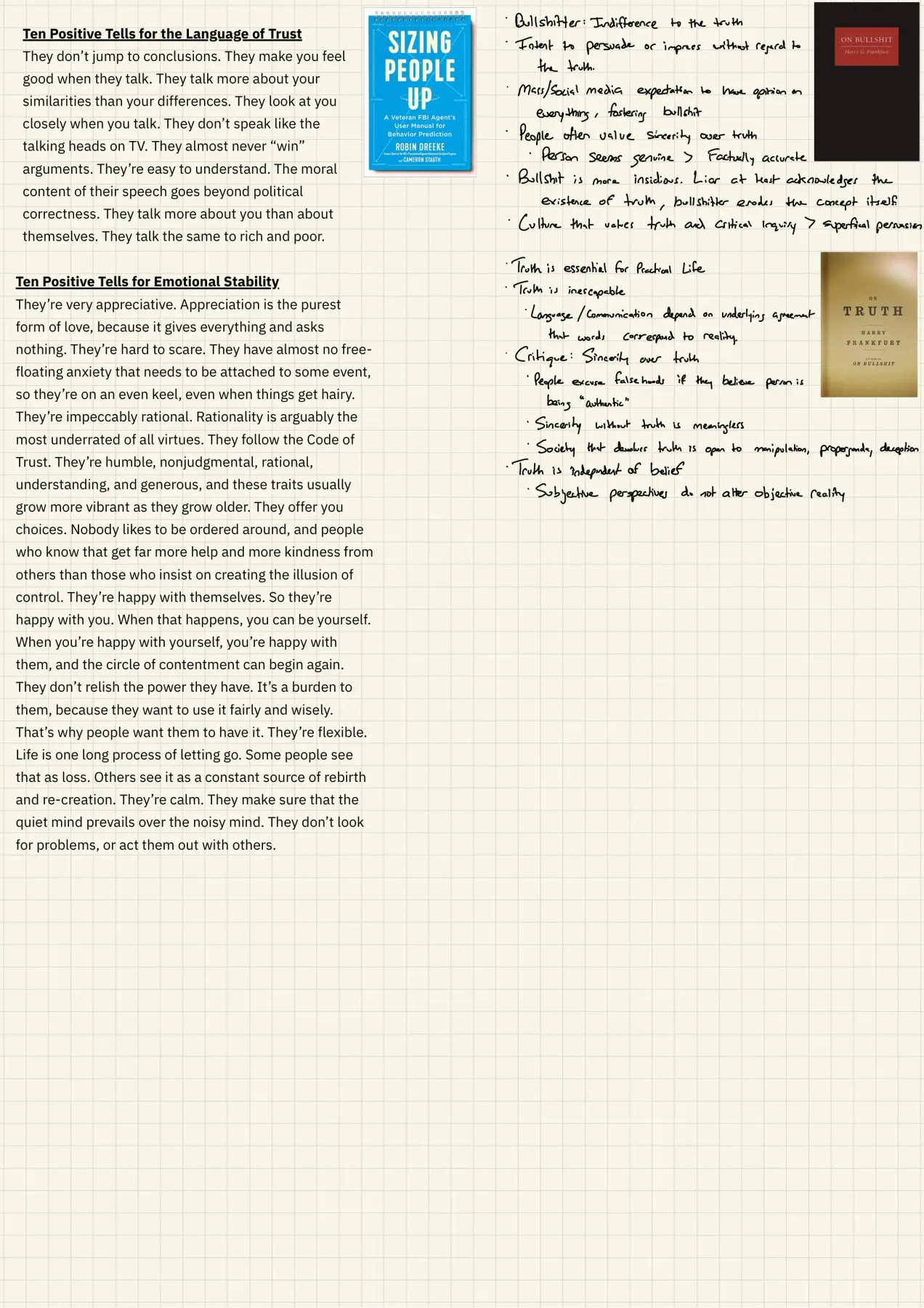
Readwise Information
Author:: Robin Dreeke, Cameron Stauth
Title:: Sizing People Up
Type:: readwise/category/books
Last-Highlighted-Date:: 2025-01-31
Link:: https://readwise.io/bookreview/49453779
Readwise-Source:: readwise/source/kindle
Related-To::
Tags::
Review-for-Repurpose::
Highlights
- PART I FRIEND OR FOE? (Location 61)
- 1 PREVAIL IN A WORLD OF STRANGERS (Location 64)
- To function effectively, humans must be able to predict what others will do, and trust them accordingly. But if you hand out your trust like candy, you can lose the things you treasure most. If there’s any hint of that happening, you’ll be tempted to close the doors you need to open, and you’ll end up cold and alone in your own foreboding. Fear, fear, fear. We’ve all been there. (Location 182)
- Almost every primary fear in relationships, though, can be conquered by one of the mightiest of all human abilities: the power of accurate prediction. Without that power, you’ll probably always be reluctant to trust—and you’ll pay a steep price for that deficit. Trust creates a state of calm and creativity, animates everyone involved, and unites entire nations. It sits at the top of the human hierarchy of positive actions, because it is the action-equivalent of love—and often exists in combination with love. When you’re sizing people up, you learn a lot about their character, traits, tendencies, desires, fears, affections, strengths, weaknesses, and skills, but all of that feeds into the single most important attribute that you’re invariably looking for: trustworthiness. It’s the one quality that strips away mystery, illuminates the truth, and is indispensable to a positive relationship. (Location 185)
- The Six Signs for Behavior Prediction (Location 192)
- Sign #1: Vesting Creating symbiotic linkage of mutual success. Sign #2: Longevity Believing your bond will last. Sign #3: Reliability Demonstrating competence and diligence. Sign #4: Actions Displaying consistent patterns of positive behaviors. Sign #5: Language Creating connections with masterful communication. Sign #6: Stability Transcending conflict with emotional accord. (Location 194)
- The system isn’t a popularity contest, nor even a measure of good or bad, but only predictability. It consists of reading the tells that accurately reflect somebody’s character, traits, and abilities. (Location 206)
- My system works because it cuts to the core of human behavior and rests primarily upon a single fundamental truth: The one thing that you can almost always predict people to do is to act in their own best interests. (Location 215)
- So to determine how people will act, you simply need to learn what they think is in their own best interests, and use that knowledge to predict their behavior. That’s not always easy, but you can learn how. Quickly. And your life will never be the same. The power of prediction is a virtual superpower. Trust, therefore, is not a matter of morality. Trust is a predictability. (Location 221)
- But it’s important not to use this truth for mere manipulation. If you do, you may still be able to find people who you can trust, but they’ll never trust you. The world is already full of manipulators, and you do not want that label to apply to you. (Location 233)
- I’ll teach you how to think like a BAP agent: objectively, rationally, systematically, and free from emotional distractions. With that mindset, you can accurately analyze the most predictive data points of people’s behavior: their actions, statements, body language, opinions, personal reputation, professional track record, and abilities. (Location 239)
- people are so consistent about trying to get what they want that you can predict how they’ll act. (Location 369)
- 2 THINK LIKE AN FBI BEHAVIORAL ANALYST (Location 379)
- THE SIX SIGNS FOR BEHAVIOR PREDICTION (Location 499)
- Sign #1. Vesting: Does this person believe they will benefit from your success? If they do, it’s one of the most positive signs in all of human behavior. More than any other quality—including, sometimes, even love—it signifies partnership and commitment. (Location 500)
- To find out if somebody would be a good ally, talk to them about their immediate goals, necessities, concerns, and passions, and see if they fit with yours. If they do, tell them. They’ll probably jump all over it. The urge for partnership is a primal need. (Location 512)
- Sign #2. Longevity: Does this person think they will have a long relationship with you? Time equals trust. (Location 517)
- Short relationships invite exploitation. (Location 520)
- Sign #3. Reliability: Can this person do what they say they will? And will they? (Location 529)
- You can’t predict how someone will act if they don’t show signs of reliability, a quality that’s composed of competence and diligence. (Location 530)
- Sign #4. Actions: Does this person consistently demonstrate patterns of positive behavior? (Location 548)
- Past patterns of various character issues—such as honesty, effectiveness, and fairness—are especially poor at predicting current trustworthy behavior. (Location 559)
- Among the most important current behaviors that indicate positive character traits are: honest communication, lack of secrecy, consistency between actions and the descriptions of the actions; transparency about actions; signs of diligence; and descriptions of past or current actions that are simple and unadorned. Plain talk is good, because simplicity reveals and complexity conceals. (Location 563)
- Sign #5. Language: Does this person know how to communicate in a positive way? Or do they talk trash? (Location 567)
- The single most revealing linguistic method for measuring character is to monitor people’s language for nonjudgmental, validating statements about others. (Location 576)
- Effective communicators ask a lot of questions, are easy to understand, don’t try to manipulate, and are almost always looking for ways to connect. (Location 587)
- Sign #6. Stability: Does this person consistently demonstrate emotional maturity, self-awareness, and social skills? (Location 589)
- The most fatal flaw to predicting emotionally imbalanced people is that sometimes they think they’re acting in their own best interests but are not. When people intermittently operate as their own best enemies, it’s almost impossible to know what to expect from them. (Location 597)
- The Hard Truths About Predicting Behavior Variability: The behavior of almost all people changes significantly throughout life, depending upon their situations, and their degree of control over their own lives. Immunity: People with notable power—which decreases their accountability—are sometimes tempted to behave badly, and often succumb to the temptation. Vulnerability: The actions of vulnerable people are the easiest to predict, because they are the most accountable. Incompetence: People often mislead others by making the honest mistake of thinking they can do things they can’t. The 50 Percent Rule: The most common forms of predicting behavior—lacking the data points of behavioral science—are wrong approximately half the time. Intuition: Intuition is notably ineffective for predicting what someone will do. Appearances: People who share many situational similarities with you are often no easier to predict than anyone else. Longevity: Long-term relationships, by choice or by circumstance, make both parties more accountable, and therefore predictable. Perceptions: Predicting what people will do depends primarily on their perceptions, not yours. Persistence: People who are the most manipulative often masquerade as the most virtuous and trustworthy. Trust: Trust—based on objective, observable actions such as honesty and transparency—is the most important value in most human transactions. The Six Signs for Behavior Prediction Vesting: People’s belief that they will benefit from your success. Longevity: People’s belief that they will have a long relationship with you. Reliability: People’s observable, quantifiable degrees of competence and diligence. Actions: People’s present behaviors, especially when they are consistent with their past behaviors. Language: People’s ability to communicate in a way that is nonjudgmental, validating, selfless, deep, and focused on you. Stability: People’s degree of emotional maturity, dependability, and consistency is free from manipulative, self-destructive traits. (Location 681)
- PART II THE SIX SIGNS FOR BEHAVIOR PREDICTION (Location 709)
- 3 BUILD BULLETPROOF ALLIANCES (Location 712)
- Sign #1: VESTING Does this person believe they will benefit from your success? (Location 714)
- TEN POSITIVE TELLS FOR VESTING IN YOUR SUCCESS 1. People are happy to work at your tempo, and in your work style instead of theirs. There are people who just won’t allow others to disrupt their way of doing things, and they tend not to vest in others simply because we all have somewhat different ways of getting things done. People who are comfortable vesting in others, though, are proud of bending over backward to accommodate the needs of their close associates. 2. People typically talk in terms of your own priorities, interests, and prosperity. They make you the center of attention because they see you as their surrogate and don’t need to recapture the spotlight for themselves. The wise response is to grant them the same courtesy and commitment. 3. People look for ways to expand their relationship with you. They seek further common interests, and include you in many of the important things they do, even if it’s not something you can do on a level equal to theirs. They’ll find a way to employ your skills. They will also bridge the gap between personal and professional relationships—by bringing you into their personal life if you work together, or by sharing their professional life with you if they’re a social friend. 4. People join you in a difficult project even when they would rather not. On several occasions, colleagues of mine have been assigned to something that felt like a death march to me, but I’ve volunteered to join them out of personal consideration. There’s no better foundation for vesting than to suck it up and dive in. A less dramatic but still meaningful way to show you’re vested in someone’s success is to work unpaid overtime with them, especially if you can contribute something they can’t. As always, actions speak loudest. That’s partly why I volunteer as a pilot for a medical airlift organization. It’s time and resource intensive, and is the most action-oriented contribution I can make. 5. People call in their own favors on your behalf. Cashing in the currency held in someone’s own “favor bank” is a huge tell of vesting. It not only signals the proactive willingness of their help, but also often creates a new relationship for you, if you meet the person who owed the favor. It can also create what’s called the Benjamin Franklin Effect: When someone does a favor for you, it makes them like you more, because they’ve invested in you and would suffer from cognitive dissonance if they didn’t like you. It’s almost pure elixir of vesting. Franklin discovered it when he borrowed a book from an enemy and found that the guy no longer disliked him. 6. Virtually all of someone’s positive actions are unsolicited. I call this the “initiative test.” If someone helps you on their own initiative, it indicates much more vesting than if you have to ask them for help. It shows even more vesting if they create new forums, tasks, or venues that are intended to help you, such as forming a committee and putting you at its head. 7. People create a… (Location 996)
- THE TAKEAWAYS Vesting is not considered to be a virtuous act, because making allies is inspired by one’s own self-interest. But it can create gratitude and friendship, particularly in a long-term relationship. Vesting in someone is essentially a form of investment. Vesting is a common practice in business. It’s also present among most immediate family members, and sometimes among friends, especially if the friendship is based partly upon professional ties. Vesting is the single strongest animating force in teamwork, professionally and personally. (Location 1178)
- The Four Main Ways the Tells of Trust and Distrust Are Conveyed: Verbal communication is the most straightforward means of discovering what people want. And giving people what they want is the best way to build the empowering alliances that are characterized by the virtues of trust, honesty, and mutual support. Nonverbal communication, known colloquially as body language, is an effective method of conveying and interpreting what people truly believe, even when it is not consistent with what they are saying. Actions speak more honestly than words. They are often the most powerful tells of any of the six signs. Past actions are revealing, but current actions—if they benefit both parties—are an even more powerful tell for predicting continued mutual benefit. Intentions, stated as well as observed, indicate a person’s relative degree of alignment with your own goals and dreams. (Location 1185)
- Ten Positive Tells for Vesting in Your Success They change their work style and tempo to fit yours. They talk in terms of your best interests. They actively explore other things they can do with you. They do things with you that they’d rather not do. They call in their own favors to help you. They offer help even when you don’t ask for it. They talk you up inside the company and industry, and give you credit for things they did with you. They get genuinely excited when you succeed. They bring you into their social circle. They share deep secrets. (Location 1194)
- 4 MAKE TIME COUNT (Location 1217)
- Sign #2: LONGEVITY Does this person think they will have a long relationship with you? (Location 1218)
- FIVE HACKS TO ACCELERATE THE TEMPO OF A RELATIONSHIP (Location 1341)
-
- Intensify the experience. You’ve probably noticed that when you pack a lot of experiences into one day, the day seems longer. Simple geographic changes, such as flying cross-country, can also make the hours expand, even when time zones don’t change. To make a recent relationship feel longer, saturate the time with intense experiences. This happens with soldiers in battle, and anyone who undergoes a traumatic event with you. It also happens in happy experiences, such as falling in love, vacationing together, going to a movie, or buying somebody lunch when they get a promotion. Take people out of their routines, off autopilot, and outside their zones of defense. (Location 1342)
-
- Ritualize the relationship. Rituals memorialize moments, mark the passage of time, and have the power to expand time. Bring someone their favorite coffee drink every Friday, or send a note on… (Location 1347)
-
- Begin at the end. You do this by trusting people soon after you’ve met. It pushes time, and isn’t as risky as it sounds if you stay reasonable. Remember: Doveryai no Proveryai—Trust, but verify. (Which is even easier to remember in Russian, because it rhymes.) Almost everybody can be trusted to do something, even if it’s just… (Location 1350)
-
- Demonstrate people’s value. It heightens their feeling of affiliation with you and promotes their honesty and generosity. People feel like they can be themselves around you. Every moment of your life when you have the pleasure of acting exactly the way you feel can stretch linear time majestically. In friendships, people often experience this time-stopping freedom. If you can… (Location 1354)
-
- Decode the “Code of Trust.” In my last book, I created a system called the Code of Trust, a five-point formula for inspiring people to trust you. The Code of Trust parallels the Six Signs for Behavior Prediction because you usually can’t trust people who don’t trust you. So one of the best ways to find people that you can trust is to reverse engineer the Code of Trust and look at yourself from their perspective. I call this reverse engineering process “decoding trust.” When you apply the five principles of the Code of Trust to yourself—from the perspective of someone you are sizing up—and if you think that they don’t find you trustworthy, try to show them that you really do follow these five basic principles: 1. Suspend your ego. If other people think you’re an egomaniac, they’ll be put off and you won’t see the best side of them. They’ll be wary, offended, defensive, and often unfriendly. They won’t trust you to be fair—and you’ll feel the same. To fix the situation, let them be the center of attention, and you’ll begin to see the best in them. 2. Validate people. If people don’t think you approve of them, they’ll pull away and look for people who do. We’re all like that. But if you keep an open mind—and talk to them about their likes, dislikes, experiences, abilities, and problems—they’ll feel comfortable around you, and will be themselves. When that happens, you usually like what you see, because most people do have common decency—and common decency is the common ground of humankind. 3. Don’t judge people. If you do, they’ll judge you back, even if that’s something they don’t usually do. When they start judging you, you’ll stop seeing their kindness, intelligence, and fairness. You’ll just pull away, and that will be the end of it. 4. Be reasonable. If you’re reasonable with people, they’ll probably be reasonable with you. When you are rational… (Location 1358)
- Some people think it’s ironic that generous, humble, reasonable, nonjudgmental people are quite often more successful than people who are egocentric, self-serving, and full of blame. I don’t. Even though we live in a world where treacherous people amass power and money, these are also the people who so often fall from grace, become their own worst enemies, lose the few friends they’ve got, and don’t even enjoy the process. (Location 1391)
- Lead by example: It is often possible to predict that people will behave honorably and kindly if you do it first. It can speed the process greatly, by enhancing the perception of duration. The wise, cautious approach is to offer people things of emotional and practical value, such as confidentiality or nonmaterial resources for their priorities. (Location 1667)
- The Code of Trust: A System for Inspiring Trust in Others Suspend your ego. It’s not all about you. Ever. The more you think it is, the less it will be true. Validate people. Find out who they are and why they do what they do. They’ll open up, and you’ll find things you like about them. Don’t judge. It doesn’t mean you approve. It means you understand. People want understanding even more than approval. Be reasonable. Stick tightly to reality and realism. You’ll never get anywhere if you’re not real. Be generous. When you go win-win in everything you do, you always win. (Location 1670)
- 5 KNOW WHO TO GO TO (Location 1700)
- Sign #3: RELIABILITY Can this person do what they say they will? And will they? (Location 1702)
- Diligence consists primarily of specific, core qualities of character: Persistence. There’s no easy way to do a hard job. Motivation. Your work, if your heart is in it, can live long after you die, and travel the world, and with it, a part of your heart. Thoroughness. If you can’t finish, don’t start. Attention to detail. Nobody wants to clean up after you. Not even your mom. An impeccable work ethic. Work is the great equalizer. It exalts the humble and humbles the exalted. A sense of self-responsibility in all tasks, no matter how minor, or seemingly unrelated. They call it due diligence because it’s due—not optional. Consideration for others. The only measure of love that is true is not how you feel but what you do. (Location 1829)
- THE TAKEAWAYS Competence: The skills, knowledge, and experience that a task requires. Lack of competence—and the lack of ability to quickly become competent—is typically a dealbreaker for predicting success at a task. Competence can generally be accurately measured. Most people are competent in a relatively small number of difficult professional tasks. (Location 2130)
- Diligence: The character qualities—such as drive, self-responsibility, and a strong work ethic—that turn competence into action and completion. Virtually anyone, with enough effort, can be diligent. But diligence is harder to measure than competence, and is easier to fake. Approximately 50 percent of all people lack diligence, according to behavioral science polls. Lack of diligence destroys reliability through absenteeism, poor productivity, apathy, lethargy, and negativity. (Location 2136)
- Ten Positive Tells for Reliability (Competence Plus Diligence) They are genuinely confident for the obvious reason: They know what they’re doing. They speak with specifics: clear, concise, memorable, motivational (C2M2). They’re transparent about mistakes and weaknesses. No sad stories. They welcome difficulties and deadlines. They know that hard can be fun. They work fast, finish first, and know that time is money. They’re inquisitive. That’s worth its weight in platinum. Questions prevent problems. They accept responsibility—never with excuses, but sometimes with reasons. They’re productive. They don’t watch the clock—they watch their production. They display comfortable nonverbals during hard tasks. They don’t hold grudges and don’t seek revenge. (Location 2141)
- Ten Negative Tells for Reliability (Competence Plus Diligence) They micromanage, without really helping. They’re hard to contact—on purpose. They’re chronically late: a nasty combo of lack of diligence and competence. They grab credit, often so surreptitiously that they get away with it. They have a careless physical presentation: sloppy, dirty, messy. They make others solve the hardest problems. They learn slowly. They don’t care. They’re careless with record keeping—a great way to hide things. Or they’re just lazy. They like planning far more than action. It’s easier. They don’t take their mistakes seriously. Sometimes they’re not even aware of them. (Location 2154)
- 6 DETERMINE THE DEALBREAKERS (Location 2166)
- Sign #4: ACTIONS Does this person consistently demonstrate patterns of positive behavior? (Location 2168)
- THE TAKEAWAYS Patterns: Past patterns of honesty and fairness can sometimes crumble when people are no longer held accountable, due to power, wealth, or anonymity. Character: Actions are the most tangible, observable, and measurable indicator of a person’s character. That’s primarily why action is one of the six signs for behavior prediction. Morals: A strong moral code heightens predictability, but can change over time. (Location 2511)
- Ten Positive Tells for Patterns of Actions They remain loyal while others are irrationally critical. They fulfill documentation requests immediately. Their versions of stories never change. They don’t participate in gossip. They don’t complain about their families. They avoid divisive topics. Their work personality is essentially the same as their home personality. They sometimes cite moral obligations in business situations. Their social media is consistent with their professional life. They live up to what they said during the hiring process. (Location 2517)
- 7 LISTEN FOR THE REVEAL (Location 2539)
- Sign #5: LANGUAGE Does this person know how to communicate in a positive way? Or do they talk trash? (Location 2541)
- THE TAKEAWAYS Listen carefully: The language of trust focuses more on the listener than the speaker, and reflects a continuous effort to understand what people want, and how to be a resource for those desires. Pay attention to nonverbal communication: Nonverbal communication is more important and revealing for the language of trust than it is for any of the other signs, simply because it is another form of language. Avoid misunderstandings: Lack of understanding causes so many conflicts that one of the most common synonyms for a disagreement is a “misunderstanding.” Get the facts. Then talk. (Location 2931)
- Ten Positive Tells for the Language of Trust They don’t jump to conclusions. They make you feel good when they talk. They talk more about your similarities than your differences. They look at you closely when you talk. They don’t speak like the talking heads on TV. They almost never “win” arguments. They’re easy to understand. The moral content of their speech goes beyond political correctness. They talk more about you than about themselves. They talk the same to rich and poor. (Location 2938)
- 8 SEE INSIDE PEOPLE (Location 2959)
- Sign #6: STABILITY Does this person consistently demonstrate emotional maturity, self-awareness, and social skills? (Location 2961)
- Embracing imperfections: When people realize that they’re good enough as they are, they usually see that they’re even better than they need to be. One last, ironic note to perfectionists: Don’t worry about being perfect. Worry about being good enough. That does not mean being just okay. It means reaching a high level of conduct and insight. And there’s even a good chance you’ve already done it. (Location 3542)
- Ten Positive Tells for Emotional Stability They’re very appreciative. Appreciation is the purest form of love, because it gives everything and asks nothing. They’re hard to scare. They have almost no free-floating anxiety that needs to be attached to some event, so they’re on an even keel, even when things get hairy. They’re impeccably rational. Rationality is arguably the most underrated of all virtues. They follow the Code of Trust. They’re humble, nonjudgmental, rational, understanding, and generous, and these traits usually grow more vibrant as they grow older. They offer you choices. Nobody likes to be ordered around, and people who know that get far more help and more kindness from others than those who insist on creating the illusion of control. They’re happy with themselves. So they’re happy with you. When that happens, you can be yourself. When you’re happy with yourself, you’re happy with them, and the circle of contentment can begin again. They don’t relish the power they have. It’s a burden to them, because they want to use it fairly and wisely. That’s why people want them to have it. They’re flexible. Life is one long process of letting go. Some people see that as loss. Others see it as a constant source of rebirth and re-creation. They’re calm. They make sure that the quiet mind prevails over the noisy mind. They don’t look for problems, or act them out with others. (Location 3546)