Zibaldone 2024–2025 journal
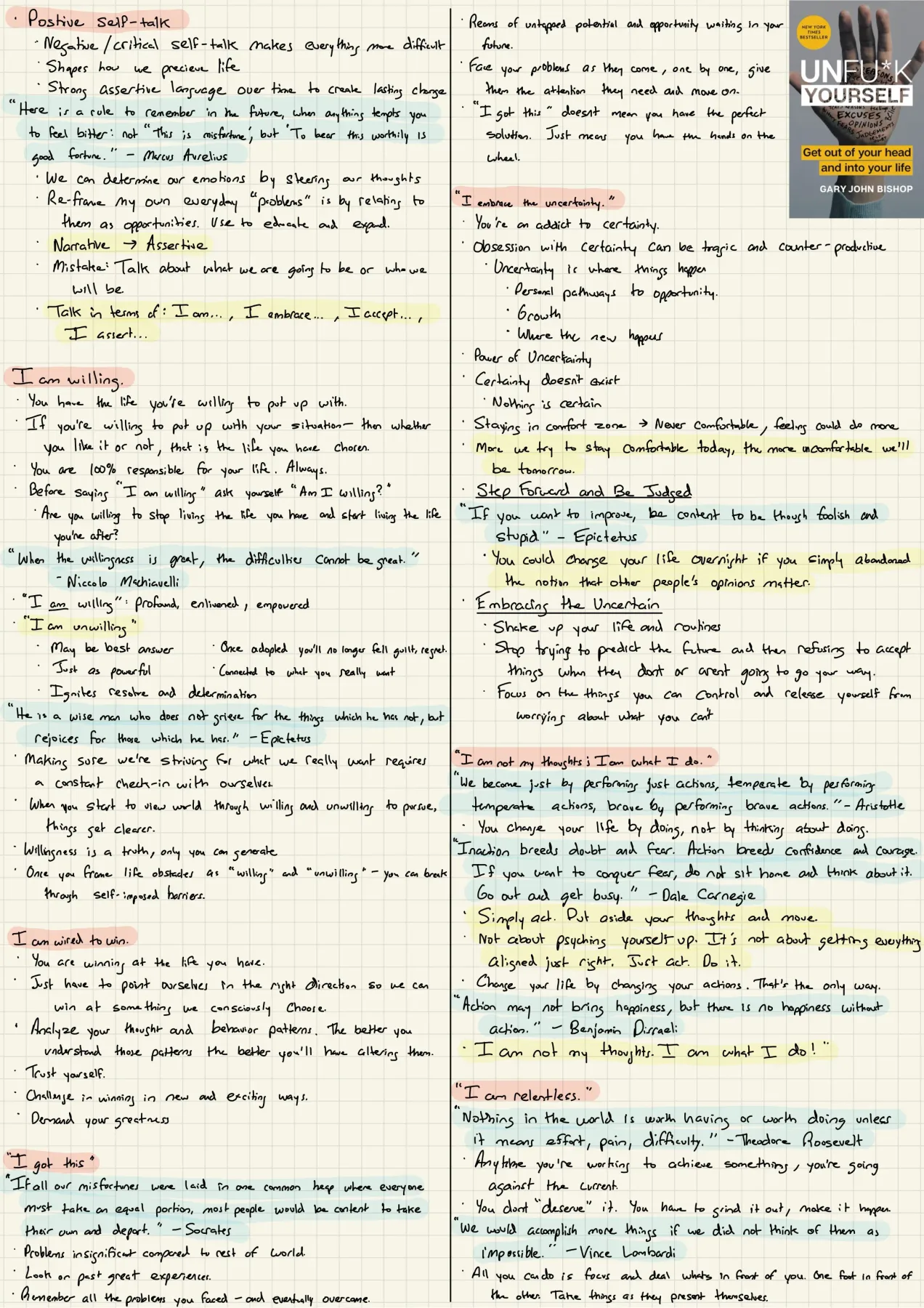
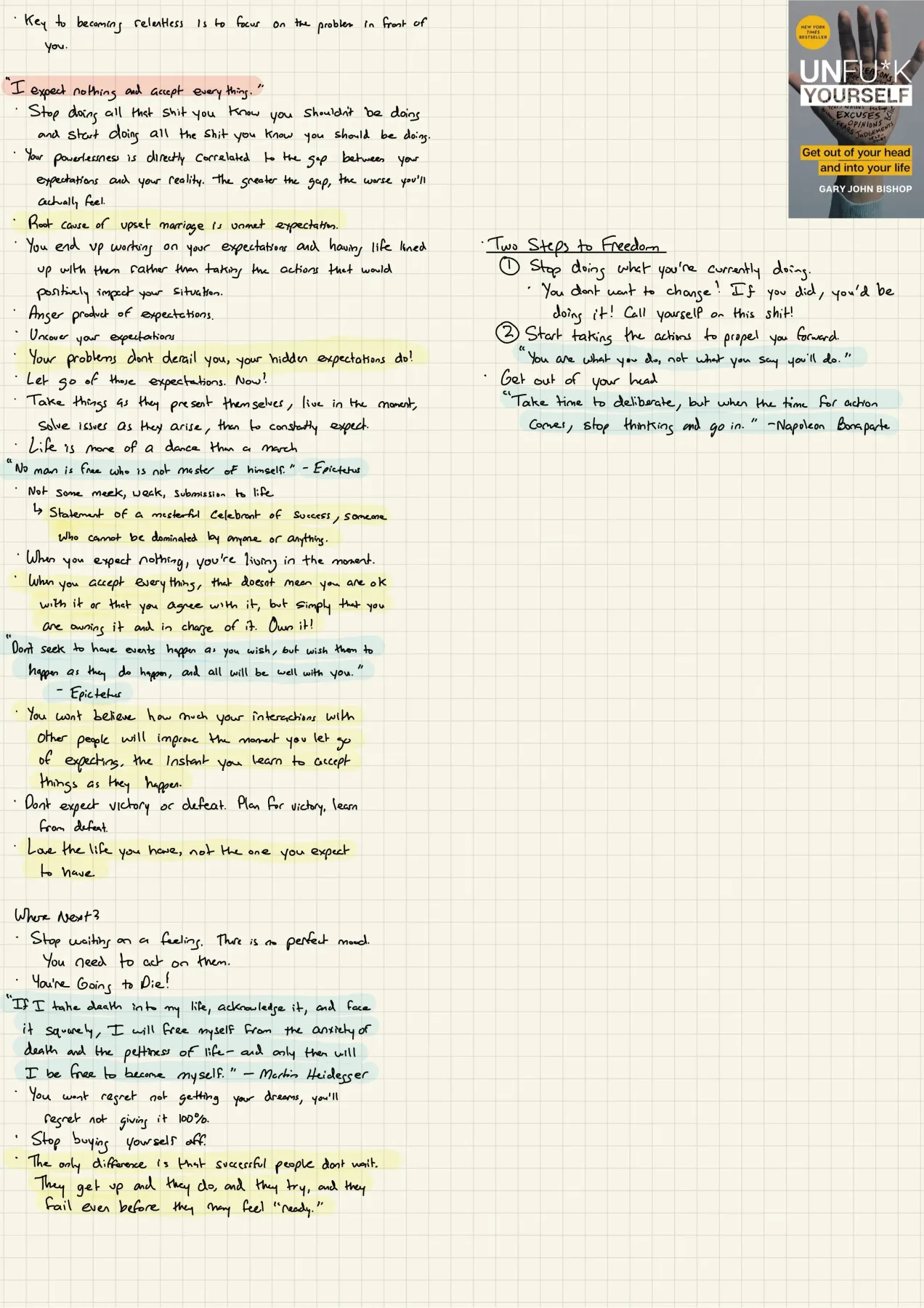
Journal connection: Personal-agency and self-talk notes from Unfu*k Yourself.
Source boundary: These are captured journal materials; the integration does not independently verify every clipped claim, quotation, or figure.
PDF++ pages: p. 179 (file not included in this release) · p. 180 (file not included in this release)
Embedded previews:
Zibaldone 2024-2025.pdf (file not included in this release)
Zibaldone 2024-2025.pdf (file not included in this release)
Open the complete Zibaldone page index
Description
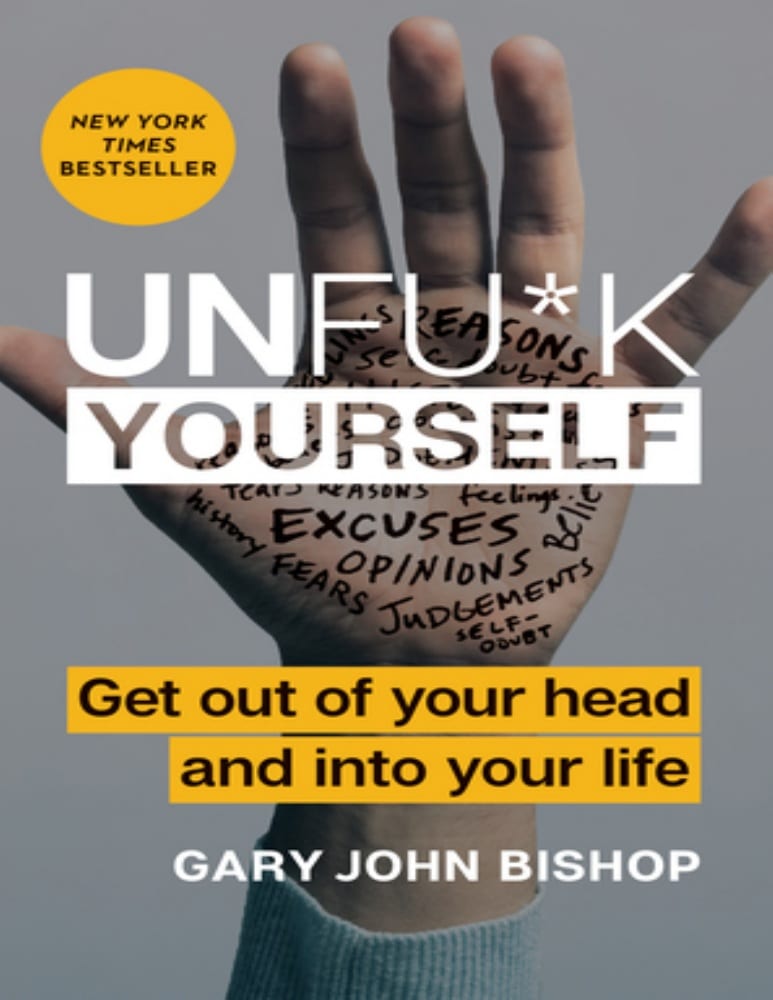
Gary John Bishop, a Glasgow-born coach who calls his approach “urban philosophy,” argues that what keeps most people stuck is not their circumstances but the running commentary in their heads and the behavior it licenses. Rejecting positive thinking and affirmations, he offers seven present-tense “personal assertions” instead: I am willing; I am wired to win; I got this; I embrace the uncertainty; I am not my thoughts, I am what I do; I am relentless; and I expect nothing and accept everything. An opening chapter explains why assertive, in-the-moment language beats the narrative of “I will” and “I should,” and each following chapter takes one assertion, diagnoses the self-defeating pattern it answers, and ends with exercises. Along the way the book moves its weight from language to action: by Chapter 6 the claim is that you are what you do, not what you think, and the closing chapter insists the internal world improves only through action in the external one. The tone is deliberately profane tough love, and quotations from Stoics and other thinkers, along with a few studies, are offered as support rather than proof.
Vault PDF and source boundary
Open the complete book (file not included in this release)
Page links: citations use the PDF viewer’s page count for this file (141 pages, a reflowed ebook conversion), not the page numbers of the printed edition.
Evidence boundary: these notes reconstruct the author’s argument from the supplied book. Claims, statistics and attributions of quotations are the author’s; they have not been independently fact-checked.
Chapter-by-Chapter Overview
Linked reading map
Use the entries below to jump to the full argument, analytical divisions, essential evidence, concepts, conclusion, and reflection questions for each chapter.
- 1. In the beginning: Self-talk shapes how we perceive and act, so Bishop replaces positive thinking with present-tense “assertive” language and asks readers to test it as a personal experiment. p. 10 (file not included in this release)
- 2. I am willing: You have the life you are willing to put up with; dropping all blame and asking “Am I willing?” (or declaring “I am unwilling”) turns procrastination and envy into owned choices. p. 25 (file not included in this release)
- 3. I am wired to win: Repeated failures are successes at proving hidden beliefs about yourself, and the same subconscious drive can be redirected toward goals you consciously choose. p. 40 (file not included in this release)
- 4. I got this: Problems spread and distort until you zoom out across your whole life, see the present as one “something” among many, and claim agency on the strength of your track record. p. 55 (file not included in this release)
- 5. I embrace the uncertainty: The craving for certainty is an outdated survival instinct; certainty is an illusion, and everything new, including success, lives in the unknown. p. 68 (file not included in this release)
- 6. I am not my thoughts; I am what I do: Thoughts need not dictate action; acting regardless of mood is both how you change your life and the fastest way to change your thinking. p. 82 (file not included in this release)
- 7. I am relentless: Success comes through discomfort, nothing stops you unless you agree it does, and relentlessness means focused, step-by-step action when all else has run out. p. 97 (file not included in this release)
- 8. I expect nothing and accept everything: Hidden expectations, not problems, drain your power; dropping them and accepting what is (as ownership, not approval) frees you to act. p. 111 (file not included in this release)
- 9. Where Next?: All seven assertions mean action: stop the habits sourcing your problems, start the ones that move you forward, and stop waiting for the right feeling. p. 127 (file not included in this release)
Review
Handwrite First
Use this section with the book and notes closed. Retrieval matters more than polished prose.
1. Before Reading
- Prediction:
- Question I want answered:
- What I already think about self-talk, motivation, and action:
- What I expect to disagree with:
2. Closed-Book Recall Dump
-
Main claims I remember:
-
Key evidence, stories, or contrasts:
-
Assertions, examples, and concepts:
-
What feels fuzzy or incomplete:
3. Core Argument From Memory
- The book or chapter in one sentence:
- The problem Bishop is correcting:
-
The causal chain:
- Best evidence I remember:
- Most important qualification:
4. Feynman Check
Explain the argument in plain language to an intelligent reader who thinks self-help means positive thinking and affirmations. Circle any term—assertive versus narrative self-talk, willingness and unwillingness, responsibility without blame, wired to win, domains, zooming out (“a sea of somethings”), the certainty addiction, thought-action independence, relentlessness, hidden expectations and the gap, or acceptance as ownership—that you cannot define without looking.
5. Pushback From Memory
- Strongest alternative explanation:
- Claim Bishop may overstate:
- Evidence that would change my mind:
- What follows from Bishop’s examples, and what remains interpretation:
Type Into Obsidian
After checking the chapter notes, correct the handwritten reconstruction.
1. Correction After Checking
- What I remembered accurately:
- What I distorted or omitted:
- Chapter or passage that corrected me:
2. Clean Core Argument
- Thesis:
- Reasoning:
- Essential evidence:
- Qualification:
- Connection to the book:
3. Connections
- The Subtle Art of Not Giving a Fuck — both books sell profane tough love against positive thinking; does Manson’s emphasis on choosing what to care about agree with Bishop’s willing/unwilling test, or does it point somewhere different?
- Distorted Automatic Thoughts — Bishop cites Albert Ellis and cognitive restructuring; which of his assertions map onto specific distortions in that list, and where does he skip the step of examining a thought before acting against it?
- Dichotomy of Control — Bishop quotes Epictetus and Marcus Aurelius throughout; does “expect nothing and accept everything” track the Stoic distinction between what is and is not up to us, or does Bishop’s 100% responsibility claim go further than the Stoics?
- Feel the Fear and Do It Anyway — how does Jeffers’s case for acting while afraid compare with Bishop’s “I am not my thoughts; I am what I do” and “I embrace the uncertainty”?
- New connection:
4. Flashcards / Atomic Recall
- Q: What is the difference between assertive and narrative self-talk? A: Assertive self-talk stakes a claim in the present (“I am…”, “I accept…”); narrative self-talk is a running commentary of opinion and judgement, often in the future tense (“I will…”, “should”, “try”), which postpones change.
- Q: What are Bishop’s seven personal assertions? A: I am willing; I am wired to win; I got this; I embrace the uncertainty; I am not my thoughts, I am what I do; I am relentless; I expect nothing and accept everything.
- Q: In what sense is a failed relationship a “win” in Chapter 3? A: It succeeds at proving a hidden belief (for example, that no one will ever love you); the mind is wired to win at its operative goal, even when that differs from the stated one.
- Q: According to Chapter 8, what determines how powerless you feel about an area of life? A: The size of the gap between your hidden expectations and reality; the greater the gap, the worse you feel.
- Q: What are the “two steps to freedom” in the final chapter? A: Stop doing what is sourcing your problems, and start taking the actions that propel you forward, replacing old habits with new ones.
Retention Check
24 Hours Later
- Reconstruct the seven assertions and the self-defeating pattern each one answers.
- Name one claim, one example, and one qualification from the book.
1 Week Later
- Apply one assertion to a real stuck area, noting what you were “winning at” there and what action you took regardless of mood.
- Explain how Chapter 6 changes the meaning of Chapter 1’s focus on self-talk.
1 Month Later
- Rebuild the book’s argument from “self-talk shapes your life” to “improve the internal by acting in the external” without opening the note.
- Identify the strongest claim you accept, the strongest you resist, and the evidence needed to decide between them.
Notes
Book Argument and Reading Map
Bishop’s governing claim is that most people are stuck not because of their circumstances but because of how they talk to themselves about those circumstances, and the behavior that talk produces. The opening chapter states the problem as a “self-defeating monolog,” a constant, mostly unnoticed stream of judgement and doubt, and offers the book as “a conversational slap” to wake readers up. His remedy is explicitly not positive thinking. Instead of affirmations or promises about the future, he proposes personal assertions: short, present-tense statements that “stake a claim for this moment of time” and replace the narrative of “I will…”, “should” and “try.”
The book is built as a sequence of seven such assertions, one per chapter, each answering a distinct way people defeat themselves. “I am willing” removes blame and recasts procrastination as an unacknowledged choice. “I am wired to win” explains repeated failure as success at proving a hidden belief. “I got this” restores proportion when problems spread and overwhelm. “I embrace the uncertainty” targets the addiction to prediction and comfort. “I am not my thoughts; I am what I do” separates action from mood. “I am relentless” carries action through long stretches without visible progress. “I expect nothing and accept everything” dissolves the hidden expectations that turn setbacks into crises. A short final chapter, “Where Next?”, insists that none of this works unless acted upon.
The through-line is a gradual shift of weight from language to action. Chapter 1 treats self-talk as “the very foundation for our reality”; Chapter 6 dismisses “Change your thoughts, change your life” and argues that action is both possible regardless of thought and “the quickest way to change your thoughts”; Chapter 9 concludes that “in order to improve your internal world, you have to start by taking action in the external world.” Read together, the assertions work less as beliefs to install than as present-tense commitments that direct behavior, with the subconscious patterns of Chapters 3 and 8 made visible so they can be redirected.
Two further threads run across the chapters. One is responsibility without blame: Bishop holds readers “100% responsible” for what they do after events they did not choose, while insisting that blaming anyone, including oneself, is useless. The other is a borrowed Stoic frame: Epictetus, Seneca and Marcus Aurelius appear in almost every chapter to support the claim that our response, not the event, is what matters, and Chapter 8’s acceptance is close to Epictetus’s advice to wish things to happen as they do.
Interpretive guardrails
- Bishop says the quotations and “snippets of scientific findings” are there “to add weight to my approach but not to prove it.” Studies and statistics (fifty thousand thoughts a day, Lipton’s 95 percent figure, Will Hart’s experiments) are cited without references and should be read as illustration.
- The book’s own standard of evidence is personal experiment: “There is no greater knowledge than the knowledge you have verified for yourself, in your own experience.” Its claims are framed to be tried, not assessed as general psychology.
- Several claims are deliberately absolute for rhetorical effect (“100% responsible… no excuses,” “certainty is a complete illusion,” “There is no changing of plans,” “YOU DON’T WANT TO CHANGE”). Bishop qualifies most of them elsewhere: tragic events are acknowledged, planning is endorsed, abusive relationships are not to be accepted, and belief is “only one” part of success.
- Quotations attributed to historical figures are reported as Bishop presents them; the notes do not verify the attributions.
- The final chapter recommends getting a coach and advertises the author’s own paid program, which is worth weighing alongside that advice.
Chapter 1: In the beginning…
Chapter Objective and Through Line
The opening chapter names the problem the whole book addresses: a constant, mostly unnoticed stream of self-talk that judges, doubts and limits us, leaving people “like a hamster on a wheel” who work hard and get nowhere p. 14 (file not included in this release). Bishop’s thesis is that the language you use about your circumstances shapes how you see, experience and act within them, so that the main obstacle in most lives is not the circumstances themselves but “the weight of self-talk that pulls you down” p. 19 (file not included in this release). The book is offered as “a conversational slap from the universe” to wake readers up to that fact p. 14 (file not included in this release).
The argument moves in three steps. First, self-talk is shown to be ubiquitous and largely automatic, but we still choose which thoughts we attach significance to. Second, Bishop gathers support from psychology (Will Hart, Albert Ellis), philosophy (Wittgenstein, the Stoics) and neuroscience (neuroplasticity) for the claim that language and perception drive emotion and behavior. Third, he distinguishes his approach from positive thinking: the remedy is not affirmations but a shift from narrative self-talk to assertive self-talk, statements that stake a claim in the present (“I am…”, “I accept…”).
The chapter is the book’s method statement. The seven chapters that follow are each built around one such assertion, and the final section tells the reader how to use them: as a personal experiment, verified in one’s own experience, rather than as a body of claims to be assessed.
Chapter Structure at a Glance
- The problem is internal chatter: most of our conversations are with ourselves, and the negative ones drain us without our noticing.
- Language shapes experience: research and philosophy are cited for the claim that how we describe events changes how we feel about and deal with them.
- This is not positive thinking: Bishop rejects affirmations and promises an “authentic” alternative.
- Self-talk becomes perception, and perception becomes behavior: an “unfair” story about life produces the behavior that makes it come true.
- The answer is inside, and it can be trained: Stoic reframing and neuroplasticity support the claim that we can change our relationship to circumstances by changing our words.
- Assertive versus narrative language: present-tense assertions intervene now, while “I will” statements postpone change.
- How to use the book: treat it as an experiment, dip in where needed, and expect to be annoyed.
Section-by-Section Argument
Opening: the two kinds of talk (analytical division; the chapter’s opening pages have no heading)
Bishop begins with the claim that there are two kinds of talk, talking to others and talking to yourself, and that most of each day’s conversations are of the second kind p. 14 (file not included in this release). The point is not that self-talk is abnormal (“we all do it”) but that its effects go unseen. He concedes that we have “little or no say” in the automatic thoughts that arise, but insists “we have a massive say in which of those same thoughts we attach significance to” p. 15 (file not included in this release). This distinction between having a thought and giving it significance is the hinge for the rest of the book.
- He cites the figure that we have “over fifty thousand thoughts per day” to stress the scale of the stream p. 15 (file not included in this release).
- Professor Will Hart’s experiments are offered as evidence that describing an event as ongoing intensified the feeling attached to it, positive or negative; Bishop’s gloss is that “the language you use to describe your circumstances determines how you see, experience and participate in them” p. 15 (file not included in this release).
- Wittgenstein, Heidegger and Gadamer are invoked to show the idea is old, not as detailed philosophical support.
- Negative self-talk “can make small problems seem bigger – and even create problems where none existed before” p. 16 (file not included in this release).
Having established the stakes, Bishop immediately disowns the obvious remedy. He is “NOT suggesting you suddenly take on positive thinking or personal affirmations” and will not ask readers to tell themselves they are tigers; he is “much too Scottish for that” p. 16 (file not included in this release). The promised alternative is “an authentic leg-up” that feels genuine to the reader.
The Difference Between Success and Failure (author’s heading)
This section supplies the psychological mechanism. Bishop quotes Albert Ellis: if emotions largely result from thinking, one “may appreciably control one’s feelings by controlling one’s thoughts – or by changing the internalized sentences, or self-talk” p. 16 (file not included in this release). Ellis is also credited with showing that our thinking is often irrational. Bishop’s contribution is to point to the moment just before an overreaction, where “you had a flash of outrageous self-talk” p. 17 (file not included in this release).
- Subtle self-talk matters as much as dramatic self-talk: “This is so hard. What if I don’t finish in time?” leaves a residue of anxiety even when nothing has gone wrong p. 17 (file not included in this release).
- The dreaded chore example (folding laundry, unloading the dishwasher) shows how a negative “personal conversation” about small tasks produces resistance; enough of these collapse together into a feeling of being overwhelmed p. 18 (file not included in this release). Bishop asks readers to look for their own “stuck-ness” as the sign of a “self-talk blockage.”
How Language Changes Our Lives (author’s heading)
Here the argument extends from feeling to behavior over time. Self-talk “can seep into our subconscious and become internalized,” shaping perception, and perception directly drives action p. 18 (file not included in this release). Someone who keeps calling life “unfair” will perceive slights and put in less effort, so “the unfair view will quickly become your reality”; someone who sees success as close will work for it and be energized by it p. 18 (file not included in this release).
- Bishop qualifies his own claim: belief in success “is only one, (albeit important), part of success,” and great things can be accomplished without it, though “the ride will be a bit rougher” p. 18 (file not included in this release). This qualification matters because the book does not ultimately rest on belief; later chapters shift the weight to action.
- Marcus Aurelius is quoted for the reframe “not ‘This is misfortune,’ but ‘To bear this worthily is good fortune’” and for “Reject your sense of injury and the injury itself disappears” p. 19 (file not included in this release). Bishop adds that Stoics believed outside events hold no power over us.
- The section turns the argument into a challenge: how willing are you to consider that your life is as it is because of your self-talk rather than your circumstances? Looking outside for the solution produces “a see-saw of success and disappointment,” and some circumstances never change p. 19 (file not included in this release).
- Bishop’s client line summarizes the turn inward: people wait for the cavalry, “never realizing they are the cavalry” p. 19 (file not included in this release).
Re-Train Your Brain – One Word at a Time (author’s heading)
Bishop next argues that this inward change is physically real, not “psychobabble.” Neuroplasticity means the brain keeps rearranging its pathways, and “the easiest way to shape those thoughts is through conscious, decisive self-talk” p. 20 (file not included in this release). Assertive language, repeated over time, works like habit formation. He adds that much will depend on “your basic tolerance of your current mindset and your willingness to change it,” which anticipates Chapter 2 p. 20 (file not included in this release).
- His own practice is to relate to everyday problems as opportunities, which makes him “curious and engaged” rather than annoyed p. 21 (file not included in this release).
- The neuroscience is stated generally, without specific studies; it functions as plausibility support.
Assertive vs Narrative (author’s heading)
This is the chapter’s main practical distinction. Narrative self-talk is a running commentary of opinion and judgement about yourself, others and life, often framed in the future (“I will…”, “I’m going to…”, “should”, “try”). Such language subconsciously places change somewhere other than now, which is why New Year’s resolutions fail: they start with enthusiasm and leave a “giant hole” when the old behavior is merely being “stopped” p. 21 (file not included in this release). Assertive self-talk “stake[s] a claim for this moment of time,” using forms like “I am…”, “I embrace…”, “I accept…”, “I assert…” pp. 21–22 (file not included in this release).
- The contrast “I am relentless” versus “I will be relentless” captures it: one intervenes in the present, the other describes what is to come p. 22 (file not included in this release).
- The reader is asked to try assertive speaking in daily life and to catch the narrative mode when it appears.
Using This Book (author’s heading)
The final section frames the evidence and the method. Quotations from historical figures and “snippets of scientific findings” are there “to add weight to my approach but not to prove it” p. 22 (file not included in this release). The real test is personal: “There is no greater knowledge than the knowledge you have verified for yourself, in your own experience.” Readers should treat the book as a personal experiment rather than an assessment, accept that parts will “confront, annoy, jar and exasperate,” and use each chapter on its own as needed, returning when stuck pp. 22–23 (file not included in this release).
Key Concepts and Distinctions
- Self-talk: The ongoing internal conversation, mostly automatic, through which we describe ourselves, others and life.
- Significance: It is the book’s causal lever; Bishop locates most “stuck-ness” there rather than in circumstances.
- Thought versus significance: We cannot control which thoughts arise, but we can choose which ones we treat as meaningful.
- Significance: This keeps the program from requiring control of the mind’s every movement and prepares Chapter 6’s separation of self from thought.
- Language to perception to behavior: Words shape how situations appear, and appearances shape action, often in self-fulfilling ways.
- Significance: It explains why a mere way of talking can have real consequences in a life.
- Assertive versus narrative self-talk: Present-tense claims (“I am…”) versus future-tense or judgemental commentary (“I will…”, “should”, “try”).
- Significance: It defines the form of every chapter that follows, each titled by an assertion.
- Experiment rather than assessment: The reader tests the assertions in their own experience instead of evaluating them as claims.
- Significance: It sets the standard of proof the book asks to be judged by.
Chapter Conclusion and Significance
Bishop concludes that the place to intervene in a stuck life is the language one uses with oneself, and that the right intervention is not cheerfulness but present-tense assertion. The evidence he offers (Ellis, Hart, Stoic reframing, neuroplasticity) is explicitly meant to “add weight,” not to prove; the real warrant is to be the reader’s own experiment. The chapter therefore sets up the book’s structure, seven assertions, and its voice, a deliberately abrasive tough love aimed at those who are “easily offended.”
There is an unresolved tension at the start. Bishop treats language as the foundation of reality (“We create our own reality with our minds”) while also conceding that belief is only one part of success and that the ride is possible without it. The book will gradually move the weight from thinking toward action, culminating in Chapter 6’s claim that you are what you do; this opening chapter should be read as describing the entry point, not the whole mechanism.
Questions for Reflection
- Bishop rejects positive affirmations but recommends assertive statements like “I am relentless.” What exactly distinguishes the two, and is the difference one of content, tense, or attitude?
- If quotations and studies are meant “to add weight… but not to prove,” what would count as a successful or failed test of the book’s approach in your own experience?
- How does the distinction between having a thought and attaching significance to it relate to the Stoic claim that outside events hold no power over us? Does Bishop’s version claim more or less than the Stoics?
Chapter 2: “I am willing.”
Chapter Objective and Through Line
The first assertion establishes the book’s foundation: responsibility without blame. Bishop opens with the blunt claim “You have the life you’re willing to put up with” p. 29 (file not included in this release). Whatever you are not willing to act on, you have in effect chosen, and defending your circumstances only makes “a case for being where you are.” Even events you had no say in, such as a death or a business failure, leave you a “MASSIVE say” in how you live afterwards, so that “you are 100% responsible for what you do with your life in the aftermath of those events” pp. 29–30 (file not included in this release).
The chapter’s distinctive move is to recast what we usually call laziness, procrastination or lack of motivation as unwillingness, and then to show that unwillingness, once stated honestly, is itself a resource. The question “Am I willing?” forces an answer; “I am unwilling” can draw a line in the sand; and admitting that you have been willing to stay where you are opens the way to change without self-blame. Bishop then applies the willing/unwilling test to goals: many desires (wealth, a certain body, a nicer car) are not things we are actually willing to pay for, and seeing that frees us from envy and guilt.
In the book’s design, this is the gateway assertion. Chapter 1 argued that self-talk shapes life; Chapter 2 identifies the first piece of self-talk to change, the excuses and “buts” that convert people into victims, and replaces it with a present-tense declaration of readiness.
Chapter Structure at a Glance
- Your life reflects what you tolerate: circumstances reveal you; your response, not the event, is your responsibility.
- Blame must stop entirely: blaming luck, others, childhood or even yourself is useless; “but” turns you into a victim.
- “Am I willing?” opens the door: the question demands an answer and reframes procrastination as unwillingness.
- Unwillingness can be equally powerful: declaring what you will no longer put up with produces resolve, and admitting you have been willing to stay stuck creates an opening.
- Test your goals against willingness: if you will not pay a goal’s real cost, stop yearning for it and love the life you have.
- Shrink the task and plant the flag: break hard things into small willing steps, and organize life around what you are willing to do rather than what you want.
Section-by-Section Argument
Opening: the life you’re willing to put up with (analytical division)
Bishop’s first claim is that most problems have obvious remedies (get a new job, end the relationship, change your diet) and that if you are not willing to take them, the resulting life “is the life you have chosen” p. 29 (file not included in this release). He anticipates the objection and refuses it: “No buts. You can’t afford them.” Epictetus supplies the frame, “Circumstances don’t make the man; they only reveal him to himself.”
- No blame of any kind. Bishop calls this “fundamental to everything” in the book, and extends it to self-blame: “Even blaming yourself is completely useless” p. 30 (file not included in this release). The no-self-blame clause is what distinguishes total responsibility from guilt.
- He defines willingness from the dictionary as “readiness,” a state in which we can see a situation from a new perspective. No one can make you willing; it “starts with you and ends with you” p. 30 (file not included in this release).
- “I am willing but…” is the characteristic victim sentence p. 30 (file not included in this release).
- He admits the tone is meant to provoke, “to inflame you to your own potential.”
Finding the Door (author’s heading)
The section introduces the assertion as a question. Seneca’s “Fate leads the willing and drags along the reluctant” sets the stakes: life goes on whether you participate or not p. 31 (file not included in this release). “Am I willing?” is powerful because it “pulls for a response” and cannot be left unanswered. Bishop then makes the reframing that drives the chapter: “We often view ourselves as procrastinators or lazy or unmotivated. When in reality, we’re simply unwilling” p. 31 (file not included in this release). Treating avoidance as unwillingness rather than a character flaw makes it something you can generate a different state about.
- Willingness was easy in childhood and has been lost, not destroyed; you remain “a master generator” of it p. 32 (file not included in this release).
- Machiavelli’s “Where the willingness is great, the difficulties cannot be great” is used to say willingness is the doorway to effort, steps and dealing with setbacks.
When the Door Is Closed (author’s heading)
Here Bishop reverses the expected direction. Sometimes “I AM UNWILLING!!” is the better answer: unwilling to live with an unhealthy body, paycheck to paycheck, or with unworkable relationships p. 32 (file not included in this release). Unwillingness “ignites resolve and determination” and marks a line in the sand p. 33 (file not included in this release). People differ in which framing moves them, and the same problem can be stated either way (“I am willing” to find a new job; “I am unwilling” to stay in one I hate).
The Power of Purpose (author’s heading)
For the “great-starters-but-not-finishers,” Bishop offers a harder version: admit that you have been “all too willing to remain the same,” since otherwise you would have changed by now pp. 33–34 (file not included in this release). This admission is presented as freeing rather than shaming. It must be done “without blaming yourself,” and its logic is symmetrical: “In the moment you realize you have cognitively and systematically put yourself here… you can cognitively and systematically get yourself out!” p. 34 (file not included in this release). Separating the task from “the drama of the past” lets you deal with the issue itself.
Reaching for the Stars With Short Arms (author’s heading)
The willingness test is then applied to goals. Being “filthy rich” requires 60 to 80 hour weeks, skipped vacations and risk; most people have not confronted what such goals demand pp. 34–35 (file not included in this release). Bishop blames a social “headlong rush” to be the richest, prettiest or strongest for producing “disappointed and unfulfilled human beings” who have forgotten why they pursue what they pursue.
- The qualification is important: he does not say to stop pursuing big goals or to stagnate; long hours are fine for those who really want the result. The point is to check whether you actually want it, and if not, stop wasting “precious headspace” yearning for it p. 35 (file not included in this release).
- “I am unwilling” statements become a way of owning choices (“‘I am unwilling’ to trade time with my family for an extra zero on my paycheck”), which removes guilt, resentment and regret p. 36 (file not included in this release).
Chart Your Path (author’s heading)
Looking honestly at goals also forces re-evaluation of the path, which is usually smaller than the mind has built it up to be. Thirty minutes of exercise, offering an idea in a meeting, or even large tasks like years of back taxes begin with “that same glimmer of willingness” p. 36 (file not included in this release). When a task looms too large, break it into smaller declarations of willingness: “stand up”, “get out of bed”, “open my email.”
- The larger example is a long-kept secret: “Am I willing to tell the truth to that person I’ve been lying to?” turns a dreaded event into “an occasion to talk, listen and then deal with the consequences” p. 37 (file not included in this release). The point is that what is at stake is “the life that’s available after,” not the task itself.
Plant Your Flag (author’s heading)
The conclusion generalizes the lens: view the world through what you are willing and unwilling to pursue rather than what you want and don’t want p. 37 (file not included in this release). This replaces “envy, lust, and desire” with chosen commitments and lets your conscious self, rather than “some sub-conscious glitch,” determine your truth. Self-judgements like “I am a failure because I’m not a millionaire” lose their power “because you will have owned your choices” p. 38 (file not included in this release). The chapter closes with the instruction to ask “Am I willing?” repeatedly, morning and night, until a “resounding YES” arrives.
Key Concepts and Distinctions
- Willingness: A state of readiness to act and to see a situation newly, generated only by oneself.
- Significance: It is the precondition for every later assertion; without it, nothing moves.
- Responsibility versus blame: Full responsibility for one’s response to events, combined with refusal to blame anyone, including oneself.
- Significance: It lets Bishop demand total ownership without inducing guilt, which he treats as another form of being stuck.
- Procrastination as unwillingness: Avoidance reinterpreted as an unacknowledged choice rather than a fixed trait.
- Significance: A choice can be remade; a character flaw seems permanent.
- Willing/unwilling versus want/don’t want: Organizing life by what you will actually do rather than by desires.
- Significance: It separates real goals from socially induced yearning and dissolves envy and regret.
Essential Evidence and Examples
- The “filthy rich” test: Shows how most goals carry costs we have not faced, supporting the claim that unexamined wanting breeds disappointment.
- The BMW versus Honda contrast: If you will not work 10 or 20 extra hours a week for the better car, the yearning is wasted headspace; it illustrates owning a choice rather than resenting it p. 35 (file not included in this release).
- Telling the truth after lying: Demonstrates that even a large, frightening task becomes manageable once framed as a question of willingness.
Chapter Conclusion and Significance
Bishop concludes that willingness is “the lifeblood of the new” and that the obstacles that hold people back are largely self-imposed barriers that dissolve when framed as matters of willing and unwilling p. 38 (file not included in this release). The argument rests on a simple inference: if your situation persists, you have been tolerating it, and what you have tolerated by choice you can stop tolerating by choice.
The chapter’s strength is also its pressure point. Bishop concedes tragic and uncontrollable events, but his claim that there is “always something you can do” and that you are “100% responsible… Always, every time, no excuses” leaves little room for constraints that limit the response itself (poverty, illness, other people’s power). His answer is that responsibility attaches to the response, not the event, and that blame of any kind is useless; whether that fully meets the objection is left to the reader’s experiment.
Questions for Reflection
- Is reframing procrastination as “unwillingness” an accurate description or a useful fiction? What is gained, and what might be missed, by treating avoidance as a choice?
- How can a person be “100% responsible” for their life without blaming themselves? Is Bishop’s separation of responsibility from blame coherent?
- Which works better for you in a specific current problem, “I am willing” or “I am unwilling,” and what does that suggest about how motivation differs between moving toward something and refusing something?
Chapter 3: “I am wired to win.”
Chapter Objective and Through Line
The second assertion inverts the reader’s sense of failure. Bishop’s paradoxical thesis is that you are always winning: your life, including its repeated defeats, is the successful outcome of what you subconsciously set out to prove. “The truth of it is, you are winning at the life you have” p. 45 (file not included in this release). The problem is not that the mind fails to achieve goals but that “what you really want—on a subconscious level—and what you say you want are different, sometimes radically so” p. 47 (file not included in this release).
The chapter develops this through a long relationship example, then generalizes it. Hidden beliefs (“I’m not worthy of love”, “I’m a failure”) act as goals; behavior serves to prove them right, and life confirms them with uncanny accuracy. Bishop adds the idea of domains: we win within a familiar world (an income bracket, a fitness level) whose limits are set by the conclusions we have drawn about ourselves. The practical task is to find what you are “winning at” in your problem areas, see the belief it proves, and then redirect the same capacity toward consciously chosen goals with a concrete game plan.
In the book’s sequence, Chapter 2 asked whether you are willing; Chapter 3 explains why, even when willing, people keep reproducing the same results. It shifts the source of stuck-ness from circumstances to subconscious commitments and recasts that hidden power as an asset to be re-aimed rather than an enemy to be fought.
Chapter Structure at a Glance
- The paradox: a failed relationship, viewed rightly, is a “resounding win.”
- The mechanism: a subconscious belief becomes the real goal, and behavior undermines conscious goals to prove it.
- Most of life runs on autopilot: subconscious patterns keep you within a familiar domain of income, fitness and relationships.
- Diagnosis: look at problem areas and ask what you get to be right about.
- Reframing the power: the mind that unconquerably proves the negative can be pointed at positive goals.
- A game plan: break goals into steps, anticipate the mindset shift, and change direction rather than fighting old thoughts.
Section-by-Section Argument
Opening: the failed relationship as a win (analytical division)
Bishop sets up the claim with a scenario the reader is asked to apply to any area where they cycle: a lifelong search for love, a promising relationship, “I love you’s,” then doubt, arguments, a dried-up connection and a breakup pp. 44–45 (file not included in this release). The punchline is that this “was in fact a glorious, resounding win.” He forestalls the obvious objection (“What if I don’t want this life?”): “Fine; but this is the one you’re currently winning at” p. 45 (file not included in this release).
Building the Mystery (author’s heading)
This section explains the paradox. Bishop explicitly rejects the comforting explanations, that you are better off without them or that “everyone else is the problem” p. 46 (file not included in this release). Instead: “You won at that failed relationship because you achieved exactly what you set out to accomplish in the first place.” What if you subconsciously chose a partner who would re-create the same scenes, because you are driven to prove “that no one will ever love you,” a belief planted by a turbulent childhood or past breakups? Then you became sensitive to problems that weren’t there and blew up small things until the relationship reached “its obvious, final and natural conclusion” p. 46 (file not included in this release).
- The general principle: “our thoughts are so powerful that they are constantly pushing you toward your goals, even when you don’t realize what those goals actually are!” p. 47 (file not included in this release).
- It applies equally to career, fitness and finances; readers who do not relate to the relationship example are told to look at their own “dark spots.”
Ruler of Your Domain (author’s heading)
Here Bishop supplies the scale of the subconscious and the idea of domains. He attributes to Dr. Bruce Lipton the finding that “95% of what we do in our day-to-day life is controlled by our sub-conscious,” so only a small fraction of action is truly volitional p. 47 (file not included in this release). People relate to themselves as belonging to an economic class and a level of fitness, and “your actions serve to keep you in place, right where you’re most familiar to yourself.”
- Domains: a $30,000 income is a domain, made up of the planning and thinking that produce it. Making $60k is “not necessarily any harder”; forty hours of work is forty hours at either rate p. 48 (file not included in this release).
- Moving to another domain requires uncovering the “absolutes,” the conclusions “about yourself, others and life itself,” which are “the limit of your potential” p. 48 (file not included in this release).
- Bishop concedes this “seems like an overly simplistic view of life” and defers a fuller treatment.
Find Your Winning Edge (author’s heading)
This is the diagnostic method. Look at problem areas and ask: “What is it that you get to be right about when all is said and done?” p. 49 (file not included in this release). Last-minute work wins at proving you have no time or are a procrastinator; repeated failures prove “I’m not smart” or “I’m a failure.” Succeeding would require proving such beliefs wrong, which “would in fact unsettle the very foundations of who you have become” p. 49 (file not included in this release). That is why the pattern resists change.
- The parent-proving pattern: many of Bishop’s clients share “the subconscious desire to prove that their parents did a bad job raising them,” acted out through self-neglect, addiction, arrests, failed relationships, financial crises or simple disconnection p. 49 (file not included in this release). The belief also supplies a “ready-made explanation” for their own bad behavior p. 50 (file not included in this release).
- Why we do it: “We are survival machines”; re-living what has been is a way of surviving, since it “got you this far” p. 50 (file not included in this release).
- Readers are told to write down patterns, connect situations (broken diets, skipped gym days, the mall instead of the bank) and find the “win” in one.
- The dirty-dishes example makes the point comically: avoiding the sink until you eat cereal from Tupperware with a baking spoon is “rather impressive in a weird kind of way” pp. 50–51 (file not included in this release). You are good at what you are winning at.
The section ends by turning the diagnosis into hope. Seneca’s “It is the power of the mind to be unconquerable” applies now to proving the negative, but the same unconquerable mind can be aimed at chosen goals: “we just have to point ourselves in the right direction” p. 51 (file not included in this release).
Creating a Game Plan (author’s heading)
Since even perfect conscious decisions govern only a fraction of life, the assertion must be supported by a plan that fills the “bucket” with the right ideas pp. 51–52 (file not included in this release). Choose what you want to change, break it into exact steps and mile markers, and “get it in reality” through daily actions. Then consider the mindset change: how will your sense of self and beliefs differ when you reach the goal?
- A warning against fantasy: “Your future is not the answer to your present”; you will not “suddenly be awesome,” because subconscious thoughts are deeply ingrained p. 52 (file not included in this release).
- Problem areas may trace back to emotionally charged events (infidelity, bullying, public embarrassment, career failure).
- Redirect rather than resist: discovering what you have been winning at is “not about fighting against or resisting those thoughts and actions but rather changing direction and setting yourself new goals” p. 53 (file not included in this release). Awareness works as a set of red flags for getting off course.
- With chosen goals and relentless action, “it’s only a matter of when” p. 53 (file not included in this release).
Key Concepts and Distinctions
- Wired to win: The mind always achieves its operative goal; repeated failures are successes at proving a hidden belief.
- Significance: It changes the question from why do I fail? to what am I succeeding at?, which exposes the belief.
- Stated goal versus subconscious goal: The gap between what you say you want and what your behavior is actually built to produce.
- Significance: The gap, not lack of effort or ability, is the source of stuck-ness in this chapter’s account.
- Domain: A familiar world of results (income, fitness, relationship pattern) maintained by conclusions about yourself, others and life.
- Significance: Changing results requires changing domains, which means breaking through those conclusions rather than simply working harder.
- Being right: The payoff of a self-defeating pattern is confirmation of a belief.
- Significance: It explains why people resist success: it would make them wrong about who they are.
- Redirecting versus resisting: Setting new goals and directions instead of fighting old thoughts.
- Significance: It anticipates Chapter 6’s refusal to wait for thoughts to change before acting.
Essential Evidence and Examples
- The last-minute deadline worker: Waiting until pressure forces action “wins” at proving “you have no time” or that you are a procrastinator pp. 48–49 (file not included in this release); it shows the diagnostic question (what do you get to be right about?) applied to an everyday habit rather than a dramatic one.
- The parent-proving clients: Bishop’s most common client pattern shows how a single hidden aim can surface across unrelated domains (health, money, relationships, the law), supporting the claim that the subconscious goal, not the circumstance, organizes the outcome.
- The income domain: The $30k versus $60k comparison supports the claim that results are bounded by self-conclusions rather than effort alone, since forty hours of work is the same at either rate.
Chapter Conclusion and Significance
Bishop concludes that the same subconscious power that keeps people stuck is the resource for change: “We are wired to win. You are wired to win” p. 53 (file not included in this release). The argument works by reinterpretation. If patterns are achievements, then the self that produces them is competent, and the work is to aim that competence at goals one claims consciously, with concrete steps and heightened awareness of when one drifts off course.
The chapter leans heavily on unsourced or loosely sourced claims (Lipton’s 95 percent figure) and on client patterns presented as typical; Bishop himself calls the domain idea “overly simplistic.” The interpretive frame is also unfalsifiable in a way worth noticing: any outcome can be read as a “win” at proving something. Its value is diagnostic and motivational rather than explanatory, and the chapter’s own advice (treat it as an experiment, find the “win” in one pattern) fits that reading.
Questions for Reflection
- If every outcome can be described as “winning” at proving some belief, does the idea explain anything, or is it a reframing tool? What would make it more than a reframe?
- Bishop says succeeding would require proving a core belief wrong and that this threatens “who you have become.” How does this account of identity explain resistance to change better or worse than the willingness account of Chapter 2?
- Pick one recurring problem area. What would you “get to be right about” if it continued, and what would have to become false about you if it stopped?
Chapter 4: “I got this.”
Chapter Objective and Through Line
The third assertion addresses what happens when life goes badly. Bishop’s thesis is that problems overwhelm us less because of their size than because of how we see them: a single difficulty spreads “like a toxic chemical” into every area of life until the emotion around it becomes “the lens through which you see everything” pp. 59–60 (file not included in this release). Statements like “Life is too hard” or “Everyone’s a jerk” do not reflect reality “but rather your perception of your reality” p. 60 (file not included in this release). The remedy is “a new, powerfully optimistic and grounded approach,” summed up in “I got this.”
The argument is built as a perspective exercise. Bishop first deflates the sense that one’s problems are uniquely heavy (by comparison with others and with history), then concedes that comparison alone solves nothing. He therefore asks the reader to imagine their whole life as a railroad track, walking back through past joys and past problems that were overcome, then forward to future joys, hardships and finally death. Seen against that span, the present difficulty becomes “just another something in a sea of somethings” p. 65 (file not included in this release). Only then is the assertion made, grounded in one’s own track record rather than in wishful thinking.
Within the book, this chapter supplies the emotional stance for the struggles that willingness (Chapter 2) and the redirection of hidden goals (Chapter 3) will inevitably produce. It turns the Chapter 1 theme, that perception shapes experience, into a concrete reframing technique.
Chapter Structure at a Glance
- Problems spread: a single setback contaminates the rest of life and becomes a distorting lens.
- Comparison restores proportion, but does not solve: others and earlier eras have had it worse, yet that changes no tires and pays no bills.
- Zoom out across the whole life: the railroad-track exercise reviews past joys and past problems survived.
- Look forward to the end: future joys, hardships and one’s own death frame the present as a passing scene.
- Handle problems one at a time: keep areas separate, solve pragmatically, step back until emotion releases its grip.
- Assert “I got this”: not a perfect solution but hands on the wheel, backed by your track record.
Section-by-Section Argument
Opening: how problems spread (analytical division)
Bishop begins with both large problems (layoff, divorce, a wrecked car) and trivial ones (a broken pair of glasses, burned dinner), because his point applies to both: negative experiences “rarely stay contained to that one issue” p. 59 (file not included in this release). Financial worry spoils dinner, makes you resentful toward a spouse and irritated by traffic. His image is a coffee spill heading for the laptop and bills, made worse by panicked dabbing. He concedes that knowing these are perceptions “makes no difference whatsoever when you’re stuck right bang in the middle of it all,” which is why a deliberate practice is needed p. 60 (file not included in this release).
Putting Problems in Perspective (author’s heading)
The first move is comparison. A saying attributed to Socrates frames it: if all misfortunes were pooled and shared equally, “most people would be content to take their own and depart” p. 60 (file not included in this release). Bishop asks readers to admit that their problems are likely smaller than those of a child in Somalia, an Untouchable in India, people before modern medicine, or even people across town; “we only see the highlight reels of others’ lives” p. 61 (file not included in this release).
- The candid concession: “how does any of that help me solve my problems? I’ll tell you: it doesn’t” p. 61 (file not included in this release). Comparison’s purpose is not to solve but to connect you to reality instead of “your emotionally soaked self-talk narrative,” and to starve negativity.
- If others manage their worse problems, “then you certainly can.”
- He acknowledges that real problems still hurt; the response is to “take a step back. Way back,” beginning in imagination p. 61 (file not included in this release).
The railroad track: the past (analytical division within “Putting Problems in Perspective”)
Bishop’s coaching exercise asks clients to imagine their entire life as a railroad track running left (past) and right (future) through varied landscapes p. 62 (file not included in this release). Walking left, recall the best experiences (a wedding, a child’s birth, a first house, a wanted job) and let yourself feel them. Then recall the bad ones (arguments, breakups, surgery, an unpaid electricity bill, a tough childhood) and notice that you overcame them p. 63 (file not included in this release).
- The key observation: many past problems were similar to today’s and felt equally final (“you’d never get over your ex”), “But you did” p. 63 (file not included in this release).
- Some now seem “a little silly” (a D on a math test); even serious ones “helped shape and form who you are today.”
Looking to the Future (author’s heading)
Turning right, the reader imagines future relationships, places, children and grandchildren, and also future “trials and tribulations” pp. 63–64 (file not included in this release). Bishop insists on going “ALL the way to the end”: “think about the day you’re going to die… why not accept it now?” p. 64 (file not included in this release). People will leave, money will be lost, “your dog will die,” but you will get through it as before, because these are “yet another passing scene in the movie that is your life’s story.”
A Sea of Somethings (author’s heading)
This section draws the practical lessons. The exercise’s purpose is to see that “everything on your plate at this point in time is just another something in a sea of somethings” p. 65 (file not included in this release). But perspective is not passivity: like a captain in a squall, you must “steer your life back in the direction you want it to go.”
- Keep domains separate: do not let work struggles make you miserable at home or relationship trouble ruin your mood at the office p. 65 (file not included in this release).
- One problem at a time: bundling problems “into a morass of confusion” overwhelms; dealing with them “pragmatically and with a solution in mind” requires “precision, patience and discipline of thought.”
- Everything is solvable: “if you can’t see a solution, it only means you haven’t worked it out yet,” usually because you are “too close to the problem” p. 65 (file not included in this release).
- Bishop links this to what psychologists call cognitive restructuring and to cognitive biases we cannot see; he quotes David D. Burns that in bad moods “we often fool ourselves and create misery by telling ourselves things that simply are not true” pp. 65–66 (file not included in this release).
- The working question is “what’s really going on here?”, asked until the problem appears “free of that emotional anchor” p. 66 (file not included in this release).
You Got This (author’s heading)
The assertion arrives only after perspective is restored. “I got this” doesn’t mean you have the perfect solution. It just means you have your hands on the wheel” p. 66 (file not included in this release). Bishop distinguishes it from comfort talk: it is not “to paper over the cracks”; it rests on evidence, “Look at your track record; you’ve really got this!”
Key Concepts and Distinctions
- Spread of problems: One difficulty’s emotion becomes the lens for all of life.
- Significance: It explains why small problems feel overwhelming and sets the target of the chapter’s technique.
- Perception versus reality: Global judgements (“Life is too hard”) describe how things look, not how they are.
- Significance: It justifies working on perspective rather than only on circumstances.
- Zooming out: Placing the present within the whole span of a life, from past to death.
- Significance: It is the chapter’s main tool, converting a crisis into one “something” among many.
- “I got this” as agency, not certainty: Confidence that you have a say, grounded in having handled problems before.
- Significance: It separates Bishop’s assertion from the positive affirmations he rejected in Chapter 1.
Essential Evidence and Examples
- The coffee spill: Pictures how a contained problem spreads and how frantic responses make it worse, supporting the call to separate and slow down.
- The railroad track: Supplies personal evidence, your own record of survival, as the warrant for the assertion.
- Burns on bad moods: Connects the chapter’s reframing to cognitive therapy’s account of distorted thinking.
Chapter Conclusion and Significance
Bishop’s conclusion is that once problems are seen in proportion, a person can honestly hear the assertion as fact: “You can handle this. It’s not going to kill you. Your life isn’t over” p. 66 (file not included in this release). The argument moves from diagnosis (problems spread and distort) through a perspective exercise to a grounded assertion; its persuasive force comes from asking the reader to supply the evidence from their own life.
Two qualifications matter. Bishop admits that comparison with others does not solve anything and that knowing about distortion does not help in the moment, which is why he relies on an imaginative exercise rather than an argument. And “everything is solve-able” is an attitude, not a promise; the chapter’s own definition of “I got this” as having hands on the wheel, not a perfect solution, keeps it from becoming the denial Chapter 5 will warn against.
Questions for Reflection
- Bishop admits comparison with people who have it worse “doesn’t” solve anything. Why might it still change how a problem is handled, and when might it backfire into guilt or dismissal?
- Does contemplating your own death make present problems smaller, or could it make them weigh more? What does Bishop assume about how people respond?
- Is “everything is solve-able” a factual claim, a working assumption, or a stance? How does the “hands on the wheel” definition of “I got this” change your answer?
Chapter 5: “I embrace the uncertainty.”
Chapter Objective and Through Line
The fourth assertion targets what Bishop calls an addiction: the craving for certainty. “You’re an addict… that craving is for prediction” p. 72 (file not included in this release). We size people up in seconds, buy familiar brands, and date for years “to make sure that it turns out in a way that we can predict.” His thesis is that this craving, once a survival necessity, now keeps us from living, because “Uncertainty is where new happens” p. 73 (file not included in this release): growth, opportunity and new results only occur in the unknown, while certainty itself is an illusion.
The chapter argues in a sequence. It first explains the craving historically (the ancestral world was deadly, the modern West is far safer), then gives two reasons the obsession is counterproductive: uncertainty is the only place new things happen, and certainty does not exist anyway. Bishop adds that much of our fear of the unknown is fear of others’ judgement, and that wisdom begins with admitting how little we know. He ends with the assertion “I embrace the uncertainty” and practical exercises for building tolerance for the unfamiliar.
In the book’s progression, Chapter 4 helped the reader face problems that have already arrived; Chapter 5 addresses the fear of what has not yet arrived. It also sets up Chapter 7’s relentlessness, since Bishop’s account of successful people here is that they “succeeded because they didn’t let uncertainty stop them” p. 75 (file not included in this release).
Chapter Structure at a Glance
- We are addicted to prediction: daily life is organized to secure certainty.
- The craving is an outdated survival instinct: the ancestral world was lethal; ours mostly is not.
- Uncertainty is where new happens: comfort repeats the past, and success always carries risk; even achievers doubted and kept going.
- Achieving certainty breeds settling: successful people go flat when they choose certainty.
- Certainty does not exist: life, knowledge and even science are provisional.
- Fear of judgement drives avoidance: you must be willing to look foolish.
- Practice embracing it: small departures from routine build the “muscle” to be with uncertainty.
Section-by-Section Argument
Opening: the addiction to certainty (analytical division)
Bishop describes ordinary life as a pursuit of predictability, from the weather to the stock market to romantic partners p. 72 (file not included in this release). We all know the slogans praising risk, and “our openness to taking risks directly correlates with our potential for fortune and possibility,” yet we stay in a small organized world. The reason is historical: for most of human existence “every step into the unknown was a dance with death” p. 72 (file not included in this release).
- The modern contrast: medicine and technology improve, and violent crime “is in fact a rarity in the everyday life of your average citizen in a Western country” p. 73 (file not included in this release).
- Comic examples (your boss won’t kill you for asking for a raise; asking someone out won’t end in fatal embarrassment) make the point that most feared outcomes are social, not mortal.
- Conclusion: “Those same survival instincts that once kept us alive can now be the very thing that keeps us from actually living” p. 73 (file not included in this release).
A Paradigm of Potential (author’s heading)
The first reason certainty-seeking is counterproductive: uncertainty is the pathway to opportunity, “the environment in which you grow, experience new things and produce new, unprecedented results” p. 73 (file not included in this release). Staying comfortable is “living in the past,” repeating behaviors that were once risky and became routine. New places, friends, romances, raises and career advances all require leaving the known; and since we cannot predict even people we know, or our own thoughts, social life is uncertain regardless p. 74 (file not included in this release).
- Theodore Roosevelt’s line that “the worst thing you can do is nothing” leads to Bishop’s gloss: “Missing the target isn’t the worst thing you can do. Not taking the shot is” p. 74 (file not included in this release).
- Successful people doubted constantly. They did not succeed “because they were certain they were going to succeed; They succeeded because they didn’t let uncertainty stop them” p. 75 (file not included in this release). This corrects the assumption that achievers possess a confidence the reader lacks.
- Success can end achievement. Bishop reports coaching successful clients whose lives had “gone flat.” Once money and success seemed certain, the drive receded: “We settle for certainty” p. 75 (file not included in this release). Uncertainty “can make us or break us.”
Chasing What Doesn’t Exist (author’s heading)
The second reason is stronger: certainty is “a complete illusion” p. 76 (file not included in this release). You could fail to wake up or fail to arrive at work; plans eventually falter. By running from uncertainty we reject “the one thing in life that is guaranteed in favor of something that’s nothing more than a fantasy.” Socrates’ “All I know… is that I know nothing” is used to argue that wisdom comes from recognizing ignorance, which keeps one open to the unknown.
- Even “hard facts” are often “half-truths… assumptions… misinterpretations… guesses”; science revises what it believed 5, 10 or 20 years ago p. 77 (file not included in this release). If we cannot be certain about the present, we cannot know tomorrow.
- Comfort is never comfortable: staying in the comfort zone leaves “that nagging feeling that you could be doing more”; “The more we try to stay comfortable today, the more uncomfortable we’ll be tomorrow” p. 77 (file not included in this release).
Step Forward and Be Judged (author’s heading)
Bishop identifies a social root of the aversion: fear of what “the tribe” thinks and of being cast out, of looking “weird” or being called a “failure” p. 77 (file not included in this release). Epictetus supplies the counsel, “If you want to improve, be content to be thought foolish and stupid.” Bishop claims “you could change your life overnight if you simply abandoned the notion that other people’s opinions matter,” but immediately qualifies it: this does not mean becoming “a brazen sociopath.” It means being willing to be judged without letting it stop you p. 78 (file not included in this release).
Embracing the Uncertain and Opportunity Hunting (author’s headings, grouped)
The assertion follows: “I embrace the uncertainty.” Meet it, cherish it, enjoy it; the unknown holds the bad but “also holds everything good as well” pp. 78–79 (file not included in this release). Bishop’s practical program escalates.
- Start small: take a different route to work, eat somewhere new, talk to a cashier, greet strangers, approach someone who caught your eye p. 79 (file not included in this release).
- Then go further: “Instead of simply stretching our comfort zones, let’s blow the thing up completely” by acting completely out of character.
- The payoff is less stress: “what causes most of your worry is trying to predict the future and then refusing to accept things when they don’t or aren’t going to go your way” pp. 79–80 (file not included in this release).
- Focus on what you can control and release worry about the weather, the Dow Jones or a neighbor’s opinion of your haircut p. 80 (file not included in this release).
Key Concepts and Distinctions
- Certainty addiction: The compulsive effort to predict and control outcomes.
- Significance: It names the habit that keeps people inside routines and away from the opportunities they claim to want.
- Uncertainty as the site of the new: Growth and new results occur only where outcomes are unknown.
- Significance: It turns uncertainty from a threat into the precondition of change.
- Certainty as illusion: Nothing in life or knowledge is guaranteed; even facts are provisional.
- Significance: If certainty cannot be had, pursuing it is wasted effort and a source of worry.
- Settling: Choosing the certainty of what one has achieved over further risk.
- Significance: It explains why success can stall a life, and why the assertion applies to the comfortable as much as to the struggling.
- Fear of judgement: Concern for the tribe’s opinion as a driver of risk avoidance.
- Significance: It links uncertainty to social courage and prepares Chapter 6’s argument that action, not inner condition, should lead.
Essential Evidence and Examples
- The flat successful clients: People who stalled once money and success felt secure support the counterintuitive claim that achieved certainty can end achievement, which makes the assertion relevant to the comfortable, not only the struggling.
- Achievers’ private doubt: Bishop’s claim that the successful “doubted it every single day” p. 75 (file not included in this release) removes the reader’s excuse that others had a confidence they lack; the difference is acting despite uncertainty.
- Revisable science: The example of beliefs from 5, 10 or 20 years ago being overturned p. 77 (file not included in this release) supports the epistemic claim that even present knowledge is provisional, so certainty about the future is out of reach.
Chapter Conclusion and Significance
Bishop concludes that “the only thing that’s guaranteed in life is that it’s uncertain,” so the sensible stance is to welcome rather than resist it p. 80 (file not included in this release). The argument combines a diagnosis (an obsolete survival instinct), a practical claim (new results require the unknown), and an epistemic claim (certainty does not exist), then turns them into graduated exercises.
The chapter carries a tension. It celebrates risk and urges readers to “blow the thing up completely,” while also advising focus on what you can control and noting that the modern world’s safety is not “a utopian safe-zone.” Bishop’s statistics and claims about safety, achievers’ doubts and successful clients going flat are offered without sources and function as illustrations. His closing advice, to stop predicting and accept things that do not go your way, anticipates Chapter 8’s argument about expectations.
Questions for Reflection
- Bishop moves from the claim that certainty is rare to the claim that “Certainty is a complete illusion.” Does the stronger claim follow, and does his practical advice need it?
- How should one distinguish embracing uncertainty from recklessness? Where in the chapter does Bishop draw, or fail to draw, that line?
- If successful people “settle for certainty,” what would it look like for someone who has achieved their goals to keep embracing uncertainty without abandoning what they have built?
Chapter 6: “I am not my thoughts; I am what I do.”
Chapter Objective and Through Line
This chapter is the book’s pivot from language to action. Bishop opens by calling the slogan “Change your thoughts, change your life” “a complete pile of bullshit” p. 86 (file not included in this release). His thesis is that thoughts and actions do not have to align: you are defined by what you do, not by what is inside your head. “You are not your thoughts… You are what you do. Your actions” p. 87 (file not included in this release). What separates successful people from everyone else is not better thoughts but the understanding that “what they think and what they do don’t always have to align.”
The argument has three steps. First, controlling thoughts is unrealistic: most are automatic, many are negative, and changing the subconscious “is like turning a battleship” p. 88 (file not included in this release). Second, we already act against our thoughts every day, so the capacity exists; waiting for the right mood is the real trap. Third, and most important, action is itself “the quickest way to change your thoughts” p. 89 (file not included in this release): absorbed action quiets internal chatter, repeated action builds confidence, and only action turns thoughts into a life. The chapter closes with the assertion and a demand to act now, “Fuck how you feel, ACT!” p. 92 (file not included in this release).
In the book’s architecture this chapter qualifies Chapter 1. Language still matters, but the decisive lever is now behavior, which feeds back on thinking. It also supplies the practical engine for Chapters 2 through 5: willingness, redirection, perspective and embracing uncertainty all become real only in action.
Chapter Structure at a Glance
- The slogan is wrong: a day of distraction and self-criticism shows how thought can swallow action.
- Thought and action can diverge: great performers feel doubt and act anyway.
- Controlling thoughts is unrealistic: most are automatic; subconscious change is slow.
- You already act against your thoughts: the “muscle” exists; waiting for the right mood is the failure.
- Doing changes thinking: absorption quiets chatter, repetition builds confidence, and action alone makes thoughts real.
- Action creates momentum: inaction breeds doubt; greatness belongs to those who acted despite doubts.
- Assert the separation: “I am not my thoughts; I am what I do.”
Section-by-Section Argument
Opening: the morning at the desk (analytical division)
Bishop dramatizes how thought crowds out work: a worker dreading a task drifts from the clock to lunch plans to a time-wasting website (“Hover-shoes?!”), to credit card debt, to a dating notification (“I’ll never find someone”), feigns busyness when someone passes, and finds another half hour gone pp. 86–87 (file not included in this release). The same thing happens in relationships, where thoughts about “should/shouldn’ts” and who is right become “more consuming and debilitating than everything else.” Everyone does this, including the most successful; the difference is that they understand thought and action need not align p. 87 (file not included in this release).
You Are Not Your Thoughts (author’s heading)
The section’s claim is that greatness comes from sidestepping the inclination to act on feelings, not from lacking them. Great performers “act anyway” p. 88 (file not included in this release). Bishop addresses positive thinkers directly: even they are gripped by negativity, and their adoption of positivity was itself a response to negative thoughts.
- Why control fails: “it’s difficult to have a say in, let alone control, what you think about,” partly because most thoughts go unnoticed and many are default thoughts of unworthiness, judgement, not belonging or incompetence p. 88 (file not included in this release).
- Long-term versus immediate change: Bishop’s coaching aims to shift the subconscious, but that is “like turning a battleship.” Negative thoughts will keep coming, perhaps “hundreds of times per day.”
- The existing muscle: every day you do things you don’t want to do, so “you already have a muscle for having thoughts and acting independently of them” p. 89 (file not included in this release). His client maxim: “you don’t have to feel like today is your day, you just have to act like it is.”
- Mood is unreliable: thousands of people “have spent their lives waiting to feel or think differently”; inspiration and motivation “are fickle friends” p. 89 (file not included in this release).
- Aristotle’s line about becoming just by performing just actions supports the claim that “You change your life by doing, not by thinking about doing” p. 89 (file not included in this release).
How Doing Changes Your Thinking (author’s heading)
This section carries the chapter’s key causal claim: action is “ironically, also the quickest way to change your thoughts” p. 89 (file not included in this release). Bishop gives two mechanisms.
- First, action reshapes thought over time. When your reality consists of acting in your best interests, thoughts shift to match. If you always attack the task without hesitation, your next thought about an important task changes; thought becomes “intuitive action” p. 90 (file not included in this release). Immersion also quiets chatter: golfers, knitters, musicians and runners know “the zone,” and each experience of it builds self-confidence and trust in yourself.
- Second, only action makes thoughts real. “While your thoughts can become your reality, it’s only through your actions that your thoughts actually become your life. Until then, they are only thoughts” p. 90 (file not included in this release).
- The funhouse mirror: the mind distorts life with interpretation, programming and opinion, and “the gap between how life is and how we think life is” is where we labor fruitlessly p. 91 (file not included in this release). A mistake triggers “I’m so stupid,” which is just a reaction out of sync with the whole.
- Action as reality test: by “challenging our thoughts with actions and exposing ourselves to the situations we resist,” we learn to live life “as is”; Bishop compares this to methods used in therapy p. 91 (file not included in this release). The instruction: when a disempowering thought appears, “move on immediately. Act independently of that thought” in your best interests.
Action Greases the Wheel of Life (author’s heading)
Dale Carnegie’s “Inaction breeds doubt and fear. Action breeds confidence and courage” introduces the momentum argument p. 92 (file not included in this release). When busy acting, you “just don’t have time” for worry; once rolling, it is easier to stay moving. The car image makes the point: we want a good mood to “chauffeur us through life,” but you must start the engine and drive, “whether you’re ready to or not.”
- The instruction is blunt: act on what the item in front of you demands, not on thoughts; “It’s not about psyching yourself up… Just act… Now” pp. 92–93 (file not included in this release).
- Greatness is remembered as action: Gandhi, Rosa Parks, Lincoln, Tesla and Steve Jobs “were wracked by the same kind of shit you are, but they acted ANYWAY” p. 93 (file not included in this release).
- Thought quality does not predict outcomes: many people with “good thoughts” accomplish little, while musicians with drug problems, athletes with anger issues and “millionaires with scarcity mindsets” succeed; “positive thinking isn’t a predictor of accomplishment any more than negative thinking indicates failure” pp. 93–94 (file not included in this release).
- Not knowing is an action prompt: “Don’t know what to do or where to start? Good, that’s your first action. Find out” p. 94 (file not included in this release).
Separating Your Thoughts From Who You Are (author’s heading)
The assertion “I am not my thoughts; I am what I do” sums up the chapter p. 94 (file not included in this release). Thoughts are “just a bunch of random things running through your head,” much of which you cannot control; better thoughts will not come from sitting still. Change comes “when we challenge our bodies and minds, when we experience, when we face our fears, when we accomplish – even when we fail” p. 95 (file not included in this release).
Key Concepts and Distinctions
- Identity as action: A person is what they do, not the content of their thoughts.
- Significance: It frees the reader from waiting to become a different person inside before acting differently outside.
- Thought-action independence: One can have a thought or feeling and act contrary to it.
- Significance: It is the capacity the whole book depends on, and Bishop shows it already exists in ordinary life.
- Action changes thought: Repeated, absorbed action reshapes thinking and builds confidence.
- Significance: It reverses the slogan’s direction of causation and qualifies the book’s earlier emphasis on self-talk.
- The funhouse mirror: The gap between life as it is and life as the mind presents it.
- Significance: Action works as a reality test that shrinks the gap, as in exposure-based therapy.
- Mood versus action: Waiting for inspiration versus acting in line with what the moment demands.
- Significance: It identifies the specific trap (“waiting to feel or think differently”) that keeps people stuck.
Essential Evidence and Examples
- The wasted office morning: The drift from clock to lunch to “Hover-shoes” to debt to dating shows how thoughts, left in charge, consume time; it supports the claim that inaction is driven by attending to thoughts rather than by lack of ability.
- “The zone”: Golfers, knitters, musicians and runners who lose their internal chatter while absorbed p. 90 (file not included in this release) support the claim that engaged action quiets negative thinking more reliably than trying to think differently.
- Successful people with negative mindsets: Musicians with addictions, angry athletes and “millionaires with scarcity mindsets” p. 94 (file not included in this release) are offered as counterexamples to the idea that positive thinking predicts accomplishment.
Chapter Conclusion and Significance
Bishop concludes that the way to change your life, and eventually your thoughts, is to act now in your best interests, carrying “all your negative bullshit along for the ride” p. 94 (file not included in this release). The argument works by lowering the requirement: one need not win the battle inside the head first, because action is both possible without that victory and the means of achieving it over time.
The chapter creates a productive tension with Chapter 1, which said language and self-talk are “the very foundation for our reality.” Here thoughts are “just a bunch of random things” and the positive-thinking slogan is dismissed. The tension resolves if the assertions are read as tools for directing action rather than for controlling thought; but the book does not state that resolution explicitly. The list of successful people with negative mindsets is anecdotal and illustrates, rather than establishes, the claim that thought quality does not predict success.
Questions for Reflection
- How can Bishop say in Chapter 1 that self-talk is “the very foundation for our reality” and here that “Change your thoughts, change your life” is “bullshit”? What reading makes both claims consistent?
- Is “you are what you do” a claim about identity, about evidence (how others know you), or about change (how you become different)? Which reading does the chapter most need?
- Bishop compares acting against resisted situations to methods used in therapy. What does that comparison illuminate, and where might “Fuck how you feel, ACT!” be bad advice?
Chapter 7: “I am relentless.”
Chapter Objective and Through Line
The sixth assertion addresses the long middle of any worthwhile effort, when progress is invisible and the destination unclear. Bishop’s thesis is that “our biggest successes are born out of discomfort, uncertainty, and risk”, that most people avoid such discomfort, and that what carries the few through is relentlessness: “the momentum to keep moving and moving and moving, no matter what happens” pp. 101–103 (file not included in this release). Relentlessness is defined by its last-resort character: “true relentlessness comes when the only thing you have left is relentlessness” p. 103 (file not included in this release).
The chapter develops the idea in three movements. First, it shows where resistance comes from: other people who are used to relating to you as a certain “kind” of person, and your own mind’s objections and distractions, until you have “completely wandered off the path and into the middle of the fucking jungle” p. 102 (file not included in this release). Second, it argues that nothing actually stops you unless you agree that you are stopped, because possibility and impossibility can never be proven; opinions only become true when you accept them. Third, it defines relentlessness in practice, using Arnold Schwarzenegger as the main case: not frantic effort but focused, step-by-step attention to the obstacle directly in front of you.
In the book’s sequence, this chapter extends Chapter 6’s action principle across time. Where Chapter 6 says act now regardless of thoughts, Chapter 7 says keep acting when the evidence for success disappears. It also builds on Chapter 5: the unknown cannot be mapped, so one must walk without road signs.
Chapter Structure at a Glance
- Success comes from discomfort: the greater the difficulty, the greater the accomplishment, which is why great achievements are rare.
- Resistance is social and internal: others push back when you break your mold, and your own mind supplies objections and distractions until you lose your bearings.
- Relentlessness is what remains: when doubt, worry and lack of evidence take over, only momentum keeps you going.
- Nothing stops you unless you agree: possibility cannot be proven either way; opinions become true only when accepted.
- Relentlessness is focused, not frantic: Schwarzenegger’s path shows one step, one obstacle, one muscle group at a time.
- Progress is often invisible: keep going because you cannot know how close you are.
Section-by-Section Argument
Opening: success and discomfort (analytical division)
Bishop asks the reader to recall their biggest successes and claims to know one thing about them: “you were uncomfortable,” operating outside the comfort zone p. 101 (file not included in this release). Theodore Roosevelt’s “Nothing in the world is worth having or worth doing unless it means effort, pain, difficulty” supports the claim that greater discomfort yields a greater sense of accomplishment. The rarity of great accomplishments is explained by the same fact: “most people don’t like being uncomfortable” p. 102 (file not included in this release).
Being Relentless (author’s heading)
Working toward anything means “going against the current.” Other people resist because they have “gotten used to relating to you as a specific ‘kind’ of person,” so breaking the mold disturbs their world as well as yours p. 102 (file not included in this release). Your own mind resists too, either openly (“That’s impossible. Why even try?”) or subtly (sleep in, play the phone game). Chapter 6’s method handles these distractions, but there comes a further problem: losing track of where you are, wandering “with no map, no water and no clue,” and questioning the whole journey after each stumble pp. 102–103 (file not included in this release).
- At that point “there’s only one thing that can keep you going”: relentlessness, which does not depend on “feeling it” or freedom from doubt p. 103 (file not included in this release).
It’s Only True If You Agree (author’s heading)
This section supplies the chapter’s philosophical claim. Bishop dismisses “never give up” as a bumper-sticker slogan, then states his own version: “the world doesn’t stop you from succeeding; you’re not that big of a deal. The universe is neither conspiring for nor against you, and the only thing that stops you is when you buy into the notion that you are stopped” p. 103 (file not included in this release). Aristotle’s line about entertaining a thought without accepting it frames the method: hear the objection, decline to agree.
- The Wright brothers refused to accept that flight was impossible despite “no historical evidence”; the reader’s goals (more money, a soul mate, weight loss) have been achieved millions of times and are plainly possible p. 104 (file not included in this release).
- No entitlement: “don’t be fooled by the self-help bullshit that tells you ‘You deserve it!’ Because you don’t. No one does.” Believing you deserve it leaves you “waiting and wanting” and a victim p. 104 (file not included in this release). You have to “grind it out.”
- Two choices when told something is impossible: succumb and quit, or disagree, “No, you’re wrong, and I’m going to prove it” p. 104 (file not included in this release).
- Possibility is unprovable: you could fail a thousand times and succeed on attempt 1,001; “We never really have all the facts,” and anyone claiming all the answers is “winging it” p. 105 (file not included in this release). Therefore “an opinion only becomes true when you accept it and stop acting on your potential.”
- Bishop offers his own life as an example: “a pretty average high-school student” who has coached thousands of people internationally p. 105 (file not included in this release).
Blazing the Relentless Trail (author’s heading)
Schwarzenegger is the extended case. Born to relatively poor parents in a small Austrian town shortly after the Second World War, he dreamed of America and the movies when most households had no television; everyone would have expected him to fail, and “if he had accepted that at any point, their words would have come true” p. 106 (file not included in this release). Instead he trained daily, practiced poses, read, learned business and auditioned, with no option of giving up.
- The deeper lesson is method, not grit alone. With no precedent for his path, he could not know where he was going; “You are blazing a trail, not following one” p. 107 (file not included in this release). So he focused on what was directly in front of him: one muscle group at a time with full attention, then home, then back the next day.
- Bishop briefly adds Malala Yousafzai, Michael Phelps and Jessica Cox, a pilot born without arms, as further examples p. 107 (file not included in this release).
- Relentlessness defined: “focus on the problem in front of you. Give it your full attention,” solve it, then move to the next obstacle. This removes the need to know how far there is to go and makes obstacles “your keys to success and growth” pp. 107–108 (file not included in this release).
- Not frantic: relentlessness is not “charging into the fray headfirst” or bashing a brick wall; it is “focused, determined action,” a hammer and chisel chipping until there is a hole p. 108 (file not included in this release).
You Are Relentless (author’s heading)
The closing section permits discouragement but not stopping: “it’s completely fine to get discouraged, hell; even defeated. What’s not ok is to stop” p. 108 (file not included in this release). Relentlessness “has one direction, and that’s forward.” Bishop’s portraits (the ridiculed entrepreneur who keeps pitching, the overweight mom, the underpaid graduate staying late to learn) generalize the idea to ordinary lives. The gym analogy explains why: results are not immediate, but “Even when you don’t see anything happening, it is” p. 109 (file not included in this release). In the jungle “you don’t know if you’re three days from civilization or 30 minutes. All you can do is walk.”
Key Concepts and Distinctions
- Relentlessness: Momentum that continues regardless of feeling, doubt or visible evidence of success.
- Significance: It is the book’s answer to the stretch where willingness and motivation run out.
- Agreement with limits: A limit becomes real only when you accept it and stop acting.
- Significance: It relocates the decisive obstacle from the world to the self, consistent with Chapters 1 through 3.
- Unprovability of the impossible: Because knowledge is incomplete, no one can prove what you cannot do.
- Significance: It justifies refusing others’ and one’s own verdicts of impossibility.
- Focused versus frantic effort: Full attention to the obstacle in front of you rather than flailing toward a distant goal.
- Significance: It makes relentlessness sustainable and removes the need to know the whole route.
- No entitlement: No one deserves success; it must be made.
- Significance: It separates Bishop’s program from self-help that encourages waiting and victimhood.
Essential Evidence and Examples
- The Wright brothers: Their refusal to accept that flight was impossible “even though there was no historical evidence” p. 104 (file not included in this release) supports the claim that a limit becomes real only when accepted, and makes ordinary goals look modest by comparison.
- Schwarzenegger’s training method: Working one muscle group at a time with full attention p. 107 (file not included in this release) shows that relentlessness is a method of focused, local action, not merely a refusal to quit.
- The treadmill: Thirty minutes on a treadmill does not transform you, but progress accumulates unseen p. 109 (file not included in this release); it supports continuing when evidence of success is absent.
Chapter Conclusion and Significance
Bishop concludes that the way out of any jungle is forward, step by step, and that the reader can claim this now: “I am relentless” p. 109 (file not included in this release). The argument rests on two supports: an epistemic one (no one can prove impossibility, so refusing to agree is always available) and a practical one (attention to the immediate obstacle makes persistence possible without a map).
The chapter’s “no changing of plans” rhetoric sits uneasily with Chapter 2’s advice to drop goals one is not truly willing to pay for, and with the obvious fact that some persistence is wasted. Bishop’s own distinction between focused chipping and bloody-fisted bashing partly answers this, but the chapter offers no test for when a path should be abandoned. Its examples are well-known success stories, which illustrate relentlessness but cannot show how often relentlessness fails.
Questions for Reflection
- Bishop says “There is no changing of plans,” yet Chapter 2 urges you to drop goals you are unwilling to pay for. How should a reader decide which applies to a given goal?
- Does the claim that impossibility can never be proven justify persistence in every case, or only show that persistence is not irrational? What else would be needed?
- Why does Bishop insist that no one “deserves” success? How does rejecting entitlement support, rather than undermine, the motivation to keep going?
Chapter 8: “I expect nothing and accept everything.”
Chapter Objective and Through Line
The final assertion targets hidden expectations, which Bishop treats as the main source of upset and powerlessness. He warns at the outset, “do not be deceived by the title of this chapter” p. 115 (file not included in this release): expecting nothing and accepting everything is not resignation but “the statement of a masterful celebrant of success” p. 122 (file not included in this release). The thesis is that “Your powerlessness is directly correlated to the gap between your hidden expectations and your reality” p. 118 (file not included in this release). Problems do not derail us; the blow to our expectations does, and that blow diverts energy from dealing with what is actually in front of us.
The argument begins with a long story of a would-be business owner whose key product deal collapses and who spirals into doubt about the whole venture. Bishop then diagnoses the spiral as the product of expectations formed unconsciously while planning, offers a written exercise to uncover them, and argues that letting go of them is more powerful than clinging to a plan reality has overtaken. He connects expectations to the broader limits of free will, since automatic thought processes drive many choices, and closes with the assertion and its application to relationships, using the phrase “This is appropriate.”
As the last of the seven assertions, this chapter completes the book’s progression from willingness to acceptance. It draws together earlier threads: Chapter 4’s reframing of problems, Chapter 5’s critique of prediction, and the book’s opening claim that change starts with making the unconscious conscious.
Chapter Structure at a Glance
- A plan meets reality: the business story shows a setback snowballing into doubt about everything.
- The real blow is to expectation: hidden expectations, formed while planning, cause disappointment and powerlessness in proportion to the gap.
- Expectations sidetrack action: people work on making life match their expectations instead of on the problem.
- Uncover and drop them: a two-page exercise exposes the gap; the coaching is “CUT IT OUT!”
- Plan without attachment: plans are fine; being welded to them is like rowing without a boat.
- Free will requires seeing automatic processes: expectations are one of the hidden drivers we can make conscious.
- Expect nothing, accept everything: ownership, not approval; “This is appropriate,” especially in relationships.
Section-by-Section Argument
Opening: the business that hits a wall (analytical division)
Bishop narrates a dream business carefully planned: location found, licenses, accountant, equipment, employees, until “BOOM!” the deal for the unique product falls through and replacement suppliers are far beyond the pricing model pp. 115–116 (file not included in this release). The entrepreneur’s thinking cascades: “I just knew something like this would happen!!”, the hours are worse than at the old job, maybe it was all a mistake, maybe I’ll have to crawl back to my old boss pp. 116–117 (file not included in this release). The story’s function is to show a reasonable setback turning into a crisis of the whole project. Bishop interrupts: “Easy tiger!”
Expecting the Unexpected (author’s heading)
The diagnosis: “You, like everybody else, are weighed down by expectation,” not conscious expectations but “hidden and treacherous expectations” that blindside you p. 117 (file not included in this release). They form naturally when we prepare for a project from experience, reading and imagination: the picture in our heads becomes the template, and with it comes “a world of hidden expectations.” For the entrepreneur, “the interruption to his expectation was actually the biggest blow” p. 118 (file not included in this release).
- How to find them: wherever you feel “disappointment, resentment, regret, suppression, anger, lethargy,” or anywhere “you’re just not yourself,” a hidden expectation is present p. 118 (file not included in this release).
- The gap principle: the greater the gap between expectation and reality, the worse you feel and the less powerful you are.
- Bishop’s escalation: a claim he “read somewhere” says unmet expectation is the root of marital upset; he contends “the problem is expectation itself” p. 118 (file not included in this release).
- The cost: expectations are “like a mirage that diverts us from our genuine power”; you end up “working on your expectations and having life line up with them rather than taking the actions that would positively impact your situation” p. 118 (file not included in this release).
Cutting Out the Middle Man of Expectation (author’s heading)
Failed relationships, work dissatisfaction and abandoned diets are traced to expectation, and so is anger: it arises from the gap between “how it is and how it should have been,” including unspoken expectations that people will be agreeable, truthful and keep agreements p. 119 (file not included in this release).
- The exercise: on one sheet write in detail how a troubled area was “supposed” to turn out; on another, how it actually is. Place them side by side; the pain is greatest where the gap is widest, and there lie the hidden expectations pp. 119–120 (file not included in this release).
- The decisive question: does feeling this way make any difference to reality? “Hell no… It even makes it WORSE! Your problems don’t derail you, your hidden expectations do!” p. 120 (file not included in this release).
- The coaching: “CUT IT OUT! Let go of those expectations NOW!” Bishop notes that letting go of expectations is an old idea, rarely practiced in the West; Heraclitus’s river supplies the principle that the world is constant change p. 120 (file not included in this release).
- Planning versus attachment: “It’s not that I’m anti-planning,” but rigid attachment to a plan is “like falling out of a row-boat and continuing to row even though you have no oars and no boat under you anymore.” When the game changes, pivot: “Wake up, you’re in the water” p. 121 (file not included in this release).
Life Is More of a Dance Than a March (author’s heading)
Expectations are one example of the automatic processes that limit free will. Bishop’s test of how much free will you have: “stop doing all that shit you know you shouldn’t be doing and start doing all the shit you know you should be doing. All of it” pp. 121–122 (file not included in this release). Unconscious processes drive even conscious-seeming choices; “our subconscious is the puppet master.” But freedom can be reclaimed by “understanding how your mind works, seeing what it’s doing as it does it,” and choosing otherwise: “To make conscious that which is currently unconscious” p. 122 (file not included in this release).
When Life Is Appropriate (author’s heading)
The assertion is defined carefully. Expect nothing means living in the moment, neither worrying about the future nor rejecting the past. Accept everything “doesn’t mean you are ok with it or that you agree with it, but simply that you are owning it and in charge of it,” and “you can always change something when you can take ownership and responsibility for it” p. 122 (file not included in this release). Epictetus’s “wish them to happen as they do happen” frames the stance p. 123 (file not included in this release).
- “This is appropriate”: growing pains at a new job are exactly what one should expect from a new job, so expectations “dissolve right there” p. 123 (file not included in this release).
- Relationships: we expect partners to be consistent and to read our needs “as if by magic,” and we keep unspoken debts (a foot massage expecting reciprocation). Letting go of these improves interactions immediately p. 123 (file not included in this release).
- The limits of acceptance: it does not mean putting up with “shitty or abusive relationships”; in those, “invoke the boat analogy… shift your plan” p. 124 (file not included in this release). Ask for what you want “with no expectation,” give generously without counting, and confront serious recurring problems directly.
- On wrongdoing: people will lie, steal and cheat; expecting otherwise and then raging only hurts you, since “you’re doing that part to yourself!” Acceptance “doesn’t mean you condone them or that you won’t decisively change them” p. 124 (file not included in this release).
Expect Nothing, Accept Everything (author’s heading)
The closing restates the planning point: plan, then execute “in a dance” with life; “Don’t expect victory or defeat. Plan for victory, learn from defeat” p. 125 (file not included in this release). Even expecting love or respect is pointless; love people as they are. The final lines return to the book’s theme of responsibility: “no one can save you, no one can shift you, all of that is your responsibility” p. 125 (file not included in this release).
Key Concepts and Distinctions
- Hidden expectation: An unconscious picture of how things are “supposed” to go, formed while planning or relating.
- Significance: It is the chapter’s diagnosis of why ordinary setbacks feel devastating.
- The gap principle: Distress and powerlessness grow with the distance between expectation and reality.
- Significance: It gives a way to locate expectations (follow the upset) and a reason to drop them.
- Acceptance as ownership: Accepting a situation means owning it and taking charge, not approving it.
- Significance: It keeps the assertion from becoming passivity and links it to Chapter 2’s responsibility.
- Planning versus attachment: Making plans while refusing to be welded to their expected outcomes.
- Significance: It reconciles the assertion with goal-setting and with Chapter 7’s relentlessness.
- Making the unconscious conscious: Freedom comes from seeing automatic processes as they operate.
- Significance: It states the book’s general mechanism of change, of which each assertion is an instance.
Essential Evidence and Examples
- The collapsed product deal: The entrepreneur’s spiral shows that the expectation’s interruption, not the setback, produced the despair, which is the chapter’s central causal claim.
- The row-boat image: Rowing on after falling out of the boat p. 121 (file not included in this release) distinguishes having a plan from being attached to it, and shows what pivoting means.
- The new job’s growing pains: Calling them “appropriate” p. 123 (file not included in this release) shows how reframing a situation as what one should expect dissolves an expectation on the spot.
Chapter Conclusion and Significance
Bishop concludes that letting go of expectations “gets you out of your head and powerfully into your life, out of your thoughts and into your reality” p. 125 (file not included in this release). The argument depends on the gap principle and on a distinction between the problem itself and the extra suffering produced by the violation of expectation; once the latter is removed, energy returns to the former.
The chapter’s strongest claim, that “the problem is expectation itself,” invites pushback: reasonable expectations (that people keep agreements) seem necessary to cooperation and to recognizing wrongs. Bishop’s qualifications, that acceptance does not mean condoning or putting up with abuse and that confrontation is sometimes required, narrow the claim to expectations that are unspoken, rigid, or held as demands on reality. It is also worth noticing that his free-will discussion and the earlier claims of total responsibility pull in different directions; he reconciles them by making freedom something achieved through awareness rather than given.
Questions for Reflection
- Is Bishop’s target expectation itself, or attachment to expectations? How would the chapter’s advice change if it said the second?
- How can one “accept everything” while still confronting a partner about a serious recurring problem or leaving an abusive relationship? What exactly is being accepted?
- Bishop says many would argue we lack free will because of automatic processes, then says freedom can be taken back through awareness. Is this a coherent account of free will, and how does it fit with Chapter 2’s claim of 100% responsibility?
Chapter 9: Where Next?
Chapter Objective and Through Line
The closing chapter names the theme that unites the seven assertions: “If you want your life to be different, you have to make it happen” p. 131 (file not included in this release). Thinking, meditating, planning and even medication will not change a life without action, and “positive thinking alone” will not do it either. Bishop’s summary formula is the chapter’s epigraph: “in order to improve your internal world, you have to start by taking action in the external world. Get out of your mind, and get out into your life” p. 132 (file not included in this release).
The chapter argues by warning, confrontation and prescription. It first identifies a trap specific to readers of books like this one, becoming “a personal development drone” who knows a great deal and changes nothing because they wait for the right internal state p. 131 (file not included in this release). It then uses a deathbed visualization to make the cost of waiting vivid: the only regret will be not trying. Next it attacks two excuses, buying yourself off with “I can’t” and blaming your past. Finally it offers “two steps to freedom”: stop doing what is sourcing your problems, and start the actions that move you forward, replacing old habits with new ones.
The chapter thus reframes the entire book in light of Chapter 6. The assertions are not mental states to cultivate but commitments to act, and Bishop insists that “Nothing that I’ve shown you will make a single difference in your life, unless you act on it” p. 138 (file not included in this release).
Chapter Structure at a Glance
- The seven assertions share one theme: change requires action, not waiting for the right mood.
- Self-development can itself become an obstacle: knowing more while waiting to feel ready keeps people stuck.
- Death clarifies the stakes: the deathbed exercise shows that the real regret is not trying.
- Excuses and the past are not reasons: “I can’t” is self-bribery, and past suffering does not outweigh a future one can build.
- Two steps to freedom: stop the habits sourcing your problems, and start replacement actions that build evidence for a new life.
- Get out of your head: each assertion means action, and only the reader can take it.
Section-by-Section Argument
Opening: the shared theme (analytical division)
Bishop lists the seven assertions and says each “plays into a theme”: you have to go out and do p. 131 (file not included in this release). He then turns on his own genre. “One of the ironic things about developing our mind and our mindset is that it can actually keep us from acting.” You can become “a personal development drone” who knows “tons of cool shit” with no change in the trajectory of your life p. 131 (file not included in this release). Statements like “As soon as I get rid of my worry or discomfort, I’ll start dating again” express the belief that the inner state must be fixed first; working on “procrastination” keeps people in a cycle of procrastination.
- Waiting on a feeling: “When we feel ‘off’, we put our lives off… There is no perfect mood” p. 132 (file not included in this release).
- A candid warning: the assertions will not make life easy; “for a while, it’s more than likely to make your life harder!” Internalizing them is not enough; “You need to act on them” p. 132 (file not included in this release).
You’re Going to Die (author’s heading)
Heidegger is quoted on facing death to become free “from the anxiety of death and the pettiness of life” p. 132 (file not included in this release). Bishop asks the reader to imagine a deathbed and a life in which nothing changed: the same job, relationship and body; books read but never applied; diets planned but not followed; “dozens if not hundreds” of ventures that wilted p. 133 (file not included in this release).
- The key claim about regret: “future you is not going to regret a lack of achievement… The only thing you will regret is not trying” p. 133 (file not included in this release). You won’t regret not making a million dollars but never starting the business; not a supermodel spouse but staying in a dead-end relationship.
- The mountaineer image: not all climbers reach the summit; some turn back and re-tool, but they are “never satisfied with standing at the bottom… explaining their lack of ascent” p. 133 (file not included in this release). This qualifies the earlier chapter’s “no changing of plans”: retreat and retooling are fine; not climbing is not.
Stop Buying Yourself Off (author’s heading)
Excuses are a bribe paid to yourself, and their cost is “a growing relationship to yourself as a bullshitter”; “You’re way more likely to sell out on yourself than anyone else!” p. 134 (file not included in this release). The only difference between you and someone living the life you want “is that they’re doing it”: they are not smarter, more mindful or stronger, and they act before feeling ready, “flying the airplane while they’re building it.” “Your internal condition means nothing… those risky zones ARE life! The rest is just existing” p. 134 (file not included in this release).
Stop Blaming Your Past (author’s heading)
Bishop acknowledges that some pasts are “horrific,” then asks, “why is it you show more passion for your past than you do your future?” p. 134 (file not included in this release). Blaming the past is “an easy way to relieve yourself of the responsibility you have for your current circumstances” p. 135 (file not included in this release). His remedy mirrors the chapter’s formula: as we improve the internal by acting externally, “we can forget our past by creating a future.” A future “big enough, bright enough, sexy enough” will “snap you free” from the past, and the past has also produced plenty of good in you, “enough to get you what you want” p. 135 (file not included in this release).
Two Steps to Freedom (author’s heading)
This is the chapter’s practical core.
- Step 1: stop doing what you’re currently doing. Identify the habits “sourcing your problems” (binge-watching, donuts, eating out) and stop now, without listing reasons pp. 135–136 (file not included in this release). “If you can’t even stop watching TV long enough to get your life together, you obviously don’t want to change.” Bishop does not ask readers to become robots, but to put feelings “much further down the ladder of importance.” “I want to change my life but…” means “YOU DON’T WANT TO CHANGE! If you did, you’d be doing it!” p. 136 (file not included in this release). “You’re not a fucking special case who needs different rules” p. 137 (file not included in this release).
- Step 2: start taking the actions to propel you forward. Build positive habits; if you want a new job, apply, network, ask for references, “No, I mean really do them” p. 137 (file not included in this release). Take stock of goals, map the next step, and hold yourself accountable “moment by moment.”
- Why the steps are linked: quitting “cold turkey” is psychologically hard, especially for habits that affect brain chemistry; “Stopping your bad habit doesn’t help, unless you replace it with something else” p. 137 (file not included in this release). You are “building a case for a new life, item by item,” and the process must be “thorough and decisive” pp. 137–138 (file not included in this release). Replace TV, unread self-help and sofa camping with tango classes, book clubs, cycling, “ANYTHING!”
- Bishop recommends getting a coach and advertises his own i365 program “for a dollar a day” p. 138 (file not included in this release).
Get Out of Your Head (author’s heading)
Napoleon’s “when the time for action comes, stop thinking and go in” introduces the final synthesis p. 138 (file not included in this release). Each assertion is reinterpreted as action: “You are willing – to take action”; “I am relentless” means “relentlessly doing,” not relentless thinking or TV. “Confidence won’t save you, the future is not suddenly going to improve, your worry isn’t going to suddenly disappear,” and new qualifications won’t suddenly make you credible; “Only you can take a stand for your potential” p. 138 (file not included in this release). The book ends with the demand to apply it now and to seize “your fucking life… as though your life depended on it. Because, the reality is, it does” p. 139 (file not included in this release).
Key Concepts and Distinctions
- Outside-in change: Improve the internal world by acting in the external world.
- Significance: It is the book’s final statement of mechanism, subordinating self-talk to action.
- The personal development drone: Someone who accumulates insight while waiting to feel ready.
- Significance: It turns the book’s critique against its own readers’ likely habit.
- Buying yourself off: Using “I can’t” and other excuses to avoid action, at the cost of self-trust.
- Significance: It explains why broken promises to oneself compound into a self-image as a “bullshitter.”
- Stop and start: Removing the habits that source problems while replacing them with forward-moving ones.
- Significance: It converts the book’s assertions into a concrete behavioral program.
- Regret of not trying: The deathbed regret is for unattempted effort, not unachieved outcomes.
- Significance: It moves the measure of a life from results to striving, which makes failure acceptable and inaction not.
Essential Evidence and Examples
- The personal development drone: Someone who knows “tons of cool shit” but has not changed course p. 131 (file not included in this release) shows how insight can substitute for action, supporting the chapter’s case against waiting for the right internal state.
- The deathbed regrets: Not the missing million but the business never started, not the supermodel but the dead-end relationship kept p. 133 (file not included in this release), support the claim that what will matter is effort, not outcome.
- Netflix, donuts and video games: These everyday habits p. 136 (file not included in this release) make “stop doing what you’re currently doing” concrete and expose “I can’t” as a preference rather than an inability.
Chapter Conclusion and Significance
Bishop concludes that the assertions, and the book, are useless unless acted upon, and that action is available now regardless of internal condition, past or circumstances. The deathbed exercise supplies motivation, the attack on excuses removes the usual exits, and the two steps supply a minimal program. The chapter adds the book’s clearest statement that the inner world follows the outer, which retroactively frames the earlier focus on self-talk as an entry point rather than the main mechanism.
Two tensions remain. Bishop says “Your internal condition means nothing” and also that he is not asking readers to become robots; the reconciliation is that feelings are real but should not set priorities. And his insistence that anyone who is not changing simply “DON’T WANT TO CHANGE” leaves little room for the habit-chemistry he himself acknowledges when explaining why replacement must accompany stopping. The plug for his paid program is worth noting when weighing the chapter’s advice to get a coach.
Questions for Reflection
- Does “If you did, you’d be doing it!” follow from the rest of the book, or does Bishop’s own point about addictive habits and replacement undermine it?
- How does the closing formula, improve the internal by acting in the external, change the meaning of Chapter 1’s emphasis on self-talk? Is the book’s method ultimately linguistic or behavioral?
- Bishop says the only deathbed regret is not trying. What would it take for this to be true of your own priorities, and which current habit would the stop-and-start steps target first?
Highlights