⬅️ Hub: 60.14 Colonialism · Sisters: 60.13 Wars · 60.23 History · In-project: Africa · Asia · Opposition Case · Evidence Locker
The record of Africans conquering, colonizing, and enslaving Africans, and Asians doing the same to Asians — assembled specifically for cases where Europeans were absent, irrelevant, or arrived afterward. Built to be argued from, not filed.
The one thing to get right before using any of this
The argument that wins is “conquest is a human universal” — not “therefore European colonialism was fine.” The second is a tu quoque and a competent opponent will kill it in one sentence: “A robbed B; B also robbed C; that does not un-rob B.” Everything in this project is built to support the first claim and to survive the second objection. Read Conquest Without Europeans - The Opposition Case before the case files.
The thesis, said better than I said it — Karsh, Islamic Imperialism (Yale, 2013), on your NAS
“To many educated Westerners, ‘empire’ and ‘imperialism’ are categories that apply exclusively to the European powers and, more recently, to the United States. In this view of things, Muslims, whether in the Middle East or elsewhere, are merely objects — the long-suffering victims of the aggressive encroachments of others.”
“Expelling occupiers from one’s patrimony is an act of self-liberation. Conquering foreign lands and subjugating their populations is pure imperialism.”
✅ Verified in your copy. Five sources have now been read against your own library — see what that changed.
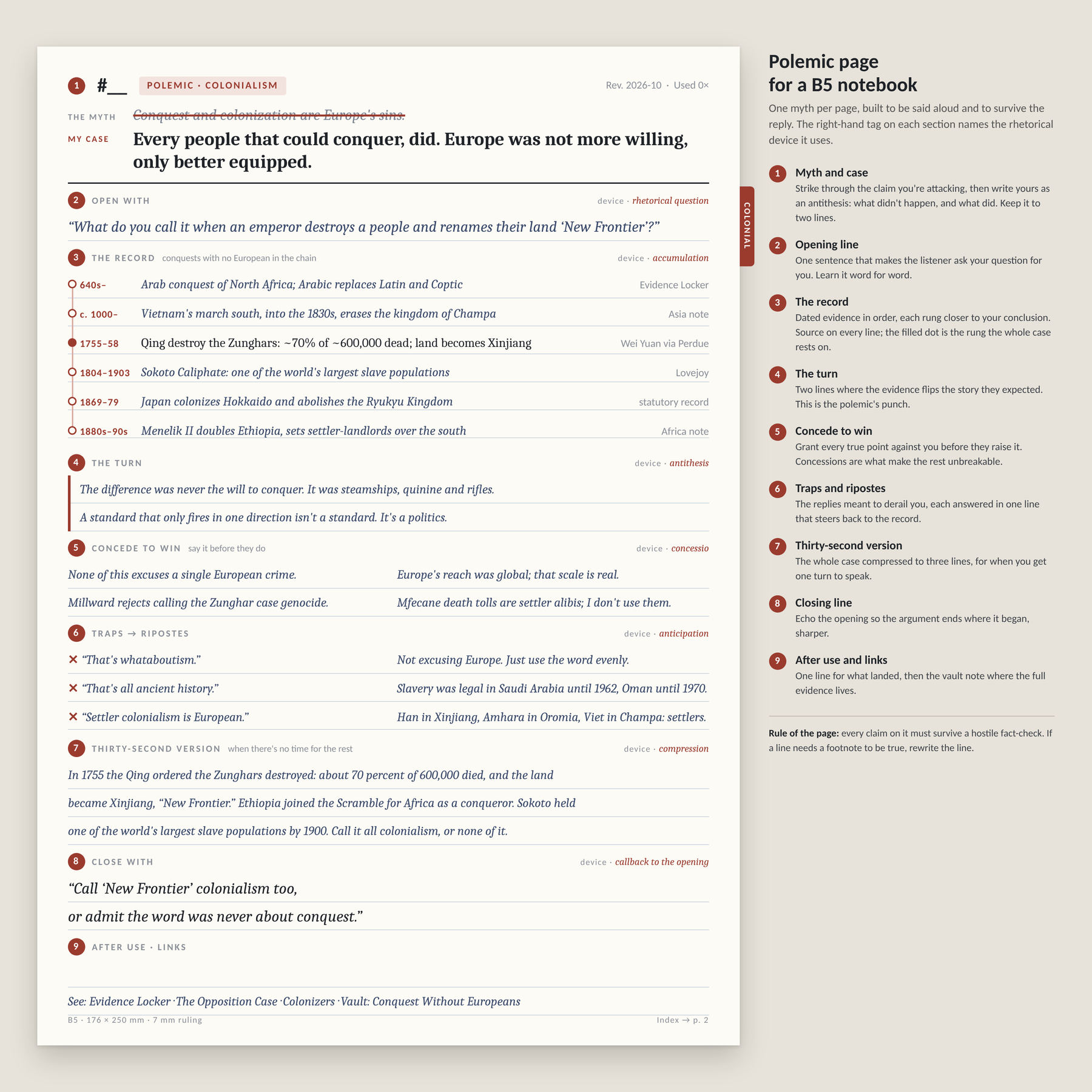
Notebook page (B5)
Polemic page against “conquest and colonization are Europe’s sins”: six non-European conquests from the 640s to the 1890s, the turn, concessions (Millward, the Mfecane), traps and ripostes, a thirty-second version and the closing line. Source: HTML (file not included in this release).
The resolution and the falsifier
Resolution: Conquest, colonization, mass enslavement, and the extermination of rival peoples were normal instruments of statecraft across Africa and Asia, practiced at scale by non-European powers against their own neighbours, before European contact and independent of it. Any framework that treats these as distinctively European is describing European capability, not European morality.
What would change my mind (written before the research, per the method in Adversarial Debate Prep - A Learning Method):
| If this were true | The thesis fails |
|---|---|
| The strongest non-European cases all turn out to be European-caused or European-armed | The “no European influence” claim collapses; only the weaker “everyone did it once contact began” survives |
| Non-European conquest were consistently small-scale, tributary, and non-displacing — extraction without settlement or population replacement | ”Colonialism” would be the wrong word for it, and the analogy fails |
| The atrocity claims rest on European colonial-era sources with an obvious motive to invent them | The evidence base is contaminated at the root |
| Serious historians of Africa and Asia deny these events | I’d be arguing against the field, not with it |
Where it partly fails, honestly: the third test bites in one important place. The Mfecane death tolls come largely from settler-era accounts and were built into a justification for white settlement — see Conquest Without Europeans - Evidence Locker > The Mfecane problem. The second test bites nowhere: Ethiopian neftenya settlement in Oromia, Vietnamese settlement of Champa, and Qing settlement of Zungharia are settler colonialism on any definition that captures Australia.
The case bank at a glance
Two gradings run through every case file. Get used to reading both.
Grading key
Evidence — ✅ solid, safe to assert · ⚠️ real event, contested magnitude or interpretation, state the caveat out loud · ❌ do not use, the figure collapses under scrutiny
European entanglement — 🟢 none · 🟡 marginal (Europeans present at the edges, not causally central) · 🔴 entangled (European markets, weapons, or politics materially shaped it)
The ten strongest cases
These are the ones to actually memorize. Each is documented, large, and clean of European causation.
| # | Case | Date | Who did it to whom | Ev. | Eur. |
|---|---|---|---|---|---|
| 1 | Qing extermination of the Zunghars | 1755–58 | Manchu Qing → Zunghar Mongols; ~70% dead of ~600,000, land resettled and renamed Xinjiang (“New Frontier”). ✅ verified vs. Perdue; ⚠️ Millward disputes the word “genocide” | ✅⚠️ | 🟢 |
| 2 | Menelik II's southern conquests | 1880s–90s | Ethiopian Empire → Oromo, Kaffa, Wolayta, Sidama; territory doubled, settler-landlord system installed | ✅ | 🟡 |
| 3 | The Mongol conquests | 1206–1300s | Mongols → China, Persia, Central Asia, Rus’; the deadliest imperial project before the 20th c. | ✅ | 🟢 |
| 4 | The Sokoto Caliphate | 1804–1903 | Fulani jihad → Hausa states; largest state in 19th-c. Africa, one of the largest slave populations on earth | ✅ | 🟢 |
| 5 | Vietnam's *Nam tiến* | ~1000–1830s | Đại Việt → Champa and Khmer; a kingdom erased, its people now a minority in their own land | ✅ | 🟢 |
| 6 | Arabization of North Africa | 640s–11th c. | Arabs → Berbers, Copts, African Christians; a completed language-and-religion replacement | ✅ | 🟢 |
| 7 | Japan's empire | 1874–1945 | Japan → Ainu, Ryukyu, Taiwan, Korea, China; a non-European empire that did all of it, while calling itself anti-colonial | ✅ | 🟡 |
| 8 | Egypt's conquest of Sudan | 1820–1885 | Muhammad Ali’s Egypt → Sudan, explicitly for slaves and gold | ✅ | 🟡 |
| 9 | Timur (Tamerlane) | 1370–1405 | Timurid → Persia, Delhi, Baghdad, Damascus; skull towers documented in his own court chronicles | ✅ | 🟢 |
| 10 | Songhai's conquests | 1464–1591 | Songhai → Mali, Mossi, Timbuktu; recorded by African chroniclers, in Africa, about Africans | ✅ | 🟢 |
The rest, by region
| Africa | Asia |
|---|---|
| Egypt’s 500-year colonization of Nubia · Kush’s conquest of Egypt (25th Dynasty) | Neo-Assyrian mass deportation as state policy |
| Aksum and the end of Meroë | The Delhi Sultanate and the Ghaznavid raids |
| The Almohads — forced conversion in the Maghreb and al-Andalus | The Qing conquest of China: Yangzhou, the queue order, the Great Clearance |
| Mali’s slave-holding empire | The Taiping, Dungan, and Panthay rebellions — tens of millions dead |
| The Fulani jihads: Massina, the Toucouleur Empire, Samori Ture | An Lushan and the Tang collapse |
| Oyo, Dahomey, and Ashanti tributary empires | Hideyoshi’s Korean invasions and the mimizuka |
| The trans-Saharan and Indian Ocean slave trades | Burmese destruction of Ayutthaya and Arakan · Siamese destruction of Vientiane |
| Zanzibar, Tippu Tip, and the Swahili-Arab raids into the Congo | The Central Asian khanates’ slave markets |
| Rwanda’s pre-colonial expansion · Buganda and Bunyoro | The Crimean Khanate’s slave raids on the Slavs |
| Merina Madagascar under Radama I and Ranavalona I | Ottoman devşirme, the sack of Constantinople, the Armenian Genocide |
| The Mahdist state in Sudan | 20th c.: Mao’s famine, the Khmer Rouge, Indonesia 1965, Bangladesh 1971 |
Full detail with sources → Conquest Without Europeans - Africa · Conquest Without Europeans - Asia
Routing table
| If the argument is about… | Go to |
|---|---|
| ”Colonialism was a European invention" | Opposition Case §1 |
| "You’re just doing tu quoque” | Opposition Case §2 — concede it, then reframe |
| Scale — “nothing matched Europe’s reach” | Opposition Case §3 |
| Race — “only Europeans racialized conquest” | Opposition Case §4 |
| Slavery — “chattel slavery was uniquely evil” | Opposition Case §5 · Africa § slave trades |
| “Those empires are ancient history; ours still structures the present” | Opposition Case §6 |
| Settler colonialism as a category | Opposition Case §7 · cross → Colonizers · Indigenous |
| Numbers, and which ones will get you killed | Conquest Without Europeans - Evidence Locker |
The compressed versions
10 seconds
Every people that could conquer, did. The Qing exterminated the Zunghars and renamed their land “New Frontier.” Ethiopia doubled its territory during the Scramble for Africa — as a conqueror. Sokoto held millions of slaves with no European involved. Europe was not more willing. It was better equipped.
30 seconds
The claim isn’t that European empire was harmless. It’s that “colonialism” describes a permanent feature of organized human power, not a European deviation from a peaceful norm. Between 1755 and 1758 the Qing emperor ordered the Zunghar Mongols exterminated; roughly four in five died, and Han and Uyghur settlers were moved onto the emptied land, which was renamed Xinjiang — “New Frontier.” In the 1890s Ethiopia doubled its territory by conquering the Oromo and Kaffa, installing northern settlers as a landlord class over the conquered south. The Sokoto Caliphate ran one of the largest slave populations on earth in 1900 without a European in the chain of command. Vietnam spent eight centuries erasing the kingdom of Champa. Apply the word “colonialism” to all of them or to none of them — but a standard that only fires in one direction isn’t a standard, it’s a politics.
Pressure questions
Ask these; don’t assert. Each one forces the opponent to either apply their framework consistently or admit it’s selective.
- The Zunghar question. In 1755 the Qianlong Emperor ordered a people destroyed; roughly 80% died, settlers were moved in, and the land was renamed “New Frontier.” Is that a genocide and a colonization? If yes — why does it appear on no decolonial syllabus? If no — what is your definition of either word?
- The Ethiopia question. Ethiopia participated in the Scramble for Africa. Not as a victim — as a conqueror, doubling its territory. Oromo historians call it Abyssinian colonialism. Are they wrong?
- The Arabic question. Arabic is not indigenous to North Africa; neither is Islam. Both arrived by conquest and displaced what was there. At what point does a conquest stop being colonialism and become “just history” — and who sets that clock?
- The Sokoto question. In 1900, before British administration, the Sokoto Caliphate held a slave population estimated in the millions. Who built that, and who ended it?
- The consistency test. Does your framework apply “settler colonialism” to Han settlement in Xinjiang, Arab settlement in Nubia and the Maghreb, Amhara settlement in Oromia, and Vietnamese settlement of Champa? If it applies to one case in your list and none of these, the concept is doing political work, not analytical work.
- The capability question. What do you think the Mongols, or Timur, or the Qing, would have done with steamships, quinine, and breech-loading rifles? If the answer is “the same thing,” then the variable you’re tracking is technology, not virtue.
Across the vault
- Colonialism: 60.14 Colonialism · Colonialism TP · Timeline of Colonialism · colonialism_empires_country_table · Non-European Colonialism (superseded by this project) · Arab Colonization
- The moral debate: The Case for Colonialism (Gilley) · Colonialism - A Moral Reckoning by Nigel Biggar · Not Stolen (Fynn-Paul) · the critique → Said, Rodney, Césaire, Tuck & Yang in the hub's book library
- Wars & death tolls: 60.13 Wars · Continents by Death Toll · Genocide percentages · African wars · Sudan, Wars & Genocide · Darfur
- Islam: Islam Caliphates, Conquering, Colonizing · Arab Slave Trade · Slavery (Islam) · Ottoman Caliphate
- Asia: Mongol Empire · Genghis Khan — Weatherford · The Silk Roads — Frankopan
- The Americas (the parallel case, already built): Native American Wars with Each Other Before Europeans Arrive · Aztec Empire · Comanche · 1000-1500CE - Mississippian Warfare · 1609-1701 - Beaver Wars (Iroquois Wars in Canada)
- Israel–Palestine (where this argument gets used): Colonizers · Indigenous · Zionists calling themselves 'colonizers'