Attachment (file not included in this release)
DESCRIPTION
A New York Times Notable Book of the Year “A remarkable book … an important book—one that challenges, stimulates and entertains. Anyone who does not believe there are lessons to be learned from history should start right here.”— The Economist Sometime around 1750, English entrepreneurs unleashed the astounding energies of steam and coal, and the world was forever changed. The emergence of factories, railroads, and gunboats propelled the West’s rise to power in the nineteenth century, and the development of computers and nuclear weapons in the twentieth century secured its global supremacy. Now, at the beginning of the twenty-first century, many worry that the emerging economic power of China and India spells the end of the West as a superpower. In order to understand this possibility, we need to look back in time. Why has the West dominated the globe for the past two hundred years, and will its power last? Describing the patterns of human history, the archaeologist and historian Ian Morris offers surprising new answers to both questions. It is not, he reveals, differences of race or culture, or even the strivings of great individuals, that explain Western dominance. It is the effects of geography on the everyday efforts of ordinary people as they deal with crises of resources, disease, migration, and climate. As geography and human ingenuity continue to interact, the world will change in astonishing ways, transforming Western rule in the process. Deeply researched and brilliantly argued, Why the West Rules—for Now spans fifty thousand years of history and offers fresh insights on nearly every page. The book brings together the latest findings across disciplines—from ancient history to neuroscience—not only to explain why the West came to rule the world but also to predict what the future will bring in the next hundred years.
Henrich, Chapter 14 — a proposed handoff from geography to institution–psychology coevolution
Henrich accepts the force of biogeographic accounts for the early rise of complex Eurasian societies and says they explain much of the world visible around 1000–1200 CE. He then argues that they do not by themselves explain why England, Scotland, and the Netherlands later overtook older centers. His proposed next layer is a feedback loop: Western Church family policies weakened intensive kinship; mobility, markets, towns, and voluntary associations altered psychology; and those minds helped sustain individual-centered law, representative institutions, science, Protestantism, and innovation-driven growth. Attachment (file not included in this release) · Attachment (file not included in this release)
This is best read beside Morris, not as a decisive replacement. Henrich’s date boundary is an interpretive partition, Figure 14.1 is a schematic rather than one estimated causal graph, and geography can continue to matter through energy, disease, transport, resources, state competition, and empire. Morris’s geography-first account can underdescribe historically variable psychology and institutions; Henrich’s psychology-first extension can underweight material constraints and global coercion. The combined question is when geography changes the opportunity set, when institutions change how people exploit it, and how each feeds back into the other. Attachment (file not included in this release) · Chapter 14 source audit
Review
🛠️ Active Reading Workflow
1. Prime (5 min)
- Thesis Prediction:
- Prior Knowledge:
- Questions to Answer:
2. Process (The “During” Loop)
Mark: T (Thesis), R (Reason), E (Evidence), D (Def), O (Objection).
- [ ] Q→A: Convert headings to questions; notes = answers.
- [ ] Feynman Check: Explain dense sections in 1-2 sentences.
- [ ] Originality: One original analogy/example per concept.
3. Review & Consolidate (Post-Session)
- [ ] Recall Dump: (Close book, list claims/terms).
- [ ] 3-2-1: 3 takeaways · 2 questions · 1 application.
- [ ] High-Yield Flashcards: (Definition, Claim → Reason, Objection).
🏛️ Analytical Deep-Dive (Adler/Paul-Elder)
| Element | Summary / Notes |
|---|---|
| Unity | The book in one sentence. |
| Problem | The central question the author is solving. |
| Propositions | Main claims in my own words. |
| Logic | Premises → Conclusion. |
| Criticism | Is the author uninformed, misinformed, or illogical? |
Counter-Argument (Steelman):
🚀 Application & Quality Gates
- The Experiment: [Define one behavior change].
- Gate 1: I can explain this in 3 mins without notes. [ ]
- Gate 2: I have at least one original counter-argument. [ ]
- Gate 3: Notes are <10% of original text length. [ ]
🖋️ Scratchpad
Unfiltered thoughts, argument trees, or “what if” scenarios.
Introduction
This introduction sets up the book’s central problem: why “the West” has exercised global dominance in the last ~200 years, and whether that dominance will persist. Morris argues that the familiar answer (“industrial revolution”) is only a partial explanation; the deeper question is why industrialization happened first in the West, and what long-run patterns made that outcome more likely. He frames the book as an attempt to reconcile two rival explanatory styles—long-term “lock-in” theories and short-term “accident/luck” theories—by establishing the overall shape of historyand then explaining it using three “tools”: biology, sociology, and geography.
Main Ideas (organized by the author’s subsections)
ALBERT IN BEIJING
- Purpose of the vignette: Morris opens with a counterfactual, almost satirical reversal of the 19th-century balance of power—Britain humbled, China dominant—to make the core question feel strange again: why did the world not turn out this way?
- Methodological move: By imagining a plausible-seeming inversion (China coercing Britain), Morris primes the reader to recognize that “Western rule” is historically contingent and therefore in need of explanation—especially because, in many earlier periods, the West was not obviously destined to dominate.
LOOTY IN BALMORAL
- Reality check vs. counterfactual: Morris snaps back to what actually happened: the “Qiying” episode is real in parts (a Chinese ship did arrive), but the power relationship was the reverse; Britain coerced China and looted the Summer Palace, bringing back a Pekinese dog, Looty, as a symbol of imperial dominance.
- Why Looty matters: Looty becomes a concrete emblem of Western imperial reach and sets a memorable anchor for the core puzzle: what forces produced a world where Looty ends up in Britain rather than Albert ending up in Beijing?
LOCKING IN
- Claim being examined: Morris defines the problem bluntly—“Why does the West rule?”—and immediately qualifies what “rule” means: not formal world government, but persistent asymmetries in military projection, cultural-linguistic dominance, and agenda-setting power.
- **Industrial revolution as proximate cause, not ultimate cause: Morris grants the standard explanation (steam, coal, factories, gunboats) but insists it only pushes the question back: ==why did the West get the “Maxim gun” first?**==
The proximate explanation isn’t enough
“Whatever happens we have got / The Maxim Gun, and they have not.” — Page 24
- **Western dominance as lived reality:** Morris illustrates “rule” through cultural and institutional diffusion—English as a default bridge language, Western media as global reference points, even modern calendrical conventions as inherited standards.
Cultural dominance as “rule”
“I am wearing your clothes, I speak your language, I watch your films, and today is whatever date it is because you say so.” — Page 24
- **Long-term lock-in theories (target of critique):**
- Morris sketches older approaches that treat Western dominance as the outcome of deep, durable structural advantages (often tied to geography, climate, disease environments, or very old cultural-political differences).
- He highlights Marx as a major “lock-in” thinker: “Oriental despotism” allegedly froze Eastern trajectories, while Europe progressed through distinct stages toward capitalism (and beyond). Morris notes the political afterlife of these ideas, suggesting they helped rationalize coercive “shock” programs by Leninists and later regimes.
- He emphasizes that accumulating historical facts (e.g., China’s maritime capability) forced long-termers to keep revising, rather than settling the dispute.
LUCKING OUT
- The “California School” as the flagship short-term challenge: Morris describes a cluster of scholars associated with UC Irvine who argue that East–West similarities dominated until surprisingly late, making “deep Western lock-in” look implausible.
- Andre Gunder Frank’s version: Frank argues Europe was a peripheral appendage to a Sinocentric world economy, gaining leverage via American silver flows into China; the West rises less through intrinsic superiority than through contingencies plus an “East” decline after ~1750.
- Goldstone’s contingency story: Goldstone treats the early modern world as balanced on a knife edge; ideological breaks (e.g., Protestant rejection of Catholic traditions) matter, and small accidents (a near-miss musket ball) could have rerouted outcomes.
- Pomeranz’s “coal + colonies” luck: Pomeranz argues industrialization was a near-fluke that averted ecological limits because Britain had convenient coal near key industries plus the broader Atlantic system; without coal, Britain would have faced impossible energy constraints.
- Morris’s stance in this section: The sheer diversity and incompatibility of both camps’ explanations suggests a framing error: the debate is stuck because each side misreads the baseline of premodern history.
THE SHAPE OF HISTORY
- Core methodological demand: Before arguing about why the West pulled ahead, we must establish what the long-run pattern actually looks like—i.e., the trajectory of development over the full sweep of human history.
- Critique of truncated time horizons:
- Many analysts focus on the last ~500 years, even though the dispute is partly about whether premodern differences were decisive.
- Others focus on deep prehistory and then leap to modernity, implicitly minimizing the “middle” millennia—an approach Morris rejects as distorting.
- Morris’s claim of comparative advantage: As an archaeologist/ancient historian, he presents himself as better positioned to connect deep history, ancient societies, and modern outcomes into one continuous explanatory story.
SLOTH, FEAR, AND GREED
- Tool 1: Biology (humans as “clever chimps”): Morris argues that treating humans as an animal species yields broad regularities:
- Groups survive by capturing energy and converting it into population and capacity.
- Humans are unusually effective tinkerers because of brains, language, and dexterity.
- While individuals differ, large populations have broadly comparable distributions of talents—making persistent group-level divergence more likely to reflect constraints and incentives than innate differences.
- Tool 2: Sociology (how change happens and what it causes):
- Innovations spread when pressures make them attractive; “progress” is often driven by ordinary motives under constraint.
- Morris adapts Heinlein into his own causal shorthand: people innovate for comfort, profit, and safety, often without grasping consequences.
Morris’s causal shorthand for change
“Change is caused by lazy, greedy, frightened people looking for easier, more profitable, and safer ways to do things. And they rarely know what they’re doing.” — Page 39
- The paradox of development: Success increases demands on resources and institutions, generating bottlenecks that can stall or reverse gains; solving problems creates new problems.
- The “five horsemen of the apocalypse”: When societies fail to clear bottlenecks, compounding disruptions—famine, epidemic, uncontrolled migration, state failure, plus additional destabilizers like climate shifts—can drive prolonged collapse and “dark ages.”
History as pattern beneath the noise
“HISTORY, n. An account, mostly false, of events, mostly unimportant, which are brought about by rulers, mostly knaves, and soldiers, mostly fools.” — Page 38
LOCATION, LOCATION, LOCATION
- Tool 3: Geography (explaining divergence, not just overall growth):
- Biology + sociology can explain why development tends to rise (and sometimes stall/collapse) across humanity, but they are constants; to explain why East and West diverge, Morris argues we need geography.
- Morris signals a deliberately provocative stance: once we recognize large groups are broadly similar, “all that is left is maps”—meaning material and spatial constraints deserve explanatory priority.
- He acknowledges historian resistance: many prefer cultural/institutional accounts and view “material law-like” explanations as reductive or ideologically suspect.
The shift from “chaps” to maps
“Once we recognize that chaps … are all much the same … all that is left is maps.” — Page 40
(Geography section continuation) Advantages of backwardness, shifting cores, and why “lock-in” fails
- Geography doesn’t permanently lock outcomes: Morris argues geographical advantages are **self-defeating** because development changes what geography “means.”
- Cores and diffusion: As development rises, “cores” expand through migration, imitation, and independent innovation; techniques (farming, states, empires, industry) spread into new contexts with varying success.
- Advantages of backwardness: Big leaps often occur where imported methods fit poorly, forcing adaptation and breakthroughs; what counted as “peripheral” can become central when technology changes constraints (e.g., Atlantic-facing Europe shifts from disadvantage to advantage once ocean-crossing becomes feasible).
- Moving centers of development: Within each core, the leading sub-region shifts over time (West: Hilly Flanks → Mesopotamia/Egypt → Mediterranean → Atlantic Europe; East: Yellow–Yangzi region → Yellow River → Wei/Qin region).
- Instability and collapse dynamics: The West’s lead fluctuates because expansions and incorporations are violent and unstable; maritime connectivity (e.g., the Mediterranean) can amplify disruption, contributing to collapse episodes that differ across regions.
- Why the West rules (intro-level answer): By the time the Atlantic becomes decisive (early modern period into the industrial age), actors best placed to exploit it (first Britain, then the U.S.) generate new empire/economic forms and unlock fossil energy—turning a lead into dominance.
THE PLAN
- Book structure:
- Part I (Chs. 1–3): Define “West,” starting points, “rule,” and introduce social development as the core metric.
- Part II (Chs. 4–10): Narrative comparison of East/West across state formation, empires, collapses, recoveries, and the industrial pivot that converts lead into rule.
- Part III (Chs. 11–12): Synthesize a law-like account: biology + sociology shape global history, geography shapes East/West differences, and the interplay (not pure lock-in or pure accident) yields the Looty-not-Albert outcome; then extend the framework to the future.
Why deep history helps forecast
“The farther backward you can look … the farther forward you are likely to see.” — Page 25
Key Concepts (chapter-specific frameworks)
- Long-term lock-in model: Explanations claiming durable, deep-rooted structural advantages (geography, disease, demography, political forms) made Western dominance effectively inevitable.
- **Short-term accident model:** Explanations claiming East–West parity persisted until late, with Western takeoff driven by contingencies (coal location, colonial systems, ideology shifts, near-miss events).
- The “shape of history” approach: Establish the long-run baseline pattern of development before arguing causation; rejects both “prehistory-only” and “modern-only” lenses.
- Three tools / three layers of explanation:
- Biology: constraints and commonalities of the species (“clever chimps”) driving long-run upward pressure on development.
- Sociology: incentives and diffusion mechanisms; change catalyzed by constraint and ordinary motives.
- Geography: explains divergence by shaping opportunity sets and by changing meaning as development rises.
- Paradox of development: development generates pressures that undermine further development, producing ceilings, stagnations, and possible collapses.
- Five horsemen of the apocalypse: famine, epidemic, uncontrolled migration, state failure (plus amplifiers like climate shifts) as a recurring package driving deep breakdowns.
- Advantages of backwardness: peripheral zones can leap ahead when new technologies/constraints flip the value of geographic position.
- Cores: regions where development rises fastest at a given stage; cores shift as constraints and key resources shift.
Key Terms (definitions for quick reference)
- The West / The East: Large, comparative civilizational clusters centered on original “cores” in western and eastern Eurasia (fully defined later, but introduced here as the book’s main comparison axis).
- Rule: Not formal global governance, but disproportionate ability to set terms (military projection, economic leverage, cultural-linguistic standards).
- Long-term lock-in (model): The view that deep historical conditions made Western dominance effectively inevitable.
- Short-term accident (model): The view that parity persisted until late and modern dominance is contingent and potentially temporary.
- California School: Label for prominent short-term/parity scholarship associated with UC campuses (esp. Irvine), emphasizing late divergence.
- Social development: Morris’s core analytic measure (defined in detail later), used to map the “shape of history” across time and regions.
- Heinlein Theorem (as used here): Progress driven by laziness seeking easier methods; Morris broadens/complicates it.
- Morris Theorem: Morris’s expanded causal rule-of-thumb tying innovation to sloth, greed, fear under pressure.
- Paradox of development: Success creates bottlenecks that threaten further success.
- Five horsemen of the apocalypse: Recurring disruption cluster that can turn stagnation into collapse.
- Advantages of backwardness: Latecomer advantage when constraints shift and older centers become less well-positioned.
- Core: Geographic zone where development advances fastest at a given stage; can migrate over time.
Critical Analysis
- Strengths
- Problem-framing is unusually clear: The opening counterfactual forces the reader to treat “Western rule” as a historical outcome requiring explanation, not a default assumption.
- Useful reconciliation attempt: Rather than choosing “deep causes” or “recent luck,” Morris proposes a structured synthesis: biology and sociology explain the global trajectory; geography explains divergence; rising development reinterprets geographic constraints.
- Mechanism for rise-and-fall, not just rise: The paradox/horsemen framework builds collapse and stagnation into the model, avoiding a simplistic “always upward” Whig story.
- Weaknesses / risks
- Reductionism pressure: The “all that is left is maps” posture risks understating how culture, institutions, and ideas can be causal (not merely epiphenomenal), even if groups are biologically similar. Morris acknowledges this pushback but leans hard into material explanation.
- Law-like language invites controversy: Claiming “laws” of history (previewed in the plan) raises the bar: readers may demand more formal specification and clearer falsifiability than narrative history typically provides.
- Forecasting temptation: Using deep patterns to speak about the future can be illuminating, but it can also encourage overconfidence—especially if the metric (social development) turns out to compress heterogeneous phenomena into a single score.
Questions for Reflection (3–5)
- If “the industrial revolution” is only a proximate cause, what kinds of deeper causes would count as satisfactory—material constraints, institutional evolution, cultural norms, or some combination?
- Does Morris’s claim that large populations are broadly similar (biologically) actually justify prioritizing geography, or could institutional/cultural path-dependencies still dominate outcomes?
- How persuasive is the paradox of development as a general engine of history? Can you identify cases where success didn’t create a destabilizing bottleneck?
- Are “accidents” (near misses, contingencies) best treated as noise around a structured pattern, or as genuinely history-making causes that resist systematization?
- If geographic advantages are “self-defeating” because development changes their meaning, what present-day “advantages” (for any country) might plausibly flip in value over the next century?
Connections
- People / thinkers mentioned: Queen Victoria, Prince Albert, Governor Qiying, Emperor Daoguang, Martin Jacques (journalist), Ambrose Bierce, Winston Churchill, Robert Heinlein, Edmund Bentley, Hilaire Belloc, Karl Marx, Lenin, Mao Zedong, Pol Pot, the Kim dynasty (North Korea), Zheng He, Christopher Columbus, David Landes, Jared Diamond, Andre Gunder Frank, Bin Wong, Kenneth Pomeranz, Wang Feng, Jack Goldstone, Alfred Crosby.
- Events / historical reference points: Opium War context (Britain coercing China), looting of the Summer Palace, Crusades, Battle of the Boyne (1690), industrial revolution, Japan’s defeat of Russia (1905) and Pacific War arc (1942–45), China’s post-1978 rise, 2008 Olympics, 2006 emissions milestone.
- Internal conceptual links to later chapters: definition/measurement of social development (Part I), detailed East/West comparative narrative (Part II), “laws” synthesis + future projection (Part III).
Chapter 1 — Before East and West (Ian Morris, Why the West Rules—for Now)
Chapter objective
This chapter’s job is to show that “East” and “West” are not timeless essences but historically produced clusters that emerge from (1) human biology and (2) geography + climate, long before “civilizations” exist in the usual sense. Morris uses early human evolution to argue that biological differences between populations were real but temporary, and that the later story of “Western rule” must be explained through how societies develop, not through permanent racial/cultural superiority claims.
What is the West?
- Morris signals that “West” is a working category, not a natural kind: it will be defined pragmatically to compare large populations over time, rather than to assert fixed cultural traits.
- He frames the problem historically: Western global dominance is recent, but explaining it requires deep time—not just modern economics or politics.
In the Beginning
- Morris starts from biology: humans are “clever chimps” whose history is constrained by how living things survive and reproduce.
- Three baseline implications:
- Humans (like all life) must extract energy from environments.
- Humans are unusually strong tinkerers/problem-solvers (big brains, speech capacity, hands).
- Individuals vary, but very large groups tend to average out and become broadly comparable in their distributions of abilities—so long-run differences need explanation in terms of conditions and development, not “better people.”
The Beginnings of East and West?
- Morris locates the earliest “East/West” split in the Old World as populations spread and adapt to different ecologies. One marker is the Movius Line (a rough boundary) separating regions where archaeologists find classic hand axes from regions where they largely do not.
- Key interpretive move: tool differences are treated as evidence of different developmental trajectories (skills, coordination, transmission), not necessarily “intelligence” in a crude sense—yet they matter because they indicate diverging adaptations over very long periods.
The First Easterners: Peking Man
- At Zhoukoudian (near modern Beijing), Homo erectus (“Peking Man”) appears as a distinct Eastern trajectory. Morris emphasizes:
- Communication and coordination likely exceeded that of great apes (e.g., evidence consistent with organized activity and survival strategies).
- Fire use seems plausible/likely in context, and butchery behavior is visible (e.g., processing animal heads for nutrient-dense parts).
- Earlier claims of widespread cannibalism are revised: some cranial marks reflect scavengers (hyenas), though at least one skull shows stone-tool marks.
- Morris’s interpretive point: even if you could “meet” them, you could not really converse or share symbolic communication as with modern humans; there is no strong evidence that representational art “made sense” to them.
The First Westerners: Neanderthals
- In Western Eurasia, Morris stresses that after ~800,000 years ago, northern ecologies and selection pressures accelerated divergence:
- The Atapuerca finds (Spain) suggest emerging forms (e.g., Homo antecessor) with more modern craniofacial features and larger brain cavities than H. erectus.
- Heidelberg Man becomes a key “bridge” form—bigger-brained than H. erectus, more adaptable to northern climates.
- Morris treats it as “incontrovertible” that by ~600,000 years ago, Eastern and Western Old World populations included different Homo species (East: small-brained H. erectus; West: larger-brained forms).
- Neanderthals, in Morris’s telling, show an unmistakably more “human” social profile than earlier Homo:
- Evidence from Shanidar supports that severely injured individuals survived for years, implying sustained care networks.
- Morris’s conclusion is explicitly moral-psychological language:
Neanderthal “humanity”
“Neanderthals … showed something we can only call ‘humanity.’” — Page 66
- Speech debate and genetics:
- Competing anatomical interpretations (hyoid bone vs. larynx position; brain shape) leave uncertainty about full language.
- FOXP2 enters as a candidate gene influencing speech/language processing (not “the language gene”), highlighted through a family with verbal dyspraxia.
- Sequencing ancient DNA complicates the “modern humans alone had FOXP2” story: Neanderthals also had FOXP2.
Baby Steps
- Morris critiques older “Great Leap Forward” models (a sudden behavioral revolution around ~50,000 years ago) as requiring two unexplained transformations—modern bodies without modern behavior, then modern behavior without bodily change—often invoking mysterious neurological rewiring.
- He uses Arthur C. Clarke’s monolith story as a foil: it captures the felt “mystery,” but archaeology increasingly makes it unnecessary.
- The empirical pivot: as more sites (especially African) were excavated, “modern-looking” behaviors appear well before 50,000 BCE—supporting a gradual accumulation model (“Baby Steps”).
- Pinnacle Point (~160,000 years ago): shellfish exploitation and bladelets suitable for projectile points (a technological contrast with Peking Man and Neanderthals as Morris presents it).
- Mumbwa Cave (~100,000 years ago): hearth arrangements suggesting structured living space and social life.
- Ostrich-eggshell beads across Africa (and nearby regions): patient fine-motor production implying symbolic/social signaling.
- Katanda (~90,000 years ago): bone harpoons and specialized fishing.
- Blombos (77,000-year-old ocher): suggests widespread ocher use and likely drawing/mark-making traditions.
- Climate mechanism (Milankovitch + long-run cooling): Morris explains why the window from ~190,000–90,000 BCE mattered—ice-age harshness created severe selection pressure and demographic fragility.
- Lake Malawi as a vivid indicator of extreme aridity; estimates that total H. sapiens population may have fallen to tens of thousands.
- The proposed dynamic: small, isolated bands allow mutations to flourish locally but also risk extinction, slowing cumulative cultural exchange until conditions improve.
- The “tipping point” synthesis: when climate improved (~70,000 years ago), populations expanded; demographic density enabled regular contact, pooling of genes and know-how; change became cumulative, and biological East/West distinctions began to collapse.
No single “Leap”
“There were no monoliths; no Great Leap Forward; just a lot of sex and babies.” — Page 74
Out of Africa—Again
- Morris argues that expansion out of Africa followed climate-driven opportunity and routes: as some African regions became wetter, North Africa dried, so movement likely went from the Horn of Africa across to Arabia and onward (Iran as an early waypoint in this reconstruction).
- The interpretive payoff for “East vs West”: once fully modern humans spread widely and interacted, regional biological divergence (earlier East/West species differences) ceased to be the main story; the later divergence becomes about social development under different geographic constraints.
Key concepts (chapter-specific)
- Movius Line as developmental divergence: a tool-distribution pattern used to frame very early East/West differences in technological traditions.
- “Baby Steps” model of behavioral modernity: modern behavior emerges in piecemeal innovations across tens of thousands of years, strongly associated (in Morris’s telling) with African sites and then amplified by demographic expansion.
The “Leap” dissolves
“The Great Leap Forward … began to dissolve into a series of Baby Steps Forward.” — Page 71
- Demography as accelerator: biological/cultural change becomes cumulative when populations reach densities that sustain frequent contact and exchange.
- Climate as constraint/trigger: Milankovitch-driven variability + long-run cooling produce harsh bottlenecks that shape survival and innovation opportunities.
- Unity of modern humans restored: modern global populations descend from dispersals out of Africa, making “race-as-deep-biological-boundary” explanations inadequate for explaining later historical divergence.
Key terms (with brief definitions)
- Homo erectus: long-lived hominin species central to Morris’s “Peking Man” Eastern trajectory.
- Peking Man: H. erectus population associated with Zhoukoudian; limited evidence for symbolic art; likely more advanced coordination than apes.
- Homo antecessor: proposed transitional/emergent species at Atapuerca (“Ancestral Man”).
- Heidelberg Man: larger-brained than H. erectus; associated with accelerated change in northern climates.
- Neanderthals: Western Eurasian hominins; evidence suggests care for injured, possible ritual burial, and complex social life.
- FOXP2: gene influencing neural processing relevant to speech/language; not a single “language gene”; found in Neanderthals too.
- Milankovitch cycles: long-term orbital/axial variations driving changes in solar radiation distribution, contributing to ice-age cycling.
- Mitochondrial DNA: maternally transmitted DNA used to reconstruct lineages without sexual recombination effects.
- African Eve: most recent shared maternal ancestor implied by mitochondrial DNA patterns; phrase used in popular shorthand.
African Eve
“one lucky mother.” — Page 78
- Y-chromosome DNA / “African Adam”: paternal-line asexual inheritance marker pointing to deep African lineages; used alongside mtDNA.
- Out-of-Africa model: modern humans originate in Africa and spread outward, with later admixture noted.
- Multiregional model: alternative hypothesis proposing parallel evolution in several regions with extensive gene flow; Morris presents it as a minority position resisting the genetic inference.
- Bladelets: small light stone points suited for projectiles; linked here to Pinnacle Point evidence.
- Ocher: pigment/iron ore with practical uses but also strongly associated with marking/drawing traditions in the chapter’s examples.
Critical analysis
- Strengths
- Synthetic explanatory style: Morris ties together archaeology, paleoanthropology, genetics, and paleoclimate into a single causal narrative, making “East vs West” a problem of conditions + development, not innate hierarchy.
- Good handling of scientific uncertainty: he repeatedly stages disputes (speech capacity; FOXP2 implications; out-of-Africa vs multiregional) rather than pretending perfect consensus.
- Strong evidentiary payoff against “sudden miracle” accounts: the accumulation of pre-50,000 BCE behavioral evidence makes the “Great Leap” less necessary as an explanation.
- Weaknesses / vulnerabilities
- Speculative reconstruction risk: several key transitions rely on inferred behaviors and routes (“must have done,” “we should probably imagine”), especially in migration narratives and demographic estimates.
- Interpretation load-bearing on ambiguous finds: e.g., pollen/flowers at Shanidar and debates about language anatomy can be read multiple ways; Morris flags uncertainty, but the narrative still benefits rhetorically from the most “humanizing” reading.
- Broad-brush East/West framing: using tool distributions (Movius Line) and a few flagship sites risks over-weighting what survives archaeologically and what has been excavated.
Questions for reflection
- If “behavioral modernity” is mostly demographic and cumulative, what does that imply about how fragile (or robust) major historical breakthroughs are?
- How should we weigh genetic evidence (mtDNA/Y-chromosome) against skeletal continuity arguments in interpreting human origins and migration?
- What parts of Morris’s story depend most on climate forcing (Milankovitch + cooling), and what parts depend more on cultural transmission once populations densify?
- Does the “Movius Line” represent genuine cognitive/organizational differences, or could it be a contingent artifact of preservation, raw materials, and research focus?
- If Neanderthals possessed FOXP2, what kinds of evidence would you require to confidently infer complex language, rather than partial vocal systems?
Connections
- Thinkers/writers referenced: Ambrose Bierce (history quip), Winston Churchill (deep past → future insight), Arthur C. Clarke (2001 monolith), Jean Auel (Clan of the Cave Bear), Rebecca Cann (mtDNA work).
- Sites/events: Zhoukoudian (Peking Man), Atapuerca (early Europeans), Shanidar Cave (Neanderthal care/burial debate), Pinnacle Point / Blombos / Katanda / Mumbwa (African “Baby Steps”), Ice Ages driven by Milankovitch cycles, Out-of-Africa dispersals.
- Earlier frame in the book: the debate between long-term lock-in vs short-term accident theories sits behind this chapter’s insistence that you need a deep-time baseline before arguing about “Western rule.”
Chapter 2: The West Takes the Lead
This chapter explains how and why “West” and “East” became historically meaningful categories after the last Ice Age. Morris argues that global warming reshaped the “energy” available to ecosystems, which then reshaped human options. Because some regions had unusually rich concentrations of domesticable plants and animals, early domestication and village life appeared there first—especially in the Western core (the Hilly Flanks). Over time, agriculture expanded outward through a mix of migration, local adoption, and adaptation, producing uneven frontiers where geography constrained and redirected development. The chapter then shows that a broadly parallel (though later and ecologically different) process occurred in the Eastern core between the Yellow and Yangzi rivers.
GLOBAL WARMING
- Morris frames the end of the Ice Age as a transformation in the planet’s “energy” regime: shifting temperatures, melting glaciers, rising seas, and changing ecologies expand (and then periodically constrict) the menu of viable human strategies.
- He introduces the chapter’s guiding metaphor—an unstable Great Chain of Energy—to connect cosmic/solar forces to plant growth, animal abundance, and finally human choices about labor, diet, and reproduction.
Great Chain of Energy
“We might do better… to imagine an anything-but-timeless Great Chain of Energy.” — Page 89
THE GARDEN OF EDEN
- Morris treats the early postglacial Near East as unusually favorable because wild grains and herd animals were dense, nearby, and exploitable—especially in the Hilly Flanks—creating conditions where repeated human interaction could push plants/animals toward domestication.
- He highlights archaeological evidence for increasingly intimate human–animal relationships (e.g., early dog domestication) as part of the shift toward settled life and managed food resources.
DAILY BREAD
- The chapter’s “bread” story emphasizes domestication as cumulative micro-change: small, repeated human choices (harvesting, replanting, storing) gradually favor traits that make plants more dependent on people (and more productive for them). This same logic is later mirrored in the East with rice and millet domestication trajectories.
- Domestication is not a single invention but a long coevolutionary process: tools, storage, settlement patterns, and social practices change alongside crops and animals.
PARADISE LOST
- Morris stresses climate volatility as a driver of structural change: even when warming improves conditions, shocks (notably the Younger Dryas) can destroy “golden age” foraging equilibria and push communities toward more intensive management of resources.
- The core claim is not “humans suddenly got smarter,” but that ecology and geography made certain pathways more likely in some places than others.
PARADISE TRANSFORMED
- As farming villages stabilize and expand, Morris emphasizes the downstream social effects: food storage, fortifications, ritual investment, and emerging hierarchies. He treats intensified ritual/ancestor practices as a major “energy sink” that also legitimizes authority.
- He explicitly connects agricultural life to patterned domination inside communities—especially age and gender subordination—as part of the new social package that becomes common once farming regimes mature.
The social package of mature agriculture
“By 3500 BCE agricultural lifestyles… involving hard work, food storage, fortifications, ancestral rites, and the subordination of women and the young…” — Page 131
GOING FORTH AND MULTIPLYING
- Morris explains agricultural expansion as an uneven process:
- Some scholars emphasize demic diffusion: people move and bring farming with them.
- Others emphasize cultural diffusion/local adoption: neighbors settle, copy, trade, and converge.
- He underscores a methodological parallel across West and East: linguistic and genetic evidence often cannot conclusively decide migration vs. adoption at the macro scale (yet), producing recurring expert disputes.
- The big historical point: once farming begins in a core, the growth dynamics (more food → more people → more pressure/innovation) tend to push outward, but geography and local constraints shape where it succeeds, stalls, or must transform.
PREDESTINATION
- Morris uses the idea of frontier “bumps” to show how development gets redirected: expansions hit limits, producing instability, conflict, and forced adaptation (often with long-term consequences for where the “most developed” zones end up).
- His broader frame rejects simple, permanent “lock-in”: geography matters, but changing social complexity changes what geography means (so advantages can become self-defeating or shift elsewhere).
THE EAST TAKES THE LEAD
- Morris shifts to the Eastern core and highlights the technical problem of evidence: rice preserves poorly, so archaeologists rely on indirect traces (e.g., husks in pottery) and especially phytoliths (microscopic silica “stones” shaped like plant cells) to reconstruct cultivation and domestication.
- Key development sequence (as presented here):
- People were gathering wild rice early (Diaotonghuan), then climate shock reduced availability, followed by renewed exploitation as weather improved.
- Signs of cultivation intensify (larger phytoliths; increasing cultivated varieties), with millet cultivation clearly present in the north by ~7000 BCE.
- Over millennia, East Asian domestication expands into full agricultural systems: rice becomes fully domesticated; water buffalo and specialized tools appear; paddies emerge; villages grow and begin defensive works.
- Social/religious complexity parallels the West but differs in expression:
- Evidence for ritual and ancestor emphasis includes flutes, turtle shells with signs, and elaborate burial practices—suggesting early symbolic systems and status differentiation.
- Later, elite burial goods (notably jade) and dedicated ceremonial centers (e.g., Niuheliang) point toward consolidating authority around ritual leadership.
Phytoliths as evidence
“The silica… leaves microscopic cell-shaped stones, called phytoliths, in the soil.” — Page 125
Key Concepts (unique to this chapter)
- Great Chain of Energy: Morris’s explanatory metaphor linking orbital/solar dynamics → plant growth → animal energy → human choices and population pressures.
- Core regions (Western/Eastern cores): geographically favored zones where domestication begins earliest and from which later expansions radiate.
- Domestication as coevolution: long, distributed change across crops/animals/techniques/social practices, not a single breakthrough.
- Expansion mechanisms debate (migration vs. adoption): recurring interpretive conflict in both West and East, limited by imperfect genetic/linguistic resolution.
- Geography without permanent lock-in: geography strongly shapes early trajectories, but rising complexity changes which geographic features matter most.
Key Terms
- Younger Dryas: abrupt cold/dry interval disrupting postglacial abundance; treated here as a major stressor pushing intensification.
- Hilly Flanks: the Western core zone in southwest Asia with dense domesticable resources; a launch point for early farming.
- Phytoliths: microscopic silica residues used to detect rice use and domestication where seeds rarely preserve.
- Rice paddies: engineered fields with banks for flooding; a marker of intensive rice agriculture.
- Ancestral rites: ceremonial investment oriented around the dead/spirits, linked to early authority formation.
- Jade: prestige material in later Eastern burials/ritual contexts, signaling inequality and elite formation.
Critical Analysis
- Strengths
- Strong integrative framework: climate + ecology + domestication dynamics + social organization are treated as a connected system (not isolated “cultural traits”).
- Methodological transparency: Morris repeatedly notes where evidence underdetermines big claims (especially migration vs. adoption), which helps prevent false certainty.
- Comparative symmetry: the East is not treated as a passive follower; it has its own core, technical challenges, and distinctive pathways (e.g., rice evidence via phytoliths).
- Weaknesses / risks
- The energy-chain metaphor is powerful but can feel totalizing: it risks implying a one-directional causal flow from physics → society, even when the chapter also claims that rising development changes what geography means. (This is a tension inside the framing.)
- Some social claims (e.g., about systematic subordination patterns) are sweeping; they may be broadly plausible but can vary widely across sites/times, and the chapter necessarily compresses complex debates.
- Heavy reliance on “core” logic can underplay multi-directional influence from peripheral zones once exchange networks begin to thicken (a point the book develops more later).
Questions for Reflection
- If domestication is a long coevolutionary process, what kinds of evidence best distinguish intentional cultivationfrom intensified foraging?
- How convincing is Morris’s “Great Chain of Energy” metaphor as an explanatory device—does it clarify causation, or does it risk oversimplifying?
- In the migration vs. adoption debate, what combination of genetic, linguistic, and archaeological evidence would be most decisive?
- Are “agricultural packages” (storage, fortifications, hierarchy, ritual investment) causally linked, or can they emerge in different orders depending on local conditions?
- Does the chapter successfully avoid “West as superior values” narratives, or do any assumptions quietly reproduce them?
Connections
- Earlier in the book (Part I framing): Chapter 2 is explicitly positioned as tracing “the formation and growth of the original Eastern and Western cores after the Ice Age.”
- Archaeological sites and regions mentioned here: Hilly Flanks; Diaotonghuan Cave; Pengtoushan; Jiahu; Hemudu; Jiangzhai; Niuheliang.
- Recurring comparative theme: both cores show long domestication timelines, expanding villages, growing ritual/ancestor investment, and later disputes over whether expansion was driven more by migrating farmers or local adoption.
Chapter 3 — Taking the Measure of the Past
Chapter Objective
- Morris “breaks the narrative” to define “social development” and explain a method for measuring whether the East or West has been more developed at different times—because the “why the West rules” question depends on relative development over long spans, not just anecdotes or isolated comparisons.
- He also sets up a methodological stance: this index is a tool for seeing patterns, meant to be criticizable and improvable rather than definitive.
Progress as increasing complexity
“the transformation of the homogeneous into the heterogeneous.” — p. 138
Archaeology Evolving
- Why “evolution” took off (and why it was vulnerable): Morris frames social evolution as a modern concept tied to Herbert Spencer (1857). Spencer’s “progress” story—simple → complex—became a sweeping explanation applied to the universe, life, and societies.
- Stage models and conceptual mess: Spencer proposed multiple levels of social differentiation (from simple bands to “great civilizations”), and later theorists multiplied competing stage labels—so much so that Max Weber mocked the terminological vanity.
- Why archaeology eventually became the stronger evidentiary base: Early evolutionists often relied on contemporary ethnography to “fill gaps” because archaeology was still thin and poorly dated. Morris sketches archaeology’s maturation:
- breakthroughs in decipherment (Egyptian hieroglyphs; Mesopotamian scripts) expanded “documented” history;
- stratigraphy gave ordered sequences;
- radiocarbon dating ended much of the “haze of conjecture,” making global prehistoric frameworks feasible.
Weber on jargon wars
“the vanity of contemporary authors… as if it were his toothbrush.” — p. 139
Anthropology Devolving
- The promise of measurement: Morris highlights mid-20th-century “neo-evolutionists” who tried to quantify social development. He uses Raoul Naroll (1955) as a key example: Naroll built an index across randomly chosen preindustrial societies using proxies like largest settlements, craft specialization, and subgroup counts, then assigned scores (with striking spread from very low to very high).
- Why it collapsed (politics + epistemology): Morris argues neo-evolutionism “imploded” because (a) many anthropologists saw quantification as naïve and detached from field realities, and (b) the 1960s politicized the issue: measuring societies looked like ranking non-Western peoples by Western standards, shading into ethnocentrism and ideological justification.
- Sahlins as emblem of the turn: Morris notes Marshall Sahlins shifting away from evolutionism amid moral/political disaffection over Vietnam (as Sahlins himself framed it), symbolizing a broader disciplinary backlash.
- Post-1960s critique hardens: Morris cites critics who claim evolutionary theories “slip” into Western self-justification and treating other cultures as foils for “our civilization,” and he evokes the era’s Manichean academic-political atmosphere.
Measurement as ideological risk
“Evolutionary theories… easily slip into ideologies of self-justification…” — p. 143
What to Measure?
- Core definition: Morris’s target variable is social development = societies’ abilities to get things done (shape physical/economic/social/intellectual environments).
- Descriptive, not celebratory: He stresses that moderns disagree whether development is “good,” given its association with environmental damage, war, inequality, and disillusionment—yet insists the phenomenon (and cross-societal differences) is real and historically consequential.
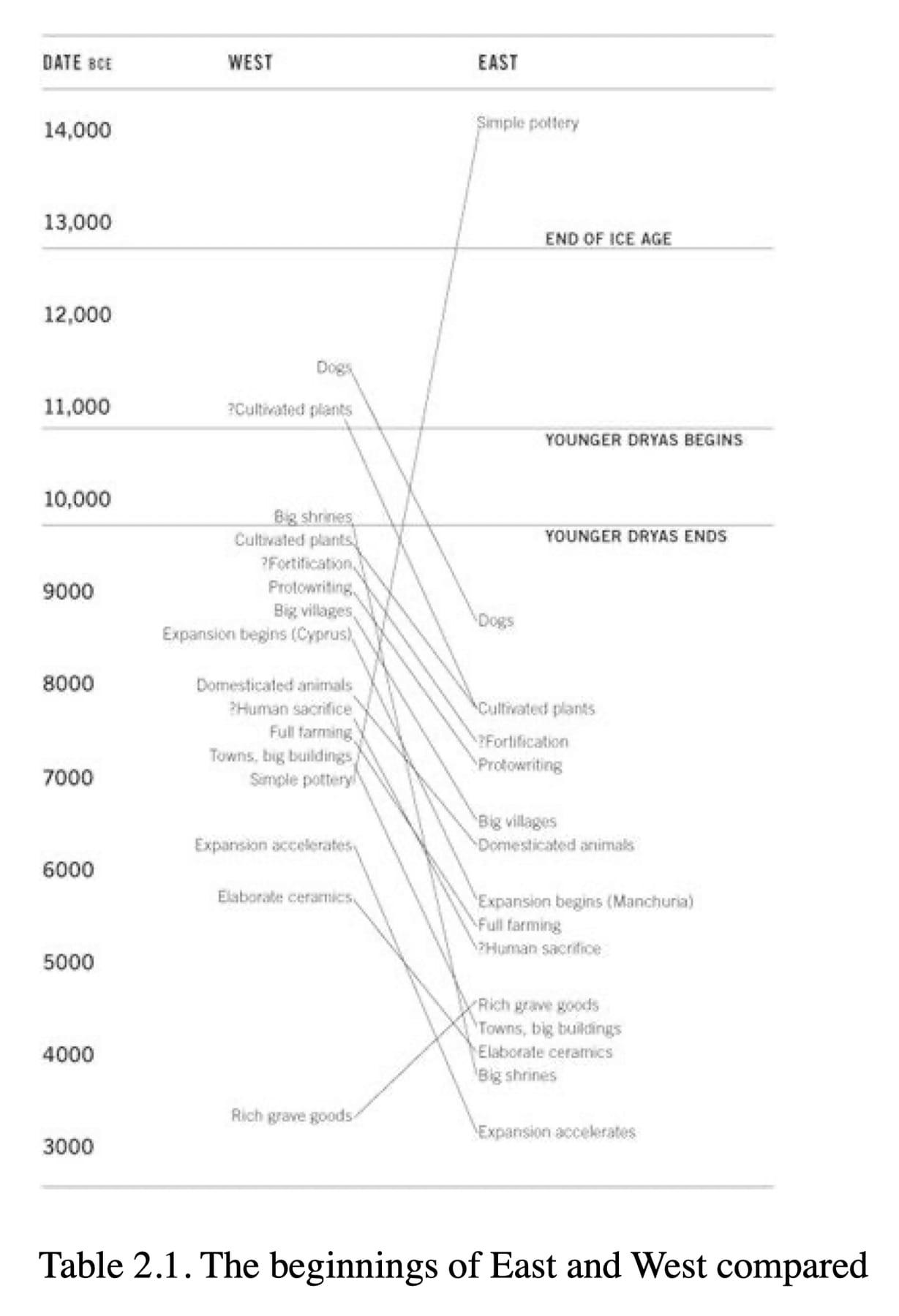
- Why this helps the East–West question: If “why the West rules” is about relative development, then a measure should let us compare Eastern/Western trajectories since the Ice Age, instead of relying on impressionistic lists like Table 2.1.
- Implied measurement strategy (as set up here): Morris is moving toward an index—explicit, comparable over time, and capable of producing a “shape of history” graph—rather than treating “lead/rule” as an unmeasurable vibe.
Social development as capacity
“societies’ abilities to get things done…” — p. 159
How to Measure?
- A frank stance on uncertainty: Morris emphasizes that historical quantification involves estimates; the key question is whether errors are large enough to overturn the fundamental pattern, and he argues they would likely need to be systematically huge to do so.
- Consistency as a partial safeguard: He suggests that if the same scorer applies the same principles across cases, errors may at least be consistent (even if not eliminated).
- Open invitation to falsify/replace: He explicitly welcomes alternative indices and treats the enterprise as Popperian: progress via challenge and replacement by better theories.
Popper’s model applied to history
“conjectures and refutations” — p. 159
The goal is a better successor
“There could be no fairer destiny for any theory…” — p. 159
When and Where to Measure?
- Frequency must match evidence + tempo of change:
- Recent history could be measured extremely finely, but for long-run shapes it’s unnecessary; century-by-century is often enough in recent millennia.
- Deep past: evidence is coarser and change slower, so Morris uses a sliding scale—e.g., every 1000 years early on, then more frequent intervals as evidence improves and change accelerates.
- Implied geographic principle (context from earlier framework): Because development’s “leading edge” shifts within cores over time (the “advantages of backwardness”), “where” you measure can’t be fixed to one spot forever.
The Pattern of the Past
- Methodological payoff promised: Morris’s explicit aim is that once social development is measured, we can see large patterns across millennia—patterns that neither “long-term lock-in” nor “short-term accident” stories capture well on their own.
- A key implication of the method: the index is intended to show when and how strongly East vs. West leads, and to clarify what needs explaining (rise, plateau, collapses, surges), before turning to causal narratives in later chapters.
Key Concepts
- Social evolution (Spencerian tradition): an explanatory framework claiming societies (and many other phenomena) move from simple to complex through differentiation.
- Neo-evolutionist measurement: mid-20th-century attempts to quantify “development” across societies using coded cross-cultural data (e.g., Naroll).
- Ethnocentrism critique of measurement: the argument that ranking societies by a single developmental yardstick often embeds Western assumptions and can legitimize Western power.
- Popperian methodology for history: treat indices/theories as testable conjectures that should invite refutation and improvement, not reverence.
- Sliding-scale temporal sampling: adjust measurement resolution to match evidentiary quality and the pace of change.
Key Terms
- Stratigraphy: dating logic based on layered deposits—upper layers formed after lower ones—used to reconstruct sequences.
- Radiocarbon dating: dating organic remains via decay of carbon isotopes; a major turning point in prehistoric chronology.
- Differentiation: increasing complexity via specialized parts/roles (central to Spencer’s account).
- Neo-evolutionism: 20th-century revival/reworking of evolutionary social theory with heavier emphasis on data and comparison.
- Human Relations Area Files (HRAF): the multi-university coded ethnographic database Naroll used for index-building.
- “Law-and-order crowd”: critics’ label for quantification-focused anthropologists using coding/statistics/computers.
- Manichean showdown: Morris’s characterization of how academic disputes became moralized, polarized battles.
Critical Analysis
- Strengths
- Methodological transparency: Morris openly acknowledges uncertainty and argues about what magnitude of error would be needed to change conclusions, which is more rigorous than pretending precision.
- Explicitly falsifiable posture: framing the index as a Popper-style conjecture encourages cumulative improvement rather than authority-by-assertion.
- Good historiographical self-awareness: he takes the political/ethical critique seriously (measurement as ethnocentric or ideological), rather than dismissing it as mere academic noise.
- Weaknesses / vulnerabilities
- Reductionism risk: compressing whole societies into a single score invites category disputes (what counts as “getting things done,” and who decides). Morris mitigates this by admitting contestability, but the conceptual hazard remains.
- Metric-choice bias: even if “development” is real, the selection of proxies can smuggle in contested values; critics can argue the index reintroduces a hierarchy under a technical veneer (the very charge raised against evolutionists).
- Data-quality asymmetries: archaeology’s improved tools (stratigraphy, radiocarbon) help, but deep-time quantification still leans on uneven evidence, which may systematically distort early periods.
Questions for Reflection
- If social development is “ability to get things done,” what kinds of “things” should count—and which should not (moral goods, coercive power, ecological transformation)?
- Can an index avoid ethnocentrism, or does any single-scale ranking inevitably import the measurer’s priorities? What would a genuinely pluralistic measurement look like?
- Is Morris right that only very large, systematic errors could change the “fundamental pattern,” or is that confidence itself vulnerable to hidden assumptions (about data, proxies, weighting)?
- How should historians balance thick description (Malinowski-style context) with the need for comparabilityacross millennia and continents?
- If progress in history-writing is Popperian, what would “refuting” Morris’s index look like in practice: new traits, new datasets, different regional boundaries, or different sampling intervals?
Connections
- Thinkers & scholars mentioned: Herbert Spencer, Charles Darwin, Max Weber, Bronislaw Malinowski, Raoul Naroll, Marshall Sahlins, Michael Shanks, Christopher Tilley, Karl Popper, Albert Einstein.
- Historical events invoked as context for disciplinary backlash: the Vietnam War, and (more broadly) 1960s-era political movements shaping anthropology’s self-understanding and its suspicion of “ranking” projects.
- Prior chapters referenced:
- Chapter 2 (including Sahlins’s “Original Affluent Society” as a key reference point in the critique of development narratives).
- The methodological problem raised at the end of Chapter 2—what it means to “lead,” how to compare cultures without tearing practices out of context—flows directly into Chapter 3’s measurement project.
Chapter 4: The East Catches Up
Chapter objective
This chapter explains how and why the first states emerged, why the Western core initially pulled ahead, and why that lead proved fragile—narrowing sharply after the Western collapse of 1200–1000 BCE. Morris uses his social development scores (Figures 4.1 and 4.2) to show the “big picture,” then argues that early state growth repeatedly triggered a paradox of social development: development generates the very disruptions that can overwhelm it.
The Elephant in the Room
- What the graphs show (5000–1000 BCE):
- Morris highlights that the early story is not a smooth Western rise. Instead, the West’s lead swings with disruptions, and the East’s later state formation allows it to close the gap over time (Figures 4.1–4.2).
- The chapter’s core causal claim:
- Early state-building raises coordination capacity (taxes, administration, force), but also raises systemic risk: as societies grow more complex and interconnected, the scale of failure can grow too. This becomes the chapter’s running lens for comparing West and East.
Lead is not destiny
“After the collapse, the West’s lead was wafer-thin; another such setback could wipe it out altogether.” — p. 223
- Early state-building raises coordination capacity (taxes, administration, force), but also raises systemic risk: as societies grow more complex and interconnected, the scale of failure can grow too. This becomes the chapter’s running lens for comparing West and East.
Hotlines to the Gods
- Problem early cities had to solve: survival and coordination under volatility (including climatic stress), when communities increasingly depended on organization to get through hard times.
- Mechanism of legitimacy-building:
- Morris describes a self-reinforcing loop: ambitious religious specialists claim special access to the gods, demand resources for temples/ceremony, and then use that visible splendor as “proof” of divine favor—converting religious authority into political authority.
- Over time, kings’ claims escalate into divine ancestry and sacral kingship, strengthening centralized institutions.
- State formation as institutional consolidation:
- Uruk becomes “not only a city but also a state,” with centralized institutions imposing taxes and binding decisions backed by force; an elite stratum forms around warriors, landowners, merchants, and bureaucrats.
The hotline claim as a political technology
“Entrusting power to men who had hotlines to the gods worked wonders.” — p. 182
- Uruk becomes “not only a city but also a state,” with centralized institutions imposing taxes and binding decisions backed by force; an elite stratum forms around warriors, landowners, merchants, and bureaucrats.
The Gods Made Flesh
- Why “gods made flesh” matters here:
- Morris treats divine kingship as a durable solution to early-state coordination problems: when existential uncertainty rises, populations often turn to leaders claiming privileged access to (or identity with) the divine.
- Anti-“ancient aliens” point (methodological lesson):
- He uses von Däniken as a foil: you don’t need spacemen to explain god-kings; you need to explain how religious specialization + material incentives + political need can generate and stabilize divine rulership claims.
- Institutional contrast that will matter later (comparative leverage):
- Morris later explicitly contrasts a fully integrated bureaucratic state “like Egypt” with looser political structures elsewhere, using Egypt as a benchmark for what high integration can look like.
No spacemen required
“We do not need spacemen to explain Mesopotamia’s godlike kings …” — p. 182
- Morris later explicitly contrasts a fully integrated bureaucratic state “like Egypt” with looser political structures elsewhere, using Egypt as a benchmark for what high integration can look like.
The Wild West
- Thesis: early Western states achieved impressive scale, but paid for it with fragility—and the West’s geography (and later, its connectivity) made disruption cascades more likely.
- Fragility principle:
- Morris states the general rule bluntly: growing complexity increases exposure to breakdown.
- How collapses happen (the “horsemen” model):
- Comparing major disruptions, Morris argues collapses become likely when climate change, famine, state failure, and migration align—and especially when disease joins them.
- Why the big Western collapses differ (2200–2000 vs 1200–1000 BCE):
- In the earlier crisis, Egypt and Mesopotamia were not tightly linked, so each could “stand or fall” more independently.
- By 1200 BCE, the Western core was far more interconnected; disasters compounded across regions (“When one kingdom fell, it affected others”), producing a larger, rolling breakdown.
Complexity breeds vulnerability
“But the price of growing complexity was growing fragility.” — p. 189
When collapse becomes likely
“When the four horsemen … ride together … disruptions can turn into collapses.” — p. 221
The Band of Brothers
- Meaning of the “band of brothers”:
- Morris’s label captures an interstate club of great powers whose rulers treat one another as peers (“brothers”), creating dense diplomacy, rivalry, and entanglement—conditions that raise both prosperity and systemic risk.
- Why it matters for collapse dynamics:
- Interconnection makes contagion possible: crises in one place compound crises elsewhere, turning regional shocks into core-wide breakdowns.
- 1200–1000 BCE as the chapter’s pivot:
- This collapse is positioned as the first major “turning point” because it slashes the West’s once-commanding lead.
Ten Thousand Guo Under Heaven
- Core claim: the early East was not a single “China” marching smoothly through dynasties; it was a landscape of many competing states (guo) whose interactions increasingly resembled the West’s multipolar world.
- Against the “simple dynastic” story:
- Morris cites Sima Qian’s neat sequence (Xia → Shang → Zhou) but stresses archaeology shows this oversimplifies: even dominant centers faced dozens of neighboring states.
- Material picture of Shang power:
- The Shang king at Anyang appears to have run a looser alliance/tribute system, not a fully integrated bureaucratic state; tribute included animals, divination materials, and even humans for sacrifice.
- Archaeology expanding the map of early East Asia:
- Discoveries like Sanxingdui (and nearby Jinsha) reveal rich, previously unknown polities; the East was full of complex centers beyond the canonical dynasties.
- Comparative punchline:
- Morris argues that as evidence grows, the processes driving social development in East and West look “more and more similar”: jostling states, partial cultural sharing, trade, war, diplomacy.
“China” was not one thing
“Sima Qian’s account oversimplified things.” — p. 212
- Morris argues that as evidence grows, the processes driving social development in East and West look “more and more similar”: jostling states, partial cultural sharing, trade, war, diplomacy.
Things Fall Apart
- Return to von Däniken as a teaching device:
- Morris uses the popularity of “economical” alien explanations to highlight what real explanation requires: tracing feedback loops between belief, organization, incentives, and crisis.
- The chapter’s culminating causal synthesis:
- Bigger cores produce bigger problems (the paradox), but also potentially bigger capacities to respond; sometimes responses fail and collapse follows.
- Modern analogy (to clarify mechanism, not equate eras):
- He analogizes cascading vulnerability in tightly coupled systems using 1929 and 2008 financial shocks.
- Final takeaway for “why the West rules”:
- After 1200–1000 BCE, the West’s lead is shown to be contingent and reversible; “no simple long-term lock-in theory” can explain permanent Western dominance.
No permanent lock-in
“No simple long-term lock-in theory can tell us why the West rules.” — p. 223
- After 1200–1000 BCE, the West’s lead is shown to be contingent and reversible; “no simple long-term lock-in theory” can explain permanent Western dominance.
Key concepts
- Social development: Morris’s composite measure used to compare East/West trajectories (invoked via Figures and periodized scores).
- Paradox of social development: the tendency for development to generate forces that undermine it, producing cycles of growth and disruption.
- Horsemen of the apocalypse: a bundled causal model for collapse risk—climate change, famine, state failure, migration, with disease as an amplifier.
- Core interconnection and cascade failure: the idea that tighter linkage causes shocks to compound across polities, turning crises into system-wide collapse.
- Divine kingship as institutional solution: sacral authority (“hotlines,” “gods made flesh”) functions as a political technology for early coordination under uncertainty.
Key terms
- Guo: (here) “states” or polities—Morris uses the phrase “ten thousand guo” to emphasize multiplicity rather than unity.
- Sima Qian: early historian whose dynastic narrative Morris treats as influential but simplifying.
- Anyang: Shang center described as receiving tribute and divination materials; used to illustrate a less integrated political form.
- Sanxingdui / Jinsha: archaeological finds that complicate a single-line dynastic story by revealing other major centers.
- Erich von Däniken: invoked as a foil to show why “economical” stories are not good explanations.
Critical analysis
- Strengths
- The chapter’s strongest move is its mechanism-driven comparison: it does not just narrate events; it repeatedly ties them to general dynamics (legitimation, interconnection, cascade failure).
- The “horsemen” framework is a clear analytic tool for separating types of disruption and explaining why some crises escalate into collapse.
- Weaknesses / risks
- Morris openly concedes that key causal questions (especially the 1200–1000 BCE collapse) may be unknowable with current evidence, which means some synthesis necessarily leans on inference.
- The modern finance analogy is illuminating, but it also risks over-smoothing differences between ancient political economies and modern global markets (useful as analogy, not proof).
- His approach foregrounds material and systemic explanation; readers who prioritize ideology/culture as prime movers may find the chapter’s emphasis underweights those variables (even when religion is discussed, it is framed as organizational/political technology).
Questions for reflection
- If development predictably increases fragility, what kinds of institutions actually convert complexity into resilience rather than collapse?
- Does Morris’s “horsemen” model imply that collapse is mostly about bundling (several bad dynamics aligning) rather than any single cause?
- How persuasive is the claim that ancient East and West had “rather similar networks of jostling states,” and what evidence would most strongly confirm or falsify it?
- If a system’s interconnection increases prosperity and collapse risk, what is the tipping point where linkage becomes net-dangerous?
- What does it mean for modern forecasting if “nothing lasts forever” is a structural feature of social development rather than a historical accident?
Connections
- Erich von Däniken (Chariots of the Gods?) — used as a foil for explanation-by-assertion.
- Arthur C. Clarke — invoked to contrast science fiction “economy” with historical explanation.
- Sima Qian — dynastic narrative vs. archaeological complexity.
- Biblical Joseph — referenced as a lens on famine/planning as part of collapse dynamics.
- 1929 and 2008 financial crises — modern analogy for cascading failure in tightly coupled systems.
Chapter 5: Neck and Neck: The Advantages of Dullness
Chapter objective
This chapter explains why both the Western core (Mediterranean/West Asia) and Eastern core (Yellow River basin/China) avoided a second systemic collapse as they climbed back to roughly the same “danger-zone” level of development that had preceded the Late Bronze Age breakdown—then surged far higher by 100 BCE. Morris frames the chapter around three linked puzzles: (1) why collapse didn’t recur around ~700 BCE in the West or ~500 BCE in the East when both neared ~24 points of social development, (2) why social development rose so dramatically by 100 BCE, and (3) why East and West looked so structurally similar by then.
Key concepts
- High-end vs. low-end state strategies
A comparative model for how states finance and organize power:- High-end: centralized rulers pay salaried bureaucrats and standing armies; funding comes from regularized taxation; the apparatus enforces extraction and administration.
- Low-end: rulers minimize fixed costs by relying on local elites/kin to raise troops from their own bases; rulers reward them largely through shares of plunder rather than a tax-funded salary system.
Morris treats the first millennium BCE as a decisive acceleration of the long drift from low-end toward high-end state formation.
- Restructuring instead of collapsing
When environmental, demographic, and geopolitical pressures intensified, both cores managed the risk by inventing new institutions that kept them “one step ahead” of disruptions generated by growth itself. - Disenchantment and Axial thought as downstream of state change
Morris links the rise of “Axial Age” classics to transformations in political economy and the decline of “godlike kings,” arguing these moral/intellectual revolutions were often consequences (and later tools) of high-end restructuring rather than initial causes. - Advantages of backwardness and the paradox of violence
Peripheral “edge empires” (notably Qin and Rome) combine borrowed organizational techniques with frontier-hardened militarism; after conquest stabilizes, the very violence that built empire can leave many survivors materially better off—Morris’s “paradox of violence.” - Geography ↔ social development feedback loop
Geography shapes development, but development also changes what geography means by shrinking distance and integrating regions into a single Eurasian system (trade routes, steppe corridors, ocean links).
Key terms
- Social development: Morris’s composite measure (energy capture, organization, war-making capacity, information technology) tracked across time to compare regions.
- Sons of Heaven: Zhou royal title/ideology of sacral kingship; persists rhetorically even as real power fragments.
- Ba (overlord): title given in the Zhou interstate system to a dominant power claiming to represent Zhou interests.
- Axial Age: Karl Jaspers’s label for centuries around 500 BCE as a pivot of moral/intellectual history.
- Ren: (Confucian) “humaneness,” treated as ethically central yet difficult to define; tied to self-cultivation and ritual order.
- Dao: (Daoist) “Way,” portrayed as ultimately ineffable; naming it falsifies it.
- Jian ai: (Mozi) “universal concern”/egalitarian sympathy; presented as a critique of Confucian family-centered ethics.
- Legalism: Chinese statecraft tradition emphasizing law, discipline, rewards/punishments, and centralized authority; exemplified by the Book of Lord Shang.
- Persuaders: itinerant Warring States diplomats-for-hire who broker coalitions and intrigue among competing courts.
- Shihuangdi: Qin ruler King Zheng’s imperial title after unification (“First Emperor”).
- Da Qin: Chinese designation for Rome (“Great Qin”), framed as a distant mirror of China’s empire.
Main sections and subsections
KINGSHIP ON THE CHEAP
- The core problem: ==growth makes old political forms brittle==
- Morris opens by arguing that avoiding collapse required institutional invention as expanding cores generated new disruptions.
- The chapter will be dominated by state “management and fighting,” because first-millennium BCE scale dwarfs earlier experiments.
- Two ways to run states
- High-end: centralization + salaries + standing army + taxes; expensive but scalable.
- Low-end: cheap rule through local elites/kin; rewards via plunder; vulnerable to elite defection and succession crises.
- Eastern low-end vulnerability (early Zhou as a case)
- Zhou conquest methods illustrate low-end limits: control via puppets/allies because rulers lack administrators to annex and govern directly.
- Low-end systems are especially exposed to sibling rivalry and elite coalition shifts during succession moments.
THE WINDS OF CHANGE
- Climate change as a pressure multiplier
- Around ~800 BCE, shifts in Earth’s axis strengthen winter winds; outcomes differ by region:
- In the Mediterranean, more winter rain can reduce heat/drought disease and support harvest reliability.
- North of the Alps, colder/damper conditions intensify respiratory disease and shorten effective growing seasons; population falls in parts of northern/western Europe while rising around the Mediterranean.
- In China, stronger Siberian winds bring cooler, drier conditions—easing flooding in some river zones but stressing northern border ecologies and peoples.
- Around ~800 BCE, shifts in Earth’s axis strengthen winter winds; outcomes differ by region:
- Population growth drives both innovation and conflict
- More mouths on fixed land raises pressure; the same pressures generate:
- innovation (more wealth potential),
- conflict (more coercion and competition),
- bigger labor/war pools (more extraction capacity).
- More mouths on fixed land raises pressure; the same pressures generate:
- Low-end kings lose control as local bosses gain leverage
- The “winners” under these conditions are often governors, landlords, and commanders—the intermediaries low-end kings rely on—so kings become structurally weaker.
- In the 770s BCE, both East and West see monarchs losing control of vassals (Egypt fragments; Assyria’s “interval”; China’s Zhou authority collapses into interstate competition).
- A vivid Western illustration: terror as governance
- Morris uses Assyrian ideology/practice to show how imperial “order” can be sustained through exemplary brutality as well as bargains with client kings.
Assyrian terror as policy
“I flayed all the chiefs who had revolted… Some I impaled… Many captives… I burned with fire.” — p. 232
- Morris uses Assyrian ideology/practice to show how imperial “order” can be sustained through exemplary brutality as well as bargains with client kings.
- A vivid Eastern illustration: the Zhou break
- The King You/Bao Si beacon story dramatizes how low-end legitimacy collapses when vassals stop responding to royal summons (even if the anecdote is folkloric, Morris treats it as preserving real dynamics).
When vassals stop coming
“King You lit the beacons… the many lords all came… there were no intruders… Bao Si laughed.” — p. 238
- The King You/Bao Si beacon story dramatizes how low-end legitimacy collapses when vassals stop responding to royal summons (even if the anecdote is folkloric, Morris treats it as preserving real dynamics).
TOWARD THE HIGH END
- The “turning point when history didn’t turn”
- 750–500 BCE looks structurally like earlier danger periods (climate shifts, migration, escalating conflict, old states cracking), yet both cores restructure instead of collapse—making the development curve “dull,” and therefore analytically revealing.
- Assyria as the early Western breakthrough
- Tiglath-Pileser III transforms a broken, low-end Assyria into a high-end empire by:
- building a standing force loyal to him,
- bypassing entrenched aristocrats,
- expanding bureaucracy and regularizing finance/taxes.
- Tiglath-Pileser III transforms a broken, low-end Assyria into a high-end empire by:
- Eastern consolidation after Zhou fragmentation
- After prolonged interstate violence, fewer states dominate; rulers move “vertical” (symbolically and literally), fortify, raise taxes, and maintain permanent armies with bureaucracies durable beyond individual reigns.
- By ~450 BCE, four big powers dominate (Jin, Qi, Chu, Qin), and social development passes ~24 points—suggesting the “one empire eventually” trajectory was delayed, not derailed.
THE CLASSICS
-
Disenchantment: ==moral authority shifts away from “godlike kings”==
- As rulers become more like chief executives than sacral mediators, “the enchantment was going out of the world,” opening space for new moral/intellectual projects.
The enchantment breaks
“Godlike kings reinvented themselves as chief executives; the enchantment was going out of the world.” — p. 248
- As rulers become more like chief executives than sacral mediators, “the enchantment was going out of the world,” opening space for new moral/intellectual projects.
-
Axial Age framing and the nature of “classics”
- Jaspers’s Axial Age concept: centuries around 500 BCE as a historical hinge; diverse traditions become “timeless masterpieces” shaping later meaning-making.
- Morris stresses mediation problems: founders often wrote little; successors recorded/rewrote traditions; modern philology shows repeated revision makes “original meaning” hard to reconstruct.
-
Shared structural themes across Axial traditions
- Ineffability: ultimate reality is beyond stable definition (nirvana, ren, the good, dao).
Dao as the unnameable
“The Way that can be spoken of is not the true Way.” — p. 250
- Ineffability: ultimate reality is beyond stable definition (nirvana, ren, the good, dao).
-
Self-fashioning and ethical discipline: transcendence pursued through practices of self-training (meditation, dialogue, study, ritual).
-
Critique of rulers: many Axial voices are indifferent or hostile to kings; some upbraid rulers directly, raising countercultural questions about status and hierarchy.
-
Internal variation: “a hundred schools contended” (China as example)
- Morris uses Chinese debates to show Axial diversity within one regional tradition.
- Confucius:
- Casts himself as restoring ancient excellence via ritual order (“transmit but do not create”), though Morris suggests he idealized and projected later ritual norms backward.
- Frames ren as cultivated humaneness through disciplined ritual and moral example; the aim is political imitation through virtue.
- Mozi:
- Rejects Confucian ritual/music priorities as morally perverse amid hunger and violence; advocates jian ai (universal concern + egalitarianism).
- (Morris continues through Daoist and Legalist contrasts; the larger point is that “the classics” are not one message but a field of competing answers about order, ethics, power, and salvation.)
-
Causality claim: Axial thought follows state restructuring (and is later domesticated by states)
- Morris argues timing, geography, and logic all undermine the view that Axial breakthroughs drove development upward; instead, Axial critiques are often reactions against high-end states, and their major developmental role comes later when empires tame and institutionalize them (e.g., Han Confucianism as official ideology; Roman use of Christianity).
EDGE EMPIRES
-
Qin and Rome as peripheral conquerors
- Morris treats Qin and Rome as parallel “backward” edge powers that borrow core techniques, refine frontier militarism, and then conquer the cores that culturally despised them.
The puzzle Polybius poses
“In less than fifty-three years… the Romans brought under their rule almost the whole inhabited world.” — p. 259
- Morris treats Qin and Rome as parallel “backward” edge powers that borrow core techniques, refine frontier militarism, and then conquer the cores that culturally despised them.
-
Qin’s high-end Legalist engine
- Relentless Warring States competition pushes institutional convergence: conscription, taxation, disciplined bureaucracy; Qin’s edge position provides manpower and security.
- Legalist severity is not mere theory; Morris cites excavated administrative records indicating ruthless enforcement.
Legalist surveillance and punishment
“Anyone who failed to report criminal activity would be chopped in two.” — p. 262
-
Coalition politics fail under mistrust; Qin escalates to mass killing as strategy (“body count”), culminating in unification and the First Emperor title.
-
Rome’s “odd mix” of high- and low-end organization
- Rome combines aristocratic senate decision-making with popular assemblies dominated by middling farmers; late movement toward paying soldiers and taxing, relying long on plunder and allied manpower deals.
- Rome’s advantage is replacement capacity—absorbing catastrophic losses at sea and in battle while rebuilding fleets and armies faster than rivals like Carthage.
Polybius on Roman brutality
“To exterminate every form of life… sparing none.” — p. 263
-
The “paradox of violence”
- Qin and Rome exemplify Morris’s claim: empires can be founded by slaughter and dispossession, yet once violence stabilizes into order and infrastructure, average welfare can rise.
FIRST CONTACT
- A new symmetry by 200 BCE
- By ~200 BCE, East and West converge structurally: each dominated by a single great empire; each has literate elites shaped by Axial traditions; each has cities, productive agriculture, and trade networks; social development ~50% higher than in 1000 BCE.
- Two principles illustrated
- Humans in large groups behave similarly: isolation still yields parallel institutional outcomes; the West retains a narrow development lead rooted in earlier geographic advantages.
- Development reshapes geography: expansion of cores “eats away” distance, folding East and West into one Eurasian story with dramatic downstream consequences.
- The corridor thickens: Alexander → Bactria → Silk/steppe links
- Alexander’s Punjab campaign marks how limited mutual awareness still was as late as 326 BCE, yet his settlements help generate hybrid zones (Bactria) that later bridge information, goods, and political interest.
- Chinese accounts later describe journeys toward “Da Qin” (Rome), suggesting the conceptual mapping of a connected Eurasia even before full diplomatic contact.
Critical engagement
Critical analysis
- Strengths
- Comparative clarity: the high-end/low-end model is a powerful simplification that makes very different regions legible within a single analytic frame.
- Multi-causal synthesis: Morris plausibly integrates climate pressure, demography, institutional incentives, and interstate competition into a single narrative of why growth did not automatically mean collapse.
- Causality discipline on “ideas”: he resists treating Axial thought as a magical driver and instead argues for timing/structure-based explanations (with the later “taming” of traditions by empires as the key developmental channel).
- Weaknesses / possible biases
- Deterministic tilt: the repeated emphasis on structural incentives (and the “lazy, greedy, frightened” engine) risks understating contingency, leadership variability, and local institutional creativity that doesn’t reduce neatly to the model.
- Anecdote-heavy evidentiary texture: the narrative leans on morally vivid stories (e.g., King You, Assyrian terror) that Morris sometimes qualifies as partly folkloric, which can blur lines between illustration and proof.
- “Paradox of violence” moral hazard: the claim that imperial bloodshed can leave “most people… better off” is provocative but invites questions about measurement (who counts as “most,” which time horizon, and compared to what plausible alternative trajectories).
Questions for reflection
- If high-end state building depends on taxation + bureaucracy + coercive enforcement, what prevents that apparatus from becoming self-serving and destabilizing rather than stabilizing?
- Morris argues Axial traditions were often reactions against high-end states and only later became tools of empire. What would count as strong evidence against that sequencing claim?
- Does the “paradox of violence” hold if you change the comparison class—from “after conquest vs during conquest” to “after conquest vs plausible non-imperial development paths”?
- In what ways does development change geography today (infrastructure, shipping lanes, digital networks) in ways analogous to the chapter’s “shrinking Eurasia”?
- If both cores converge on similar structures in isolation, what does that imply about how much “culture” explains—versus incentives created by scale, war, and administration?
Connections
- Previous chapters
- Chapter 4’s collapse framework and climate episodes; the “von Däniken spacemen” thought experiment about predicted imperial convergence.
- Thinkers and texts
- Karl Jaspers (Axial Age)
- Hesiod (moral despair in an “age of iron”)
- Confucius, Mozi, Daoist tradition (dao), Legalist Book of Lord Shang
- Sima Qian (Zhou anecdotal historiography)
- Polybius (explaining Roman world conquest)
- Winston Churchill (“jaw-jaw… war-war”)
- Henry Kissinger (as a comparative metaphor for Warring States persuaders)
- Historical events and formations
- Assyrian high-end restructuring under Tiglath-Pileser III
- Zhou collapse and the emergence of the multi-state system (ba politics; interstate expansion through “barbarian” incorporation)
- Qin unification and the rise of Shihuangdi
- Rome’s wars with Carthage and conquest of Hellenistic kingdoms
- Eurasian integration via Bactria, early Silk/steppe/ocean linkages, and the Chinese concept of Da Qin
Chapter 6: Decline and Fall
Chapter objective
This chapter explains why the Roman and Han imperial systems—after reaching remarkably similar “high-end” peaks—both unraveled, and why their breakdowns produced a new political map (“smaller worlds”) and new spiritual-intellectual responses. Morris’s larger argument is that rising social development creates both unprecedented capacities and new systemic fragilities: the very networks that lift societies up can also transmit shocks that pull them down, setting the conditions for the next era’s divergence between East and West.
ALL FOR THE BEST
- Morris opens with the “optimism” problem: from the inside, imperial peace and prosperity can look like a stable end-state—even when structural stresses are accumulating.
- He frames the chapter’s puzzle with a contrast: empires can appear to be working “as designed,” yet still be drifting toward crisis because their success depends on complex balances that are hard to sustain.
Pangloss and imperial confidence
“All is for the best in this best of all possible worlds,” — p. 274
THE NEW WORLD ORDER
- Two empires, one developmental plateau. Rome and Han China converge on similar solutions to ruling huge agrarian populations: professional administration, taxation, and standing forces—i.e., high-end state capacities.
- The “paradox of violence.” Morris underscores that extreme conquest can produce long-run material gains once warfare consolidates into stable imperial order. (The “rivers of blood” can dry into predictable governance and trade.)
- Different institutional solutions, different vulnerabilities.
- Han rulers, terrified of internal military coups, worked to neutralize the army—reducing coup risk but leaving the state more exposed to powerful landed elites and regional breakdown.
- Roman rulers leaned into army centrality—often stabilizing frontiers, but increasing the risk that generals and armies would “make” emperors and trigger repeated civil wars.
The secret of empire
“Now was revealed … the secret of empire—that emperors could be made outside Rome.” — p. 300
THE OLD WORLD EXCHANGE
- Globalization before modernity. Morris’s key mechanism here is the Old World Exchange: thickening trans-Eurasian connections (trade, migration, military movement, information flow) that integrate East and West more than ever before.
- Integration as a double-edged sword. These connections raise prosperity and cultural exchange, but they also:
- accelerate pathogen transmission,
- intensify frontier pressures (movements of peoples and armed groups),
- and make local crises more likely to cascade across regions.
- From ==connected empires to synchronized vulnerability.== Unlike earlier localized collapses, this crisis is Eurasia-wide—a system problem rather than a single-region failure.
LOSING THE MANDATE OF HEAVEN
- China’s legitimacy crisis becomes structural collapse.
- “Mandate of Heaven” language marks not just moral failure but a breakdown of state capacity: elites defect, regions militarize, peasants are squeezed, and rebellion becomes thinkable.
- Refugee movements, elite factionalism, and landlord power corrode reconstruction efforts; even where courts retain splendor, command and compliance fragment.
- The result is not merely a change of dynasty but a long phase of competitive states, shifting capitals, and partial restorations.
THE AWFUL REVOLUTION
- Gibbon’s framing as symptom and evidence. Morris uses Edward Gibbon’s “awful revolution” to emphasize how total the imperial unmaking felt—and how long its shadow lasted.
- Rome’s recurring failure mode: because emperors rely on armies, political legitimacy becomes hostage to military loyalty; civil wars become a structural feature, not an exception.
- Frontier dynamics intensify.
- Populations beyond the borders grow and reorganize; cross-border movement is not just “invasion” but a mix of raiding, trading, settling, and coalition-building.
- Over time, the frontier ceases to be a manageable edge and becomes a generator of replacement regimes.
SMALLER WORLDS
- The classical unified world breaks into halves and peripheries.
- In East Asia: the Eastern Jin holds the south while northern China splinters into immigrant kingdoms.
- In the Mediterranean: Byzantium holds the eastern empire while western Europe fragments into successor kingdoms.
- Why the old empires cannot be reassembled.
- Morris stresses that the problem is no longer a single battle or leader but the loss of the underlying imperial “glue”: administrative networks, monetized taxation, and long-distance commercial integration.
- “Low-end” successor states feel rational to elites with swords.
- New kings may tax, but without salaried bureaucracies and standing armies to fund, regularized extraction looks optional; coercion and patrimonial reward systems substitute for state depth.
- Rome’s end is anticlimactic—and telling. The western empire ends as a negotiated reality, not a heroic last stand: Odoacer’s message to Zeno signals that the integrated Mediterranean imperial form is no longer enforceable.
The end without a bang
“In 476 he wrote to Zeno … the world no longer needed two emperors.” — p. 310
PATIENCE AND PUSILLANIMITY
- Cultural-ethical adaptation to a narrowed world. As the old moral seriousness of court ideology looks absurd amid violence and insecurity, Morris describes a turn toward:
- withdrawal, pastoralism, aesthetic cultivation, and “private” virtue (including performative versions of retreat).
- New salvation options arrive and scale.
- The Old World Exchange does not only move goods and armies; it moves ideas. Buddhism becomes visible in China early, but gains transformative traction later through translation and doctrinal adaptation.
- Dharmaraksa’s role is pivotal: he renders Buddhist concepts legible in Chinese intellectual language and promotes Mahayana forms that lower the cost of salvation and broaden appeal.
- Mass movements and volatility. Apocalyptic or charismatic claims (self-identifying Buddhas, millenarian mobilizations) show how spiritual democratization can merge with banditry and rebellion.
- Institution-building: monasticism fits the new order. Monastic rules are adapted to Chinese society, providing durable communities, learning, and discipline in an age of broken state guarantees.
Buddhism simplified for mass salvation
“Mahayana Buddhism … [made] salvation less onerous.” — p. 315
Key concepts
- Old World Exchange: Morris’s term for intensified Afro-Eurasian connectivity (trade routes, migrations, military movement, idea transmission) that raises prosperity while synchronizing risk—especially via disease and cascading frontier pressures.
- Paradox of violence: extreme imperial conquest can increase long-run welfare once violence consolidates into stable order; but the structures that sustain order (armies, extraction, networks) also create new political failure modes.
- High-end vs low-end state strategies (applied here to decline): high-end empires depend on salaried bureaucracies, taxation, and managed militaries; in collapse, successor regimes often revert to low-end logics where patrimonial reward and coercive leadership substitute for deep administration.
- “Smaller worlds”: the post-collapse political ecology in which the old imperial cores split, long-distance integration thins, and regional kingdoms become the default units of power.
- Salvation as social technology: in conditions of insecurity and moral disillusionment, religious innovations (e.g., Mahayana Buddhism’s broadened accessibility) function as scalable responses to suffering, instability, and loss of meaning.
Key terms
- Mandate of Heaven: a Chinese legitimacy framework indicating Heaven’s approval; in practice here it tracks the perceived breakdown of imperial moral authority and administrative capacity.
- Byzantine Empire: the eastern continuation of Roman imperial governance centered on Constantinople, claiming the whole Roman inheritance.
- Eastern Jin: southern Chinese dynasty claiming succession to the Han imperial inheritance while northern China fragments.
- Mahayana Buddhism: a Buddhist tradition (as presented here) that expands access to salvation via Buddhas/Bodhisattvas and less onerous practices, enabling mass religious uptake.
- Bodhisattva: enlightened figure who delays nirvana to aid others’ liberation from rebirth and suffering.
Critical analysis
- Strengths
- The chapter’s most powerful move is the systems explanation: collapse is not reduced to “bad emperors” or single invasions, but tied to the interaction of institutions, networks, and frontier dynamics—especially the claim that disease/migration/war dissolved the connective tissue of imperial rule.
- Morris’s comparative method is clarifying: Rome/Han differences are not moralized; they’re treated as alternative risk profiles (army-centered vs army-neutralized governance).
- Weaknesses / risks
- The “Old World Exchange” can feel like a master-variable: it explains a great deal, but the chapter sometimes moves quickly from connection → crisis without fully unpacking which specific causal chains matter most (e.g., relative weights of disease vs fiscal strain vs military reorganization in particular regions).
- The narrative leans toward macro-structural inevitability; individual agency and contingency (key battles, administrative reforms, diplomatic choices) can read as secondary—even though the text occasionally acknowledges near-miss counterfactuals (e.g., whether recovering Carthage could have mattered).
Questions for reflection
- If imperial success depends on long-distance networks, what kinds of redundancy (political, economic, logistical) would be required to prevent networked collapse?
- Morris treats “low-end” kingdoms as rational adaptations. Under what conditions do such regimes become developmental dead ends versus stepping-stones to renewed high-end states?
- Does the Roman “army-first” solution fail primarily because of civil war incentives, or because it changes the very meaning of legitimacy (from law/tradition to force)?
- In Morris’s account, why does religious innovation scale during collapse—what social needs does it meet that states and philosophies no longer can?
- How would the argument change if we foregrounded climate variation or epidemiology more explicitly—does it strengthen the “Old World Exchange” thesis or compete with it?
Connections
- Edward Gibbon, History of the Decline and Fall of the Roman Empire (“awful revolution”).
- Tacitus on imperial legitimacy and army-made emperors.
- Eastern Jin (south China) and Byzantium (east Rome) as post-imperial high-end continuations.
- Mahayana Buddhism, Bodhisattvas, Pure Land dynamics as second-wave Axial-era mass salvation forms.
- The chapter’s recurring macro-theme: networks (trade, migration, war) as both engines of growth and conduits of crisis (“Disease, migration, and war…”).
Chapter 7: The Eastern Age
Chapter Objective
- This chapter explains how and why the “East took the lead” after ~550 CE, reversing the earlier pattern in which Western development had often matched or exceeded Eastern development. Morris’s core claim is that the same deep driver—geography—still does most of the work, but its effects shift over time as frontiers open/close, states reorganize, and shocks (war, disease, climate) hit unevenly.
- The narrative goal is twofold:
- Show why the Eastern core rises sharply (China’s reunification, southern economic dynamism harnessed by a strong state).
- Show why the Western core keeps falling through the sixth–seventh centuries (strategic overreach + plague + frontier limits + imperial exhaustion), making the crossover possible.
The underlying driver
“the same simple fact …: geography.” — p. 324
Key Concepts (entire chapter)
- Social Development (the index): A composite measure (energy capture, organization, war capacity, information) used to compare Eastern vs. Western trajectories through time.
- Core–frontier dynamics: Major leaps come when a core taps a new economic frontier (here: the Yangzi rice zone) and when state structures can convert frontier wealth into imperial scale.
- High-end vs. low-end strategies: States juggle bureaucratic control, legitimacy, coercion, and incentives; different mixes make societies more or less resilient to shocks (war, plague, climate).
- Shock asymmetry: Similar shocks (war, disease) can produce different outcomes because the structural conditions differ—especially frontier opportunities, strategic position, and institutional capacity.
- Religious-political mobilization on the periphery: Islam emerges as a powerful organizing doctrine that enables rapid coalition-building and conquest when older imperial centers are exhausted.
- Climate as pressure multiplier: Medieval-era shifts in temperature, rainfall, and wind patterns alter agricultural yields, nomad–settled relations, migration pressures, and state stability across Eurasia.
Key Terms (entire chapter)
- Eastern core / Western core: The main “central” zones of development in East Asia vs. the Mediterranean/Europe–SW Asia world.
- Grand Canal: The transport spine linking north and south China, enabling large-scale grain movement and imperial integration.
- Civil service examinations: Recruitment mechanism that helps shift governance toward educated officials (and expands education/printing economies).
- Bubonic plague (sixth century): The epidemic shock that entrenches Western contraction and strains institutions.
- An Lushan Rebellion: The mid-Tang crisis that reshapes Chinese governance, militarization, and regional autonomy.
- Sunni / Shi‘a: The major Islamic split rooted in legitimacy and succession disputes.
- Cairo Geniza: The documentary “time capsule” revealing dense medieval trade and finance networks.
- Medieval Warm Period: Climate interval tied here to shifting rainfall/pressure patterns and geopolitical stress.
- Paper money (Song): Early large-scale state-backed currency innovation linked to commercialization and state capacity.
Main Ideas by the Author’s Subsections
THE EAST TAKES THE LEAD
- Morris frames a turning point: after ~550, Eastern development overtakes Western and the gap widens for centuries, creating an “Eastern Age.”
- He insists the explanation is not “mysterious cultural superiority,” but structural advantages that shift over time—especially the opening and exploitation of a new Eastern frontier and Western vulnerability to compounded shocks.
The gap widens
“by 1100 the gap—nearly 40 percent—was bigger … than … 200.” — p. 324
WAR AND RICE
- The Yangzi south becomes the decisive frontier. Waves of migrants, elite relocation, and land clearance turn southern China into a high-yield rice heartland, generating population and taxable wealth that northern regimes had lacked.
- Political weakness in the south + military strength in the north creates a ==“two-halves” China:==
- The south is economically dynamic but politically fragmented and tax-resistant.
- Northern “barbarian” successor states develop hardened military capacity; eventually, reunification becomes feasible when the north consolidates. (Morris treats this as a structural setup for the Sui.)
- Reunification is surprisingly fast once the structural imbalance flips. When Wendi (Sui) moves against the south, the southern capital collapses quickly, converting southern wealth into an imperial-scale state.
The speed of reunification
“Jiankang … surrendered … in a day.” — p. 329
WU’S WORLD
- Unification (589) is the hinge: it imposes strong state power on the south while opening the whole realm to southern economic expansion—this is Morris’s “half” explanation for the East’s surge.
- The Grand Canal as an integration machine: massive transport infrastructure lets northern political centers tap southern grain and revenue, turning geographic diversity into imperial strength.
A supporter’s verdict
“The benefits they provide are enormous indeed!” — p. 330
- Chang’an and state capacity: the capital becomes a magnet of people, production, and administration, reflecting a jump in organizational reach.
- Meritocratic governance expands (imperfectly): civil service exams and the educational ecosystem grow; printing and tutoring flourish; cheating becomes an industry—evidence, for Morris, that information systems and bureaucratic selection are scaling.
- Wu Zetian’s rule as a test case of statecraft and legitimacy: Morris treats Wu as a uniquely capable (and controversial) ruler who shows how ideology, court politics, and coercion can stabilize a high-capacity state—while also exposing the fragility of elite acceptance and factional control.
THE LAST OF THEIR BREEDS
- Morris pivots: Eastern rise alone doesn’t explain the crossover; the West must also keep falling.
- Justinian’s attempted Western reunification faces worse geography than Wendi’s.
- Wendi can unite a consolidated north and then absorb a rich but weak south.
- Justinian faces multiple poorer but militarized “barbarian” kingdoms and a serious Persian threat; “one-campaign” reunification is structurally impossible.
- Plague as institutional corrosion: the sixth-century bubonic plague kills at terrifying rates, recurs for generations, disrupts labor, taxation, and urban life, and accelerates state breakdown.
- Policy misfire under strain: wage pegging after the plague (to protect elites) fails; land is abandoned, cities shrink, taxes fall, institutions degrade—Morris’s mechanism for a downward spiral.
Refusing flight
“purple … makes the best shroud.” — p. 336
THE WORD OF THE PROPHET
- Islam rises on the imperial margins: Muhammad’s prophetic movement turns Arabia’s tribal politics into a disciplined moral-military coalition. Morris emphasizes the fusion of religious certainty, community-building, and war-making capacity.
- Timing is everything: Byzantium and Persia are exhausted by decades of war and fiscal strain; Arab armies exploit a moment when the old centers are hollowed out.
- Rapid conquest, uneven reception: conquests advance quickly (Egypt by 639 is one benchmark Morris highlights), and local religious divisions inside the old empires shape the ease of transition.
- A new center of gravity forms: the Islamic world becomes a major organizer of the former Western core’s southern/eastern zones, reshaping trade routes, state forms, and the West/East balance.
THE CENTERS DO NOT HOLD
- Morris argues that high achievement produces its own fragility: very powerful centers can become brittle when succession, court faction, or military delegation goes wrong.
- China:
- After Tang expansion and brilliance, the system destabilizes; the An Lushan rebellion becomes a watershed that shifts power toward militarized regional commanders and makes the center less able to hold the whole.
- Later fragmentation does not erase economic dynamism; commercialization and regional growth (especially in the south) persist even when central control weakens—Morris treats this as a key asymmetry with earlier collapses.
- The Islamic world:
- A legitimacy problem (succession and authority) hardens into durable splits (Sunni/Shi‘a) and repeated civil conflict.
- The Abbasid center experiments with doctrinal authority and enforcement (Morris highlights an “inquisition”-like mechanism) and, crucially, outsources coercion to slave soldiers, which later traps the caliphate in dependence on armed clients.
- The West’s “periphery” begins reorganizing: Morris tracks the rise of northern European forces (Franks/Carolingians, then raiders) that signal long-run Western recovery, even while parts of the old Roman world remain diminished.
UNDER PRESSURE
- Climate as a system-wide stressor: Morris links medieval-era climate shifts to changing agricultural margins and political volatility—warming in some regions, drying in others, and altered wind patterns affecting rainfall.
- Steppe pressure and state vulnerability: shifting ecological conditions and incentives on the steppes amplify migration/raiding cycles, pushing on borderlands and forcing states to adapt (or fail) through institutional innovation, militarization, or territorial loss.
- Trade and finance deepen despite instability: the Cairo Geniza documents reveal dense commercial networks (contracts, correspondence, credit practices) that complicate any simple “dark age” narrative; economic sophistication can coexist with political fragmentation.
- Latin Christendom’s outward strike: Morris treats crusading as both symptom and cause of Western reorganization—mass mobilization, new elites, and a militarized religious logic—while noting the brutality and speed of conquest.
The tempo of conquest
“breached the walls … in twelve hours.” — p. 362
DARK SATANIC MILLS
- Morris flips the lens back to East Asia to show how the Eastern core not only leads but innovates in ways that look proto-modern.
- Song-era commercialization + state capacity:
- Rising urban demand and industrial production put strain on traditional fuel supplies; Morris uses vivid examples of fuel riots and price spikes to illustrate “growth pains.”
- The response includes a major energy pivot: expanded use of coal as a fuel source for high-temperature industry, which Morris frames as a decisive structural innovation.
- Industrial-scale iron output: Morris emphasizes the magnitude of Song production (iron measured in tens of thousands of tons) to argue that the ==East is not merely agrarian-successful but industrially dynamic.==
- Monetary innovation: the chapter highlights early paper money as both a response to commercialization and an indicator of administrative sophistication.
Output as an argument
“125,000 tons of iron.” — p. 365
Critical Analysis
- Strengths
- Coherent causal architecture: Morris ties together frontier economics, state capacity, war, plague, and climate into a single explanatory arc, making the East’s lead feel structurally grounded rather than culturally mystical.
- Effective use of illustrative evidence: he mixes macro indicators (development gaps) with concrete cases (Grand Canal integration; plague dynamics; Geniza trade evidence; Song coal/iron; paper money).
- Weaknesses / vulnerabilities
- Index risk: the social development metric clarifies trends, but it can also compress heterogeneous realities into a single score, encouraging readers to treat complex social changes as a single “leaderboard.”
- Geographic determinism pressure: the insistence that the “same simple fact” explains large swings may underweight contingency, ideology, and institutional creativity—especially in moments like Islamic consolidation or Song innovation.
- Speculation at the climate–plague margin: Morris reports contested explanations (temperature shifts, comets/volcanism) around plague emergence; the chapter is candid about dispute, but the mechanism remains partly inferential.
Questions for Reflection
- If geography is the deep driver, what kinds of institutional choices meaningfully “bend” geographic constraints—and which merely redistribute costs?
- In Morris’s story, the East rises by merging southern economic dynamism with northern state power. What modern analogs (if any) share this “two-engine” structure?
- Does the chapter treat Islam primarily as belief or as coordination technology—and how would your interpretation change the causal story?
- How much of the West’s sixth–seventh century decline is “plague-driven” versus “frontier-limited”? What would count as decisive evidence either way?
- Song coal/iron/paper money look proto-industrial. What, in Morris’s framework, prevents this from becoming an early industrial revolution?
Connections
- Rulers & states: Sui Wendi; Wu Zetian; Tang collapse/An Lushan; Justinian, Theodora, Belisarius; Khusrau II, Heraclius; Abbasids and al-Ma’mun; Charlemagne; crusading Europe.
- Thinkers / writers mentioned: Procopius (Secret History); Bishop John of Ephesus; Edward Gibbon; Tacitus; Bai Juyi.
- Major shocks & systems: Bubonic plague recurrence; climate shifts of the Medieval Warm Period; steppe dynamics and migration pressure; commercialization and documentary evidence via Cairo Geniza.
- Earlier book themes echoed: Old World Exchange consequences; core/periphery logic; high-end vs low-endstate strategies; the idea that long-run trajectories track structural constraints more than “great men.”
Chapter 8: Going Global
Chapter Objective
This chapter explains why globalization accelerated after 1400 and why the Western core—after centuries of lagging behind China—ended up taking the lead. Morris argues that the decisive drivers were structural (geography, disease ecology, political fragmentation, incentives created by trade routes), not simply “European genius.” He uses counterfactuals (especially around Zheng He) to show how small contingencies mattered, but only within constraints set by deeper forces.
Key Concepts
- Globalization as a social-development multiplier
- Rising social development shrinks distances and intensifies exchange; exchange then feeds back into development—sometimes positively (trade, ideas) and sometimes catastrophically (epidemics, collapse).
- Old World Exchange / Second Old World Exchange
- Large, cross-regional networks linking the cores through steppe and ocean routes; they spread goods and ideas but also spread systemic vulnerabilities (especially disease).
- “Maps, not chaps”
- A shorthand for geographic determinism with room for contingency: individual choices matter, but geography sets the menu of feasible outcomes.
- Hard ceilings and divergence
- The cores can approach similar developmental “ceilings,” yet diverge because their political and economic geography changes the payoff structure for innovation, war, and exploration.
- Counterfactual method
- Morris uses plausible “what if” scenarios (e.g., Zheng in Mexico) to illuminate which causes are necessary vs. merely incidental.
Key Terms
- Globalization: Intensifying long-distance connections in trade, war, migration, and information.
- Jurchen: Northern power that conquered Kaifeng (1127), destabilizing the Song and reshaping East Asian geopolitics.
- Mongols / Yuan / Ming: Successive regimes shaping Eurasian integration and China’s strategic priorities.
- Black Death: The mid-14th-century plague catastrophe that restructured labor, states, and military competition across Eurasia.
- Ottoman Empire: Major gunpowder power pressing into Europe; a key spur to Western military escalation.
- Treasure Fleet / Zheng He: State-sponsored Ming maritime expeditions projecting power into the Indian Ocean.
- Renaissance / Humanism: European cultural/intellectual rebirth framed as both backward-looking and innovation-producing.
- Tenochtitlán: Aztec capital used in Morris’s counterfactual to test whether China “could have” reached/colonized the Americas.
Three Big Things
- China’s scale and sophistication shocked Europeans, especially in commerce, administration, and urban provisioning; Polo’s amazement becomes a narrative device for explaining Europe’s later scramble to reach Asia directly.
Marco Polo on Chinese commerce
“the business … is on such a stupendous scale that no one … can possibly credit it.” — p. 374
- Morris frames the late-medieval world as tightly coupled enough that developments in one core increasingly reverberate in the other—setting up the chapter’s main puzzle: how the West surged when the East still looked superior.
The Race of Satan
- Morris opens with Kaifeng (1127) to dramatize how military pressure on China’s northern frontier reshaped East Asian trajectories:
- The Jurchen assault highlights early gunpowder warfare and the stakes of state failure.
- The larger point is systemic: steppe pressures and interstate war can redirect resources, weaken legitimacy, and reconfigure regional orders.
- The “race of Satan” motif (a Western label for steppe invaders) underscores that Eurasian integration was often violent:
- Mongol expansion helped create continent-spanning routes that increased exchange, but those same routes transmitted shock cascades (war, fiscal strain, demographic collapse).
- Morris’s interpretive bridge:
- Eurasia’s growing connectivity made it easier for the cores to hit similar ceilings—and easier for disasters to become Old World–wide rather than local.
A turning-point framing
“the end of the beginning.” — p. 376
- Eurasia’s growing connectivity made it easier for the cores to hit similar ceilings—and easier for disasters to become Old World–wide rather than local.
Guns, Germs, and Cast Iron
- The Second Old World Exchange (renewed high-connectivity across Eurasia) spreads wealth and knowledge, but also spreads pathogens that collapse populations and reorder institutions.
- The Black Death as a structural reset
- Morris stresses demographic devastation and social restructuring:
- Labor scarcity changes bargaining power, wages, and elite strategies.
- State capacity and military organization shift as societies scramble to extract revenue and manpower under new constraints.
- He integrates vivid contemporary testimony to emphasize scale and terror.
Ibn Khaldun on the plague’s scale
“Civilization … was visited by a destructive plague … [and] populations to vanish.” — p. 385
- Morris stresses demographic devastation and social restructuring:
- The disease’s clinical horror is used to keep the causal chain grounded in lived reality (not abstract modeling).
A chronicler on symptoms
“Swellings … in the armpit or in the groin.” — p. 386
- Gunpowder geopolitics and escalating competition
- Morris links plague-era disruption to an intensifying arms race:
- The Ottoman advance helps force Western polities to innovate, borrow, and scale up cannon warfare.
- The fall of Constantinople becomes both symbol and spur—Europeans interpret the threat as existential, pushing military and fiscal experimentation.
- He uses the famous image of Hagia Sophia to register what contemporaries felt they were losing.
Gibbon on Hagia Sophia
“the earthly heaven, the second firmament.” — p. 392
- Morris links plague-era disruption to an intensifying arms race:
Different Rivers
- Morris argues that after similar crises, East and West “step into different rivers”—their paths diverge because the incentives and constraints differ.
- Political geography
- Europe’s fragmentation (many competing states in close proximity) creates:
- Constant security pressure
- Rapid diffusion of military advances (innovate or be conquered)
- Multiple patrons and exit options for merchants, innovators, dissidents
- China’s larger-scale unity makes it easier to:
- Coordinate policy and suppress rivals
- Also, in some contexts, shut down costly projects when elite consensus turns.
- Europe’s fragmentation (many competing states in close proximity) creates:
- Economic geography
- Europeans remain relatively poorer and more peripheral to the richest Asian networks, creating strong incentives to break into Asian trade directly.
- China’s position makes the marginal benefit of high-risk oceanic exploration less compelling—especially once northern threats and internal stability dominate priorities.
- Mechanism of divergence
- Not “Europe was smarter,” but “Europe faced a different payoff structure,” where war, commerce, and state-building rewarded certain innovations more relentlessly.
Zheng in Tenochtitlán
- Morris uses a counterfactual: what if Ming fleets reached the Americas first?
- The point is not prediction; it’s diagnosis—testing whether Europe’s lead was inevitable or contingent.
- Why this didn’t happen (in Morris’s account)
- Zheng He’s voyages were state projects aimed at prestige, tribute, and Indian Ocean dominance, not open-ended exploration/colonization.
- Once the court recalculated costs vs. threats, China could terminate the program—something harder to do in Europe’s competitive state system.
- Morris explicitly rejects popular pseudo-histories that claim Chinese discovery of America as established fact.
Morris vs. “1421”
“I am on the side of skeptics … Menzies’s 1421 …” — p. 399
Great Men and Bungling Idiots
- Morris revisits the agency/structure balance:
- Individuals can redirect events at the margins (timing, targets, coalitions), but they don’t rewrite geography or disease ecology.
- The Cortés vs. Zheng contrast highlights:
- Europe’s system produced risk-taking “free agents” who could leverage violence, alliances, and disease into conquest.
- China’s system could produce extraordinary commanders, but also constrain their long-run autonomy and strategic scope.
- He invokes Machiavelli to capture how technological/military shifts changed the character of conflict.
Machiavelli on a new kind of war
“commenced without fear … concluded without loss.” — p. 401
Born Again
- Morris treats the Renaissance as real but not sufficient:
- It mattered, yet it cannot by itself explain globalization’s direction or the West’s eventual lead.
- Renaissance optimism and cultural self-consciousness
- Erasmus becomes a marker of Europeans sensing acceleration and possibility.
Erasmus anticipates a “golden age”
“I anticipate the near approach of a golden age.” — p. 404
- Erasmus becomes a marker of Europeans sensing acceleration and possibility.
- Backward-looking that generates novelty
- Recovering and emulating classical forms can paradoxically unleash innovation (new philology, new political thought, new observational habits).
- Morris pushes against “Europe-only creativity” by emphasizing that intellectual dynamism existed elsewhere too (including within Ming China).
- How this ties to globalization
- Cultural confidence, navigational/technical improvements, and institutional experimentation interact with Europe’s political competition—creating a setting where Atlantic ventures become thinkable and fundable at scale.
The Advantages of Isolation
- Morris delivers the chapter’s punchline: geography made accidental discovery and sustained Atlantic expansion easier for Europeans than for East Asians.
The chapter’s thesis in miniature
“maps, not chaps.” — p. 412
- Physical geography
- Prevailing winds, island chains, and the relative “reachability” of the Atlantic created lower barriers for westward drift and planned crossings.
- Economic and political geography
- Europe’s incentive structure (competition + hunger for Asian trade) made sustained oceanic probing rational.
- East Asia’s strategic focus and higher internal returns reduced the payoff of expensive trans-Pacific unknowns.
- Morris crystallizes this in a memorable line that also signals his stance toward “great man” explanations.
Structure over personality
“Maps left little scope for chaps to do anything except what they did do.” — p. 415
Critical Analysis
Strengths
- Integrative causation: Morris connects warfare, trade networks, disease ecology, and state competition into a single explanatory arc—avoiding one-factor monocausal stories.
- Effective counterfactuals: The Zheng scenario clarifies which variables are doing real work (geography/incentives) vs. which are contingent (who sails first).
- Grounding in contemporary voices: Using Ibn Khaldun, Machiavelli, and Gibbon gives the argument historical texture and helps prevent purely abstract determinism.
Weaknesses / Risks
- Index-driven framing can flatten diversity: Treating “East” and “West” as single cores risks underplaying regional variation and internal contradictions.
- Geography can feel over-deterministic: “Maps, not chaps” is powerful, but it can underweight ideological, institutional, and contingency-heavy pathways (especially in moments where policy choices genuinely branch).
- Counterfactual plausibility limits: The Zheng vignette is illuminating, but the farther it extrapolates (long-term institutional consequences), the more speculative it becomes.
Questions for Reflection
- If “maps” set the menu, which kinds of “chaps” matter most—innovators, financiers, conquerors, or bureaucrats deciding what to shut down?
- How much of Europe’s advantage came from competition among states versus access to Atlantic opportunities?
- If the Black Death is a structural reset, why did it intensify European expansion rather than producing a durable Eurasian equilibrium?
- What would “Chinese discovery of the Americas” actually require beyond a voyage—settlement capacity, fiscal commitment, ideological justification, or something else?
- Is Morris ultimately offering a theory of inevitability (geography) or path dependence (small early differences that compound)?
Connections
- People / thinkers
- Marco Polo on China’s scale and commerce
- Ibn Khaldun on plague and civilizational contraction
- Machiavelli on transformed warfare
- Erasmus and Renaissance expectation
- Edward Gibbon (Hagia Sophia image)
- Gavin Menzies / von Däniken as foils for evidentiary standards
- Historical events
- Kaifeng (1127) and steppe pressure on China
- Black Death as a Eurasian turning point
- Ottoman expansion / fall of Constantinople (1453) as a spur to Western arms escalation
- Zheng He’s voyages and the choice to end them
- Book-internal links
- The chapter’s repeated return to “hard ceilings,” exchange-driven growth, and collapse continues themes from earlier discussions of social development and Eurasian system effects.
Chapter 9 — The West Catches Up
Chapter Objective
This chapter explains why social development rose sharply in both East and West between 1500 and 1800, yet rose faster in the West, allowing it to overtake the East around 1773 and end the long “Eastern age.” The chapter’s core move is to treat these as one linked problem: the same global forces raised all boats, but geography, state structures, and frontier dynamics made the Western boat rise faster.
Rising tide
“A rising tide lifts all the boats.” — Page 418
Key Concepts (chapter-wide)
- Rising tide framework (shared lift, unequal buoyancy): Global changes after 1500 pushed development upward everywhere, but local conditions determined how fast societies could convert that lift into sustained gains.
- The “hard ceiling” of organic economies: Pre-industrial societies repeatedly approached a structural limit (food, fuel, transport, disease) that forced living standards down as populations rose.
- Frontiers as pressure valves and accelerants: New frontiers can raise carrying capacity and opportunity—steppe frontiers in the East (Qing consolidation) and oceanic/Atlantic frontiers in the West (colonies, trade, coercion).
- State capacity and fiscal-military competition: Persistent interstate rivalry in Western Europe rewarded innovations in credit, navies, and administration, turning war-making into a development engine.
- Intellectual divergence under different incentives: Western scientific and social theory accelerated under Atlantic-driven novelty and rivalry, while China’s post-crisis priorities favored order, classicism, and controlled innovation.
- The “iron law” problem: Classical political economy argued scarcity and population dynamics would keep most people near subsistence—yet the chapter sets up how that apparent “law” is broken.
THE RISING TIDE
- Core claim: Between 1500 and 1800, development rose in East and West, but the West rose about twice as fast; the “tide” lifted both, yet not equally.
- How it fits the book’s arc: This is the hinge chapter where the long-run alternation of Eastern/Western leads turns into a Western lead—without invoking civilizational essence.
- Interpretive stance: The chapter flags two debates—why development rose globally, and why Western gains were larger—and argues they should be answered together (same global tide, different local converters).
MICE IN A BARN
- New World crops as a global shock: Crops from the Americas (corn, potatoes, sweet potatoes, peanuts) spread widely across Eurasia, raising caloric output and enabling large population growth—especially where marginal land could be brought into production.
- Population pressure as the “barn” dynamic: With more reliable calories, populations expanded rapidly; the chapter uses the image of crowded creatures competing for limited space/resources to capture the resulting intensification of pressure on land, wages, and governance.
Crowding metaphor
“…like mice in a barn…” — Page 422
- China’s late-Ming strain: The chapter narrates how growth plus institutional rigidity and factional conflict amplified vulnerability—problems of fiscal extraction, corruption, and court politics become harder to manage in a densely populated empire.
- State capacity breakdown as multiplier: When high-level coordination fails, routine administration (appointments, courts, granaries, defense) degrades; that administrative drag turns environmental and economic stress into systemic crisis.
THE CROWN IMPERIAL
- Spain’s early lead—and its limits: Iberian oceanic expansion yields massive inflows of wealth and a first-mover imperial advantage, but the chapter stresses that how wealth is extracted and used matters: plunder and monopoly do not automatically generate durable, broad-based development.
- Fiscal overreach and imperial overstretch: Sustaining a European land empire plus global commitments requires reliable credit and administrative depth; repeated borrowing and default undermine long-run capacity (and invite challengers).
- Europe’s competitive system as selection pressure: Unlike a single consolidated empire, Western Europe’s multipolar rivalry continuously punishes inefficiency and rewards financial/organizational innovation—especially in navies and taxation.
THE HARD CEILING
- Return of the constraint: Even as states and markets expand, preindustrial growth tends to force living standards down: more mouths compete for food and fuel; disease environments worsen; ecological limits bite.
- Why the seventeenth century doesn’t “collapse” the whole system: The chapter argues that despite war, famine, and epidemics, overall development continues rising—because frontiers and state adaptations push the ceiling up a bit rather than shattering it.
- East and West converge near the ceiling: By the early 1700s, both regions pass earlier historical peaks (Roman/Song-era maxima) yet still face the same underlying organic limits.
CLOSING THE STEPPES
- The Qing solution to the steppe problem: The Manchu conquest is presented not as another “open steppe highway” disaster, but as a consolidation that ultimately stabilizes the frontier; the new regime integrates Inner Asian power into imperial structure rather than leaving the core exposed to recurrent nomadic shocks.
- Why this matters for development: A pacified steppe frontier reduces one class of catastrophic risk for the East, letting development keep rising—yet it also changes the incentive environment for military and technological acceleration.
OPENING THE OCEANS
- Atlantic frontiers as Western pressure valves: The West’s “new frontier” is the oceanic/Atlantic world—routes, colonies, plantations, and trade webs that expand resources and opportunities beyond Europe’s tight land base.
- Violence and coercion as system inputs: The chapter emphasizes that Atlantic growth is inseparable from conquest, disease-driven demographic catastrophe in the Americas, and the transatlantic slave trade—developmental gains in Europe are linked to forced labor and extraction overseas.
Cost of silver
“Every peso coin minted in Potosí has cost the life of ten Indians.” — Page 445
- Piracy/privateering and the fight for routes: Competition over oce anic highways produces long conflicts against piracy and state-backed privateering; control of trade is a strategic prize.
- Northwestern Europe’s distinctive trajectory: As Spain’s grip weakens, Dutch and English merchants expand aggressively; the chapter connects this to stronger commercial institutions, widening wage advantages in the northwest, and growth in manufacturing/market participation.
- “Advantages of backwardness”: The argument is that northwestern Europe’s comparatively weaker monarchies and stronger merchant influence created a more business-friendly environment than Spain’s extraction-heavy absolutism—enabling institutional and financial innovation.
- Consumption-work feedback loop: Expanding markets and imported goods (sugar/tea/news) encourage longer working hours and deeper commercialization; increased output feeds back into Atlantic expansion and coercive labor regimes.
LIKE CLOCKWORK
- Consumer culture as a labor-discipline engine: By mid-18th century, a North Atlantic consumer culture encourages people to work more regularly and purchase more goods; time becomes monetized and standardized.
Time discipline
”…“one-handed clocks” [no longer] sufficiently subdivide the day.” — Page 452
- Not yet a fundamental break: The chapter stresses continuity: improvements in farming, transport, and energy use resemble earlier intensifications (Roman/Song patterns), even if scaled up.
- The pressure returns: Rising development again strains against limits; real wages begin falling broadly by 1750, including in the northwest—evidence that organic constraints still dominate.
- Intellectual responses diverge: Different regions propose different “fixes” (agrarian reforms vs trade/war); the chapter sets up how these debates lead into scientific and political-economic theorizing.
TRIAL BY TELESCOPE
- Birth of “Western superiority” theories: As the West closes the gap, European thinkers begin explaining the world in ways that freeze Asia as static—invoking climate, “spirit,” and (in some cases) explicit racial hierarchy. The chapter treats these as historically situated rationalizations, not neutral diagnoses.
Climate thesis
“…in Asia a servile spirit…” — Page 458
- China’s post-Ming intellectual priorities: After dynastic trauma, Qing rulers court scholars and encourage controlled learning; scholarship turns toward encyclopedism, philology, and classical studies—highly sophisticated, but less oriented toward disruptive experimental natural philosophy.
- Jesuits and the politics of knowledge: Engagement with Jesuit science exists, but the incentives differ: where Western scholars chase new questions produced by oceanic expansion and rivalry, Chinese scholars often treat mathematics/astronomy more as classical branches than as engines of radically new theory.
- “Trial by telescope” as epistemic style: Western science is characterized by public testing, instruments, and competitive validation; the chapter links this to the broader ecosystem of plural states, print culture, and Atlantic novelty.
THE IRON LAW
- Political economy’s grim conclusion: Thinkers argue that population growth will always push wages back toward subsistence—making lasting improvement seem impossible, even if development indices rise.
The ceiling seems permanent
“…the iron laws forbade either score from rising much further.” — Page 472
- Chapter’s pivot: The chapter ends by highlighting the surprise: despite persuasive “laws” of scarcity and population pressure, something does change—setting up the next step in the book’s narrative (a break from the organic ceiling rather than another temporary push).
Critical Analysis
- Strengths
- Integrative causation: The chapter’s main strength is connecting demography, institutions, frontiers, war/finance, and ideas into one causal story rather than treating “the West” as a cultural essence.
- Institutional specificity: The contrast between Spain’s extraction-heavy empire and Dutch/English merchant-finance dynamics is concrete and mechanism-rich.
- Corrective to triumphalism: The discussion of Atlantic coercion and human cost prevents a sanitized account of “progress,” making the developmental story morally and historically thicker.
- Weaknesses / vulnerabilities
- Index-driven narrative risk: Because the argument is anchored to an index crossing point (e.g., “1773”), readers who doubt the index’s measurement choices may find the precision rhetorically stronger than the underlying uncertainty.
- Europe-centric evidentiary density: The European institutional/financial arc (credit, navies, merchant power) is often sharper than the East Asian comparators; some readers may want more symmetrical granularity on Qing-era economic dynamism and regional variation.
- Ideas vs incentives: The chapter persuasively links intellectual trajectories to political and frontier incentives, but it can sometimes underplay internal intellectual debates within China that also pushed toward empirical or mechanistic thinking.
Questions for Reflection
- If the “rising tide” is global, what specific local mechanisms most plausibly explain why some societies convert it into sustained gains while others convert it into vulnerability?
- To what extent is Western Europe’s developmental acceleration inseparable from the Atlantic’s coercive systems (conquest, slavery, extractive trade), versus driven by endogenous institutional dynamics?
- Does the chapter successfully explain China’s intellectual turn toward classical scholarship as a rational response to risk, or does it smuggle in a “missed opportunity” frame?
- Are “frontiers” primarily pressure valves (more resources/land) or accelerants(competition/innovation/violence)? Under what conditions do they become one rather than the other?
- If political economy’s “iron law” seems compelling within an organic economy, what kinds of changes (energy, institutions, knowledge) are required to falsify it?
Connections
- People / thinkers
- John F. Kennedy (rising tide metaphor)
- Qi Jiguang, Zhang Juzheng, Wanli Emperor (late-Ming governance strain)
- Habsburg rulers (Spanish imperial finances and overreach)
- Daniel Defoe (credit as the “sinews” enabling war and state power)
- Montesquieu, Hume, Kant (European theorizing about Asia and “stasis”)
- Galileo, Newton, Leibniz; Locke, Voltaire (science and its social implications)
- Kangxi; Dai Zhen; Gu Yanwu (Qing scholarship and evidential/classical orientation)
- Historical events / processes
- Columbian Exchange (New World crops reshaping Eurasian carrying capacity)
- Qing consolidation and frontier stabilization
- Atlantic expansion: silver flows, plantation economies, transatlantic slavery
- Financial revolution: national banks, public debt, bond markets (fiscal-military state)
- Anglo-French global rivalry as a “worldwide struggle” dynamic
- Links to earlier themes in the book
- The recurring pattern of cores nearing organic ceilings (Roman and Song analogies)
- The role of geography in shaping long-run options (steppes vs oceans)
Chapter 10 — The Western Age
Chapter Objective
- Morris’s goal in this chapter is to explain how (and why) the West’s lead in social development became “rule”in the 18th–20th centuries—then to show why that very triumph set up the conditions for Western dominance to peak and begin to erode.
- The chapter fits into the book’s larger argument that geography shapes social development, and that social development then reshapes geography—especially through energy capture, state capacity for war, and the cumulative, path-dependent growth of techniques and institutions. In this chapter, the decisive transition is the West’s leap beyond the old agrarian hard ceiling via fossil-fuel power and industrialization.
Key Concepts (entire chapter)
- Hard ceiling (and its annihilation): the idea that agrarian societies repeatedly pressed against ecological/organizational limits, which formerly produced stagnation or collapse; the West breaks through by turning accumulated technique + gunpowder state power + oceanic trade + fossil fuels into a new regime of growth.
- Fossil-fuel “better power” as a social-development accelerator: portable, reliable, space-neutral energy (steam → electricity/oil) changes what societies can do, and how fast.
- Industrialization → militarization multiplier: Morris repeatedly links rising energy capture to rapidly expanding military capacity, arguing that industrialization turns “lead” into global coercive reach (and therefore rule).
- Globalization as a single integrated system: “one world” means local trajectories no longer run in parallel; the industrial West forces others to react, imitate, resist, or be subordinated—often all at once.
- War as selection pressure within cores and between core/periphery: the “War of the East” and “War of the West” are not just events but mechanisms that (in Morris’s framing) choose which states/institutions scale, innovate, and survive under modern conditions.
- Convergence and the “China price”: late-20th/early-21st century catch-up is framed as the East’s rapid rise within a now-global industrial order, with benefits (cheap goods, lifted living standards) and destabilizing effects (deindustrialization pressure, geopolitical rivalry).
Key Terms (entire chapter)
- Social development: Morris’s composite measure (energy capture, organization, war capacity, information processing) used to compare East/West trajectories across time.
- Hard ceiling: the recurring upper limit for agrarian-era social development (ecological and organizational constraints) that earlier cores strained against.
- Atlantic economy: the commercial/financial system built around oceanic routes that amplifies European incentives for “semiscientific tinkering” and market expansion.
- Industrial revolution: the transition to fossil-fuel-driven production and transport that makes sustained takeoff possible.
- Portable / reliable / space-neutral power: Morris’s shorthand criteria for the kind of energy regime that breaks agrarian constraints.
- Gradgrinds / Coketown: Dickens-derived labels Morris uses for the fact-obsessed, factory-centered, socially brutal face of early industrial society.
- War of the East / War of the West: Morris’s organizing frames for major interstate conflicts shaping core dominance, first within Europe and then globally.
- Green revolution: post-1950 agricultural transformation (fertilizers, irrigation, mechanization, crop science) that massively expands global food output.
- Defense Planning Guidance (1992): a post–Cold War U.S. strategic articulation of preventing the emergence of a peer rival.
WHAT ALL THE WORLD DESIRES
- Morris opens with a symbolic “hinge moment” in late-18th-century Britain: the commercial sale of power as a commodity.
- The point is not that earlier societies lacked energy, but that the ability to buy and deploy mechanized power at scale signals a civilizational transition—power becomes something a society can mass-produce, distribute, and apply far beyond the limits of muscles, wind, and water.
-
Selling Power
“I sell here, Sir, what all the world desires to have—POWER.” — p. 473
-
- The “desire” here is double:
- Economic: more output per worker, new industries, faster growth.
- Political/military: the capacity to project force, reorganize states, and compel global outcomes.
THE JOY OF STEAM
- Morris frames steam as the answer to an old bottleneck: as land gets scarce in agrarian cores, muscle-based power gets expensive because it must be fed and supported, and its feed ultimately requires land.
- Wind and water help, but remain geographically and seasonally constrained—so the “wish list” becomes:
- Portable (bring power to the work, not work to the power),
- Reliable (not dependent on weather),
- Space-neutral (not requiring vast acreage of forests/fields).
- Coal offered massive heat energy, but the breakthrough was turning heat into motion—initially driven by the practical problem of mine flooding.
- The early engines are presented as crude but transformative:
- Coal-fired pumping to replace huge numbers of horses (and their land/food costs).
- A “tinkering” culture emerging from the Atlantic economy makes this kind of applied engineering more likely in Britain than in the East (not because of innate brilliance, but because incentives and contextsdiffer).
THE GREAT DIVERGENCE
- Morris’s core claim: the West industrialized first because conditions aligned to make annihilating the hard ceiling most likely there—especially in northwest Europe and then Britain.
- He emphasizes three large background shifts that made the 18th century different from earlier near-takeoffs:
- Cumulative technology (“same-river-twice” principle): later societies inherit more tools/skills than earlier ones, even after partial collapses.
- Gunpowder empires close the steppe highway: reducing catastrophic migration shocks and helping cores survive when pressed against limits.
- Oceanic reach and the Atlantic economy: a vast commercial engine that earlier cores never had to confront or exploit in the same way.
- Britain’s “best placed” status is described as a cluster of advantages rather than a single cause:
- comparatively higher wages, more coal, stronger finance, and (for elites) more open institutions;
- plus geopolitical outcomes: wars with Dutch and French leave Britain with more colonies, trade, warships.
- Morris also resists a simple “great man” story:
- contingency matters for which Western country leads,
- but matters less for why the West industrializes in the first place.
THE GRADGRINDS
- Morris pivots from macro-causation to the social world industrialization creates.
- Starting point: as late as 1750, East and West still share key structural similarities—advanced agrarian economies with elites confident in stable hierarchies and refined high cultures.
- By 1850, one difference overwhelms the rest: a new, steam-powered class of industrial capitalists (“iron chieftains”) transforms production and social relations.
-
The Bourgeois Shock
“has pitilessly torn asunder the motley feudal ties…” — p. 486
-
- Morris treats the moral interpretation as contested from the start:
- Smiles: industrialists as energetic improvers who turn luxuries into mass consumption.
- Dickens: industrialists as fact-worshipping brutalizers; “Coketown” as the grim social ecology of early factories.
-
Fact as a God
“Facts alone are wanted in life.” — p. 486
-
- A key mechanism Morris stresses: once mechanized labor becomes profitable enough, workers become valuable enough that elites and middle classes begin (however imperfectly) to accept reform—because replacing labor is not costless.
- Wages and profits rise together for a period; reforms emerge (workhouse debates, Dickens-driven moral pressure, child labor restrictions, early mass education).
- Comparative edge: Morris contrasts this with the Eastern core, where elite reform discourse remains more traditional and less institutionally effective (a culture of proposals and imperial non-response), making Western-style industrial reformism rare.
- He frames the West’s self-understanding in mid-century as historically unprecedented acceleration:
- a sense that time has sped up, and progress is compounding.
ONE WORLD
- “One world” marks the transition from regional stories to a genuinely integrated global system.
- Morris uses Phileas Fogg’s circumnavigation as a cultural symbol of a new infrastructure regime:
- steamships, railways, telegraphs, and global policing capacities shrink the planet psychologically and materially.
- The deeper claim: the industrial West does not merely outpace others; it forces synchronization—others must adapt to Western market tempo or be punished by it.
- The market “cannot sleep”; expansion becomes a survival requirement for industrial society.
- Morris describes this as a dissolving force:
- liberal-capitalist “acid” eats internal barriers (class/status constraints) and external ones (borders and imperial restrictions), making “ancient order” harder to preserve.
NEMESIS
- “Nemesis” reframes globalization as the revelation of a new truth:
- it’s misleading to talk as if the West is merely “ahead” within a shared game; the game itself has changed into a single connected system.
- Cores that once developed more independently are now linked, and the West’s expansion turns former independent cores into peripheries.
- Morris highlights the military-economic conversion:
- industrialization expands not only production but the ability to convert output into coercive force worldwide.
- He stresses a disproportionate growth of military capacity relative to energy capture—industrialization makes “rule” possible.
- He sets up the coming clash by noting the East’s initial refusal to treat Western power as system-changing—trying to confine Westerners to restricted enclaves.
THE WAR OF THE EAST
- Morris’s storyline: once Western domination becomes the background condition, Eastern actors face a new strategic reality:
- rapid industrialization is not only defensive (resist the West) but also intra-Eastern (dominate neighbors).
- Japan becomes the pivot:
- Morris argues Japan’s industrialization, more than British gunboats alone, becomes China’s “nemesis”—because Japan can mobilize modern force inside the Eastern core itself.
- He emphasizes that this War of the East is structurally different from earlier core wars:
- it unfolds inside a world already ruled by the West, so European powers react, interfere, and attempt to manage Asian outcomes.
- Western fear and opportunism appear side-by-side:
- “Yellow Peril” rhetoric urges European unity against Asia, even as some Westerners see Japan as a useful regional enforcer.
- The Boxer episode functions as proof of concept:
- suppressing anti-imperialist revolt requires international forces, with Japanese troops doing much of the decisive work (despite Western storytelling minimizing it).
- The Russo-Japanese War is presented as a watershed:
- Japan defeats a Western empire militarily—showing that the East, once forced to respond dynamically, can learn fast enough to overturn old assumptions.
- Morris’s comparative institutional detail (Japan vs. China):
- Japan prioritizes constitution, ministries, and mass education; expands rail and industrial infrastructure rapidly.
- China’s modernization is delayed, resisted, or sabotaged by elites afraid of destabilization (rail torn up; mass education neglected).
THE WARS OF THE WORLD
- Morris reframes 1914–1991 as a “new War of the West,” vastly larger than the earlier intra-European struggles, and one that subsumes the War of the East.
- It includes WWI, WWII, and the Cold War, framed as struggles over European dominance and then global division of power.
- Scale and stakes:
- roughly a hundred million dead and the emergence of existential risk (nuclear annihilation).
- Morris sketches the familiar ignition narrative (Balkan instability, assassinations, alliance entanglements), but uses it to emphasize a structural lesson:
- modern states mobilize whole economies for “total war”; victory depends on the capacity to harness complex industrial systems under stress.
- Political form is tested and transformed:
- dynastic empires—once the most durable war-making machines (Assyria → Persia → Qin legacy)—prove incompatible with modern war pressures and unravel rapidly (China’s Qing falls early; other imperial structures follow).
- End-state of 1991:
- the West still “rules,” but Morris underscores the widespread sense that the East is poised to overtake it—Kuropatkin’s anxieties returning in a new key.
THE AGE OF EVERYTHING
- This section treats the post-1900 energy revolution (electricity, oil, mechanization, chemicals) as a transformation of everyday life:
- “dozens of slaves” worth of energy becomes normal even for ordinary households (a moral and material re-scaling of what “comfort” means).
- Agriculture becomes a central example of both abundance and dislocation:
- tractors replace horses (and free land previously used to feed animals),
- mechanization “eats men,” uprooting rural labor and remaking communities.
-
Mechanization’s Violence
“Snub-nosed monsters…” — p. 518
- Morris stresses that the “pain” is real but the material upside is massive:
- displaced populations often find better-paid urban work after migration waves settle.
- The “green revolution” becomes the global capstone:
- quadrupling food production (1950–2000), generally falling prices, and reduced starvation except where governance collapses or brutality intervenes.
- He links energy surplus to demographic change and embodied change:
- population growth,
- increased average body size,
- sharply rising life expectancy globally (with especially large gains in parts of Asia).
THE PEOPLE’S PARADISE
- Morris narrates late-20th-century East Asian takeoff as a historically compressed catch-up:
- export-led growth, industrial clustering, infrastructure expansion, and the strategic use of global markets.
- He highlights the political drama and the fragility of legitimacy in reform regimes:
- in China, popular protest and elite division culminate in the Tiananmen crackdown; Deng frames protesters as dangerous “dregs,” fearing Western dependency and “bourgeois” political outcomes.
- The chapter’s broader logic here is comparative:
- the West pioneered industrial “rule,” but the East learns the industrial playbook and scales it rapidly once institutions and incentives align.
EAST WIND, WEST WIND
- Morris closes with the geopolitical mood after 1991:
- the U.S. stands as the victor of the Cold War, and American strategy explicitly aims to prevent the emergence of a new peer competitor.
-
Preventing a Rival
“Our first objective is to prevent the reemergence of a new rival…” — p. 530
- But the “east wind” is already visible:
- the chapter frames the post–Cold War era as the moment when Western dominance looks simultaneously maximal (unipolar) and newly threatened (rapid Eastern growth, especially China).
- The underlying tension Morris wants you to retain:
- the industrial system that made Western rule also globalized the tools of industrial growth—making convergence structurally likely, and making rivalry over the next “core” plausible.
Critical Analysis
- Strengths
- Integrative causal chain: Morris is unusually consistent about linking energy, economy, institutions, and war into one explanatory arc (steam → growth → militarization → globalization → systemic coercion).
- Comparative detail without monocausality: Britain’s rise is presented as a bundle of conditions rather than a single magic factor, and Morris explicitly distinguishes why Britain vs. France from why West vs. East.
- Attention to second-order effects: the chapter doesn’t romanticize industrialization; it foregrounds dispossession, social brutality, and the grim selection pressures of total war.
- Weaknesses / possible biases
- Index-driven compression: the social development framework clarifies big patterns, but it can flatten moral and cultural specificity—especially where coercion, imperial extraction, and contingency reshape outcomes in ways that resist clean aggregation.
- Institutional/strategic emphasis can underplay exploitation: the narrative acknowledges imperial reach, but readers may feel the causal weight sometimes leans toward “system advantages” and less toward the full historical texture of coercion, racial hierarchy, and unequal exchange.
- War as explanatory engine risks functionalism: describing wars as mechanisms that “select” effective forms can read as explaining tragedy by its outcomes, which may obscure alternative paths that were historically live but lost.
Questions for Reflection
- If industrialization “swallowed the world,” what exactly is the mechanism—markets, guns, institutions, or ideas—that does the swallowing? Which seems most decisive in Morris’s telling?
- Morris says Britain had advantages but “no lock-in” on being first. What does that imply about the balance between structure and contingency in history?
- Does the “portable/reliable/space-neutral power” framing capture the core of the industrial transition, or does it leave out something equally central (finance, property rights, state formation, science)?
- Is Morris right that industrialization turns “lead” into “rule” primarily through militarization? What alternative pathways to global dominance might challenge that view?
- If convergence is structurally likely in a global industrial system, what would it take for the West to maintain dominance without attempting to block rivals—as the 1992 guidance suggests?
Connections
- People
- Matthew Boulton, James Boswell, Watt / early engine-makers (industrial “power” as commodity)
- Marx & Engels, Dickens, Samuel Smiles (contending moral readings of industrial society)
- Kaiser Wilhelm II, Tsar Nicholas II (“Yellow Peril” framing of Asian rise)
- Puyi, Yuan Shikai (dynastic collapse and post-imperial fragmentation)
- Gorbachev, Deng Xiaoping (late Cold War collapse vs. repression-led continuity)
- Events
- Boxer Rebellion and international suppression; Japan’s rising military role
- Russo-Japanese War (Japan defeats a Western empire)
- World War I, World War II, Cold War (1914–1991) as the “new War of the West”
- Tiananmen (1989) and Soviet dissolution (1991) as contrasting regime responses
- Previous chapter links (explicitly invoked here)
- The Atlantic economy and its reward for “semiscientific tinkering,” setting up Britain’s pathway into steam power
- The book’s recurring “hard ceiling” logic and the claim that the 18th-century West was positioned to “annihilate” it
Chapter 11 — Why the West Rules … for Now (Ian Morris)
Chapter Objective
This chapter explains why Western global dominance emerged in the last two centuries and argues that the most powerful explanation is geography working through long-run social development, not racial biology, unique “Western culture,” or heroic individuals. Morris also uses counterfactual (“what-if”) reasoning to claim Western rule was probable rather than inevitable, and closes by defending the possibility of large-scale historical patterns that can even support cautious forecasting.
WHY THE WEST RULES … WHY THE WEST RULES
Biology sets the engine, but cannot explain “West vs. East”
- Biology explains the upward push of social development: humans (like all organisms) must capture energy; when energy capture rises, populations and complexity expand.
- Morris rejects older “Western racial superiority” arguments:
- There is one human species with trivial genetic differences among populations.
- If biology made “Westerners” inherently superior, the West would have stayed ahead continuously; instead, the East leads for long stretches (especially after ~550 CE).
Biology isn’t destiny
“The genetic differences between modern humans in different parts of the world are trivial.” — Page 536
Sociology explains the “shape of history”: the paradox of development + ceilings
- Morris’s “Morris Theorem”: historical change comes from “lazy, greedy, frightened people” seeking easier/safer/more profitable ways—often without understanding consequences.
- But major leaps (farming, cities, empires, industrialization) occur when societies hit crisis ceilings and must transform, not merely tinker.
- Central mechanism: the paradox of development—rising development generates new problems that threaten and can undermine it.
- When societies fail to break ceilings, the “five horsemen” (famine, disease, migration, state collapse, plus climate as an intensifier) can drive development down into dark ages.
- Two key ceilings:
- Around 24 points: an earlier ceiling linked to Bronze Age collapse dynamics in the West.
- Around 43 points (the hard ceiling): a structural limit of agricultural empires; breaking it requires fossil fuels.
The paradox of development
“Rising social development creates the very forces that undermine it.” — Page 538
Geography explains the “difference”: why the West, here, now
- Biology + sociology explain why development rises/falls, but geography explains why leadership shifts between regions.
- Geography’s meaning changes with development (e.g., coalfields matter little until the right technological/economic context makes them decisive).
- Morris recaps the book’s larger arc (Chs. 2–10) to set up the geographical story:
- Lucky Latitudes and the Hilly Flanks gave the West an early agricultural start; China had abundant domesticables too, but less concentrated.
- “Advantages of backwardness”: peripheral/frontier zones sometimes out-innovate cores because they must adapt harder (e.g., irrigation in Mesopotamia; later European Atlantic experimentation).
- The Mediterranean is a key Western geographic asset (cheap transport) but also a vulnerability; open frontiers amplify disruptions and collapse.
- East/West fortunes reverse after late antiquity:
- China’s post-Han retreat south + rice boom + Grand Canal yields a powerful integrated system; the West fragments longer after Mediterranean core disruption.
- Europe’s later rise draws on learned technologies (shipping, gunnery) and the Atlantic as a new “highway,” reshaping geography’s payoff structure.
Geography’s shifting meaning
“Living on top of a coalfield meant very little two thousand years ago, but two hundred years ago it began meaning a lot.” — Page 539
NOT WHY THE WEST RULES
Individuals matter—just usually not at the scale people imagine
- Morris grants free will and acknowledges mass choices can change history (e.g., twentieth-century fertility shifts), but emphasizes choices are strongly shaped by circumstances.
- He uses Muhammad as an extreme “great man” case:
- Muhammad’s choices mattered, yet the broader transformation depended on prior regional trends and the vulnerability of Byzantium/Persia; many macro outcomes likely persist even if details differ.
- Great individuals often speed up or slow down processes rather than redirecting history onto wholly new tracks.
Constraints on choice (Marx)
“Men [and women] make their own history… but they do not make it under circumstances chosen by themselves.” — Page 543
Inventions and “great ideas” often come in multiples
- Morris argues the recurrence of “multiple discovery” suggests innovations are frequently systemic outcomes of shared questions/methods, not singular genius.
- This undercuts “hero-only” explanations (e.g., Watt/Boulton mattered, but rivals and conditions made similar advances likely).
Culture as “town hall,” not destiny
- Morris rejects the idea that “Chinese inwardness” vs. “European outwardness” alone explains divergence; instead, cultures contain debate—constraints select which arguments win.
- He proposes that broad similarities in Eastern/Western intellectual history track similar developmental problems:
- divine kingship debates → first-wave Axial thought → second-wave Axial thought → renaissances, each corresponding to state formation, bureaucratization, collapse, and revival.
- The “scientific turn” in Europe around 1600 is framed as problem-driven (Atlantic economy created new puzzles where mechanical/scientific models paid off).
- He uses shifting sociological interpretations of Confucianism (first blamed for failure, later praised for success) to argue cultures are repeatedly reinterpreted to fit developmental needs.
- The Flynn Effect (rising IQ scores) is presented as evidence we may be getting better at the test’s modern analytical skills rather than becoming inherently smarter.
- Islam example: current deficits (few democracies/Nobels/diversified economies) are treated as historically contingent—given earlier Islamic scientific leadership—suggesting modern “inwardness” after defeat matters more than doctrine-as-essence.
BACK TO THE FUTURE
Western rule as probability, not lock-in or accident
- Morris argues Western dominance by 2000 was increasingly likely as you move forward in time, because key structural preconditions accumulate.
- Counterfactual “time-machine” method: jump into the past and ask what could plausibly prevent the observed future.
- 1800: industrialization under way; Western rule not certain but “very hard” to prevent; he suggests ~95%probable.
- 1650: Atlantic economy + institutional preconditions; different European winners could shift where/when industrialization happens, but hard to prevent it; he suggests ~80% likely.
- 1500: outcomes much more open (Habsburg consolidation, Ottoman success, steppe dynamics); Western rule closer to fifty-fifty.
- 1350: Black Death era; even more contingency (e.g., Tamerlane’s path); Western rule perhaps ~25% likely.
- To get a plausible path to Eastern rule by 2000, he claims you must go back to around 1100 (Song China avoiding Jurchen/Mongol devastation, etc.), yet even then geography makes it a long shot.
- Rome breaking the hard ceiling (industrializing in antiquity) is judged essentially implausible.
Western rule as “probable”
“Western rule… was neither locked-in nor accidental. It would make more sense to call it probable…” — Page 549
NIGHTFALL
The only real alternative: civilization-reset catastrophes
- Morris argues that to prevent industrialization and the eventual pattern of modern dominance, you’d need a true “Nightfall moment”—a disaster overwhelming all responses and knocking humanity back to square one.
- He treats the Younger Dryas (~10,800 BCE) as the closest premodern analogue: extreme climate shock halted early settlement/farming experiments and would be catastrophic if repeated in historic times.
- Other candidates: large asteroid impacts; he notes grim modeling claims and emphasizes their rarity.
- Modern near-Nightfall risk: nuclear war.
- He argues the World Wars largely accelerated/confirmed existing competitive trends (U.S. challenging European empires; later subcontinental empires).
- But full-scale nuclear exchange could annihilate civilization; he discusses Cold War brinksmanship and the Cuban Missile Crisis as a near miss.
- Post-1986 reductions lower risk, but capability remains enormous.
FOUNDATION
Big history patterns and cautious prediction
- Morris invokes Asimov’s Foundation and the fictional science of psychohistory to defend the possibility of identifying large-scale forces and projecting futures.
- He critiques historians who deny big patterns, arguing that if we expand evidence beyond texts to archaeology, genetics, and linguistics, we gain a much longer time series—enough to extract patterns and “foresee the future” in disciplined ways.
Expanding the evidentiary base
“If we widen our perspective to encompass archaeology, genetics, and linguistics… we get a whole lot more history.” — Page 559
Key Concepts (entire chapter)
- Social Development (index): Morris’s composite measure of societal capacity (energy capture, organization, war-making, information), used to compare East/West trajectories and identify ceilings.
- Paradox of Development: rising development generates new internal pressures and external disruptions that can destabilize the very progress that created them.
- Ceilings (including the Hard Ceiling): structural limits that agricultural societies repeatedly hit; the hard ceiling (~43) is decisive and requires fossil fuels to break.
- Advantages of Backwardness: peripheral regions can leap ahead because adapting to harsher constraints forces innovation and institutional change.
- Geography as a moving target: the payoff of geography changes as technology and social organization change (coalfields, oceans, steppes).
- Probabilistic history (counterfactual method): outcomes are not predetermined; probabilities shift over time as constraints tighten and contingencies shrink.
- Nightfall events: rare catastrophic shocks that can reset civilization’s trajectory (extreme climate, asteroid, nuclear war).
Key Terms (entire chapter)
- Lucky Latitudes: climatic bands with high densities of domesticable species, shaping early agricultural takeoff.
- Hilly Flanks: Morris’s “luckiest” core of early domestication in southwest Asia, ancestral to Western development trajectories.
- First-wave Axial thought: early transformative philosophical/religious frameworks linked to state centralization and new moral/political questions.
- Second-wave Axial thought: later religious/intellectual forms (e.g., Christianity, Islam, new Buddhism) associated with imperial collapse and insecurity.
- Flynn Effect: long-run rise in measured IQ scores, interpreted here as adaptation to modern analytical thinking rather than biological change.
- Mutual Assured Destruction (MAD): Cold War deterrence logic that makes nuclear war a civilization-ending risk even if avoided in practice.
- Psychohistory (Asimov): fictional predictive social science Morris uses as a metaphor for extracting patterns and forecasting from “big history.”
Critical Analysis
- Strengths
- Clear causal hierarchy: Morris is explicit about what each layer explains—biology (directional pressure), sociology (mechanisms + collapses), geography (regional divergence). This helps avoid “single-cause” history.
- Anti-essentialism with evidence: he directly confronts biological racism and simplistic cultural determinism, using long-run East/West leadership reversals to pressure-test claims.
- Methodological transparency: the counterfactual probability argument shows how contingency can matter while still sustaining strong structural claims.
- Weaknesses / vulnerabilities
- Quantification risk: the social development index (and “ceilings” at ~24 and ~43) can look more precise than the underlying historical measurement warrants; it may compress qualitatively different forms of power/capacity into one number, inviting disputes over weighting and comparability.
- Probability estimates are impressionistic: the chapter’s “95% / 80% / 50–50 / 25%” style claims are rhetorically useful but not derived from a formal model, so critics can call them “story-shaped statistics.”
- Geography sometimes risks becoming a master-variable: even when he grants agency and culture, the framework often pulls outcomes back toward geography + development, which can underplay genuine path-dependence in institutions, ideology, and political contingency—especially in tight windows (e.g., early modern state finance, scientific institutions).
Questions for Reflection
- If culture is a “town hall” shaped by developmental pressures, what kinds of evidence would show culture independently constraining economic/scientific change rather than adapting to it?
- Are Morris’s ceilings best understood as hard material limits (energy/transport/organization), or could they be broken by institutional innovations alone in some counterfactual world?
- What would count as a decisive falsification of the claim that Western industrialization was “hard to prevent”after 1650 or 1800?
- Does the “advantages of backwardness” concept generalize to modern development (late-industrializing states), or is it mainly an ancient/early modern frontier dynamic?
- If “Nightfall” risks have shifted from natural shocks (ice ages, asteroids) to human-made ones (nuclear war), how does that alter the claim that long-run patterns can support forecasting?
Connections
- Karl Marx on constrained agency (“men make history… not under circumstances chosen”).
- Robert Heinlein (inspiration for Morris Theorem) and the behavioral logic of “lazy, greedy, frightened people.”
- Isaac Asimov: Nightfall (civilizational reset) and Foundation (psychohistory, historical forecasting).
- Stephen Stigler / Robert K. Merton on multiple discovery and “Stigler’s Law” (credit and systemic innovation).
- Muhammad as a “great man” test case for agency vs. structure.
- Cold War nuclear brinksmanship (MAD, Cuban Missile Crisis) as modern Nightfall-risk.
Chapter 12 — “…For Now: In the Graveyard of History”
Chapter objective and place in the book
- Morris closes the book by returning to the central question—why the West rules—and pushing it forward into a second question: what happens next? He frames Figure 12.1 (East/West “social development” trajectories) as both a forecast and a warning: if recent trends continue, the East catches the West, but the deeper issue is that development itself may trigger forces that either transform humanity or collapse civilization.
- His stated method is the same one he claims the book has modeled: bring a very long-run historical perspectiveto bear (not just a few centuries), and factor in recurring dynamics he has emphasized earlier—the paradox of development, advantages of backwardness, and the shifting relationship between geography and social development.
Key concepts for the whole chapter
- Social development as a forecasting lens: The index (energy capture, urbanization/organization, information technology, war-making capacity) is used not only to explain past divergence/convergence, but to expose how radically unfamiliar the near future may be if development accelerates as projected.
- The “paradox of development” at planetary scale: Progress (especially fossil-fuel–driven progress) generates systemic risks—climate change, resource conflict, migration pressures, pandemics, and state failure—that can undermine the very conditions of further progress.
- Singularity vs. Nightfall: Morris’s central organizing framework for the 21st century: a race between (a) a technology-driven discontinuity that rewrites the constraints of biology/society/geography, and (b) catastrophic collapse driven by compounding global risks.
- Hard ceilings and discontinuities: He analogizes the present to earlier moments when development hit ceilings (Roman and Song eras). Past ceilings produced long declines; the modern ceiling could produce either a rapid breakthrough or rapid ruin because modern risks scale faster and globally.
- Politics lagging behind global problems: Since many decisive threats are now transnational (nuclear proliferation, climate change, pandemics, finance, migration), states alone are structurally mismatched to solutions; Morris gestures toward deeper “globalization of governance” via supranational and nonstate institutions as a pragmatic path short of full world government.
Key terms for the whole chapter
- Chimerica: The China–U.S. symbiosis (Chinese saving/lending + American spending) that fueled growth but inflated bubbles and contributed to the 2007–2009 crisis.
- Singularity (Kurzweil): A period of accelerating technological change so fast/deep it qualitatively changes what it means to be human, potentially merging human and machine intelligence.
- Moore’s Law: The observed exponential improvement in computing price-performance (used as a pillar supporting Singularity-style projections).
- Global weirding (Thomas Friedman): Climate change as nonlinear, feedback-driven instability (less “warming” than unpredictable systemic disruption).
- Arc of instability (U.S. National Intelligence Council): A broad belt (Africa through Asia) where climate/resource pressures may intensify food/water scarcity, migration, state failure, and conflict spillovers.
- Nightfall: Morris’s term for civilizational collapse on a scale that ends meaningful “rule” altogether (post-collapse politics reduced to survival).
- Drake Equation / Fermi’s paradox (SETI framing): Used to dramatize the possibility that technological civilizations commonly self-destruct; Morris treats it as suggestive but not decisive.
- Globocop: The hegemon that polices a relatively stable order (Britain in the 19th century; the U.S. in the post-1945 era), with stability eroding as relative advantage narrows.
Main ideas (organized by the chapter’s subsections)
AFTER CHIMERICA
- Morris argues that the post-2000 U.S.–China relationship was historically unusual: China’s export engine faced the classic periphery constraint (the core can’t buy everything), but the workaround was that China financed U.S. consumption by recycling surpluses into dollar assets—supporting U.S. demand and keeping Chinese exports competitive via currency dynamics.
- He presents “Chimerica” (Ferguson/Schularick) as both growth machine and instability amplifier: cheap credit inflated asset bubbles, and when bubbles burst (2007–2009) the crash reverberated globally, marking a potential turning point in perceived power transfer—analogized to 1918’s “drain” from Europe to the U.S., now possibly from the U.S. to China.
- Morris stages competing forecasts:
- U.S. reinvention (historical rebounds after 1930s/1970s).
- China’s constraints: losing low-wage advantages, demographic headwinds, resource limits, inequality, unrest, and historical patterns of dynastic breakdown/fragmentation.
- “Soothing Scenario”: convergence through prosperity—economic rise leads to liberalization/democratization and cultural Westernization, making “who rules” less meaningful.
- “Contested modernities” / Easternization (Martin Jacques): modernization without Westernization; possible multi-sphere order, later a more Sinocentric hierarchy and cultural shift.
Chimerica: a marriage that can’t divorce
“The relationship, economists realized, was rather like a marriage in which one spouse does the saving and investing, the other does the spending, and neither partner can afford a divorce.” — p. 563
2103
- Morris reframes the “East catches West” headline into a deeper claim: the level of social development implied by the graph (~5,000+) is so far beyond historical experience that near-future extrapolations that assume continuity of today’s world are conceptually broken.
- He offers concrete (and deliberately mind-stretching) implications if the components scale roughly as they did in 2000: mega-cities of ~140 million, vastly higher per-capita energy consumption, transformed warfare (robotics/cyber/nano; missile shields), and information technology approaching ubiquitous access/recall and brain–computer networking.
- The punchline is existential: development may rise so high that it changes what biology and sociology mean, not just geography—an unprecedented discontinuity.
- He uses Kurzweil’s Singularity as a provocative model: Moore’s Law–type trajectories could (in optimistic accounts) support mind-uploading and global “merged intelligence,” while warning that incredulity is not a refutation.
- He then grounds “posthuman” change in present/near-term developments: medical interventions, genetic therapies, enhancement tech (sports prosthetics), “designer babies” debates, and especially military and corporate R&D (DARPA brain interfaces; IBM brain simulation programs; synthetic biology; steeply falling DNA synthesis costs).
- A key tension: many marquee examples are Western/American, raising the possibility that technological leadership could prolong Western dominance—unless innovation leadership shifts as wealth shifts, or unless the Singularity dissolves the East/West distinction entirely.
The central implication of the graph
“We are approaching the greatest discontinuity in history.” — p. 569
THE WORST-CASE SCENARIO
- Morris introduces a counterweight to Singularity optimism: the possibility of a new “hard ceiling” driven by compounded global risks—his “five familiar figures” returning: climate change, famine, state failure, migration, disease.
- Climate change is treated as the paradigmatic “paradox of development”: fossil-fuel progress raises development while destabilizing planetary systems (rising temperatures; CO₂ increases; sea-level rise; intensified storms/fires; nonlinear “tipping points”).
- He emphasizes human reactions as the real multiplier: climate stress feeds food volatility and shortages (including biofuels/meat demand dynamics), which concentrate harm in the “arc of instability” and can cascade into migration, disease spread, and political collapse.
- Disease is framed as increasingly difficult to contain in a globalized world (air travel; SARS; H1N1; avian flu scenarios), with even “moderate” pandemics capable of large economic shocks.
- Great-power conflict risk returns through resource competition in the arc of instability (oil and broader commodities), with rising U.S.–China suspicion and a terror/WMD trigger analogy to 1914 (interdependence does not guarantee peace).
- He underlines the asymmetry: for Singularity progress, many things must go right; for collapse, one failure can be enough. This is why he treats the modern ceiling as starker than Roman/Song ceilings—no long, slow decline; errors can become terminal.
Climate change as “global weirding”
“The problem, Friedman explains, is that what we face is not global warming but ‘global weirding.’” — p. 578
THE GREAT RACE
- Morris crystallizes the chapter’s thesis: the 21st century is a race between Singularity and Nightfall, with no stable middle path that simply extends the present with different winners.
- He outlines priorities to stave off Nightfall:
- Reduce nuclear risk through arsenal management (deterrence without doomsday excess; skepticism about perfect disarmament).
- Slow climate destabilization—while noting political failure and coordination problems (Kyoto/Copenhagen dynamics; cost/political will).
- Build governance capacity fit for globalized threats: not full “world government” necessarily, but deeper entanglement of states with nonstate and supranational organizations that can produce global solutions.
- He links this to earlier historical patterns: as in the past, buying time via institutional/geographical restructuring must be followed by an energy revolution—this time away from fossil fuels—to break the “hydrocarbon ceiling.”
- He rejects the feasibility of a broad voluntary energy descent given population growth and development aspirations; therefore, the only plausible escape is abundant clean/renewable power (nuclear, solar, or more radical advances).
THE SHAPE OF THINGS TO COME
- Morris uses SETI arguments (Fermi’s paradox; Shklovskii/Sagan’s self-destruction hypothesis) as a dramatic “Nightfall is typical” possibility, but then stresses the uncertainty of the numbers (Drake Equation variability).
- He returns to his own historical model for near-term prediction:
- Power shift West → East is highly likely (China overtakes U.S. GDP “probably by 2030, almost certainly by 2040,” in his framing), driven by advantages of backwardness now playing out through integration of vast labor into capitalism.
- Military and technological dynamics complicate stability: the U.S. may lead in antimissile defenses, robotics, cyber, and space militarization, but fear of falling behind could itself incentivize preemption (a 1914-style logic).
- Unlike most of history, leadership becomes genuinely decisive because nuclear weapons eliminate the margin for error; mistakes no longer merely cause decline but can produce terminal collapse.
- His conditional optimism: if the world “gets the thought it needs,” clean energy and advanced technologies could reduce resource conflict pressures, mitigate climate harms, address demographic burdens (robotic labor/care), and even enable environmental repair—shifting odds away from Nightfall.
- Finally, he denies a neat “finish line”: even 2045 won’t settle things; if collapse is held at bay and development continues soaring, the Singularity would transform the very terms of the race and perhaps the species itself.
THE TWAIN MEET
- Morris delivers the chapter’s culminating irony: geography explained Western dominance and also implies Eastern catch-up, but rising development may soon render geography—and thus East/West—largely irrelevant. The truly significant story becomes global and evolutionary: from single cells to postbiological intelligence.
- He argues that, on a sufficiently long view, even major counterfactuals (a Chinese industrial revolution, a different oceanic highway, “Zhengland” instead of America) would not change the direction toward a shrunken, hyper-connected world where the decisive question is avoiding collapse long enough to transcend old constraints.
- Kipling’s “East and West” is repurposed: the famous line is incomplete; Morris emphasizes that the poem also insists that under certain conditions “there is neither East nor West,” and he maps that sentiment onto a postbiological future—if Nightfall can be delayed.
- He ends by claiming modern knowledge and historical understanding may enable solutions unavailable to Romans or Song elites, and explicitly casts history as one of the tools that can help humanity “get the thought it needs.”
The chapter’s core irony
“Rising social development has always changed the meaning of geography, and in the twenty-first century, development will rise so high that geography will cease to mean anything at all.” — p. 597
Critical analysis
- Strengths
- Integrative long-run framing: Morris uses his core explanatory machinery (development index; geography’s shifting meaning; paradox of development; advantages of backwardness) to connect macrohistory to plausible near-future structural pressures, rather than treating geopolitics as a standalone “current events” topic.
- Clear scenario architecture: “Singularity vs. Nightfall” is a memorable organizing device that forces the reader to weigh both techno-optimism and systemic-risk realism, instead of assuming a smooth continuation of present trends.
- Concrete causal cascades: The chapter is strongest when it traces mechanisms (development → emissions → climate stress → food volatility → migration/state failure → conflict), emphasizing feedbacks rather than single-cause explanations.
- Weaknesses / vulnerabilities
- Heavy dependence on speculative extrapolation: The argument’s urgency partly rests on extending rapid 20th-century acceleration forward and translating index points into vivid “2050/2103” imaginaries; the illustrative numbers (mega-cities, energy consumption, timelines for tech) are rhetorically powerful but intrinsically uncertain.
- Tech-trajectory selectivity: He foregrounds particular futurist narratives (especially Kurzweil-style computing trajectories and DARPA/IBM exemplars) that may overweight certain pathways while underplaying institutional, cultural, and ecological constraints that can slow or redirect innovation.
- A binary that may oversimplify: “No intermediate outcome” (either transformation or collapse) is a provocative claim; it clarifies stakes, but it may compress a wider range of messy, multi-decade mixed outcomes (partial mitigation + regional instability + uneven tech diffusion) into two endpoints.
Questions for reflection
- If East/West categories lose explanatory power under extreme development, what new categories (technological regimes, governance types, energy systems, network structures) should replace them for analyzing “who rules”?
- Morris argues that leadership becomes decisive in the nuclear era. What institutions or norms could make “good leadership” less necessary by reducing the chance that individual errors cascade into Nightfall?
- Are the paradox of development and “hard ceilings” best understood as repeating cycles, or as signs that modern civilization is approaching qualitatively new constraints that past analogies (Rome/Song) only partially illuminate?
- If preventing Nightfall requires a revolution in clean energy capture, what would count as evidence (in policy, technology, or behavior) that we are actually “shattering the ceiling” rather than delaying it?
- Suppose the Singularity arrives unevenly (by region, class, or institution). How might inequality in enhancement affect the risk of conflict and state failure—i.e., could Singularity dynamics themselves become a path to Nightfall?
Connections
- People & works referenced
- Charles Dickens (A Christmas Carol, Scrooge); Hari Seldon / Isaac Asimov (Foundation)
- Niall Ferguson & Moritz Schularick (“Chimerica”)
- Angus Maddison; Robert Fogel; Jeremy Rifkin
- Martin Jacques (“contested modernities”)
- Ray Kurzweil; Gordon Moore; Richard Smalley; Craig Venter
- Thomas L. Friedman (“global weirding,” globalization phases)
- IPCC (2007); Stern Review (2006)
- Vaclav Smil; Bulletin of the Atomic Scientists (Doomsday Clock)
- Einstein (world government; nuclear war framing)
- Enrico Fermi; Shklovskii & Sagan; Frank Drake (Drake Equation)
- Rudyard Kipling (“The Ballad of East and West”)
- Jared Diamond (Collapse)
- Institutions / events
- U.S. National Intelligence Council (arc of instability; forecasts)
- DARPA (Brain Interface, Silent Talk); IBM Blue Gene; synthetic biology milestone (JCVI-syn1.0)
- 2007–2009 financial crisis; Copenhagen summit (2009)
- Earlier chapters explicitly invoked
- Chapter 3 (quantification debate); Chapter 4 (blind men/elephant); Chapter 9 (limits of restructuring); Chapter 10 (industrial revolution changing “what it means to be human”); Chapter 11 (hard ceilings; probabilistic explanations).
Distilled Knowledge
Source contribution
Morris supplies a material-geographic counterweight to intellectual and religious foundation stories. Geography affects available energy, migration, disease exposure, trade, state formation, and the problems ordinary people solve; changing social development then alters the significance of geography.
Reusable routes
- — distinguishes the causes of moral vocabulary from the causes of geopolitical dominance.
- Moral Genealogy Is Not Moral Ownership — adds a separate material-causation ledger to debates over civilizational inheritance.
- How the World Made the West — connectivity complements geography while resisting self-contained cultural explanations.
Claims to carry forward
- Racial or timeless cultural superiority is unnecessary to explain the last two centuries of Western dominance.
- Geography is not destiny: its effects operate through social development, institutions, energy capture, migration, disease, and changing technology.
- Moral or religious genealogy cannot by itself explain industrial capacity, fiscal power, military organization, or global rule.
- Quantified social-development indexes can discipline comparison but depend on contestable choices about variables, weights, evidence, and comparability.
Evidence boundary
Morris’s model is strongest against racial and great-man explanations, but its scale can compress institutions, contingency, culture, and measurement uncertainty. Predictions about future East-West balance are time-sensitive and require current evidence. Do not use a material explanation of dominance to decide whether Christian or Enlightenment moral ideas were influential.