Project context
- Video: An Honest Review of Civil Rights
- Transcript source: YouTube automatic English captions, retrieved 2026-09-02
- Research status: Full transcript, eight preserved frames, statutory and case-law audit, EEOC-process check, economic-literature review, and source-provenance analysis completed 2026-09-03.
- Overall verdict: Mostly false or misleading. The video identifies a genuine liberty/equality tradeoff and correctly names several titles of the 1964 Act, but it misstates disparate-impact law, quotas, the burden of proof, the EEOC process, the 1976 private-school case, and the historical purpose of federal troops. Its racial-risk and civilizational conclusions are not established by the evidence it displays.
Executive verdict
The strongest version of the video’s argument is a real philosophical objection: Title II limits the choice of proprietors of covered public accommodations, and Title VII limits the employment decisions of covered firms. A person who treats almost every legally compelled transaction as a violation of freedom of association can consistently oppose those rules. Modern First Amendment law also recognizes genuine limits when a public-accommodations law compels speech or severely burdens expressive association.
That point does not validate the factual narrative built around it. Jim Crow used state law and official enforcement to impose racial caste and exclusion. Title II imposes an equal-access rule on a defined class of businesses serving the public, exempts genuinely private clubs, and does not compel personal friendship, private membership, or every commercial transaction. Calling the two systems “the same violation, just in reverse” is therefore a controversial moral abstraction—not a neutral historical description.
The legal claims that follow are substantially worse:
- A racial disparity is not automatically treated as proof of discrimination. In a disparate-impact case, the complaining party must identify a particular practice and demonstrate that it causes a protected-group disparity; the employer may show that the practice is job-related and consistent with business necessity.
- Title VII does not require racial balance. Section 703(j) expressly says an employment imbalance does not require preferential treatment, and Section 703(l) prohibits race-norming or altering test cutoffs by race.
- In an individual intentional-discrimination case, the plaintiff retains the ultimate burden of persuasion. The employer is not required to “prove innocence” by showing proportional representation.
- Filing an EEOC charge is not a finding, an award, or an automatic demand for compensation. The agency can dismiss a charge; a cause finding leads first to voluntary conciliation; failed conciliation may lead to an EEOC suit or a notice allowing the individual to sue.
- Sex was in Title VII in 1964. Protection for gay and transgender employees came from the Supreme Court’s 2020 interpretation of discrimination “because of sex” in Bostock, not from an undefined administrative expansion of identity groups.
- Title IV concerns public education. Title VI conditions federal assistance and therefore reaches public or private institutions that accept such assistance. The likely 1976 case, Runyon v. McCrary, applied 42 U.S.C. §1981—a Reconstruction-era statute—not Title IV, and did not extend Title IV to “all forms of education.”
- Eisenhower sent the 101st Airborne to Little Rock in 1957, seven years before the Civil Rights Act, after Arkansas officials used the National Guard to prevent nine Black students from entering under a federal court order. That was protection of the students and enforcement of a court order, not a federal program forcing White parents to send their children to a particular integrated school. State compulsory-attendance rules and particular desegregation orders are separate legal questions.
The video’s empirical bridge is also unsupported. It shows a real 2017 CDC school-fighting disparity but changes its meaning: “in a physical fight one or more times during the previous 12 months” is not evidence that a Black child is likely to attack classmates, that integration created danger, that racial differences are innate, or that 1960s parents were making a rational forecast. The inserted Walmart article likewise documents a disputed product-lockup practice; it does not provide customer-level theft rates or prove that Black shoppers created the store’s losses.
Debate-safe conclusion
One can debate how public-accommodations and employment law should balance equal access, property rights, speech, and freedom of association. That debate does not require accepting the video’s factual claims. The law does not presume every disparity discriminatory, require equal racial representation, make an EEOC accusation self-proving, or turn Title IV into a universal private-school mandate in 1976. The video repeatedly replaces evidence about a specific practice with racial-group averages and then treats exclusion itself as proof that the excluded group has “nothing to offer.” That is circular reasoning, not a demonstrated consequence of the Civil Rights Act.
Claim ledger
| Timestamp | Claim | Finding | Verdict |
|---|---|---|---|
| 0:00 | The Civil Rights Act “finally ended legal racism” and brought equality. | The Act was a landmark against public-accommodation, employment, educational, and federally funded discrimination, but Brown, the Voting Rights Act, Loving, and the Fair Housing Act addressed other legal structures. It did not by itself end all legal discrimination or produce equality. | Overstated summary |
| 0:23 | Jim Crow often forced private businesses to segregate. | State and local law did mandate segregation, while custom, violence, licensing, and coordinated White-customer pressure also sustained it. | Substantially correct but incomplete |
| 0:50 | Title II forces an individual to do business based on identity. | It requires equal access without race, color, religion, or national-origin discrimination in specified establishments serving the public and affecting commerce or supported by state action. Small owner-occupied lodgings and genuinely private clubs are exempt. | Core compulsion real; scope exaggerated |
| 1:03 | Title II is “the same violation of liberty as Jim Crow, just in reverse.” | Both constrain choice at a high level of abstraction. Jim Crow imposed racial caste and exclusion through state power; Title II imposes equal access on covered public-facing commerce. Their legal structure, purpose, and burdens are not symmetrical. | Normative claim / false equivalence |
| 1:28 | Economists say competition makes forced desegregation unnecessary. | Becker-style competition can penalize taste-based discrimination under strong assumptions. Customer prejudice, coordinated norms, search costs, market power, violence, and segregation can preserve discrimination; later models and the historical record do not support “the market will necessarily eliminate it.” | Real theory presented as universal result |
| 1:52 | Discrimination persisted even where Jim Crow did not formally require it. | Private discrimination did persist. Historical research finds voluntary desegregation stalled and individual firms feared losing White customers even when integration could benefit the regional economy. | Correct |
| 2:12 | The “only” explanation is that excluding Black customers was rational because they imposed theft, nonpayment, harassment, and security costs. | No customer-level data, comparison group, loss model, or causal study is supplied. Statistical discrimination is a recognized model, but the existence of a possible group average does not establish the premise in a particular store or justify treating each person as the average. | Unsupported racial-risk hypothesis |
| 2:35 | Locked Black hair-care products demonstrate the security-cost mechanism. | The displayed CBS report found selected Black hair products locked in several Sacramento stores while other hair products were open. Walmart said security choices were store-specific and data-based, but disclosed no item-level evidence in the report. Other checked stores did not use the practice; Walmart ended it nationwide in 2020, saying it had existed at about a dozen of 4,700 stores. | Real incident; does not prove narrated cause |
| 2:55 | If White customers resist integration, they may also be rational rather than prejudiced. | This simply repeats the untested racial-risk premise. Customer preference can make discrimination privately profitable without making the belief accurate or the discrimination socially efficient. | Non sequitur |
| 3:05 | Title VII forced an end to discrimination in hiring. | Title VII prohibits covered employers from discriminating because of race, color, religion, sex, or national origin; it did not instantly end discrimination and initially applied through a phased employer-size threshold. | Directionally correct; overstated |
| 3:28 | Courts compare identity groups and, whenever outcomes differ, assume the cause is discrimination. | Disparate-impact doctrine requires proof that a particular practice causes a disparity. The employer has a job-related/business-necessity defense, and the complaining party can identify a less discriminatory alternative. Constitutional equal-protection claims generally require discriminatory purpose under Washington v. Davis. | False |
| 3:54 | Disparate impact legally mandates the blank-slate theory. | The doctrine regulates unjustified employment practices; it does not decide that all groups must have identical traits or outcomes. It permits job-related standards that are consistent with business necessity. | False category error |
| 4:09 | Businesses must hire set numbers of minorities, causing race quotas. | Section 703(j) expressly rejects a requirement of preferential treatment merely because of imbalance. Section 703(l) prohibits adjusting employment-test scores or cutoffs by race. Some narrowly framed voluntary affirmative-action plans were later upheld, but that is not an across-the-board quota mandate. | False as stated; limited nuance |
| 4:29 | Qualified nonprotected applicants are rejected because firms need protected-group representation. | Unlawful race-conscious employment decisions can harm any race, and poorly designed compliance programs can create risk. The video supplies no evidence for prevalence or for a causal chain from Title VII to modern DEI. | Possible cases; generalized without evidence |
| 4:45 | Anyone can report discrimination; the EEOC investigates and demands compensation, usually inducing payment. | A charge is an allegation, not a finding. The respondent can answer and present defenses. EEOC can dismiss; a reasonable-cause finding leads to voluntary conciliation. Settlements and remedies exist, but there is no automatic payment for filing. | False / materially misleading |
| 5:08 | If a company refuses to pay, EEOC sues; the company must prove innocence through equal representation. | Failed conciliation does not guarantee an EEOC suit; the agency may decline and issue a right-to-sue notice. In intentional-discrimination litigation, the plaintiff retains the ultimate burden of persuasion. Proportional representation is not a safe-harbor requirement. | False |
| 5:27 | Protected groups later expanded from race to gender and orientation. | Sex was included in the 1964 text. In 2020, Bostock held that firing an employee for being gay or transgender is discrimination because of sex. Age, disability, and genetic-information protections arise from other statutes. | Chronologically and legally misleading |
| 5:42 | Title IV focused on desegregating public education, building on Brown. | Title IV is expressly titled public education and defines public schools and colleges. It authorized assistance and federal suits in specified circumstances. | Substantially correct |
| 5:54 | Title VI pressured private schools by withholding funding. | Title VI bars race, color, or national-origin discrimination in programs receiving federal financial assistance. It can reach public and private schools that accept such assistance, but not every private school. | Correct with a major scope qualification |
| 6:02 | A 1976 Supreme Court decision effectively expanded Title IV to all education. | The likely reference is Runyon v. McCrary, which held that 42 U.S.C. §1981 bars private nonsectarian schools from racially excluding qualified applicants. It relied on the Civil Rights Act of 1866 and the Thirteenth Amendment, not a Title IV expansion, and it did not cover literally all education. | False |
| 6:12 | Parents turned to homeschooling and community schools because integration threatened safety and educational quality. | White-flight private “segregation academies” are well documented. The modern homeschooling movement emerged later from mixed left-countercultural, religious, pedagogical, bureaucratic, and school-environment concerns. The video supplies no evidence that the asserted racial-risk mechanism explains the movement. | Conflates distinct histories |
| 6:32 | Group differences in delinquency and fighting made parental resistance rational. | The displayed CDC chart accurately reports 2017 self-reported fighting differences, but the measure is any fight during the prior year, not attacks at an integrated school. It is six decades too late to establish parents’ motives and contains no causal or genetic analysis. | Datum real; inference invalid |
| 6:50 | Accommodating innate group differences lowered educational quality. | No genetic measure, educational outcome, before/after comparison, or causal estimate is shown. A Fox News “Math is racist” clip concerns a controversial antiracist teaching toolkit, not evidence of innate group differences or desegregation’s effects. | Unsupported |
| 7:08 | Because homeschooling was legally gray, the federal government sent armed troops to force attendance at desegregated schools. | Little Rock occurred in 1957, before the 1964 Act. Troops protected the Little Rock Nine and enforced a federal court order after Arkansas officials blocked their entry. The video merges that episode with later homeschooling disputes and state truancy law. | Historically misleading |
| 7:25 | Parents faced federal fines, jail, or loss of custody for refusing integrated education. | Compulsory-attendance penalties are primarily creatures of state law; particular courts could enforce desegregation orders. No statute, jurisdiction, case, or custody record is cited to establish the broad federal claim. | Unsubstantiated |
| 7:43 | If force is needed for association, the excluded group must want a society it cannot replicate and must have “nothing to offer.” | Equal access to public schools, hotels, restaurants, labor markets, and federally funded institutions is not a demand for private friendship. Exclusion can be maintained by law, coordination, prejudice, market power, or violence; it does not prove the excluded party lacks value. | Circular and dehumanizing non sequitur |
| 8:12 | The Act caused racism; people are now more racist and afraid than before it. | “Racist” and “afraid” are undefined and no time series is supplied. Long-run attitude measures move strongly in the opposite direction: Gallup approval of Black–White marriage rose from 4% in 1958 to 94% in 2021, while perceived racial tension can fluctuate separately. | Unsupported and contradicted by a major indicator |
| 8:20 | Pre/post-1960s Black-family data show that no one benefited. | The companion video uses a false 78% pre-civil-rights two-parent figure and an unsupported welfare monocause. Economic-historical research finds major post-1964 gains in Southern Black employment, income, occupational access, and schooling, though gains were uneven and discrimination persisted. | False blanket conclusion |
What the law actually says
Title II: a real liberty restriction, but not Jim Crow “in reverse”
Title II guarantees “full and equal enjoyment” without discrimination based on race, color, religion, or national origin in specified public accommodations. Its covered list includes lodging, restaurants, gasoline stations, and entertainment venues tied to interstate commerce or state action. It exempts a genuinely private club or establishment not open to the public and a small proprietor-occupied lodging.
The video is therefore correct that the law constrains a covered proprietor’s exclusion choices. A serious argument can ask whether equal commercial access justifies that constraint. But the historical systems are not mirror images:
| Jim Crow exclusion | Title II equal access |
|---|---|
| State and local rules assigned unequal racial status and compelled or protected exclusion. | Federal law removes race as a permissible exclusion criterion in defined public-facing establishments. |
| The burden fell on a subordinated class denied access, mobility, and equal civic standing. | The burden is a limited nondiscrimination duty attached to offering covered goods and services to the public. |
| Enforcement reinforced separate facilities and racial caste. | Enforcement requires service on the same terms; it does not command personal friendship, private-club membership, or agreement with customers. |
Constitutional doctrine also distinguishes ordinary commerce from expression. Roberts v. United States Jaycees allowed nondiscrimination requirements when they served a compelling equal-access interest without materially suppressing the group’s message. 303 Creative held that a state could not use a public-accommodations law to compel custom expressive speech, while reaffirming that ordinary nonexpressive goods and services can generally be sold under equal-access rules. The video’s absolute association principle omits that distinction.
Why competition did not make Title II redundant
Competition can punish an employer or merchant who indulges a costly personal prejudice. It need not eliminate discrimination when:
- many customers share the prejudice;
- local firms coordinate or expect retaliation for integrating;
- housing and transportation segregation limit customer choice;
- violence or official pressure raises the cost of integration;
- search and information costs prevent easy switching; or
- firms have market power or differentiated locations and services.
Gavin Wright’s historical reconstruction is especially relevant because it takes the market argument seriously. Southern merchants sometimes discovered that integration was better for business after boycotts and negotiation. Yet voluntary progress stalled in 1963, individual firms feared losing White customers, and a common legal rule solved a coordination problem by preventing complying firms from being singled out. The claim that discrimination itself proves the excluded group imposed a net loss is therefore underidentified: both prejudice and purported risk can generate the same observed exclusion.
Title VII: disparity is a trigger for analysis, not automatic guilt
The video combines three different legal structures:
- Intentional disparate treatment. A plaintiff can establish an initial case; the employer can articulate a legitimate nondiscriminatory reason; the plaintiff retains the ultimate burden of persuading the court that discrimination occurred. McDonnell Douglas and Burdine do not require the employer to prove innocence by demographic parity.
- Disparate impact. After Griggs and the 1991 amendments, a complaining party must demonstrate that a particular employment practice causes a protected-group disparity. The employer can demonstrate that it is job-related and consistent with business necessity. The complainant may then show an available, less discriminatory practice that the employer refuses to adopt.
- Constitutional equal protection. Washington v. Davis rejected the proposition that disproportionate racial impact alone proves a constitutional violation; discriminatory purpose is generally required.
The original statute’s anti-quota language is unusually direct:
Section 703(j)
An imbalance in a workplace or labor pool does not require preferential treatment for an individual or group. Statistics may be evidence in a case, but representation is not itself a statutory quota.
That does not mean race-conscious policy never followed the Act. Executive Order 11246, federal-contractor compliance, agency practice, consent decrees, and later cases shaped affirmative action. In United Steelworkers v. Weber (1979), the Court held that Title VII did not bar every voluntary, temporary race-conscious plan aimed at eliminating a manifest traditional imbalance. That is real legal history—but it is not the video’s claim that Title VII automatically threatened every firm lacking equal representation.
What happens after an EEOC charge
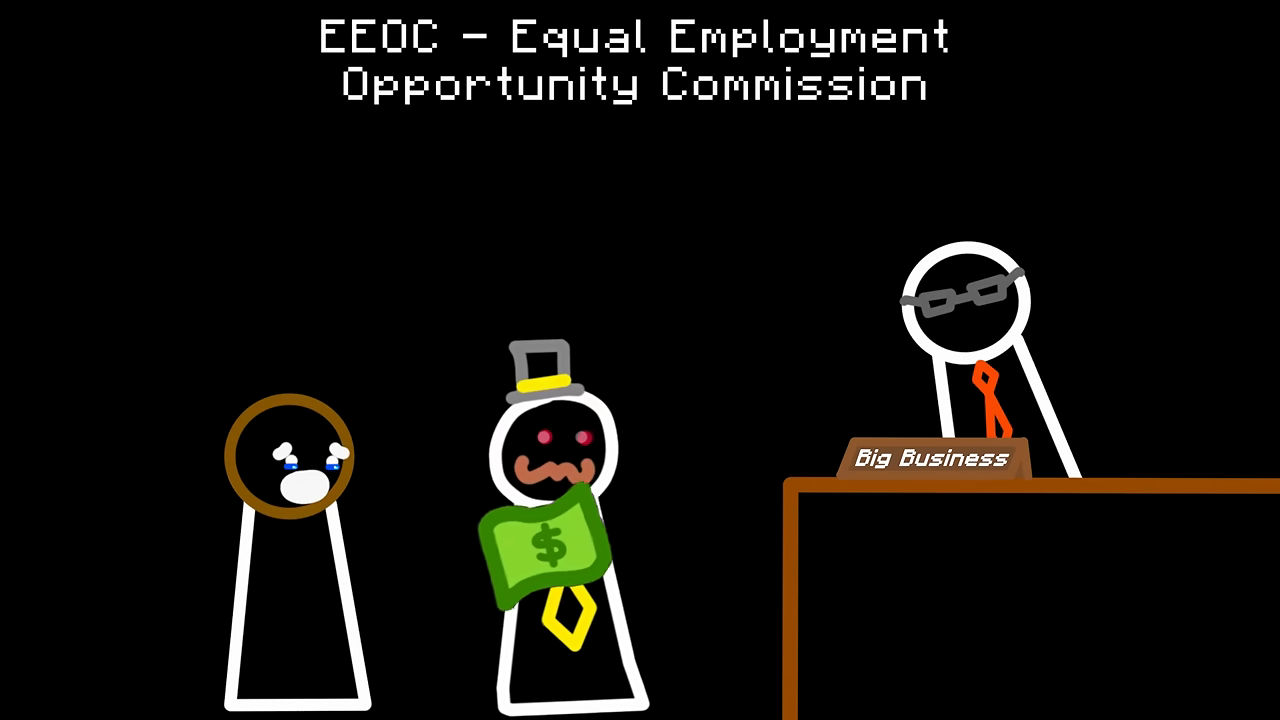
The video’s visual depicts the charging party taking money while the employer is exposed to a federal lawsuit. The official process is:
signed allegation filed
        ↓
employer notified; jurisdiction and timeliness screened
        ↓
mediation, investigation, request for information, or dismissal
        ↓
no reasonable cause → dismissal / notice of right to sue
reasonable cause → voluntary conciliation
        ↓
if conciliation fails, EEOC may sue or may issue a right-to-sue notice
The respondent can provide a position statement and factual or legal defenses. A person does not receive compensation merely for filing. A remedy can follow a negotiated settlement, successful conciliation, or adjudicated claim; knowingly false factual submissions may also carry ordinary legal consequences. The video changes a conditional enforcement system into an automatic accusation–payment–lawsuit sequence.
Titles IV and VI, and what happened in 1976
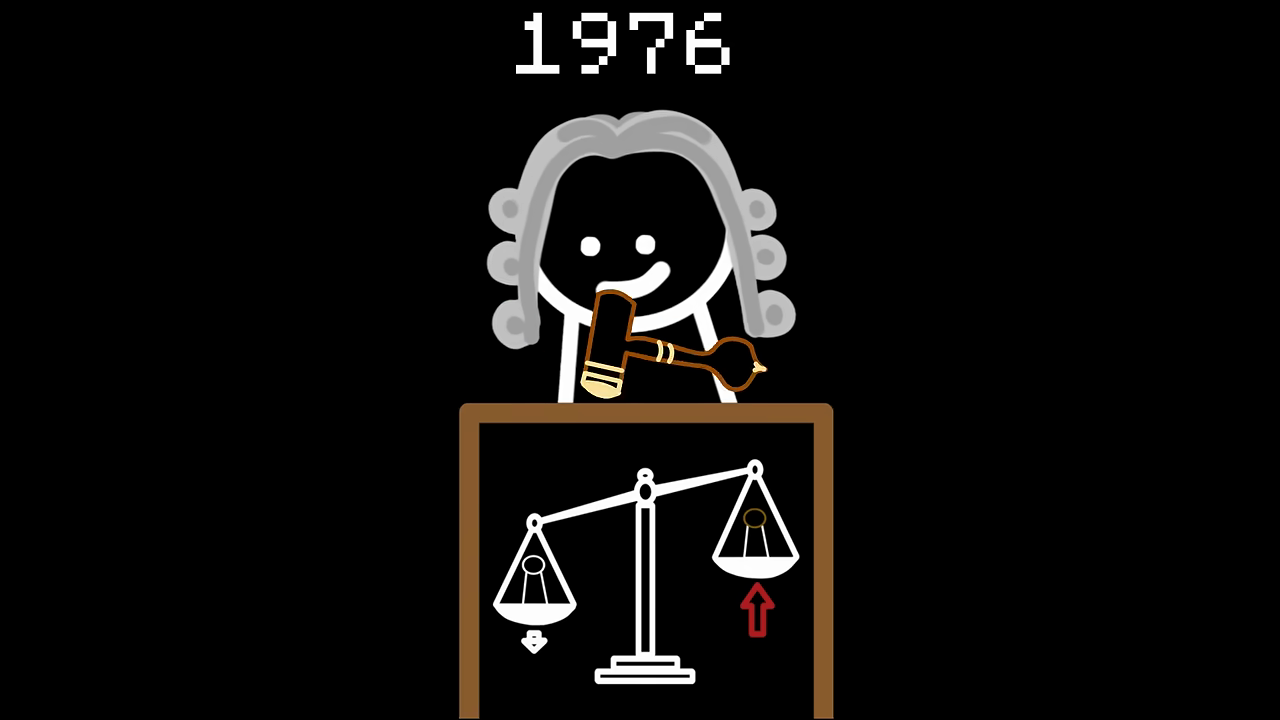
| Authority | Actual coverage | What the video gets wrong or leaves out |
|---|---|---|
| Title IV, 42 U.S.C. §2000c et seq. | Public schools and public colleges; federal technical assistance and litigation concerning desegregation | The statute itself defines public education and says desegregation does not mean assignment merely to overcome racial imbalance. |
| Title VI, 42 U.S.C. §2000d | Any program or activity receiving federal financial assistance | It reaches private schools only when they are recipients; some private schools receive no such assistance. |
| 42 U.S.C. §1981 | Equal right to make and enforce contracts | This Reconstruction-era law—not Title IV—was the basis for Runyon. |
| Runyon v. McCrary (1976) | Private nonsectarian schools could not deny admission to qualified Black children solely because of race | It did not “expand Title IV,” did not depend on federal funding, and did not regulate literally every educational arrangement. |
Audit of the displayed evidence
Walmart’s locked Black hair-care products
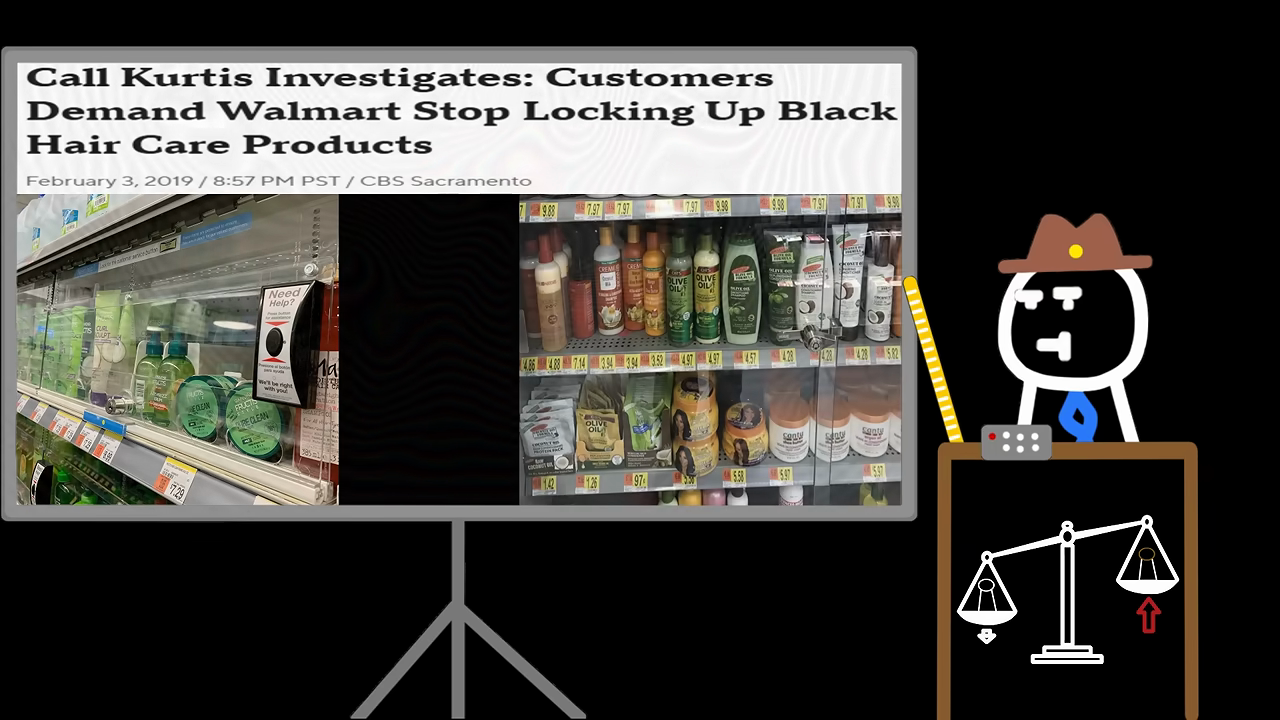
The frame is a real February 2019 CBS Sacramento report. It supports the narrow statement that several stores locked hair products marketed to Black consumers while leaving other products open. Walmart told CBS that local security choices used data and that many other high-theft categories were also secured. But the report also found very inexpensive Black hair products behind glass, reported delays in obtaining assistance, and did not receive item-level theft data establishing that every product in the racialized section presented exceptional risk.
The evidentiary mismatch is decisive:
Products used mainly by Black customers were locked
                         ≠
Black customers as a group caused enough theft to justify exclusion
In 2020 Walmart said it would discontinue the practice, which it said existed in about twelve of roughly 4,700 U.S. stores. The screenshot is therefore evidence of a controversy over a security practice, not empirical proof of the video’s generalized racial-cost model.
The “disparate outcomes” paper
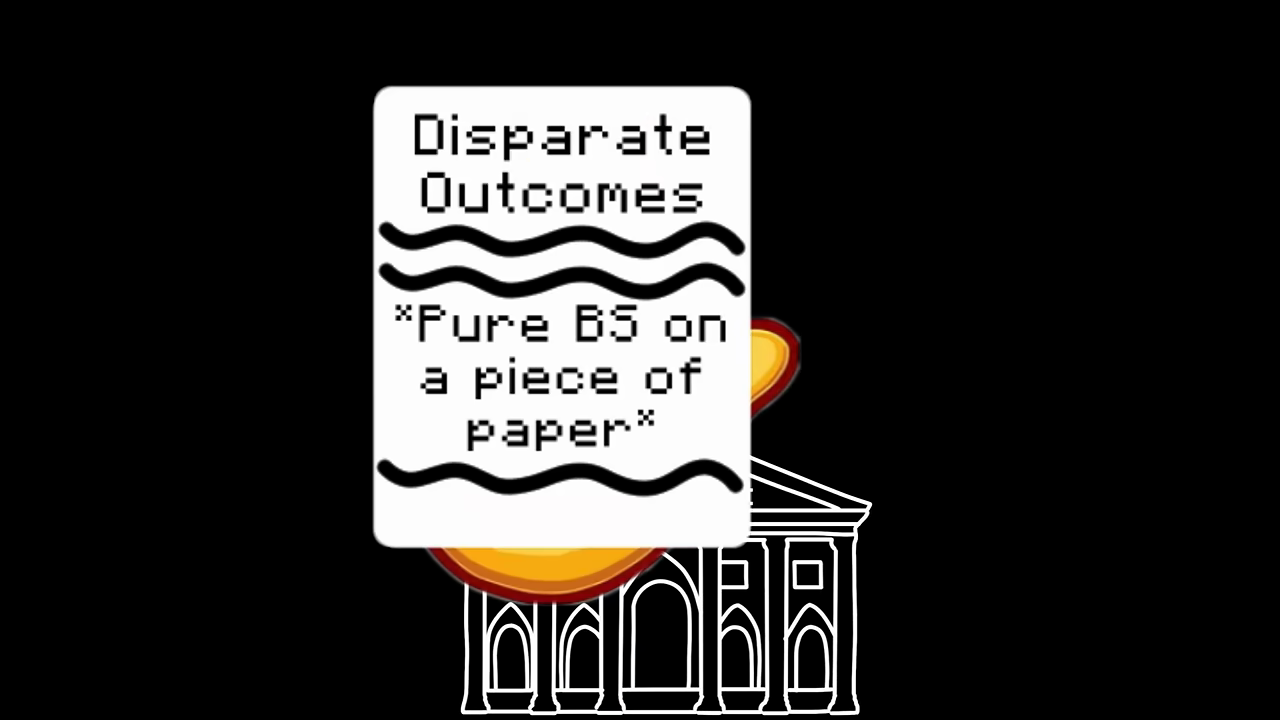
This is the creator’s own caricature, not a quotation from a statute or court. It suppresses the causal-practice requirement, the business-necessity defense, the alternative-practice stage, and the difference between statutory disparate impact and constitutional intent doctrine.
2017 school-fighting chart
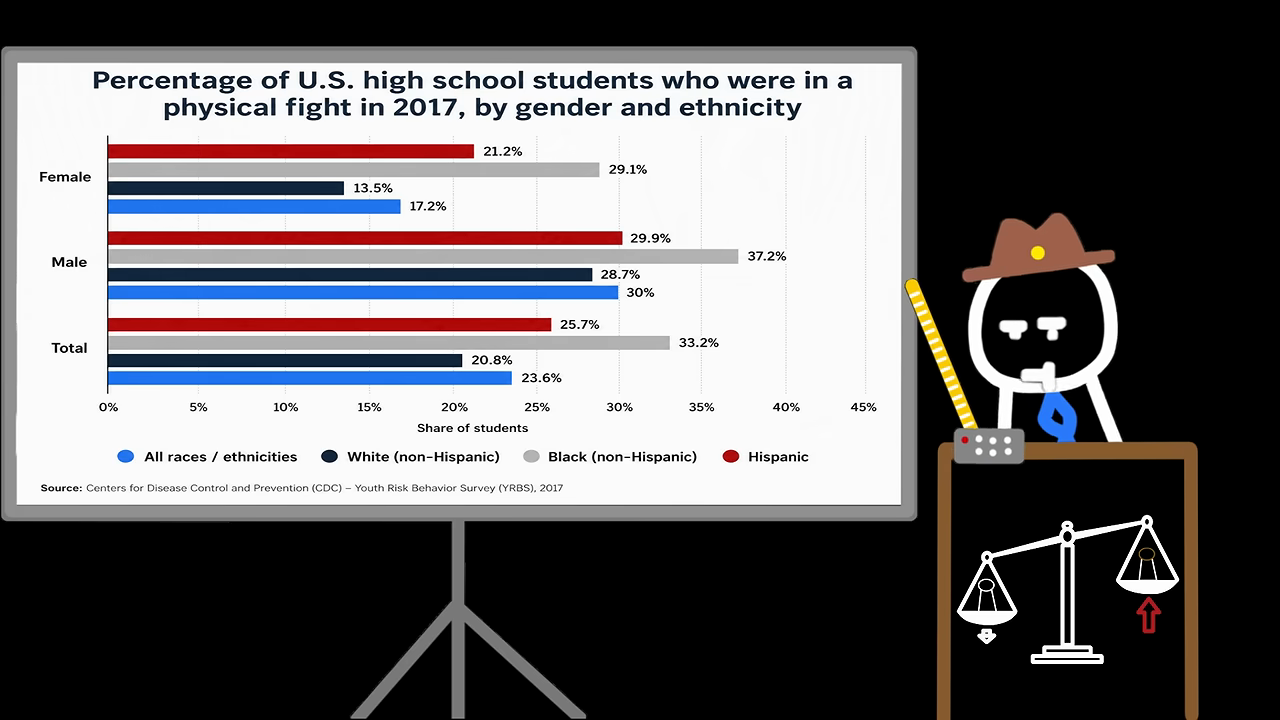
The numbers are correctly transcribed from CDC’s 2017 Youth Risk Behavior Survey:
| Group | Female | Male | Total |
|---|---|---|---|
| All students | 17.2% | 30.0% | 23.6% |
| White, non-Hispanic | 13.5% | 28.7% | 20.8% |
| Black, non-Hispanic | 29.1% | 37.2% | 33.2% |
| Hispanic | 21.1% | 29.9% | 25.7% |
What the item measured was self-reported participation in one or more physical fights during the prior twelve months. The displayed secondary chart omits the 95% confidence intervals and the fact that the question was not restricted to school. The CDC report also found that overall fighting fell from 42.5% in 1991 to 23.6% in 2017.
The statistic cannot identify:
- who initiated a fight or whom it involved;
- whether it happened at school or in an integrated setting;
- individual risk after age, neighborhood, poverty, school context, or prior victimization;
- parents’ motives in the 1950s–1970s; or
- genetic causation.
Using the Black group average as a forecast about an individual child is the same ecological move the channel makes in its crime videos.
“Math is racist” clip
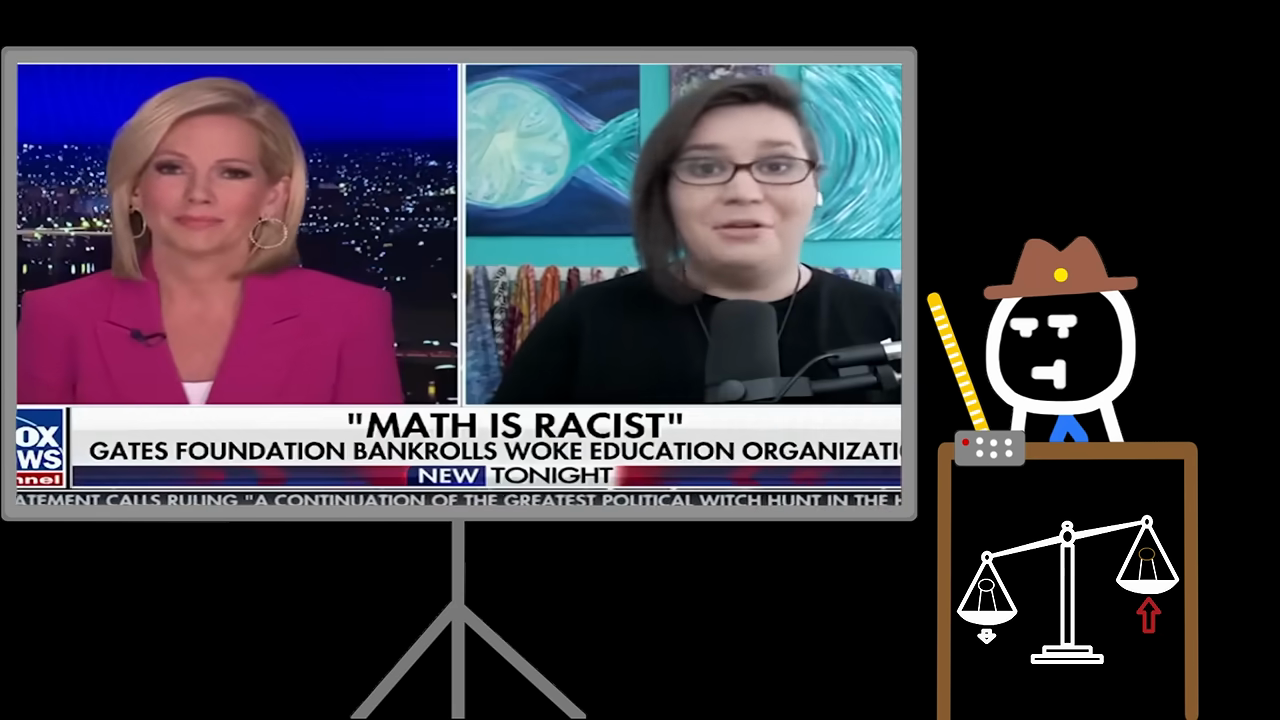
The inserted frame is a Fox News segment criticizing A Pathway to Equitable Math Instruction. The underlying toolkit described alleged “white supremacy culture” in mathematics instruction and proposed alternative classroom practices. Some of its language and recommendations are reasonably contestable, and critics can ask whether they weaken clarity or standards. But the on-screen chyron “MATH IS RACIST” is a television condensation, not the title of a scientific evaluation showing that desegregation lowered math performance. The clip supplies no evidence for innate group differences and no causal link from Title IV or Title VI to weaker instruction.
Federal troops
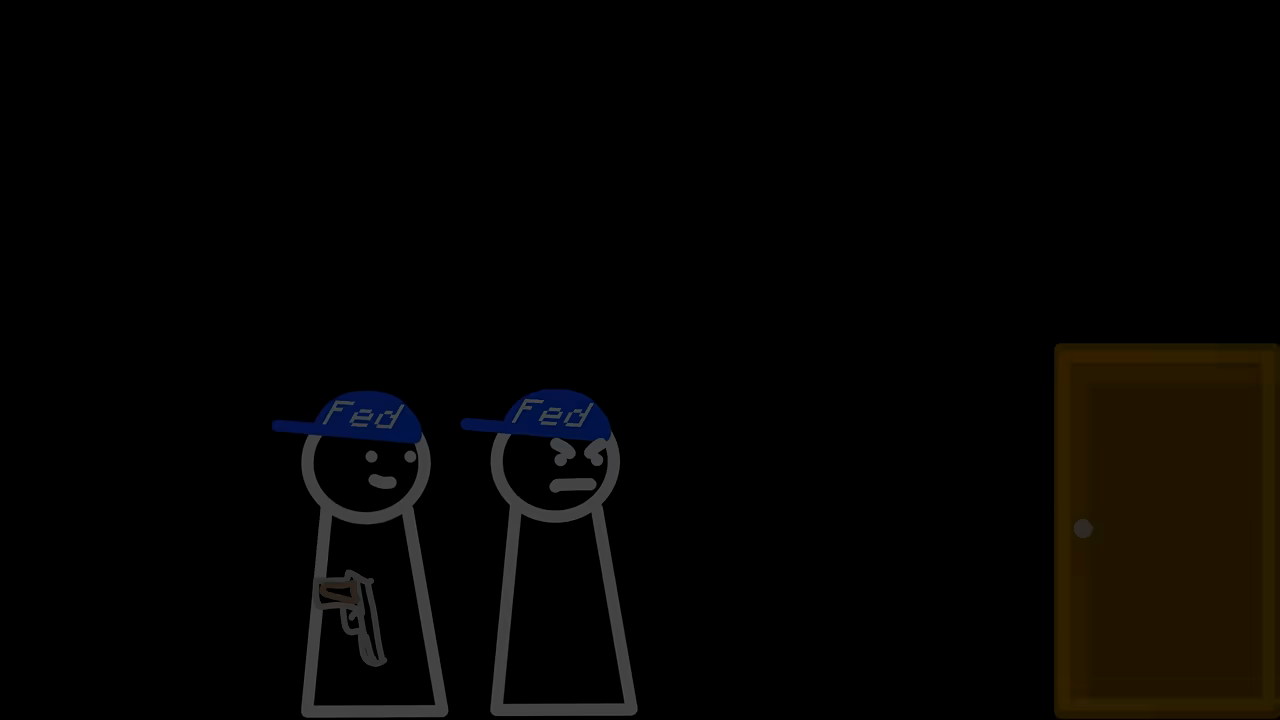
The animation accompanies a narrative that merges three different coercive powers:
- federal enforcement of constitutional and court-ordered desegregation;
- state compulsory-school-attendance rules; and
- state regulation of homeschooling.
At Little Rock, Governor Orval Faubus used the Arkansas National Guard to block the Little Rock Nine. Eisenhower federalized the Guard and sent the 101st Airborne to protect the students and enforce the court’s order. This occurred in 1957, not as a consequence of the 1964 Act, and it did not consist of soldiers rounding up White homeschoolers. Particular desegregation orders later constrained district assignment and sometimes involved busing, but the video cites no case connecting federal troops to fines, jail, or custody for homeschooling parents.
Thomas Sowell quotation
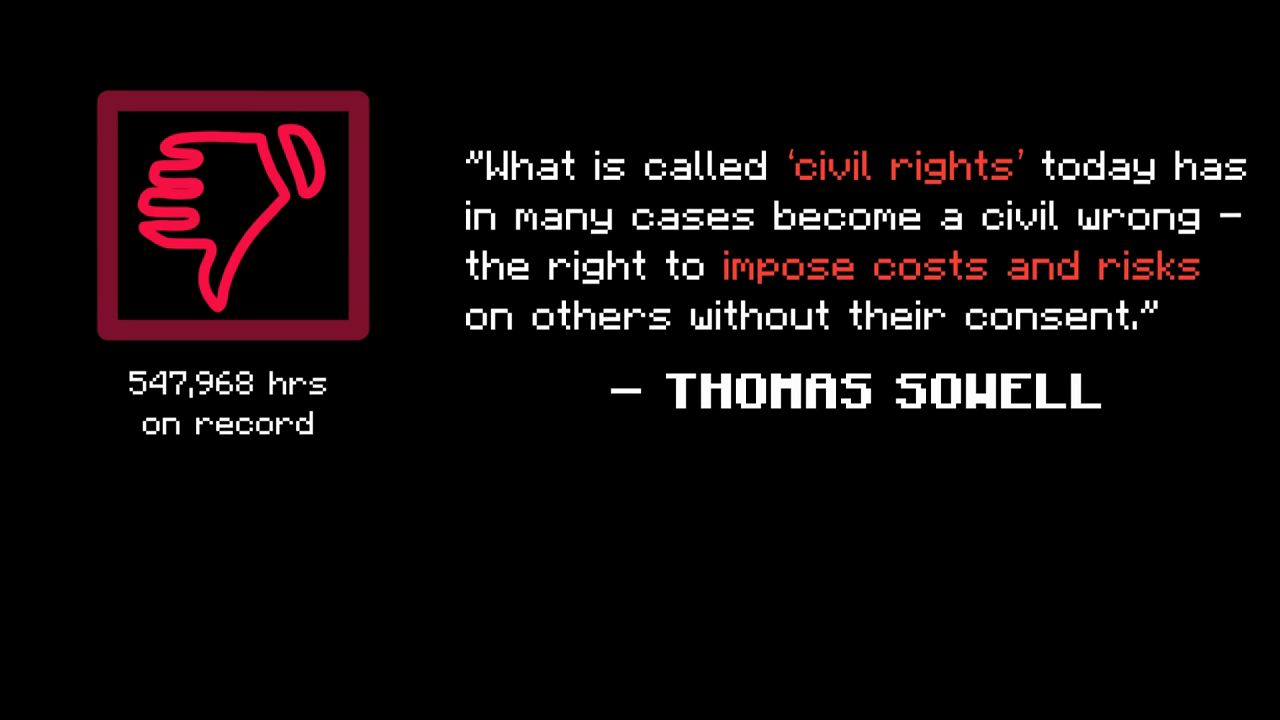
The closing frame attributes this wording to Thomas Sowell:
“What is called ‘civil rights’ today has in many cases become a civil wrong—the right to impose costs and risks on others without their consent.”
The wording is consistent with themes in Sowell’s civil-rights and risk arguments, and the channel plainly invokes him as an authority. The exact primary publication, page, interview, or transcript was not located during this pass. Preserve it as attributed to Sowell by the video, not yet as an authenticated verbatim quotation.
Causal and argumentative structure
real philosophical concern about compelled association
                         ↓
competition assumed sufficient to eliminate irrational exclusion
                         ↓
persistent exclusion treated as evidence that racial exclusion was rational
                         ↓
selected group averages used to supply the missing risk premise
                         ↓
employment disparity recast as automatic legal guilt and quotas
                         ↓
school desegregation linked to violence, innate ability, and lower standards
                         ↓
coercive enforcement treated as proof the excluded group had no value
                         ↓
Civil Rights Act blamed for racism, DEI, and Black-family decline
The central error is selection-as-proof. If markets or parents exclude a group, the video treats exclusion as evidence that association with the group was costly. But that is exactly what must be proved. The same behavior can arise from prejudice, misinformation, coordinated norms, legal inheritance, unequal power, segregated geography, security concerns, or mixtures of these. Without independent measures, the explanation is not identified.
The argument also moves between three different units without permission:
- an aggregate racial statistic;
- an individual customer, worker, or student; and
- the value of an entire group’s society or civilization.
Evidence at level 1 does not by itself establish 2, and neither establishes 3.
Source-provenance findings
Sources visibly used
| Visible item | Identified source | Evidentiary role |
|---|---|---|
| Locked hair-care screenshot | CBS Sacramento, 3 February 2019 | Real report used to suggest a racial theft/security mechanism, though it contains no group-causal estimate |
| School-fighting chart | Statista rendering of CDC YRBS 2017 Table 24 | Accurate percentages stripped of question wording, confidence intervals, trend, and causal limits |
| “Math is racist” frame | Fox News segment about A Pathway to Equitable Math Instruction | Culture-war illustration, not evidence about desegregation or innate ability |
| “1976” judge animation | Likely allusion to Runyon v. McCrary | The narration misattributes §1981 doctrine to Title IV |
| Closing quotation | Attributed to Thomas Sowell | Explicit ideological lineage; exact primary source remains open |
Intellectual and citation ecosystem
The script appears to combine at least four recognizable strands:
- a property-rights/freedom-of-association critique of public-accommodations law;
- Becker-style market discrimination and statistical-discrimination intuition;
- Thomas Sowell’s criticism of disparate-impact regulation, group proxies, and imposed risk;
- the channel’s existing hereditarian and Black-family narratives.
No single upstream article has yet been found containing the video’s exact combination of Title II, Walmart hair products, disparate impact, EEOC, Runyon, YRBS fighting, homeschooling, the Fox math clip, and the Sowell quotation. The current best hypothesis is creator-level compilation from a recurring right-libertarian/HBD citation ecosystem, not a script copied from one page.
Methodological errors
- False legal universal: a limited doctrine becomes “all disparities are discrimination.”
- Burden-of-proof reversal: an employer’s burden of production or business-necessity defense becomes a general duty to prove innocence.
- Quota conflation: statistics, affirmative action, consent decrees, contractor rules, and mandatory proportional representation are treated as one policy.
- Statutory misattribution: Runyon’s §1981 holding is called an expansion of Title IV.
- Chronology collapse: Little Rock 1957, the 1964 Act, Runyon 1976, homeschooling regulation, and modern DEI are narrated as one causal sequence.
- Market-selection tautology: persistent exclusion is treated as proof that exclusion was rational.
- Ecological fallacy: a group average becomes the expected character of each customer or student.
- Proxy substitution: a product-security controversy becomes evidence about people; a fighting survey becomes evidence about school integration.
- Causal omission: no counterfactual is offered for what discrimination, income, or schooling would have looked like without federal policy.
- Moral asymmetry: the costs imposed by equal-access law are counted, while the costs imposed by exclusion, restricted mobility, segregated markets, and state-supported caste are treated as external to the analysis.
- Dehumanizing value inference: access to shared institutions is recast as a request by people with “nothing to offer, but plenty to take.”
- Unfalsifiable hereditarian rescue: when prejudice could explain exclusion, the script asks whether the prejudice reflects real group differences but offers no discriminating evidence.
Cross-video connections
- Why Is Black America Like That supplies the family-decline ending that this video invokes without reproducing its data. That dossier finds the
78%pre-civil-rights two-parent baseline false and the welfare monocause unsupported. - Why Is Per Capita Impossible For Them shows the same ecological move from a group statistic to assumptions about an individual member’s risk.
- The Genetics Behind Unequal Societies, Racial Egalitarianism - All Arguments Ranked and Debunked, and The IQ Debate We're Not Allowed To Have supply the “blank slate was debunked” premise. None directly establishes that the Civil Rights Act’s regulated disparities were genetically caused.
- Why Is Africa Like That uses the same structure in historical form: selected group outcomes become evidence of internal civilizational deficiency while institutions and external mechanisms receive asymmetric scrutiny.
- Basic Logic Cross-Video Claim Map records this dossier as the bridge between the channel’s genetics/IQ cluster and its crime/family cluster: group differences are used to redescribe civil-rights protections as transfers from a productive in-group to a costly out-group.
Open questions
- What exact Sowell book, column, speech, or interview contains the closing sentence?
- Did the creator obtain the YRBS chart directly from Statista, from a repost, or from the same race-and-crime link bundle used elsewhere?
- Which Supreme Court case did the creator intend with the unexplained “1976” frame? Runyon is the best fit, but the video does not name it.
- What source supports the assertions that homeschooling parents were reacting primarily to integration and that federal authorities threatened custody specifically to compel interracial schooling?
- Which economist or text is intended by “economists have long argued” that competition makes public-accommodations law unnecessary?
- Does a later channel video name the legal or economic sources omitted here, especially DEI - All Arguments Ranked & Debunked or Critical Race Theory - Explained in 3 Minutes?
Primary and research sources
Statutes, cases, and official guidance
- Civil Rights Act of 1964, Public Law 88-352 — original act, including Titles II, IV, VI, and VII and Section 703(j).
- 42 U.S.C. §2000a — Title II’s equal-access rule, covered establishments, and private-club exemption.
- 42 U.S.C. §2000c — Title IV definitions of desegregation, public school, and public college.
- U.S. Department of Education, Title VI and coverage FAQ — federal-funding trigger and private-school scope.
- 42 U.S.C. §2000e-2 — unlawful employment practices, disparate-impact burdens, anti-preference clause, and prohibition on race-norming.
- Heart of Atlanta Motel v. United States, 379 U.S. 241 (1964) — constitutionality and commercial burden of public-accommodation discrimination.
- Griggs v. Duke Power Co., 401 U.S. 424 (1971) — employment practices, impact, and job relationship.
- McDonnell Douglas Corp. v. Green, 411 U.S. 792 (1973) and Texas Department of Community Affairs v. Burdine, 450 U.S. 248 (1981) — order and burden of proof; plaintiff retains ultimate persuasion burden.
- Washington v. Davis, 426 U.S. 229 (1976) — disproportionate impact alone does not establish a constitutional equal-protection violation.
- Runyon v. McCrary, 427 U.S. 160 (1976) — §1981 and private nonsectarian schools.
- United Steelworkers v. Weber, 443 U.S. 193 (1979) — limited voluntary affirmative-action holding.
- Roberts v. United States Jaycees, 468 U.S. 609 (1984) — nondiscrimination and associational freedom.
- Bostock v. Clayton County, 590 U.S. 644 (2020) — gay and transgender employment discrimination as discrimination because of sex.
- 303 Creative LLC v. Elenis, 600 U.S. 570 (2023) — compelled expressive speech limit on public-accommodations law.
- EEOC, “What You Can Expect After a Charge Is Filed”, “Resolving a Charge”, and charge flowchart — screening, investigation, dismissal, conciliation, litigation, and right-to-sue outcomes.
- Eisenhower Presidential Library, Little Rock School Integration Crisis — why the 101st Airborne was sent in 1957.
Data and historical/economic research
- and Table 24 PDF — fighting percentages, measure wording, confidence intervals, and long-run trend.
- CBS Sacramento, “Customers Demand Walmart Stop Locking Up Black Hair Care Products” — source of the inserted news frame.
- Reuters, Walmart and CVS policy change — 2020 discontinuation context.
- Gavin Wright, “The Regional Economic Impact of the Civil Rights Act of 1964” — public-accommodations coordination, enforcement, and Southern employment/economic gains.
- John Donohue III and James Heckman, “Continuous Versus Episodic Change” — evidence on the post-1964 period of relative Black economic improvement and federal policy.
- William Collins, “The Labor Market Impact of State-Level Anti-Discrimination Laws, 1940–1960” — pre-1964 fair-employment laws and heterogeneous effects.
- Åsa Rosén, “Search, Bargaining, and Employer Discrimination” — model showing that competition need not eliminate employer discrimination.
- NCES, “Homeschooled Children and Reasons for Homeschooling” — modern reasons are heterogeneous; not evidence for a single racial origin story.
- Milton Gaither, “Homeschooling in the USA: Past, Present and Future” — modern movement emerged from left and right countercultures, religion, suburbanization, and opposition to school bureaucracy/secularization.
- Library of Congress, School Segregation and Integration and U.S. Commission on Civil Rights, Twenty Years After Brown — documented growth of private White academies as an evasion of integration.
- Gallup, approval of interracial marriage, 1958–2021 — one long-run measure directly inconsistent with an unqualified claim that Americans became more racist after civil rights.
Onscreen evidence and source provenance
The eight preserved frames above are evidence of what the video selected and displayed. They are not treated as proof of their narrated interpretation. See the project catalog for the consolidated source list and the cross-video inference map.
Full transcript
Full transcript (YouTube automatic captions; lightly normalized)
Automatic captions can mishear names, numbers, and punctuation. The wording below is retained as evidence of what the video appears to say, not as authentication of every proper noun or statistic.
0:00 — The Civil Rights Act is lauded as the crowning achievement of the Civil Rights Movement that finally ended legal racism and brought about equality for black people in America. But today, America is still accused of institutional racism, key liberties such as freedom of association were sacrificed, and racial tensions are rising. So, what happened? In this video, I will go over the Civil Rights Act and give my honest thoughts on its consequences. And if you enjoyed the video, consider subscribing. It helps the channel. One of the goals of the Civil Rights Act was to oppose Jim Crow laws that often forced private business owners to segregate and not service customers on the basis of group identity. This is a fair goal. Jim Crow laws were a flagrant breach of freedom of association. That is, the right of an individual to choose with whom he shares company and does business with, free from coercion. But instead of defending freedom of association, Title II of the Civil Rights Act instead mandated that an individual must do business with
1:01 — customers on the basis of identity or suffer consequences. It’s the same violation of liberty as Jim Crow, just in reverse. Why wasn’t upholding freedom of association enough by itself? On paper, the idea that private owners were now forced to not reject customers on the basis of identity sounds good. An end to the irrational refusal to service people based solely on the color of their skin. But things are rarely that simple. Economists have long argued that it is unnecessary to force private businesses to desegregate because the market already provides the proper incentives. An irrationally racist owner who refuses customers for no good reason is losing out on business and gets outcompeted by a non-racist rival, thus rendering the clause unnecessary as the market would sort this out on its own. But defenders of the Civil Rights Act argue that despite these market incentives, racist business practices still dominated large parts of America even in the absence of
2:03 — Jim Crow laws, and they’re not wrong. Both sides are factually correct. So, what’s going on here? There’s only one answer. What if the racist business owner isn’t being irrational? What if, hypothetically, there was a group of people who, on average, while being serviced, are more likely to refuse to pay, to steal items, to harass other customers and staff, and generally cost the private owner more? What if he was forced to spend money on additional security, specifically to protect products typically used by that certain group? What if the additional business from the honest members of that group wasn’t worth the increased risk of the dishonest members of that group? That would explain the situation perfectly. Some of you may counter-argue, claiming that the real reason for the business owner’s actions is because the majority of his clients are racist, so he’d lose out on business if he integrated. Perhaps that’s true, but then we’d have to ask, why are his clients being
3:04 — racist? Are they also irrational? Or is there something to it? The same logic applies to employment. Title VII of the Civil Rights Act, probably the most controversial title, forced an end to discrimination in hiring practices. It suffers the same issues as Title II, except worse, because what counts as discrimination? A racist employer could always argue that the candidate came up short in some arbitrary way, and there’d be no way of telling if he was being discriminatory or genuine. So, the government came up with a solution in future years, disparate outcomes. In essence, a court decides what counts as an identity group, compares it to another identity group, and if there’s a discrepancy in outcome, assumes the cause is always discrimination because there is definitely nothing else that could possibly account for differences between group averages. It’s effectively a legal mandate enforcing the blank slate theory even though it’s been
4:05 — debunked over and over again. The consequences were dire. Businesses now felt like they had to hire a certain number of minorities or else face legal consequences. This led to the development of race quotas, affirmative action, and other travesties. The Civil Rights Act was meant to protect people from discrimination, but race quotas do exactly the opposite. A qualified candidate that would have been hired otherwise could be rejected simply because he wasn’t of a protected group and the company wants to preemptively protect themselves against accusations of discrimination. And perhaps even worse is the chosen enforcement system. If an individual felt like a company was discriminating against a protected group, they could file a report with a federal agency called the EEOC, which would investigate the claim and then demand some kind of compensation. The most common way of which was for the company to just pay them, which provided a financial incentive for citizens to constantly cry
5:06 — racism with no consequences. If the company refused, the EEOC would sue them and bring them to court. At that point, the company would have to try to prove their innocence and the only fair fire way of doing that is having equal representation among all protected groups, which is what caused the race quotas in the beginning. And as the number of protected groups expanded, not just race, but also gender, orientation, etc., the worse these systems became, leading to modern-day DEI initiatives. Another controversial title was Title IV, focusing on desegregating education and building upon the Brown v. Board of Education ruling from 10 years prior. There’s a misconception that the Civil Rights Act only targeted public education. In truth, while Title IV did only focus on public education, Title VI put pressure on private schools by withholding funding. And later in 1976, following a Supreme Court decision, Title IV was effectively expanded to all
6:06 — forms of education. Parents were not happy about this. They really didn’t want to put their kids in the same institutions as kids of other certain groups. And some opted for homeschooling or local community schooling. But why? The official narrative is that they were just too racist, too full of irrational hatred. That might have been the case for some of them, but just like with the business owners, what if there was a more rational concern? Could it be that a certain group was known to, on average, be more delinquent, bully kids more, cause problems, and turn faculties into hotbeds for crime? Could it also be that due to innate differences between the averages of those groups, that the faculty would have to accommodate for their unique challenges, therefore reducing the overall quality of education for the rest? If that were the case, then it would make sense that these parents would prefer to homeschool or set up local faculties of trusted community members, instead of sending their kids to public facilities, which
7:07 — is exactly what they did. But of course, that’s not real integration, and homeschooling was a legal gray area at the time. So, the federal government resorted to sending armed troops to force attendance in desegregated faculties. If parents didn’t send their kids, they could be hit with fines, jail time, or even lose custody. Here’s a thought. If you need the threat of violence against another group to force them to associate with your group, because they refuse to do so otherwise, maybe the problem isn’t them. And why do you even want to associate with them so badly If they’re so irrationally hateful towards you, why would they make good associates? Unless, of course, there’s something about their society that you want that your group can’t replicate. Because here’s the truth. If your group provides value to those they interact with, people will naturally want to associate. You don’t need force. Forced association is only necessary for those who have nothing to offer, but plenty to
8:07 — take. So, here’s my review of the Civil Rights Act. One out of 10. It caused the very thing it claims to stand against. People are more racist now and more afraid than they’ve been in a long time. And when you combine it with data from black families from before the 1960s and after, I think it’s clear no one won of this arrangement.