Lance S. Bush, creator of Lance Independent, is a philosopher and psychologist whose public work concentrates on moral antirealism, moral language, and philosophical method. This is the main note connecting the Bush material currently identified in this vault: two video reviews, an authored article, a discussion featuring him, the original debate he reviews, and my handwritten reflections.
The question I kept open
“Is Andrew’s deep point/problem … if it’s up to the individual person to decide their own morality …?”
My question while taking notes on Bush, notebook p. 160 / PDF p. 172 (file not included in this release). The omitted words concern the comparison with using the Bible. This is my question about the argument, not a quotation from Bush.
How to read this note
His position is distinguished from an antirealist option he explains, a joint panel’s argument, and my own reflections. Archived summaries are study notes, not Bush’s own prose; the original transcripts remain linked below. The journal’s general ethics charts do not establish that he endorses every theory they list. This is a synthesis of the located material, not an inventory of everything he has published.
Read in this order: the distinctions → the Wilson arguments → my journal pages → the strongest remaining objections. For my current positive argument, return to Does Morality Require Religion - Master; studying Bush does not select my metaethical position for me.
Position and philosophical method
Background and research
His own biography records a PhD in social psychology from Cornell and an MA in philosophy from Tufts. His academic page emphasizes the psychology of metaethics, experimental philosophy, and criticism of philosophical and psychological methods. His question is often how people understand moral claims, rather than merely which moral answer they select.
The coauthored paper Misunderstanding Metaethics: Difficulties Measuring Folk Objectivism and Relativism, with David Moss, questions whether survey participants interpret researchers’ questions in the intended metaethical sense. Its abstract argues that misunderstanding threatens the validity of common measures. A methodological challenge to a survey is not, by itself, a proof that realism or antirealism is true. This paragraph follows the publisher’s abstract; the complete paper has not been reconstructed here.
Intuition and evidence
In the Objectivist review’s opening discussion of David Enoch, Bush challenges the analogy between an antirealist and a colorblind person. A claim of cognitive deficiency needs an operational definition and evidence; merely comparing disagreement with defective perception does not identify who is mistaken. The reverse possibility of misleading intuitions also needs evidence. This is a methodological objection, not an empirical demonstration that realists are defective. Discussion beginning at 8:39 · local transcript.
Antirealism and quietism
In his self-description, Bush denies stance-independent moral facts and endorses metaethical quietism: he thinks conceptual and linguistic confusion explains much of the apparent dispute. He does not identify his own account with the standard packages of error theory, relativism, or noncognitivism. Explaining one of those packages therefore does not establish that it is his personal theory. Self-description.
The realist trilemma
He repeatedly proposes that realist theories are trivial, false, or unintelligible. The question is which allegedly realist content has actually been specified. A stipulated use of “good” for some descriptive property can be intelligible while leaving the contested authority unexplained; a more substantial claim must be understood and defended. This is his criticism, not an established refutation of every realist theory. See the archived review transcript, especially 53:41–55:00, and his self-description.
Pragmatism and reason-talk
In the Objectivist-review discussion, he describes himself as a pragmatist while preserving the practical distinction between a house being on fire and a cake tasting good. He also explains reason-talk through descriptive relations between goals and ways to achieve them, rejecting irreducible normative reasons. This goes beyond simply endorsing ordinary hypothetical imperatives. Sources: 24:58–26:34 and 1:00:21–1:00:51; local transcript.
The remaining question for this approach is why a goal should have authority for someone who rejects it. Bush’s rejection of irreducible reasons changes how he handles that question; it does not supply a realist account of categorical obligation. Compare stance-independent moral reasons and Internalism and externalism.
The distinctions his arguments depend on
Truth, knowledge, motivation, and conduct
Keep four questions apart:
- Truth or grounding: what would make the moral claim true?
- Knowledge or justification: how could someone know or defend it?
- Motivation: why would someone care or act?
- Conduct: what does that person actually do?
Needing a mind to discover a fact does not show that an attitude makes it true. Having an account of moral truth does not demonstrate good behavior. These distinctions connect Bush’s reviews to Moral Psychology Does Not Settle Metaethics and Does Morality Require Religion - Master. My nearby notebook p. 158 (file not included in this release) also separates knowing a fact from creating it; that page is context, not explicitly labeled as Bush’s teaching.
Stance-dependence, arbitrariness, and factuality
My p. 160 captures three separate claims:
- A preference depends on a subject’s stance.
- A preference was invented at will or chosen arbitrarily.
- A statement about that preference is false or not factual.
The first does not automatically establish the other two. People can discover tastes or commitments they did not consciously choose. Whether someone has a particular preference can itself be a fact. Likewise, denying stance-independent moral truth does not settle whether a theory allows stance-dependent moral truths, expressivist moral language, or an error-theoretic interpretation. Those are different antirealist options. See Subjectivism and Objectivism, Moral Cognitivism vs. Non-Cognitivism, and Andrew Wilson mentioning stance independence on Triggernometry.
This distinction blocks an inference; it does not yet prove that a preference generates a categorical duty for another person.
Relational facts and structured social facts
The reviews also distinguish a relation between things from a proposition’s being made true by attitudes. Comparative height is relational. Marriage and currency depend on institutions and recognized practices; that does not mean any individual can make any marriage or monetary claim true by wishing it. Which attitudes, procedures, and authorities matter must be specified. See Reviewing Andrew Wilson talking to an objectivist about moral realism and the original Objectivist debate and its analysis.
Social facts illustrate how dependence can be structured. Their existence alone does not establish objective moral rights. Compare Grounding of Rights and Contractualism.
Dependence, relativism, and scope
These questions should be stated separately:
- Dependence: are attitudes among the truthmakers?
- Relativism or indexing: is truth assessed relative to a specified standard or standpoint?
- Scope: to whom does a rule apply?
My p. 161 separates truthmaking from applicability. Shared acceptance is also different from universal normative authority. Bush’s review itself pauses to qualify the loose treatment of relativism as merely local scope: 32:50–34:09. His authored treatment distinguishes indexing from dependence: God and stance-dependence. Compare Moral Pluralism Is Not Moral Relativism.
Main arguments against Wilson’s framing
These are the principal themes of my notebook pp. 160–162, with the two archived reviews providing the fuller context. They reconstruct Bush’s criticisms; they do not establish that every Wilson exchange contains every error.
1. Rejecting realism does not eliminate all moral standards
My notes reject the jump from “no stance-independent moral facts” to “no morality,” “no standards,” or “nothing can be called immoral.” A person can have commitments, condemn actions, adopt norms, and evaluate conduct while rejecting a realist account of moral truth. What those activities mean depends on the particular theory.
The relevant challenge is whether that account is adequate—not whether its advocate has literally stopped making moral judgments. This is the first theme on p. 160 (file not included in this release). See Moral Realism vs. Anti-Realism and Subjective Morality.
2. Stance-dependence does not make error impossible
My p. 161 records three possibilities:
- Self-misunderstanding: I can be mistaken about my values or preferences.
- Empirical error: I can favor a policy as reducing suffering when it actually increases it.
- Inconsistency: my actions or judgments can conflict with the standards I claim to hold.
These permit criticism within an account without establishing an independent standard that settles every disagreement between accounts. The policy example is conditional; my notes do not supply evidence that any particular policy has the stated effects. See Intuition Is Evidence, Not a Verdict and How Should Moral Judgment Combine Intuition, Reason, and Consequences - Argument Map.
3. Antirealism is not one political or psychological package
My pages separate antirealism from postmodernism, leftism, secularism, nihilism, and lack of ethics. These positions may overlap in particular people; they are not interchangeable definitions. Bush explicitly distances himself from postmodernism in the Triggernometry review, 17:19–18:42.
Similarly, finding a badly behaved antirealist does not establish that antirealism caused the behavior. My notes leave room for principled antirealists and badly behaved realists. Bush raises alternative causal explanations, including rationalization after the fact: 26:08–28:51. That is a demand for evidence, not proof that metaethical beliefs never affect behavior.
4. Judge the theory by serious arguments
On p. 161 I wrote that a position should be assessed through its strongest defenders rather than unprepared people who barely understand its terminology. The same standard applies to religious and secular positions. A confused interview answer can expose a speaker’s difficulty without refuting the whole philosophical family.
In the Objectivist review, Bush also asks what premises establish the claimed incompatibility between atheism and objective morality. Merely restating that objective morality requires God supplies no independent support for that dependence premise. Rejecting that unsupported inference does not prove secular realism. See Can Atheism and Reason Ground Morality? and Morality and Religion - Andrew Wilson Challenge.
5. Antirealists can argue and criticize
My p. 161 lists persuasion, negotiation, compromise, conflict, and enforcement as things people with different values can do. They can also dispute evidence, expose inconsistencies, appeal to shared commitments, or challenge another person’s self-understanding.
This addresses the claim that moral discussion becomes impossible. It leaves a harder question open: what, if anything, justifies a demand against someone who rejects the relevant commitments? Keep that question in view rather than treating the existence of negotiation as its answer.
6. Moral truth does not automatically secure motivation or enforcement
My notes record Bush’s claim that realism is motivationally inert: someone might acknowledge a supposed fact and remain unmoved. His discussion is at 30:27 onward. Institutions and agents also remain necessary for practical enforcement.
Qualification: this is not by itself an argument that moral facts do not exist. Realists can distinguish having a reason from being motivated, and internalists can contest the assumed separation. Compare Internalism and externalism and Hume, Stoicism, and Whether Reason Can Motivate Moral Action.
7. Normative disagreement can survive agreement about metaethics
My p. 161 asks whether Wilson’s actual objection concerns values he condemns rather than their metaethical classification. Two realists can disagree about abortion, rights, or social hierarchy. Two antirealists can share strong prohibitions on cruelty. Moving a person into the “realist” category does not establish agreement on the right action.
This is a diagnostic possibility, not a claim that Bush has established Wilson’s motives. Compare Objective Moral Systems and Moral Psychology Does Not Settle Metaethics.
Religion and the grounding of morality
The narrow argument about divine stances
In God and stance-dependence, Bush asks whether divine attitudes make moral truths true. His conditional argument can be reconstructed as:
- Realism, in the stipulated sense, requires at least some stance-independent moral facts.
- Suppose all moral facts depend on God’s stances.
- Then this account supplies no stance-independent moral facts, so it is antirealist in that sense.
God’s being a subject is insufficient on its own. A subject could communicate independently true propositions without creating their truth. The article allows theistic accounts that ground morality otherwise. Classification under a definition also does not establish arbitrariness, falsity, or theism’s falsity. Original article.
Divine nature, value, and duty
The archived panel discussion considers a distinction between grounding goodness in God’s nature and grounding duties in commands. It is a multi-speaker discussion; not every remark should be assigned to Bush.
Important correction to my compressed p. 161 wording: a nature is not automatically a stance. The question is which feature allegedly grounds which moral truth, and whether that feature is an attitude, command, essential property, or something else. “God-dependent” and “made true by a divine attitude” should not be used interchangeably. A theistic account might distinguish value from obligation rather than fitting one simple label. See REF - Objective Morality and God and God is Subjective.
The is–ought issue applies to the proposed inference
My following notebook p. 163 (file not included in this release) asks what licenses a move from description to obligation. Introducing a fact about a divine command still leaves the normative bridge to explain; introducing a fact about suffering also leaves that burden. Antirealists who are not claiming to deduce categorical obligations from bare descriptions must be assessed on the account they actually propose. See Hume Is-Ought Problem and Is-Ought Problem and Secular Ethics.
The panel and article press this point against selective uses of the gap. They do not establish that every naturalist, theological, or constructivist treatment of the problem has failed.
My handwritten journal
Source: March 21–June 9, 2026 notebook (file not included in this release) · OCR/search companion · Journal routing table. The page numbers below were checked against the rendered scans.
| Notebook page | PDF page | What I wrote |
|---|---|---|
| 160 | March 21-June 9 2026.pdf (file not included in this release) | Explicit Lance Bush heading; realism versus standards; stance-dependence, arbitrariness, postmodernism, and moral facts. |
| 161 | March 21-June 9 2026.pdf (file not included in this release) | Universality, error, character, argument, motivation, religious grounding, and normative disagreement. |
| 162 | March 21-June 9 2026.pdf (file not included in this release) | My stronger reconstruction of Wilson’s political point, the “because I said so” comparison, and a general map of ethical theories. |
| 163, related | March 21-June 9 2026.pdf (file not included in this release) | Is–ought parity and a comparison chart; not explicitly labeled as Bush’s own position. |
| 166, related | March 21-June 9 2026.pdf (file not included in this release) | “God is subjective”: a stance-dependence argument and a comparison-fallacy reflection at the top of the page. |
The p. 160–162 sequence closely matches the topics and order of Andrew Wilson mentioning stance independence on Triggernometry. That is a source match by content; the handwriting does not print the video URL or a viewing timestamp.
Notebook p. 160 — first distinctions and my question
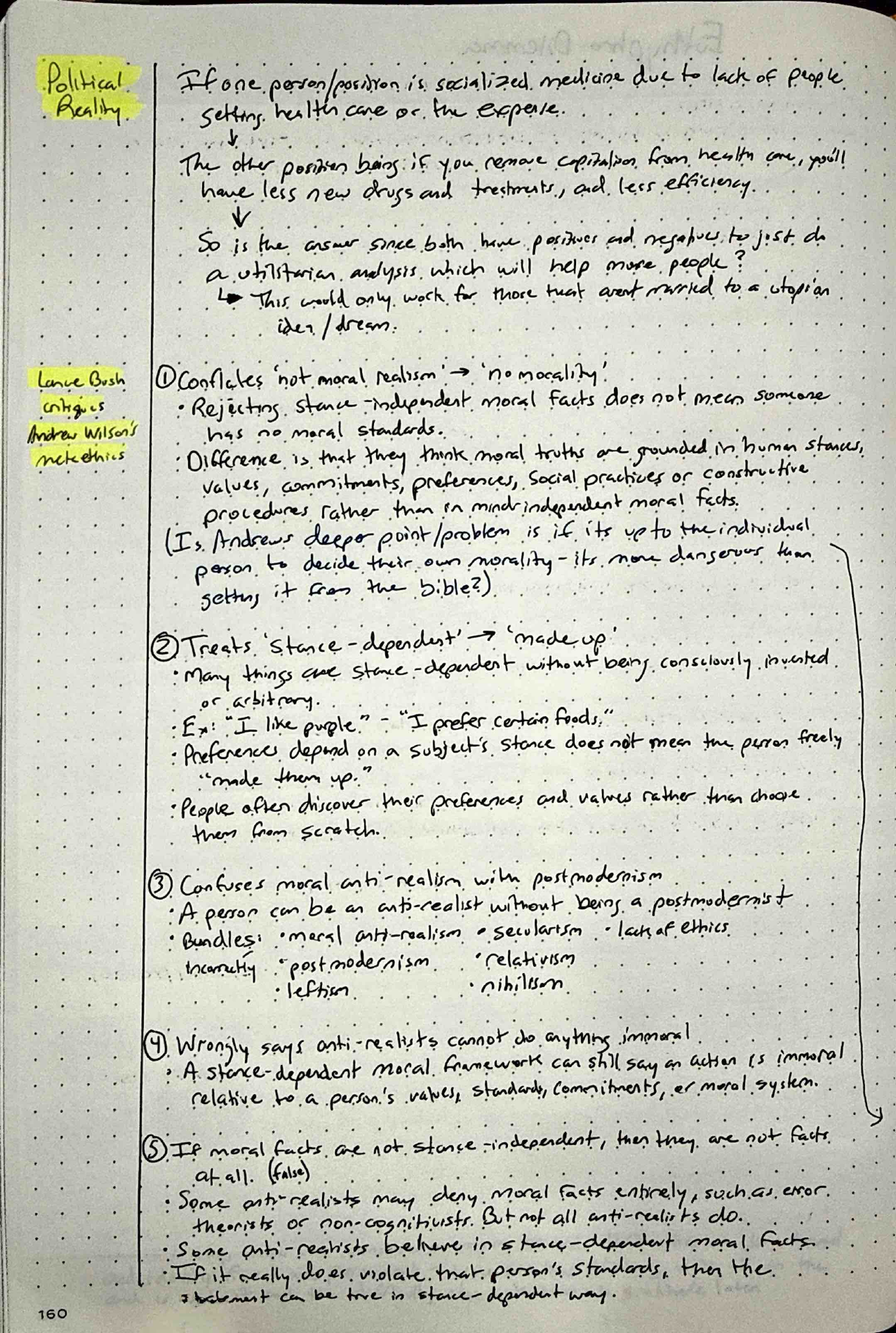
The Lance Bush entry begins partway down the page. The healthcare trade-off entry at the top is separate. The Bush section records five distinctions: rejecting realism versus lacking standards; stance-dependence versus being made up; antirealism versus postmodernism; meaningful condemnation within a framework; and stance-dependent facts versus no facts.
My parenthetical question asks whether Wilson’s deeper concern is the danger of individuals choosing morality rather than taking it from the Bible. That is a practical and comparative question I have not settled by recording Bush’s conceptual objections.
Open the original PDF page (file not included in this release)
Notebook p. 161 — criticism, motivation, and moral disagreement
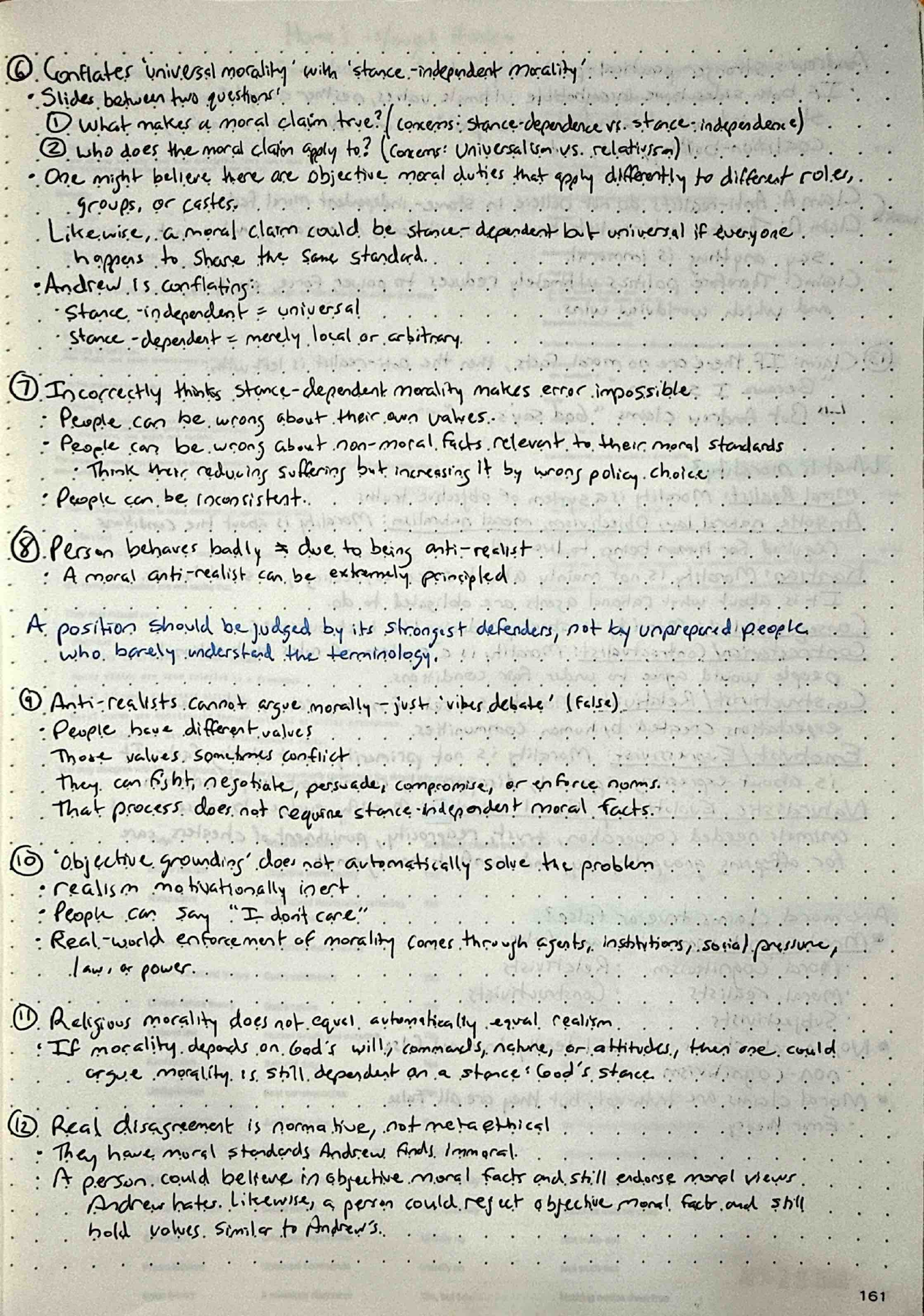
This page extends the distinctions to scope, three kinds of error, behavior, strong representatives, moral argument, enforcement, religion, and substantive values. It is the clearest single-page overview of the critique I retained. The qualifications about scope and divine nature earlier in this note prevent the compressed handwriting from becoming a misleading general rule.
Open the original PDF page (file not included in this release)
Notebook p. 162 — my stronger opposition and the ethics map
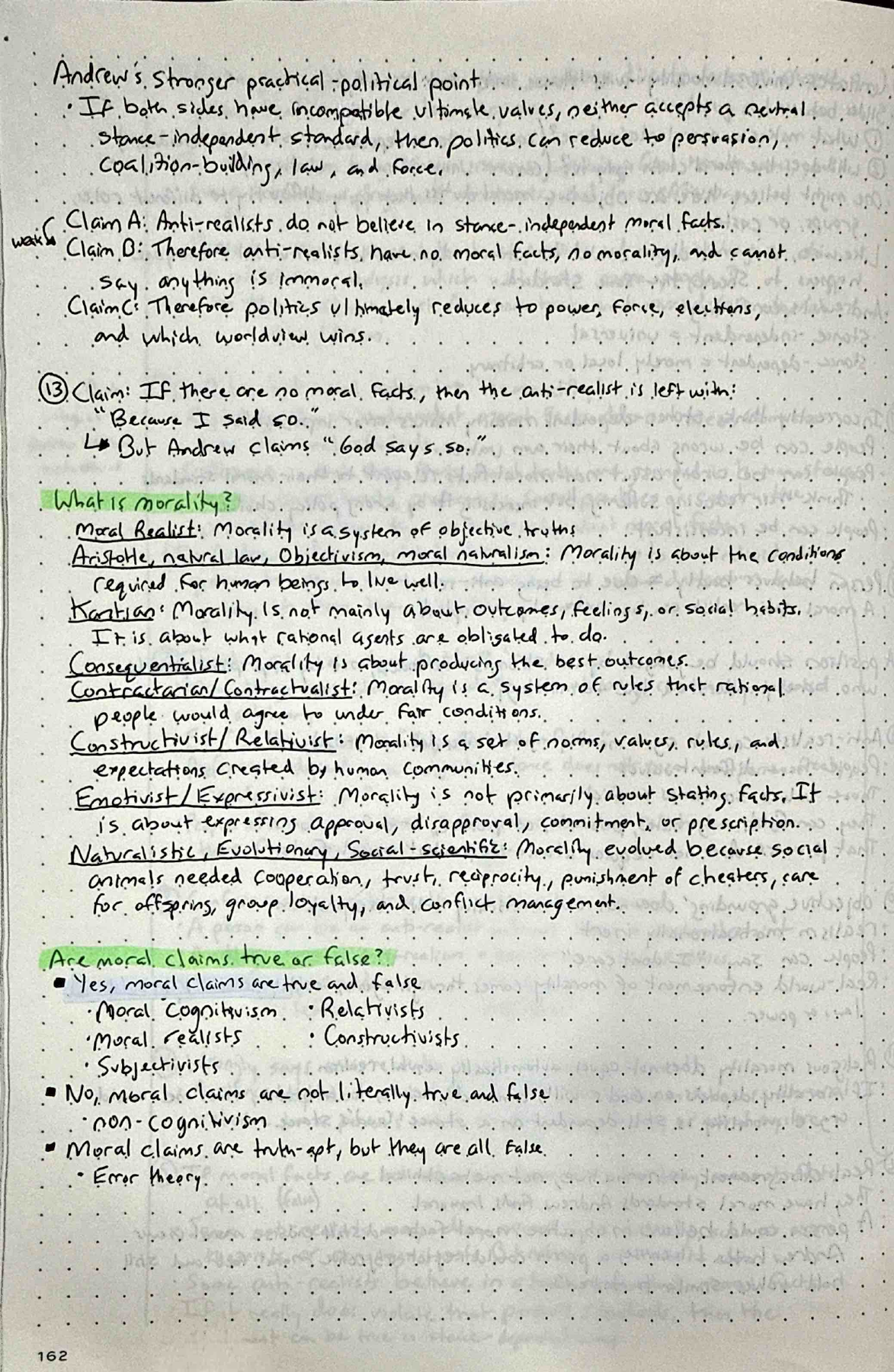
I distinguish three claims:
- A: antirealists reject stance-independent moral facts.
- B: therefore they have no morality and cannot condemn anything.
- C: political conflict between incompatible ultimate values can involve persuasion, coalitions, law, elections, and force.
My page marks the transition to B as weak while preserving the practical concern in C. C needs its own argument; political enforcement does not prove that force makes an act morally right, and realists can also face disagreement and coercion.
I also compare “because I said so” with “God says so.” This is a prompt to examine each account’s authority, not a demonstration that the two accounts are equivalent. The remainder of the page surveys ethical families. Its grouping of contractarianism with contractualism and constructivism with relativism is a compressed study map, not a claim that the pairs are identical. Use Contractualism and Moral Cognitivism vs. Non-Cognitivism for the fuller distinctions.
Open the original PDF page (file not included in this release)
Related notebook p. 166 — God, truthmakers, and comparison
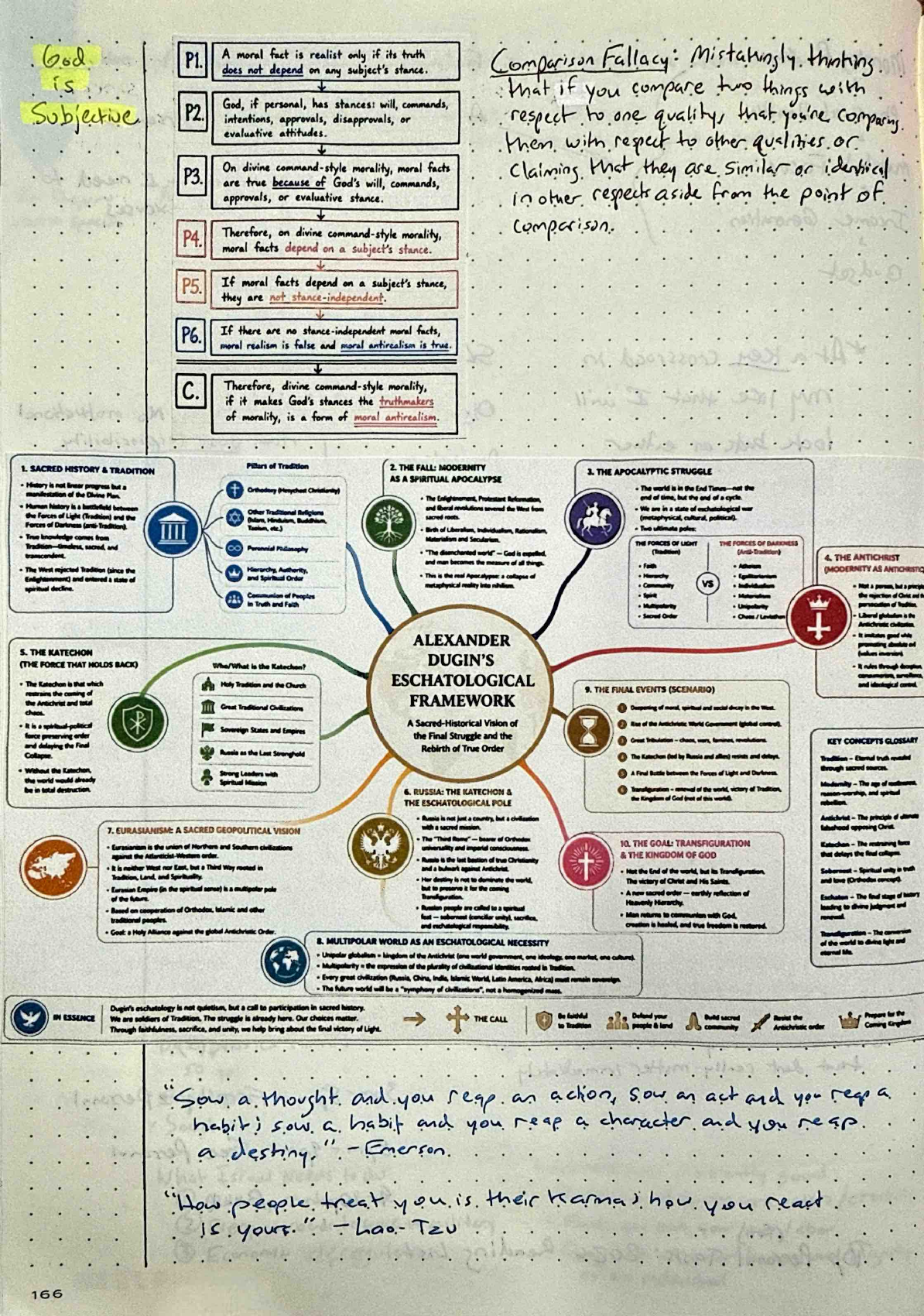
The top of this page contains the divine-stance argument and my note about comparing two things with respect to one property. It is closely related to the authored article, although the page does not name Bush. The Dugin diagram and quotations elsewhere on the page are separate material.
Open PDF p. 179 (file not included in this release) · Related vault note
Strong objections and unresolved questions
These are questions for evaluating the positions, not conclusions assigned to Bush:
- Authority: does explaining the human practice of moral criticism also explain a reason binding an unwilling wrongdoer? If Bush rejects the requested kind of reason, is that a clarification or a significant theoretical cost?
- Intelligibility: can realists explain irreducible reasons through examples and inferential roles, even without reducing them to nonnormative terms? Declaring a primitive unintelligible requires an argument. Compare stance-independent moral reasons.
- Motivation: does the possibility of indifference threaten realism’s truth, or only an internalist account of motivation? Compare Internalism and externalism.
- Divine grounding: could an essential divine nature ground value without attitudes making it true? Does a separate theory of commands explain duty? Compare REF - Objective Morality and God.
- Human flourishing and rights: descriptive facts about what promotes a chosen end do not by themselves settle whether everyone ought to choose that end or respect every other person. Bush’s defense of a distinction is not an endorsement of the Objectivist argument. Compare On the Randian Argument - Robert Nozick and Grounding of Rights.
- Political conflict: how can shared standards, negotiation, institutions, and coercion be assessed when deeper commitments conflict? My p. 162 preserves this issue rather than treating a definitional victory as its resolution. Compare Force Doctrine, Countering Advantage of the Stronger, and Law Is Not Value-Free - Legal Neutrality, Morality, and the Common Good.
- Historical and psychological evidence: claims that antirealism causes cruelty, that religion solves enforcement, or that conquest reliably promotes flourishing require evidence beyond the philosophical classification. Neither side gets those empirical conclusions merely from its definition of morality.
Related notes and current study route
The conceptual map
- Metaethics Mindmap — the existing map that first connected Bush to my notebook.
- Moral Realism vs. Anti-Realism · Objective Moral Systems — separate the truth question from the choice of normative theory.
- Moral Cognitivism vs. Non-Cognitivism · Expressivism · Quasi-realism · Frege–Geach problem — alternatives and their semantic burdens; not all are Bush’s own account.
- Moral Naturalism · Ethical non-naturalism — secular realist alternatives to compare with antirealism.
- The Foundations of Morality - Intuition, Justification, and Infinite Regress · Moral Psychology Does Not Settle Metaethics — justification and the limits of causal explanations.
My active debate project
- Morality and Religion - Andrew Wilson Challenge — Wilson’s strongest source-located challenge and the positive burden on my response.
- Does Morality Require Religion - Master — the current argument and recorded learning progress.
- Morality and Religion - Learning Path · Morality and Religion - Move Drill — use the existing route and practice rather than adding a new set of prerequisites.
- Analysis of Andrew Wilson Debate (Moral Language) — the larger vocabulary and earlier response inventory, checked against the newer challenge note.
Wider connections
- Secular Morality · Can Atheism and Reason Ground Morality? — ethical conduct, knowledge, grounding, and motivation.
- Hume Is-Ought Problem · God is Subjective · Euthyphro Dilemma — the neighboring arguments in my journal.
- Andrew Wilson - Political Ideology, Philosophical Foundations, and Program — political interpretation kept separate from the metaethical taxonomy.
- Lance Bush - Lance Independent and the Wilson Metaethics Critique — the earlier identification and resource note, retained for its original context.
Sources and complete local reading map
Direct Bush sources already in the vault
- Andrew Wilson mentioning stance independence on Triggernometry — archived review, dated April 23, 2026. Covers the realism-to-no-morality inference, arbitrariness, postmodernism, error, causal claims, scope, motivation, and moral argument. Video · local transcript.
- Reviewing Andrew Wilson talking to an objectivist about moral realism — archived review, dated April 26, 2026. Adds the knowledge/truthmaking distinction, institutional facts, relational examples, pragmatism, reason-talk, and criticism of unsupported argumentative steps. Video · local transcript.
- God and stance-dependence — authored article, June 10, 2025. The most direct prose source for his conditional classification of divine-stance theories. Article.
Discussion and original debate context
- Panel on the Dyer–Wilson exchange — archived on DannyPhilTalk’s channel, dated June 8, 2025; features multiple speakers including Bush. Distinguish their discussion from Bush’s later authored article and from the archive’s editorial summary. Video · local transcript.
- Original Wilson/Objectivist exchange — Eduardo’s debate capture, March 10, 2026, and the vault’s analysis. This is the material Bush reviews, not a Bush-authored theory or a debate in which he is the rights defender. Original video.
The source dates above are the archived metadata; the handwriting does not establish precise viewing dates. Transcript wording and speaker attribution should be checked before using an exact quotation. The full archived notes and transcripts remain in their original files.
Identity, academic work, and further research
- Lance Independent — biography and self-description.
- YouTube channel · academic page · publication list.
- Bush, Lance S., and David Moss. “Misunderstanding Metaethics: Difficulties Measuring Folk Objectivism and Relativism.” Diametros 17 (64), 2020, pp. 6–21. Publisher and abstract · DOI.
- Bush, Lance Spencer. Schrödinger’s Categories: The Indeterminacy of Folk Metaethics. Cornell University doctoral dissertation, May 2023. Cornell-hosted PDF. Bibliographic reference for further study; the full dissertation is not summarized in this note.
Compiled November 6, 2026. Journal previews reproduce the original scan; the PDF remains the page authority.