⬅️ Key Arguments (MOC) · Related: Peace Offers · Right of Return · One State, Two States · Zionism · Apartheid · Sources: Wilf at the Oxford Union · LonerBox–Jay Shapiro · Matau–LightBulb audit
One-line
No end-state works unless it protects both Palestinian political freedom and continued Jewish self-determination. Wilf’s useful boundary is that wanting peace does not require Israel to accept a one-state outcome that abolishes it; the corresponding boundary is that preserving Israel cannot justify permanent rule over Palestinians without equal rights or national self-determination. → Peace Offers
LonerBox–Jay Shapiro: the one-state implementation burden
LonerBox’s starting point is not that partition perfectly repairs history. It is that Palestinians need political freedom now while an equal one-state outcome lacks public consent and a transition capable of protecting both peoples. Jay Shapiro answers that imposed partition cannot heal the historical wound and prefers an egalitarian post-Zionist state.
The reusable pro-Israel challenge
“Equal rights is the moral floor, not a complete peace plan. Who controls the army, intelligence services, immigration, borders, refugee return, and militia disarmament during the transition? Which guarantees survive if the electoral majority changes them?”
This challenge does not excuse permanent occupation. It makes the two solutions symmetrical: a two-state advocate owes Palestinians a genuinely sovereign and viable state; a one-state advocate owes both peoples a credible constitution, security transition, collective-rights arrangement, and enforcement mechanism. → full exchange
🗺️ The Options on the Table
| Option | What it means | The problem |
|---|---|---|
| Two-State | Palestinian state next to Israel | Repeatedly proposed but never converted into a final agreement; blocked by incompatible end-state claims, security, borders, settlements, Jerusalem, Right of Return, leadership weakness, and armed vetoes |
| One-State / Binational | One state “from the river to the sea” | With unrestricted return, it ends Israel as a Jewish-majority nation-state; advocates dispute whether that is abolition or equal constitutional transformation |
| Confederation | Two states with shared institutions | Requires trust and security that don’t yet exist |
| Jordan option | Jordan absorbs the West Bank | Rejected by Jordan (majority-Palestinian already; feared PLO takeover — Black September) |
| Status quo / conflict management | Manage, don’t solve | The de-facto reality; “mowing the grass” |
🚫 Why “One State” = the End of Israel
The unicorn problem (from your talking points)
A single Arab-majority state with a protected Jewish minority asks Israeli Jews to transfer control of immigration, security, constitutional design, and national symbols to institutions that do not yet exist. Given the conflict’s history and the regional history of Jewish minority insecurity, advocates bear a heavy burden to specify enforceable power-sharing, collective rights, security integration, and remedies if the bargain collapses. → Violence Against Jews Before 1948
- Where “one democratic state” is paired with denial of Jewish peoplehood, unrestricted return as a demographic strategy, or celebration of Israel’s disappearance, it is elimination in egalitarian language. Where advocates defend equal individual and collective rights for both peoples, answer the institutional and security argument they actually make. → Right of Return · Zionism Debate - Anti-Zionist Arguments & Zionist Responses > 5. The number of states is secondary to equality under law
- The "apartheid" charge is often deployed to make the two-state solution look impossible and push toward the one-state (elimination) outcome.
🔁 Why Two-State Keeps Failing
- Incompatible finality — Palestinian acceptance of a state may not imply acceptance that the conflict and claims against Israel are over; Israeli acceptance of “two states” may not imply acceptance of a fully sovereign and contiguous Palestine. → Peace Offers · Zionism
- Right of Return — unrestricted return to Israel conflicts with preserving a Jewish-majority state; vague formulas let both publics imagine incompatible outcomes. → Right of Return · UNRWA
- Armed vetoes and security — Hamas and other armed groups can sabotage negotiations, while Israeli security control can make promised sovereignty nominal. → Gaza · Occupation
- Territory and Jerusalem — settlements, borders, contiguity, holy sites, and the capital cannot be solved by percentages alone. → Settlements · Jerusalem in the peace process
- Leadership and implementation — Camp David, the Clinton Parameters, Taba, and the 2008 talks ended without agreement; “rejection,” “reservation,” “non-acceptance,” and “no counteroffer” must be recorded separately. → 2000 Camp David, Clinton's Parameters and Taba Talks · Prophets without Honor
After October 7 — security tests without collective rejectionism
Coleman Hughes / Elliot Kaufman — source-audited argument, 5 October 2026
Institutions must prevent armed attacks, enforce commitments and protect both peoples. Hamas’s program does not describe every Palestinian actor: PLO recognition in 1993 is a direct counterexample. Mutual-recognition letters · Two-state question
Saudi statehood conditions are substantive. Surviving bilateral relationships do not by themselves solve this conflict. Saudi foreign ministry statement · Accords and conditions
For historical offers use the event-by-event dossier, preserving reservations, nonacceptance and rejection distinctions.
Security-first statehood test
The Matau–LightBulb debate supplies a useful challenge once its collective and absolutist rhetoric is removed: recognizing a right to statehood does not answer how the state will prevent armed actors from overruling its government or attacking its neighbor. October 7 gives Israelis strong reasons to demand an implementation plan, but “security” cannot remain an open-ended veto on Palestinian political rights. → full argument and fact-check
Reciprocal conditions
A credible agreement should specify one chain of command, militia disarmament or verifiable weapons limits, border and anti-smuggling controls, legitimate elections and succession, minority and religious-site protections, outside monitoring, dispute resolution, and predetermined remedies for breaches. It should also specify reciprocal Israeli withdrawal, territorial contiguity, economic access, settlement constraints, and a real end to military rule. A demilitarized archipelago is not meaningful statehood; an unmonitored armed frontier is not a credible peace plan.
This is a better argument than “Palestinian culture is not ready.” Institutions and public opinion can change; the agreement’s job is to make compliance observable and violations containable during that change.
Wilf’s Oxford boundary: peace, but not on any terms
In her 2026 Oxford Union speech, Wilf argues that Israel’s pursuit of peace is compatible with refusing an end-state that dissolves Jewish sovereignty. This is the transcript’s strongest contribution to the solutions debate:
Einat Wilf, 12:02–12:09
“We do want peace… but we will not give up our state for it.”
The argument has two steps:
- Intent: partition acceptance, treaties, negotiations, and withdrawals are counterexamples to “Israel never wanted peace.”
- Boundary: peace cannot be defined in advance as Jewish national surrender; a one-state proposal must protect Jewish collective self-determination, not only promise equal individual votes.
Necessary reciprocal test
The same logic protects Palestinians. If an Israeli “peace” plan preserves indefinite military rule, disconnected enclaves, or rights without meaningful political agency, Palestinians need not accept it merely to prove peaceful intent. The workable test is not who said “peace” but whether the proposed institutions preserve security, equality, collective self-determination, and a credible end to claims for both peoples.
🥊 “It’s not about the number of states — it’s about equality”
From Zionism Debate - Anti-Zionist Arguments & Zionist Responses §5, §19. The sophisticated one-state position, which is harder than the version usually rebutted here.
The challenge
Beinart’s prior commitment is not “one state at all costs” — it is equal rights. One state, two states, a federation or a confederation are all acceptable provided neither people permanently rules the other. Framed that way, “one state = the end of Israel by demography” answers a position he isn’t holding, and the burden shifts to explaining why partition is required rather than merely preferred.
The supporting claim: under equal citizenship, politics need not stay ethnically binary forever — coalitions could re-form around class, religion, labour, gender, secularism or region, as they do elsewhere.
The answer: formal equality is not sufficient for two mobilized national movements
- Merging institutions doesn’t merge nations. Jews and Palestinians have rival historical narratives, separate security institutions, different languages, symbols, school systems and national aspirations. A single electoral system converts an international conflict into a civil war over one army, one immigration policy, one capital, one curriculum. That is David Makovsky’s case against one state.
- Cross-cutting identities can’t be assumed. They do moderate conflict where they exist — but expecting them to overpower national identity after a century of war is a prediction, not a plan. Binational states with weak shared institutions tend toward paralysis, communal veto, secession, or war: Lebanon, Bosnia, Iraq, Cyprus (imperfect analogies, but the pattern is not encouraging). And in this region specifically, nowhere in the Arab world have Jews ever held equal rights as a minority. → Antisemitism
- The honest concession: the two-state answer is only better if the Palestinian state is genuinely viable and sovereign. A nominal state fragmented by settlements, bypass roads and military zones does not answer the equality argument — it just relocates it. → Settlements
Net position: the one-state case depends on institutions transforming identities; the two-state case depends on identities being too entrenched for a shared sovereign to be safe. Argue the second — but only while defending a real Palestinian state, or the argument is unavailable to you.
📐 Wilf’s Fix: Constructive Specificity, Not “Constructive Ambiguity”
From We Should All be Zionists - Einat Wilf (pp.63, 76–82). Her diagnosis is that Oslo’s designed vagueness was the disease, not the cure — it let each side keep its self-serving reading while trust died. Shimon Peres’s line, which she rejects: in peace-making as in love-making, you need to close your eyes.
Approach it as a divorce, not a marriage
Drop “trust” and “confidence-building”; behave like harsh divorce attorneys who spell out every detail. Her worked example of what specificity looks like — unusual in that she names actual settlements and percentages:
- Border — publish a map. Annex ~4% of the West Bank containing ~75% of settlers, with equivalent swaps; main blocs in, but not Ariel (too deep); Ma’ale Adumim and Givat Ze’ev connected to Israel by road only. Western foreign ministries should adopt a working map and then be strict east of the line and accepting within it — their present refusal to distinguish the two is what destroyed their credibility with Israelis.
- Jerusalem — stop saying “Jerusalem.” It is four separate questions: (a) west Jerusalem — settled, no holy sites, move embassies there; (b) Jewish neighborhoods east of the line — inside the 4%; (c) Arab villages annexed to the municipality after 1968 — plainly the future Palestinian capital; (d) the Old City, ~1 km² of ~100 km² — the only genuinely contested part, so freeze the status quo there and stop letting its ambiguity contaminate everything else.
- Refugees — symmetrical, explicit renunciation. → Right of Return · Jerusalem & Holy Sites · Settlements
Her charge against both superpowers’ even-handedness: Obama paired UNSC 2334 (Jews may not settle east of the line) with no corresponding resolution that Palestinians may not settle west of it, and Trump said “Jerusalem” when he should have said west Jerusalem while signaling openness to Arab east Jerusalem as Palestine’s capital. Condemn both maximalisms or neither.
”Israel’s final border” — a deflating reframe of the annexation fight (pp.88–90)
Israel began in 1948 with no settled border except the Mediterranean; the 1949 agreements were explicitly cease-fire agreements, and calling those lines “pre-1967 borders” never made them borders. Since then: Egypt 1979, Jordan 1994 (after Jordan renounced its West Bank claim in 1988), the Lebanon Blue Line in 2000, the Gaza line in 2005, US recognition of the Golan in 2019. One section remains — the eastern border. So the annexation debate is not a civilizational reckoning: “neither a descent into one-state apartheid, as some on the left contend; nor… the beginning of salvation as some of the right argue.” It is the last stretch of a 75-year process of a state acquiring recognized borders — “nothing more, but also nothing less.”
Pinker’s Chapter 5 supplement — territorial integrity, focal points, and the Green Line
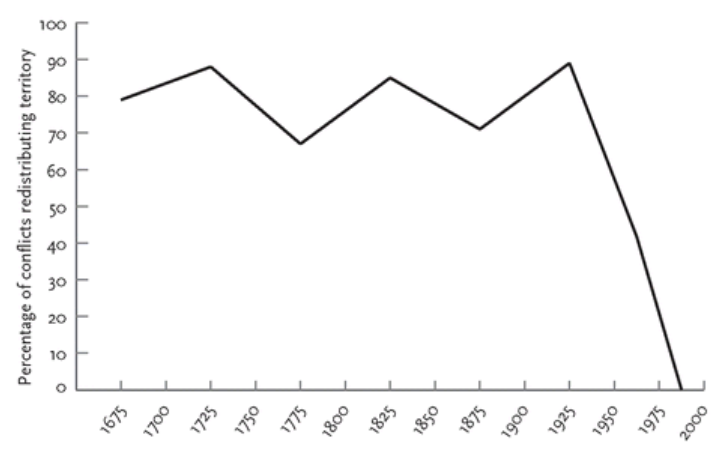
Pinker treats the post-1945 norm against changing borders by force as one component of the Long Peace. Mark Zacher’s series shows a steep decline in the share of territorial wars that ended in territorial redistribution. Pinker’s game-theoretic explanation is not that inherited borders are fair: an existing line can become a Schelling focal point, giving rivals a mutually recognizable stopping place when endless bargaining over the ideal map would be more dangerous.
Figure 5-21 — Territorial wars resulting in territorial redistribution, 1651–2000. The tradeoff matters here. Freezing borders can reduce interstate conquest while entrenching arbitrary divisions, stranding minorities, and—in Pinker’s account of the developing world—sometimes prolonging civil wars by making partition unavailable.
Pinker uses Israel as an “exception that proves the rule”: he says the 1949 armistice Green Line acquired international normative force despite not beginning as an agreed final border, and he predicted withdrawal from most remaining occupied territory, with land swaps and a special Jerusalem arrangement. That passage is Pinker’s 2011 description and forecast, not a current territorial inventory, a legal adjudication, or evidence for any particular final-status map. It belongs beside Wilf’s argument as a contrasting explanation of why an armistice line can become politically privileged. Chapter 5 synthesis · Attachment (file not included in this release) · Attachment (file not included in this release) · Attachment (file not included in this release)
🌅 The “Outside-In” Alternative
- The Abraham Accords flipped the old formula: normalize with the Arab states first, isolating the rejectionist core and reducing the Palestinian veto over regional peace. Oct 7 was partly an attempt to blow up Saudi-Israeli normalization.
🎯 Debate One-Liners
- “Israel never wanted peace” → Never is refuted by partition acceptance, treaties, Oslo recognition, withdrawals, and Israeli leaders who negotiated Palestinian statehood; the real dispute is which peace, on what terms, and whether it was implementable.
- “Just do two states” → The map is only one layer; finality, security, return, Jerusalem, institutions, and enforceable implementation have never aligned at the same moment.
- “One democratic state is the fair solution” → Specify the constitution, army, immigration rule, collective rights, vetoes, and exit guarantees. Equality is a principle; without institutions it is not yet a peace plan.
- “Gaza proves withdrawal cannot work” → It proves unilateral withdrawal without an agreed sovereign and security end-state can fail catastrophically; it does not by itself test a negotiated two-state treaty.
🔗 See Also
- Peace Offers · Right of Return · Zionism · Hamas · Gaza
- One State, Two States — Benny Morris on why binationalism fails
- We Should All be Zionists - Einat Wilf — “next to, not instead of”
- Israel Never Truly Wanted Peace with Palestine - Einat Wilf (Opposition Speech) — speech map, claim audit, strongest counter-case, and cross-examination