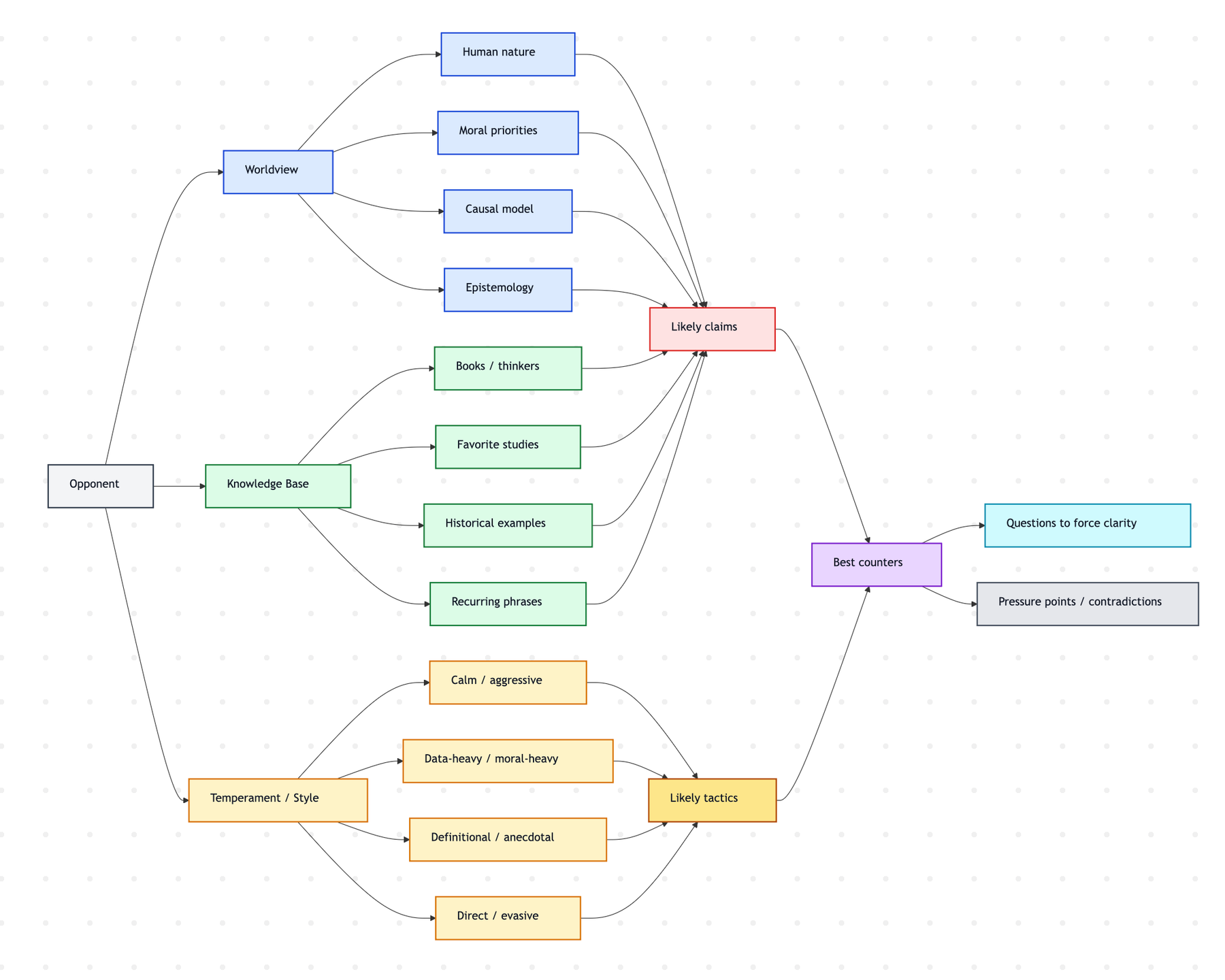
Creating predictive models for how people are going to argue is based around their worldview and knowledge base.
Opposition research, formalized. You’re not guessing at their conclusions — you’re deriving them. Three inputs, and each one narrows what they can say next.
The Three Inputs
1. Worldview — what they believe is true about the world
- Human nature · Moral priorities · Causal model · Epistemology
2. Knowledge base — what they’ve actually read and repeat
- Books / thinkers · Favorite studies · Historical examples · Recurring phrases
3. Temperament / style — how they behave under pressure
- Calm ↔ aggressive · Data-heavy ↔ moral-heavy · Definitional ↔ anecdotal · Direct ↔ evasive
The Two Outputs
| From | You get |
|---|---|
| Worldview + Knowledge base | Likely claims — the specific arguments they’ll reach for |
| Temperament / style | Likely tactics — how they’ll deliver and defend them |
Both feed best counters, which resolve into two prepared assets:
- Questions to force clarity → Socratic Questioning · Attacking An Argument > Questioning
- Pressure points / contradictions → Internal Critique · Debate - Argument Tree
Where this sits in the workflow
Step 1 of the Debate Playbook (MOC). Do it before case construction — knowing their likely claims tells you which branches of your own tree need to be deep. See Debate University Course > Opposition Research and Win Every Argument - Medhi Hasan > 15 DO YOUR HOMEWORK (Page 248).
Worked example → Andrew Wilson
Related → Theory of Mind · Constellation of Beliefs · People and their Beliefs