Zibaldone 2024–2025 journal
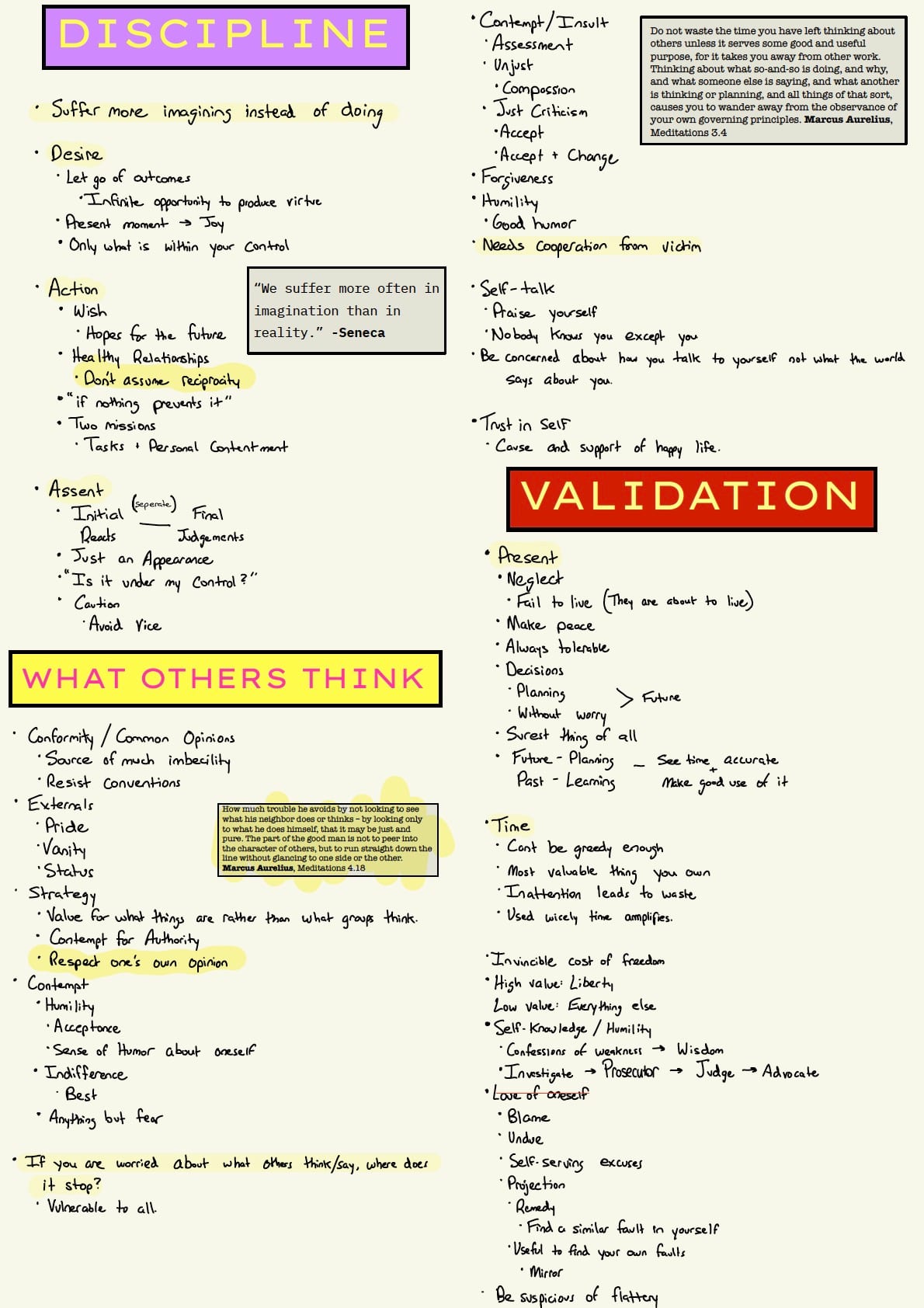
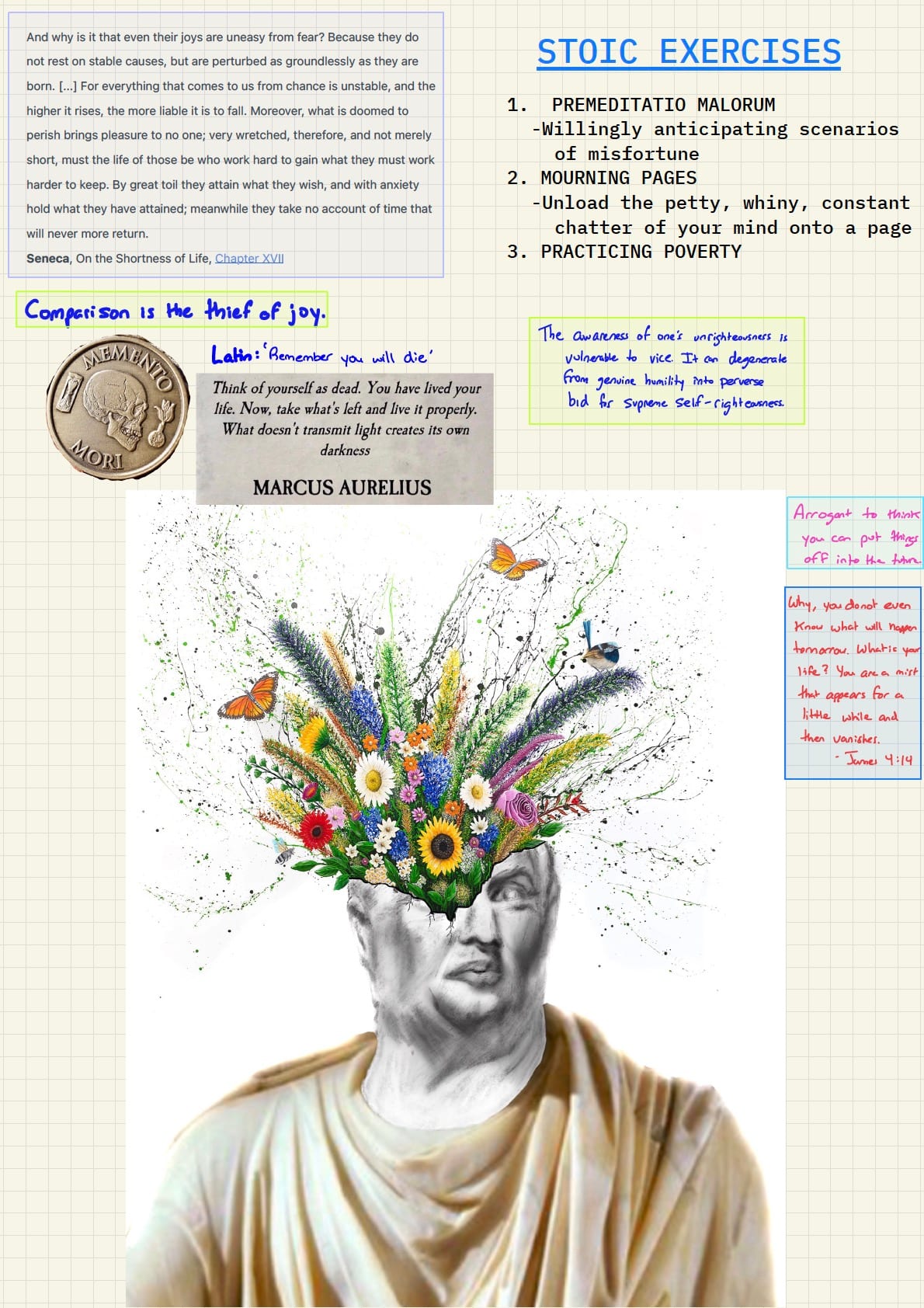
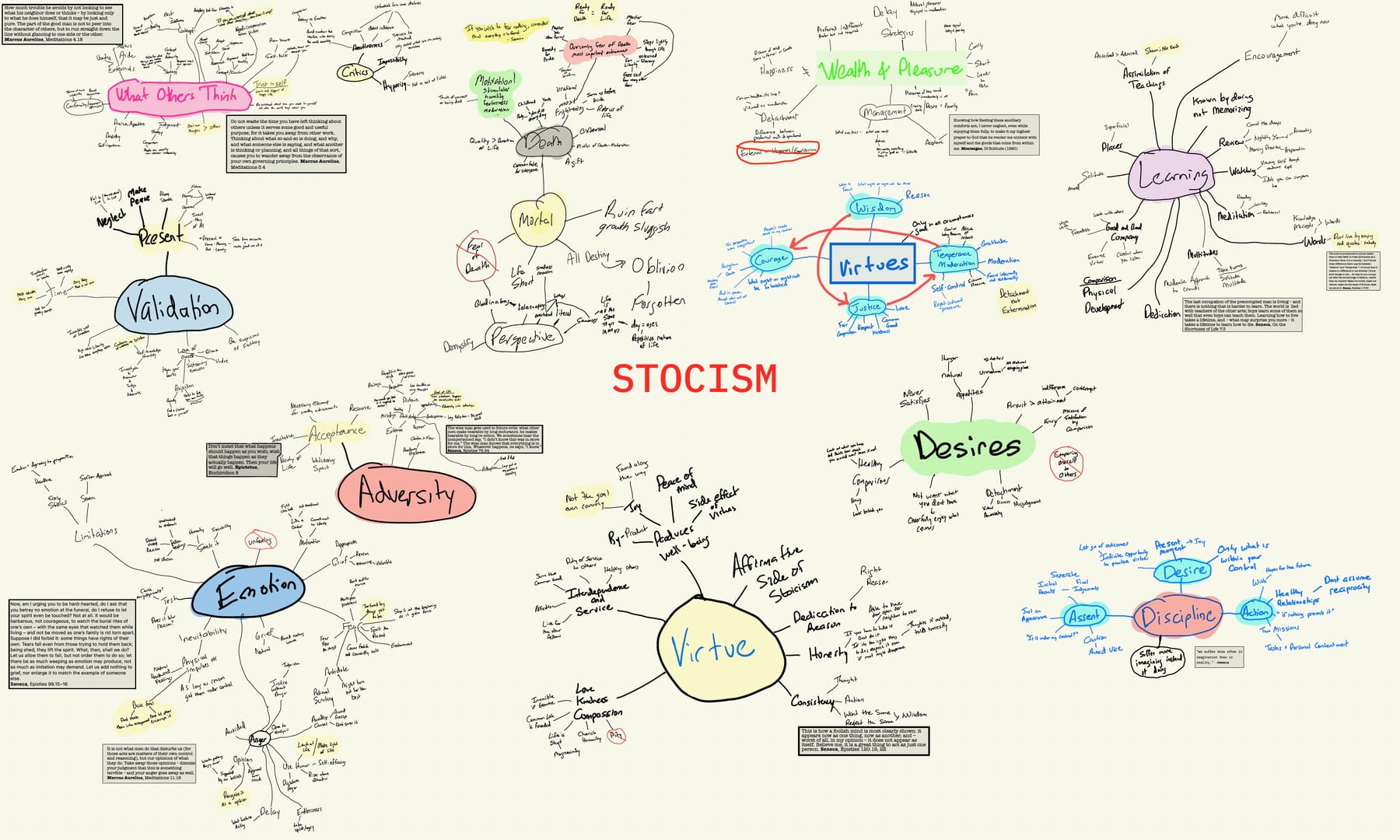
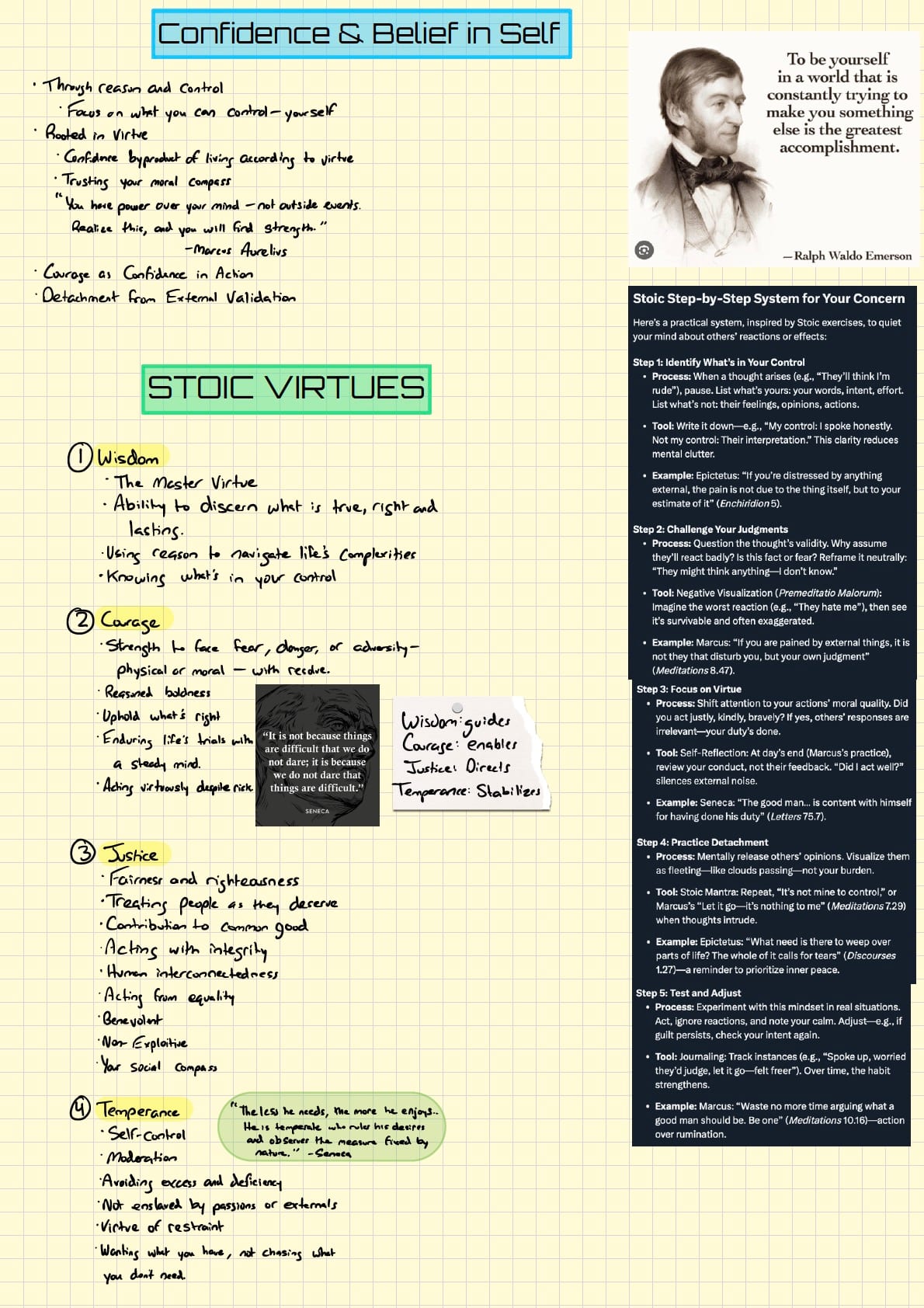
Journal connection: Stoic quotations, exercises, virtue diagrams, and notes on control, adversity, and practice.
Source boundary: These are captured journal materials; the integration does not independently verify every clipped claim, quotation, or figure.
PDF++ pages: p. 12 (file not included in this release) · p. 13 (file not included in this release) · p. 14 (file not included in this release) · p. 15 (file not included in this release) · p. 16 (file not included in this release) · p. 17 (file not included in this release) · p. 18 (file not included in this release) · p. 19 (file not included in this release) · p. 20 (file not included in this release) · p. 21 (file not included in this release)
p. 22 (file not included in this release) · p. 23 (file not included in this release) · p. 24 (file not included in this release) · p. 25 (file not included in this release) · p. 26 (file not included in this release) · p. 205 (file not included in this release) · p. 206 (file not included in this release) · p. 207 (file not included in this release) · p. 208 (file not included in this release) · p. 209 (file not included in this release)
p. 210 (file not included in this release) · p. 227 (file not included in this release)
Embedded preview:
Zibaldone 2024-2025.pdf (file not included in this release)
Open the complete Zibaldone page index
⬅️ Back to 60.12 Self-Improvement · Philosophy: 60.9 Philosophy · Schools of Thought (MOC) · Canvases: Stoicism (file not included in this release) · Stoic Virtues (file not included in this release)
The hub for the practical philosophy of Epictetus, Seneca, and Marcus Aurelius. Concepts first, then the library, cross-vault connections, and below that the full FAQ deep-dive (virtue, motivation, the goal of life, and the big misconceptions).
The one-line summary
“Some things are within your control, and others are not — and peace depends on knowing the difference.” → Dichotomy of Control
Core Concepts
- Dichotomy of Control — the foundational move: what is and isn’t up to you
- Courage — the cardinal virtue applied to fear, pain, loss, and social pressure
- Ego — the self, status, reputation, and pride as distortions of reason
- Fear & Anxiety — fear as opinion, not fact; preparation vs. worry
- Forgiveness · People's Reactions — externals you don’t control
- Sympathy vs Empathy — guarded compassion, not emotional fusion
- Stoic Compassion and Adam Smith's Sympathy — Epictetus and Seneca compared with Smith’s fellow-feeling and self-command
- Hume, Stoicism, and Whether Reason Can Motivate Moral Action — virtue as knowledge tested against Hume and contemporary neuroscience
- Can a Feeling Be Wrong - Stoics vs Hume and Hutcheson — can a feeling be false? Seneca and Epictetus against the sentimentalists
- Graver Audit - Correcting the Stoic Side of the Hume Comparison — why “reason governs passion” is not the Stoic view, checked against Graver
- Were insignificant — cosmic scale as perspective practice
- The four virtues (Wisdom · Courage · Justice · Temperance) → below
Practice
- How to Be Stoic in the Modern World — modern application (and the skeptical case)
- A Handbook for the New Stoics — 52 weekly exercises
- The Daily Stoic - Ryan Holiday — daily Perception, Action, and Will meditations · 72-story audit
- The Stoic Challenge - William B Irvine — setbacks as tests
- Discipline Is Destiny — Holiday on temperance · 79-story audit · story theme
- Cross-vault → 14 Choices a Stoic Should Make Every Day by Daily Stoic Highlights · How Stoicism Can Beat Your Social Media Addiction - Jonathan Haidt - YouTube
Primary Texts
- Meditations - Marcus Aurelius — the emperor’s private journal
- The Complete Works - Epictetus · How To Be Free - Epictetus — the slave-turned-teacher
- Letters on Ethics - Lucius Annaeus Seneca · How to Do the Right Thing - Lucius Annaeus Seneca (Philosophus) Seneca — the statesman
- People → Seneca · Epictetus
Modern Guides & Scholarship
- The Practicing Stoic — Farnsworth’s synthesis (best single modern overview)
- The Beginner's Guide to Stoicism by Matthew Van Natta
- Stoicism and Emotion - Margaret R Graver — the scholarly treatment of feelings vs. passions · audit → Graver Audit - Correcting the Stoic Side of the Hume Comparison
- Courage Under Fire - James Stockdale — Stoicism tested in a POW camp
- Lessons in Stoicism - John Sellars
Across the vault
- vs. other schools: Stoicism vs Aristotle's Ethics · Spinoza and the Stoics · Christianity borrowing from Stoicism · Christianity's Stoic Influences
- Psychology: Stoic_Psychology · Stoic_Test · Distorted Automatic Thoughts (CBT’s Stoic roots)
- Applications: The Daily Stoic story collection · The Discipline Is Destiny story collection · Discipline quotes (Seneca, Aristotle) · Enlightenment quotes (Epictetus, Marcus Aurelius) · Positivity quotes (Epictetus, Seneca) · Fear quotes
- Sister sections: Habit Building-Discipline-Time Management-Productivity · Mindfulness-Attention · Self-Esteem-Confidence-Happiness
🖼️ Visual summaries
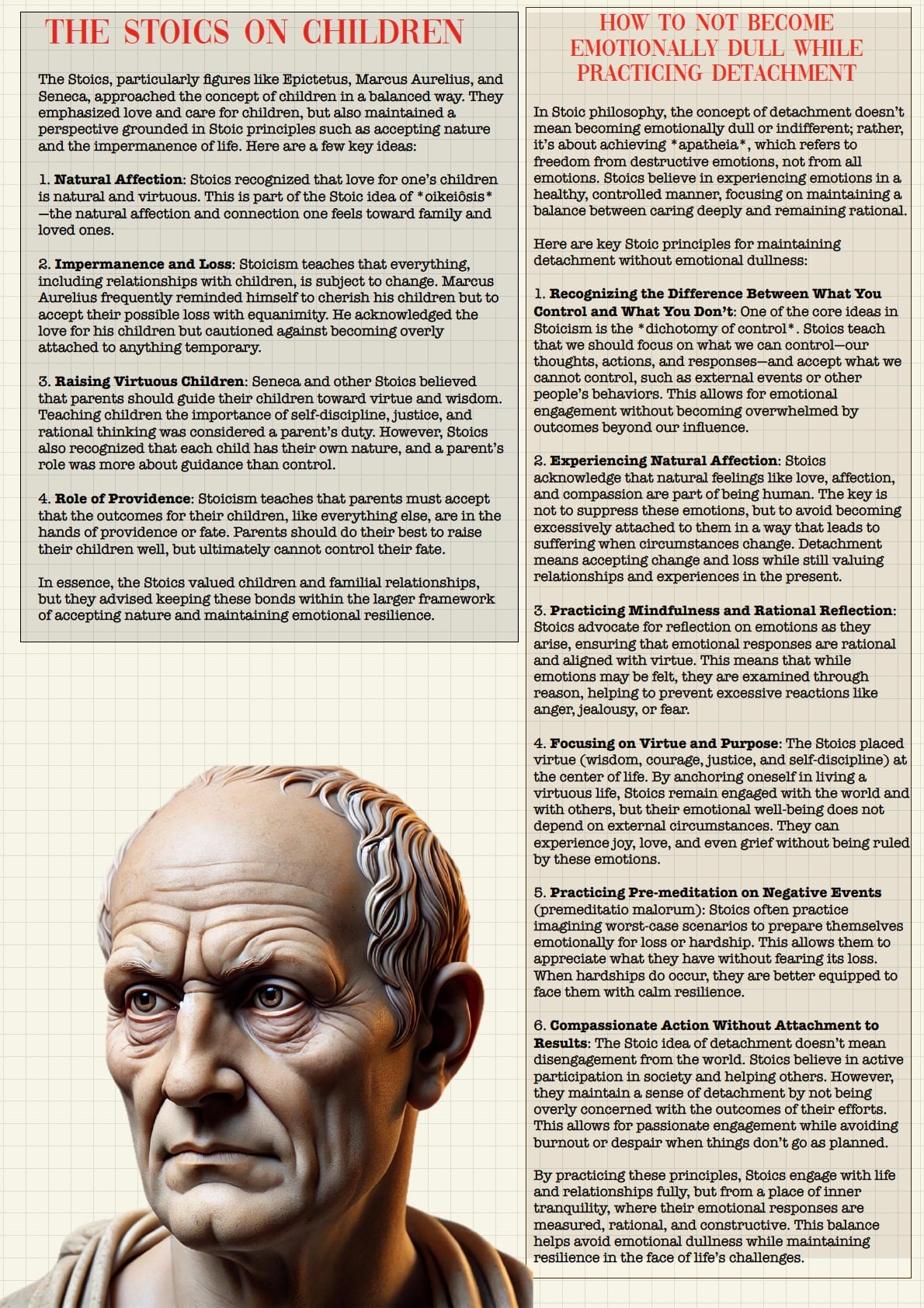
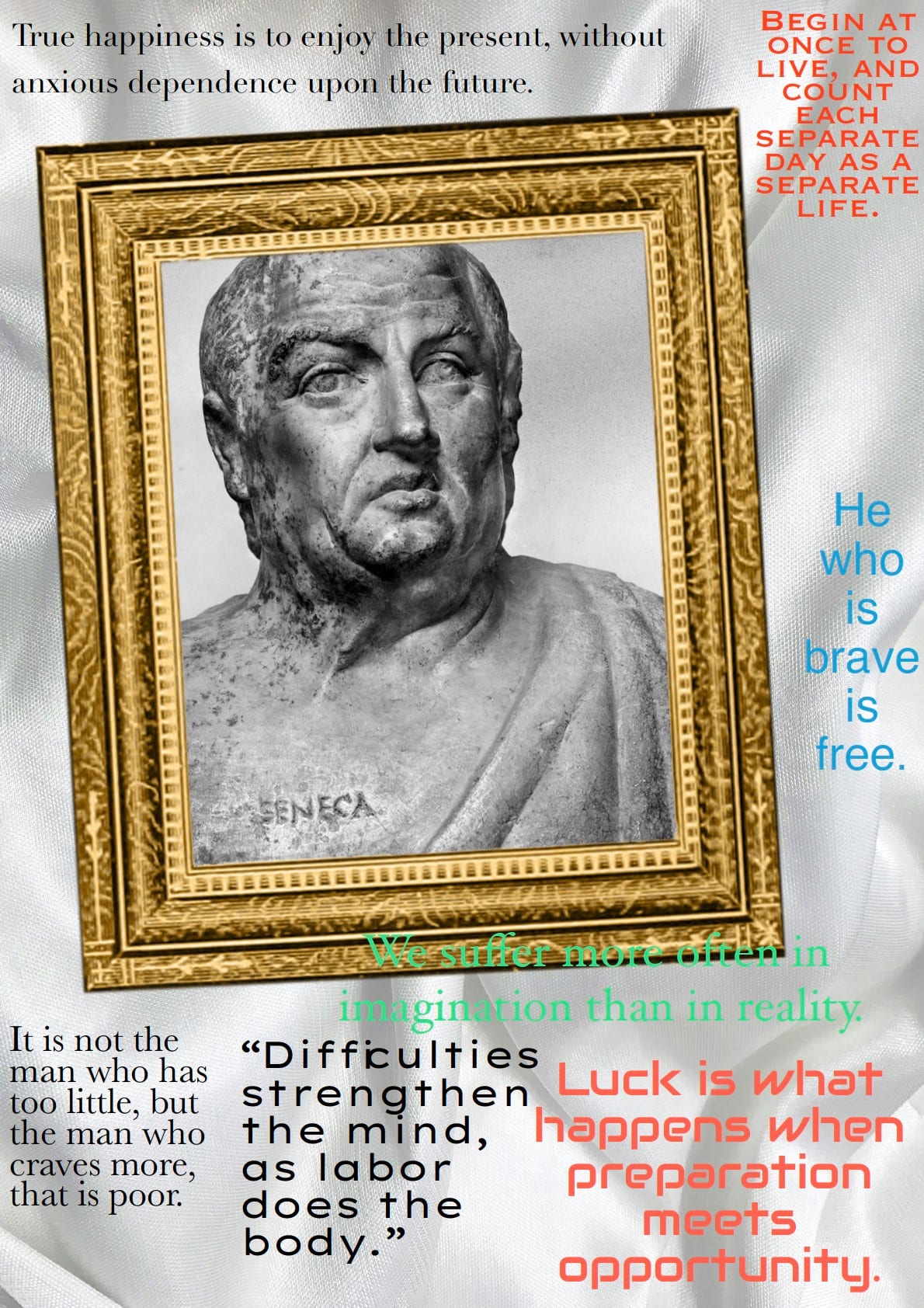
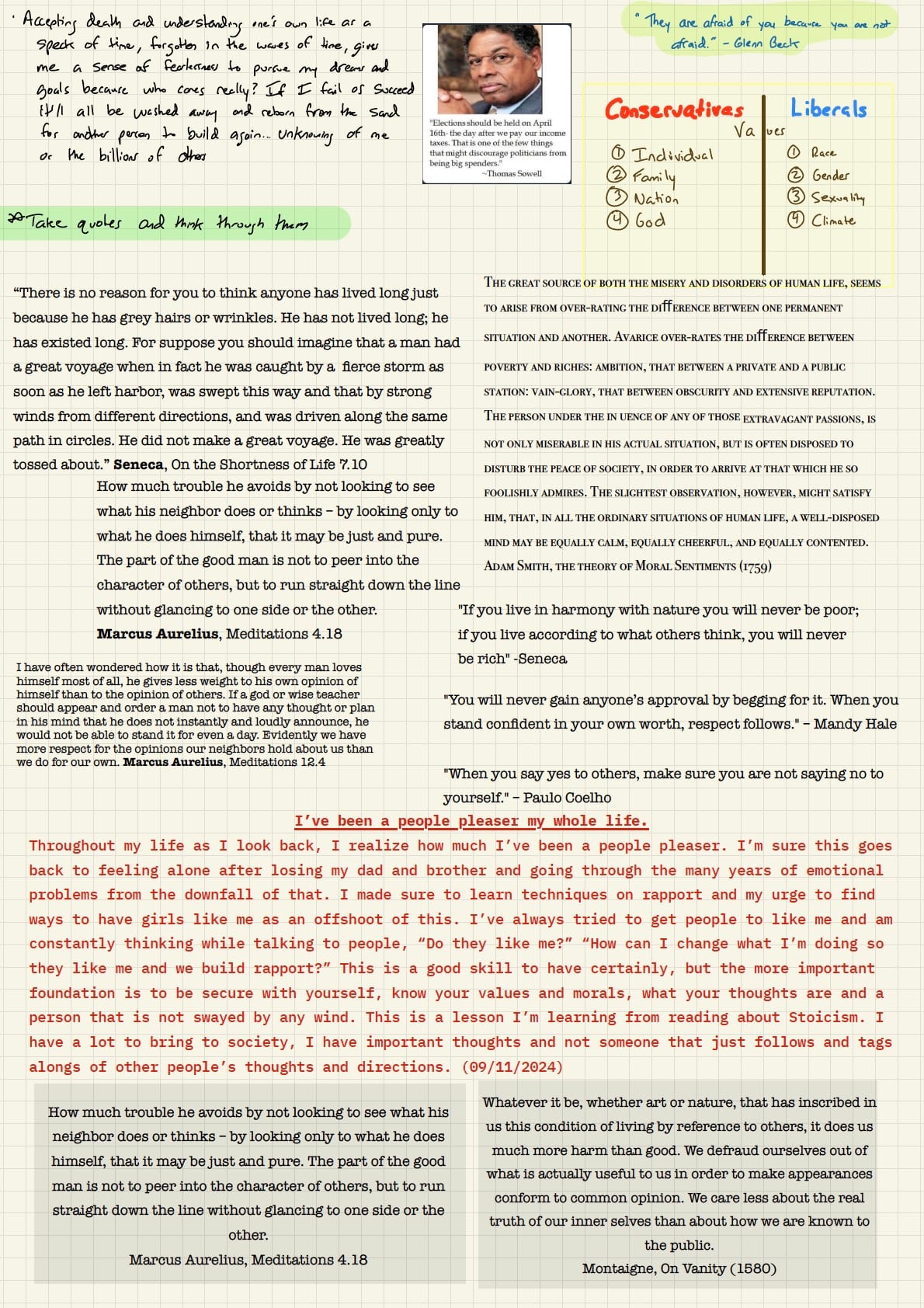
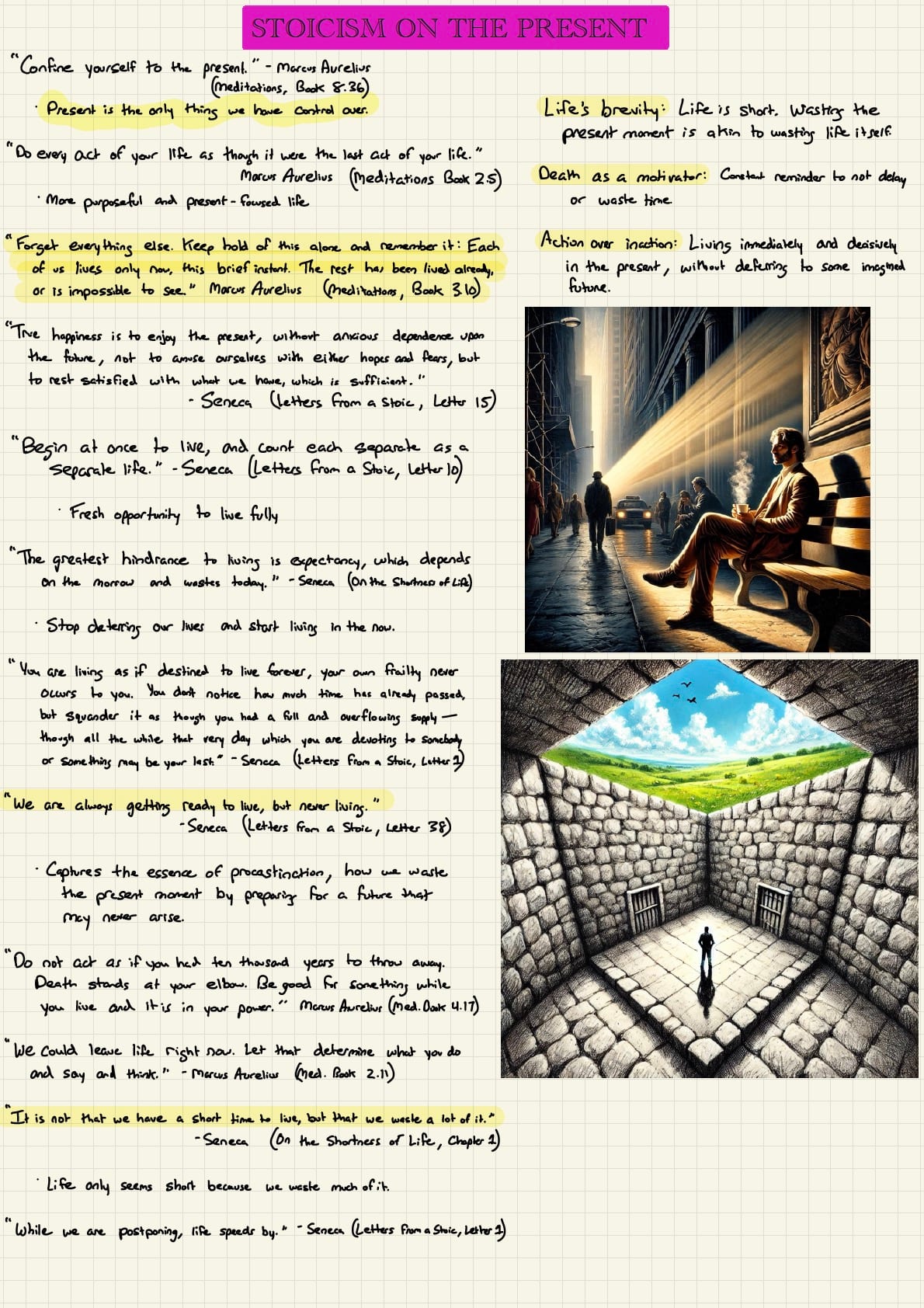
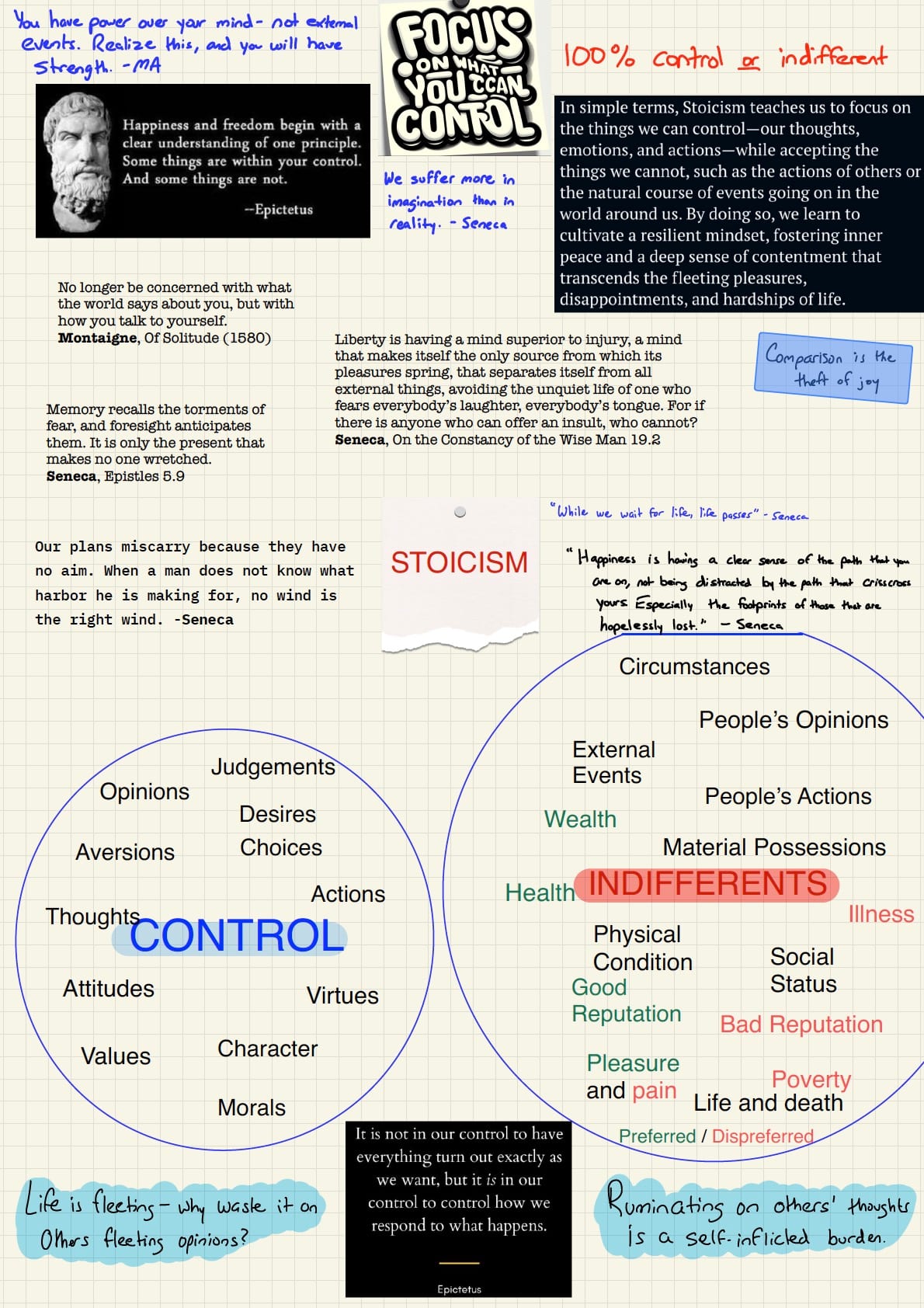
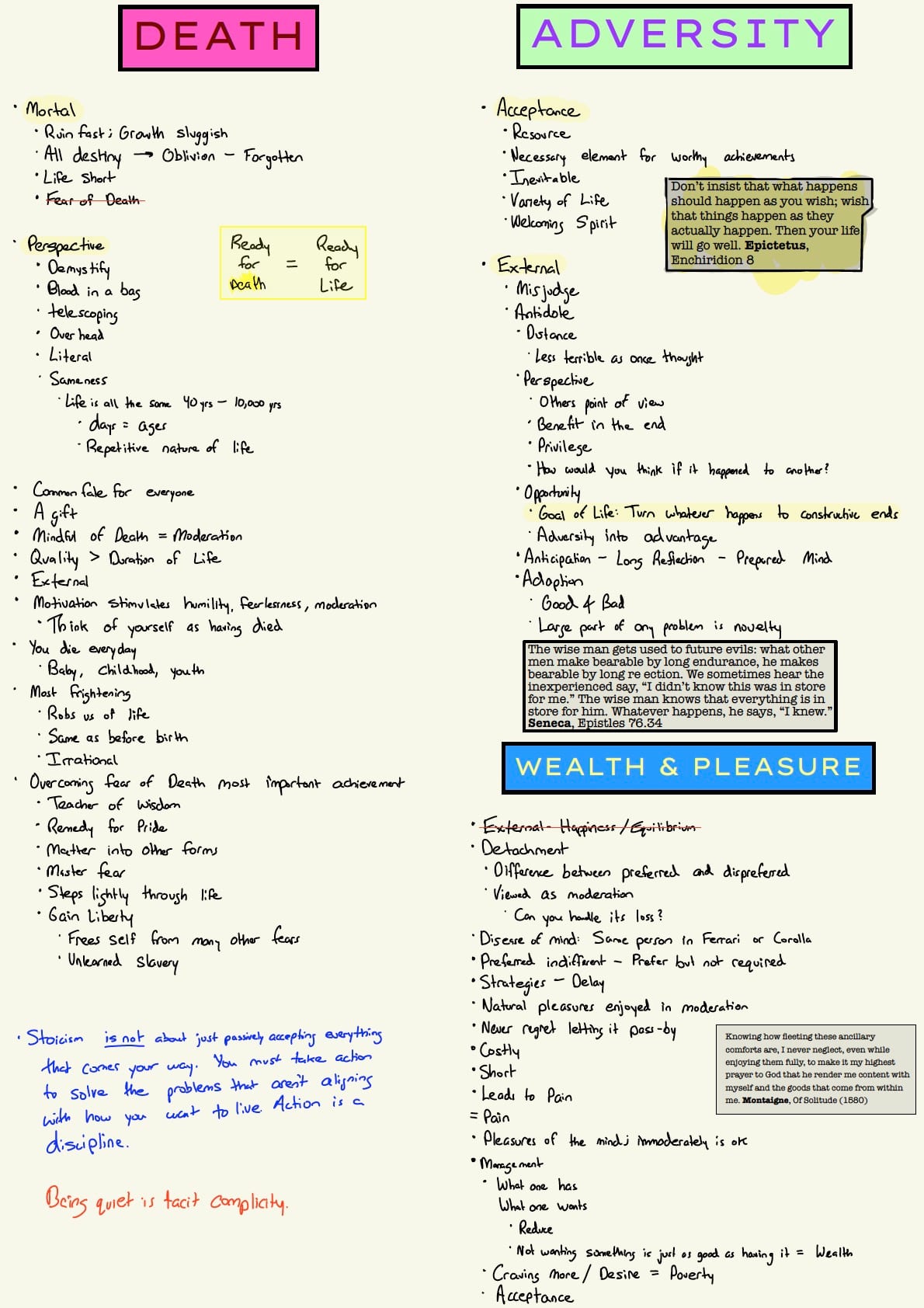
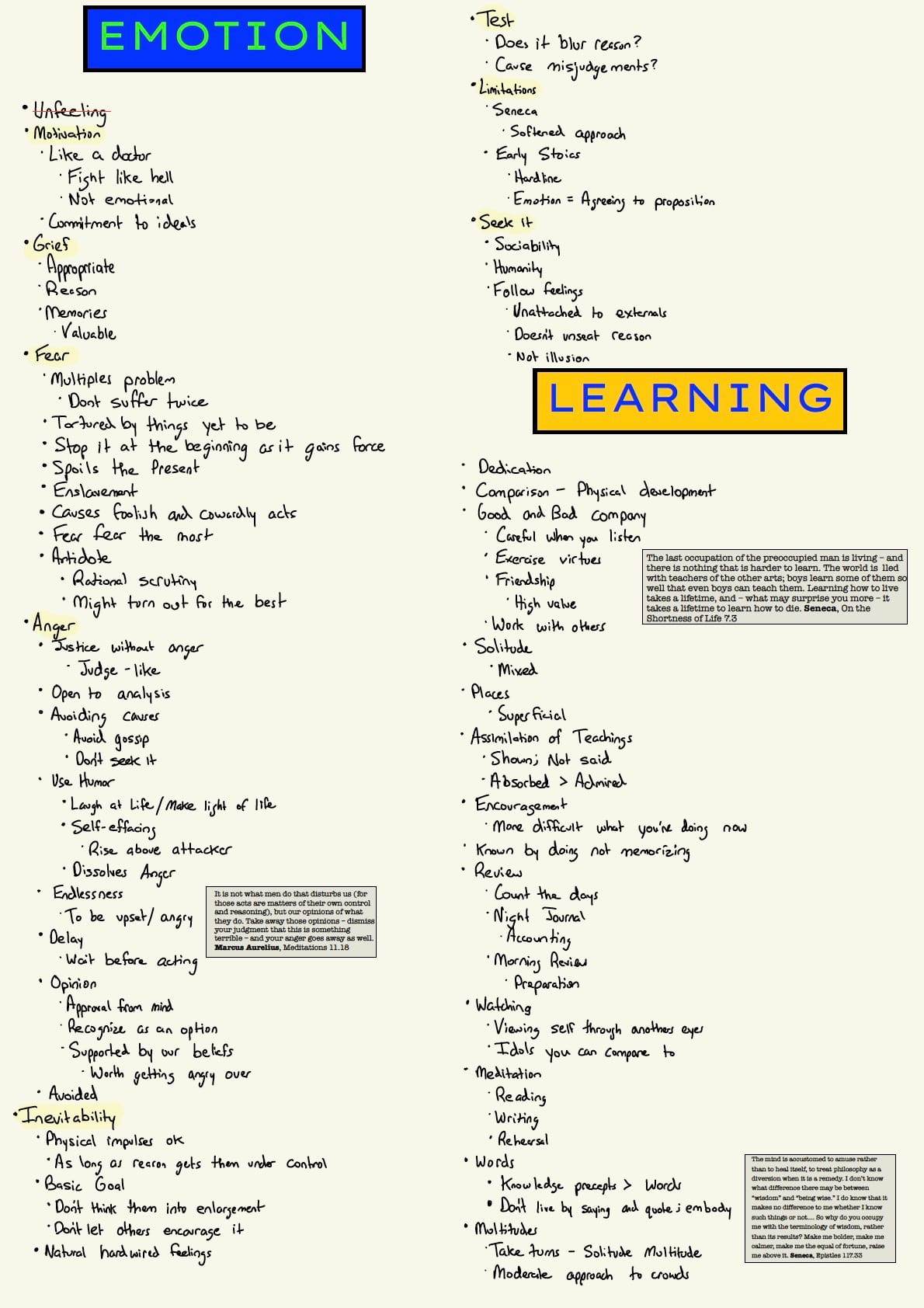
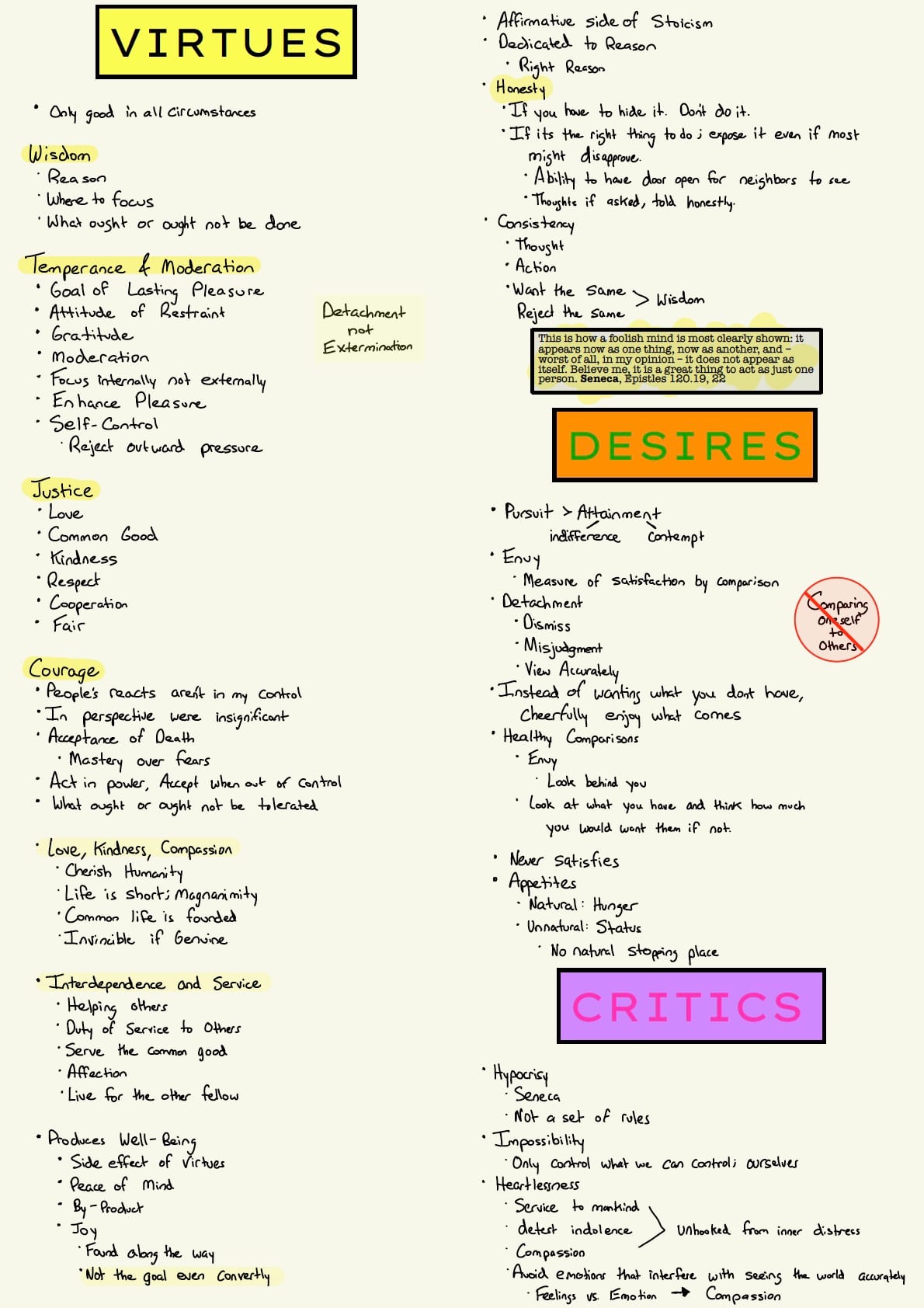
The Deep Dive (FAQ)
Virtues
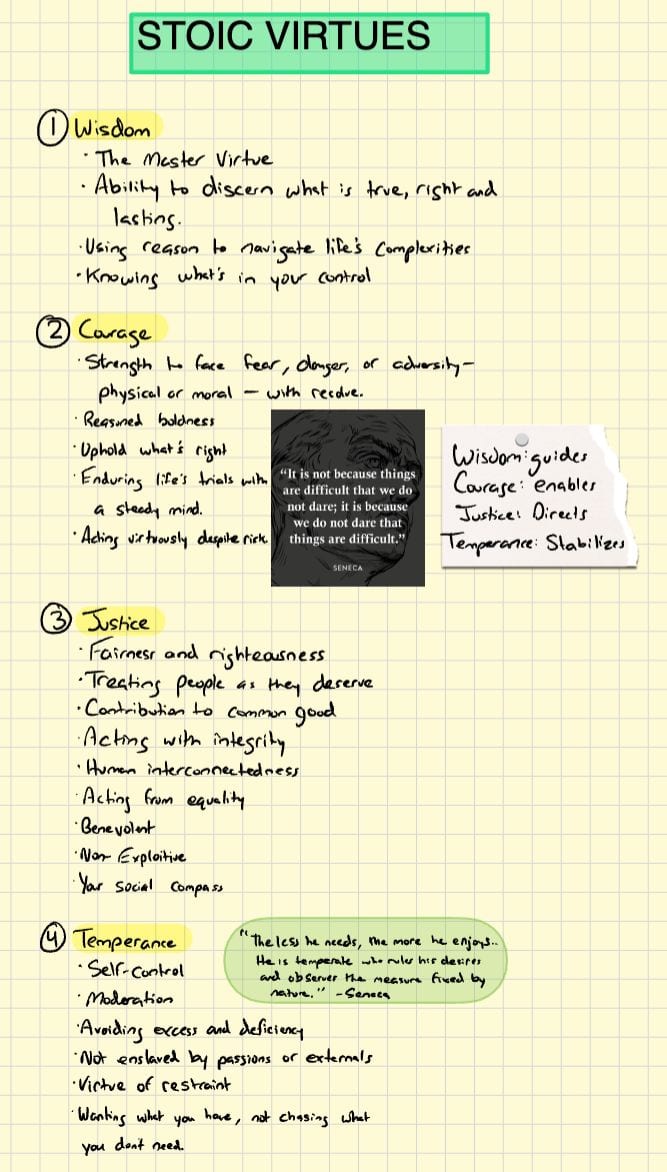
- Wisdom – Knowing what is good, bad, and indifferent, and applying reason to make sound decisions.
- Courage – The strength to act rightly in the face of fear, pain, or adversity.
- Justice – Treating others with fairness, integrity, and respect, recognizing our role within the broader human community.
- Temperance – Practicing self-control, moderation, and balance in all areas of life.
- A Guide to the 4 Stoic Virtues - Orion Philosophy
- Stoic Ethics | Internet Encyclopedia of Philosophy
What did the Stoics mean by “virtue?”
When applied to humans in the context of Stoic ethics, ἀρετή/arete (usually translated as “virtue”) meant something like “excellence of character,” and kalos/κάλος (sometimes translated as “virtuous,” but sometimes “honorable” or “becoming” instead) meant “morally beautiful.” The Stoics thought that the two referred to the same thing. There are two basic approaches to describing in more detail what the Stoics meant by “virtuous:” practical, and theoretical.
When offering practical advice, Stoic writers seem to assume that what is virtuous and what isn’t is pretty obvious. From Seneca’s Letter 71:
To infer the nature of this Supreme Good, one does not need many words or any round-about discussion; it should be pointed out with the forefinger, so to speak, and not be dissipated into many parts.
From Seneca’s On Benefits book IV:
Just as there is no law which bids parents love and indulge their children, seeing that it is superfluous to force us into the path which we naturally take, just as no one needs to be urged to love himself, since self-love begins to act upon him as soon as he is born, so there is no law bidding us to seek that which is honourable in itself; for such things please us by their very nature, and so attractive is virtue that the disposition even of bad men leads them to approve of good rather than of evil… Nature bestows upon us all this immense advantage, that the light of virtue shines into the minds of all alike; even those who do not follow her, behold her.
One’s ability to know what is virtuous is perhaps analogous to one’s ability to recognize certain sounds as being music. Although they did offer theoretical explanations, they did not rely on these to motivate being virtuous. You are not going to persuade anyone to take guitar lessons using a neurological account of why people like music, or definitions of music in terms of harmonics, beats, etc. The only real way to do it is to play them examples of music and say “see, that!”
The classical Stoics did something very similar in arguments for why virtue is the only good, or that the way to live a good life was to be virtuous. See, for example, paradox I of Cicero’s Stoic Paradoxes, or Seneca’s Letter 120, or Of a Happy Life. When trying to persuade their audience to be virtuous, they describe virtuous acts. There are also categorizations of virtues and vices. From Yonge’s 1853 translation of Lives and Opinions of Eminent Philosophers by Diogenes Laërtius:
Among the virtues some are primitive and some are derived. The primitive ones are prudence, manly courage, justice, and temperance. And subordinate to these, as a kind of species contained in them, are magnanimity, continence, endurance, presence of mind, wisdom in council…
… And analogously, of vices too there are some which are primary, and some which are subordinate; as, for instance, folly, and cowardice, and injustice, and intemperance, are among the primary vices; incontinence, slowness, and folly in counsel among the subordinate ones. And the vices are ignorance of those things of which the virtues are the knowledge.
Such virtuous and vicious character traits do seem to be widely (although perhaps not universally) admired and condemned even across cultures, and similar traits show up in modern psychology as well (see Peterson and Seligman’s character strengths and virtues, for example). The Stoics used this to get across what they were talking about when describing virtue much as someone trying to get across what they mean by “music” might use examples of performances or recordings of music.
The classical Stoics took a theoretical approach as well, perhaps analogous to a description of music in terms of patterns of sound and human psychology.
Diogenes Laërtius (VII.LII) lists a number of variations on the Stoic definition of “the chief good”, attributing them to a variety of different specific Stoics.
From Zeno, Cleanthes, Posidonius, and Hecaton:
The chief good was confessedly to live according to nature; which is to live according to virtue, for nature leads us to this point.
From Cleanthes:
Virtue is a disposition of the mind always consistent and always harmonious; that one ought to seek it out for its own sake, without being influenced by fear or hope by any external influence. Moreover, that it is in it that happiness consists, as producing in the soul the harmony of a life always consistent with itself; and that if a rational animal goes the wrong way, it is because it allows itself to be misled by the deceitful appearances of exterior things, or perhaps by the instigation of those who surround it; for nature herself never gives us any but good inclinations.
From Chrysippus:
To live according to virtue is the same thing as living according to one’s experience of those things which happen by nature… For our individual natures are all parts of universal nature; on which account the chief good is to live in a manner corresponding to nature, and that means corresponding to one’s own nature and to universal nature; doing none of those things which the common law of mankind is in the habit of forbidding, and that common law is identical with that right reason which pervades everything, being the same with Jupiter, who is the regulator and chief manager of all existing things.
From Diogenes of Babylon:
The chief good is to act according to sound reason in our selection of things according to our nature.
From Archidemus:
[The chief good is] to be living in the discharge of all becoming duties.
Arius Didymus, included in Stobaeus’s anthology, gives a similar catalogue, but asserts that Zeno’s original formulation was simply to “live consistently,” and that “with nature” was added by Cleanthes, his immediate successor.
By “nature” they mean something rather different from what a modern English speaker thinks of, such that these definitions just transform the question of what they meant by virtue to that of what they meant by “nature.” See this question, below.
They also have a theoretical discussion of how humans develop a concept of virtue, which is in itself informative (on a theoretical level) concerning what they thought “virtue” is. See this page on oikoiosis.
What motivates a Stoic?
Zeno of Citium, the founder of Stoicism, is said to have become interested in philosophy after reading from the second volume of Xenophon’s Memorabilia of Socrates, which contains Prodicus’s fable of Heracles at the crossroads, in which a young Heracles (a.k.a. Hercules) has to make a choice between following the “easy” road of vice, or the hard road of virtue, and chooses virtue over vice. Inspired, Zeno asked the bookseller where such men could be found, and was told to follow Crates the Cynic, who was walking nearby. Zeno then studied Cynicism under Crates, and then other philosophies from other teachers, and ultimately founded Stoicism.
Imitation is a basic human impulse. Children imitate their parents and others around them. Adults continue to have an instinct to imitate those they admire, adopting role models, heroes, and (when taken to an extreme) idols. We react to others and ourselves with admiration or disgust, pride or shame. We have a strong natural impulse to be good and admirable ourselves. If this were not the case, then low self-esteem would not be unpleasant, or high self-esteem, pleasant.
High self-esteem was not in itself, however, a goal of the Stoics. What the Stoics were after could not have been supplied by an experience machine. Instead, they focused on judging ones-self accurately and fairly (see, for example, the end of Epictetus’s Discourse 1.12), and then actually being worthy of esteem: of being virtuous. Put differently, the feeling of being a good person was not the goal, but rather the Stoics were attempting actually to achieve excellence.
When trying to motivate readers, Stoic writers routinely show off the virtues, either abstractly (as in the preface to book 3 of Natural Questions by Seneca), or through specific examples of virtues in people (book 1 of Marcus Aurelius’s Meditation_consists entirely of examples of this), or incidents of people being virtuous. Epictetus often uses Socrates, Heracles, and less famous figures such as Helvidius Priscus as examples, Seneca uses Cato, Cicero uses [Marcus Regulus](https://en.wikipedia.org/wiki/Marcus_Atilius_Regulus(consul267_BC)). Finally, admiration of the gods and the natural beauty of the world was used by the Stoics to inspire virtue; see Cicero’s [_Tusculan Disputations](http://www.gutenberg.org/files/14988/14988-h/14988-h.htm) 5.68-72 (chapter 24 in the linked to translation) or Seneca’s letter 41.
In short, an ideal Stoic is not motivated by the possible consequences of being virtuous, not even the pleasure of high self-esteem, but rather by the reward of being virtuous, of being like one’s heroes and role models in the ways that make them heroic or good role models. From Seneca’s Of a Happy Life Book 9 (Stewart’s translation):
In the first place, even though virtue may afford us pleasure, still we do not seek after her on that account: for she does not bestow this, but bestows this to boot, nor is this the end for which she labours, but her labour wins this also, although it be directed to another end. As in a tilled-field, when ploughed for corn, some flowers are found amongst it, and yet, though these posies may charm the eye, all this labour was not spent in order to produce them — the man who sowed the field had another object in view, he gained this over and above it — so pleasure is not the reward or the cause of virtue, but comes in addition to it; nor do we choose virtue because she gives us pleasure, but she gives us pleasure also if we choose her. The highest good lies in the act of choosing her, and in the attitude of the noblest minds, which when once it has fulfilled its function and established itself within its own limits has attained to the highest good, and needs nothing more: for there is nothing outside of the whole, any more than there is anything beyond the end. You are mistaken, therefore, when you ask me what it is on account of which I seek after virtue: for you are seeking for something above the highest. Do you ask what I seek from virtue? I answer, Herself: for she has nothing better; she is her own reward. Does this not appear great enough, when I tell you that the highest good is an unyielding strength of mind, wisdom, magnanimity, sound judgement, freedom, harmony, beauty? Do you still ask me for something greater, of which these may be regarded as the attributes? Why do you talk of pleasures to me? I am seeking to find what is good for man, not for his belly; why, cattle and whales have larger ones than he.
What is the goal of life?
The Stoics (and Greek and Roman rival schools of philosophy) expressed the “big question” of the goal of life in a variety of different ways. One of these was, indeed, to ask what the final goal of life is: if everything we do (or should do), is a means to some end, an end in itself (not requiring justification as a means to some other end), or a combination of the two, what is the goal that is the ultimate end?
Another way the Greek and Roman philosophers expressed this is by asking what it means to achieve εὐδαιμονία/eudaimonia. Eudaimonia is commonly translated as “happiness,” but also sometimes as “blessedness,” “flourishing,” or “prosperity.” All of these English translations have misleading connotations. For example, it does not necessarily refer to a pleasant life as “happiness” does in English, or intervention by a deity as “blessedness” does, etc. When Aristotle was introducing his own answer in Nicomachean Ethics (similar in some ways to the Stoic answer, different in others), he expressed the problem like this (in section 1.4 (translation by D. P. Chase)):
Let us resume our inquiry and state, in view of the fact that all knowledge and every pursuit aims at some good, what it is that we say political science aims at and what is the highest of all goods achievable by action. Verbally there is very general agreement; for both the general run of men and people of superior refinement say that it is happiness, and identify living well and doing well with being happy; but with regard to what happiness is they differ, and the many do not give the same account as the wise. For the former think it is some plain and obvious thing, like pleasure, wealth, or honour; they differ, however, from one another- and often even the same man identifies it with different things, with health when he is ill, with wealth when he is poor; but, conscious of their ignorance, they admire those who proclaim some great ideal that is above their comprehension. Now some thought that apart from these many goods there is another which is self-subsistent and causes the goodness of all these as well. To examine all the opinions that have been held were perhaps somewhat fruitless; enough to examine those that are most prevalent or that seem to be arguable.
The Stoics claimed that virtue was necessary and sufficient for εὐδαιμονία/eudaimonia. Marcus Aurelius expresses it clearly in Meditations 8.7. In Chrystal’s translation:
For every nature it is sufficient that it goes on its way, and prospers. The rational nature prospers while it assents to no false or uncertain opinion, while it directs its impulses to unselfish ends alone, while it aims its desires and aversions only at the things within its power, and while it welcomes with contentment all that universal Nature ordains.
In Discourse 4.5, Epictetus expresses the same idea, but in terms of its inverse (Matheson’s translation):
When is a horse miserable? When it is deprived of its natural faculties, not when it is unable to crow like a cock, but when it is unable to run. And the dog? Not when it cannot fly, but when it cannot follow a trail. On the same principle a man is wretched, not when he cannot throttle lions or embrace statues (for he has not been endowed by nature with faculties for this), but when he has lost his rational and trustworthy faculty…
Epictetus goes on to describe the “qualities that make him man, the distinctive stamp impressed upon his mind”, listing them as “Gentle, sociable, patient, affectionate.”
Epictetus expands on this in Discourse 4.1:
For when is a vine faring badly? When it is acting contrary to its own nature. When is a cock faring badly? Under the same conditions. So also man. What, then, is his nature? To bite, and kick, and throw into prison, and behead? No, but to do good, to work together, and to pray for the success of others. Therefore, he is faring badly, whether you will or no, when he acts unfeelingly.
You imply, then, that Socrates did not fare badly? — He did not; it was his judges and accusers who fared badly. — Nor Helvidius at Rome? — No, but the man who put him to death. — How so? — Just as you too do not say that the cock which has won a victory, even though he be severely cut up, has fared badly, but rather the one who has been beaten without suffering a blow. Nor do you call a dog happy when he is neither in pursuit nor toiling hard, but when you see him sweating, suffering, bursting from the chase. What is there paradoxical in the statement, if we say that everything’s evil is what is contrary to its own nature? Is that paradoxical? Do you not say it yourself in the case of everything else? Why, then, do you take a different course in the case of man alone? But our statement that the nature of man is gentle, and affectionate, and faithful, is this not paradoxical? — No, that is not paradoxical, either. — How, then, does it come about that he suffers no harm, even though he is soundly flogged, or imprisoned, or beheaded? Is it not thus — if he bears it all in a noble spirit, and comes off with increased profit and advantage, while the other man is the one who suffers harm, the man who is subjected to the most pitiful and disgraceful experience, who becomes a wolf, or a snake, or a wasp, instead of a human being?
There were, of course, many who disagreed with them. One major objection was that virtue itself was only valuable because of what it produces — happiness, prosperity or health for one’s self or one’s community, etc. The Stoics insisted that virtue was not valuable because of these things, but that being virtuous was more like a sport or a performance art like dancing than something like painting or shoe-making. It does produce side effects, but these are incidental. An archery contest results in arrows sticking out of targets, but archers do not enter such contests because there is anything inherently good about arrows being in targets. Expressed in terms from modern psychology, the Stoic view was that the motivation for true virtuous action is intrinsic, not extrinsic.
Another objection (from the Peripatetics, followers of Aristotle) was that, although virtue was central, additional circumstances are required. Virtue, the Peripatetics and Stoics agreed, was a kind of art: the art of living. Just as an art like shoe making requires tools and materials to be practiced, so the Peripatetics claimed that a virtuous life required at least some minimal resources for its practice. The Stoics, on the other hand, claimed that virtue can be practiced in any circumstance, although it might take different forms. In some cases, perhaps the only virtue that can be practiced is endurance, but this still is practicing virtue.
A number of sources discuss the Stoic’s “ultimate goal” in depth. Cicero’s On Ends compares the claims of several philosophical schools, including that of the Stoics (whose view is described in book 3). Seneca provides a short account in Letter 71, and a more in-depth discussion in the essay “Of a Happy Life”. The Morality of Happiness by Julia Annas provides a modern scholarly account of eudaimonism, with a particular emphasis on Aristotle and the Stoics, and a good discussion of the similarities and differences between the two.
How do I find meaning in life?
The question of how to find a feeling of meaning is related to the problem of identifying the goal, but it is not the same. The feeling of a lack of such purpose arises from the belief that one is not achieving ones actual purpose, and so can be symptomatic of either of two things: a misunderstanding of what one’s goal actually is, and actually not achieving it. The way to achieve a sense of meaning, then, is to properly understand ones true purpose, and then actually achieve it, which is done through engaging in virtuous endeavors (being virtuous). This is discussed at greatest length and detail by Seneca in his essay “Of Peace of Mind”. From the Stoic point of view, it is important to remember that it is not the feeling of a sense of meaning that is important. Rather, the feeling is merely a useful tool for identifying when one is not living as virtuously as one might, so that one might change how one lives when such change is needed.
Feeling like your life is meaningless is a symptom of your not really believing that you are living a meaningful life. The solution to finding meaning, then, is to make sure that you are evaluating your own life fairly, and then to change how you are living to match that understanding. Judging your life fairly entails distinguishing what you can and cannot control (what you are or are not responsible for, virtue or externals), and exerting yourself fully in ways you find κάλος (admirable or morally beautiful). What these endeavors might be depends on your circumstance. If someone is in significant hardship and little power, defiance or dignified resilience may be the most admirable course (and in extreme hardship, these can be admirable indeed), while those with more power have a broader scope. In any case, the endeavor chosen and the way of reacting to it depend on each individual’s nature (personal character) (see Cicero’s On Duties, 1.110-1.114).
The association between the exercise of virtue and fulfillment, life satisfaction, or subjective well-being is a feature not only of Stoicism but other philosophies as well (including rivals such as Epicureanism), although the details of how they are related vary. The association is also seen in modern psychology. See, for example, van Zyl et al. 2021, Proyer et al. 2015, and the many other studies they cite.
Misconceptions
Is it true that Stoics repress their emotions and feelings?
The Greek word pathos (πάθος) is often translated as “emotion” in English, but the Greek word (at least in the context of Stoic philosophy) does not refer to everything the English word “emotion” denotes. The Stoics did consider many emotions to be pathoi, including all emotions that might cause one to act other than according to one’s conscience and best judgement, or otherwise disrupt one’s life. (See Cicero’s On Ends 3.35 (end of book 3, ch. 10), Epictetus’s Discourse 3.2, Diogenes Laertius’s Lives and Opinions 7.110-114 (book 8, ch. 63-64).) However, there are a variety of other feelings an English speaker would consider to be emotions that a Stoic would not have considered to be pathos, and that the Stoics either approved of or advocated indifference to. Even in the case of pathos, they did not advocate repression, but rather treatment and prevention. See the start of book II of Seneca’s On Anger for a list of examples of emotions that are not pathoi. Affection seems to have been particularly highly regarded. For example, Marcus Aurelius admires one of his teachers as being “utterly impervious to all passions and full of natural affection” (Meditations I.9), and there were even Stoic psychological exercises explicitly aimed at cultivating affection (see the quote here).
Different translators handle the poor match between Stoic technical jargon and modern English in different, contradictory ways. For example, some translators translate pathos as “emotion” and propathos as “feeling”, while others (very confusingly) translate pathos as “passion” and propathos as “emotion” (or sometimes “pre-passion”). One way to avoid ambiguity is to think of them as “feeling” and “passion,” and use “emotion” to mean either.
Passions (πάθοι) are emotions caused or reinforced by a belief something outside of one’s control is good or bad. Feelings, on the other hand, are closer to perceptions we have, and not things either to be controlled or avoided; a Stoic “merely” should avoid being led by them to false beliefs about good and bad. The distinction is analogous to seeing an optical illusion, where “feeling” corresponds to “seeing” the illusion, while “passion” is corresponds to actually believing it. Marcus Aurelius expresses it like this (Meditations 5.25, Chrystal’s translation):
Let the leading and ruling part of your soul stand unmoved by the stirrings of the flesh, whether gentle or rude. Let it not commingle with them, but keep itself apart, and confine these passions to their proper bodily parts; and if they rise into the soul by any sympathy with the body to which it is united, then we must not attempt to resist the sensation, seeing that it is of our nature; but let not the soul, for its part, add thereto the conception that the sensation is good or bad.
Unlike the full scope of what “emotions” and “feelings” refer to in English, πάθος/passions necessarily involve judgements and values: feelings that “rise into the soul by any sympathy with the body to which it is united” are not to be resisted. To be a passion, the rational mind needs to participate in the creation of the feeling: it needs to judge something good or bad. From Seneca’s On Anger 2.3 (discussing the passion of anger specifically):
None of these things which casually influence the mind deserve to be called passions: the mind, if I may so express it, rather suffers passions to act upon itself than forms them. A passion, therefore, consists not in being affected by the sights which are presented to us, but in giving way to our feelings and following up these chance promptings: for whoever imagines that paleness, bursting into tears, lustful feelings, deep sighs, sudden flashes of the eyes, and so forth, are signs of passion and betray the state of the mind, is mistaken, and does not understand that these are merely impulses of the body. Consequently, the bravest of men often turns pale while he is putting on his armour; when the signal for battle is given, the knees of the boldest soldier shake for a moment; the heart even of a great general leaps into his mouth just before the lines clash together, and the hands and feet even of the most eloquent orator grow stiff and cold while he is preparing to begin his speech. Anger must not merely move, but break out of bounds, being an impulse: now, no impulse can take place without the consent of the mind: for it cannot be that we should deal with revenge and punishment without the mind being cognisant of them. A man may think himself injured, may wish to avenge his wrongs, and then may be persuaded by some reason or other to give up his intention and calm down: I do not call that anger, it is an emotion of the mind which is under the control of reason.
The practical dividing line between a passion and feeling, the question of which feelings are caused by judgements or prevent us from acting according to our best judgement, has been the subject of some debate. Some regard as “passions” only emotional problems of the sort one might see as requiring counselling for depression, anger management, or similar issues, while others see the majority of what a modern person thinks of as “emotions” as being passions, and that “feelings” are limited to emotions of the variety caused by reactions to music or fiction.
Even concerning emotions they considered pathological (passions), “repression” is not what the Stoics advocated, but rather extirpation. “Repressing” an emotion is somewhat analogous to getting a broken leg, but not treating it and attempting to walk on it normally, because that is what a healthy person would do. What the Stoics advocated was more analogous to healing the leg, and preventing it from being broken in the first place.
For a more extended discussion and related quotes and extracts from classical texts, see this /r/Stoicism wiki page. For a much more in-depth analysis and discussion of historical evidence, consult Margaret Graver’s Stoicism and Emotion.
Does Stoicism encourage passively accepting your fate?
While the Stoics did advocate acceptance of all externals, “acceptance” seems to have been meant in the context of one’s emotional reaction, rather than in actions to be taken, or not. It does not seem to imply passivity in action. Indeed, in Marcus Aurelius’s Meditations, his exhortations of acceptance are often accompanied by exhortations to virtuous action. For example, see Meditations 9.6:
It is enough if your opinion in the present is based on understanding, your action in the present directed to the common good, and your disposition in the present one of contentment with all that befalls you from a cause outside yourself.
and 8.7:
Every nature is well content when its progress is good. And the progress of a rational creature is good when that nature yields to nothing false or obscure in thought, when it directs its impulses to social acts alone, and when its appetites and aversions are confined to what is within our power, and when it has a welcome for every dispensation of the universal Nature.
(Jackson translation, modernized)
The same themes are paired many other places; for much more discussion and many similar citations, see Hadot’s The Inner Citadel.
The Meditations includes other exhortations to action and against passivity. Consider 9.16:
Not in passivity but activity lies the good of the rational and civic being, precisely as virtue and vice to the same lie in action not in passion.
and also 9.5:
Injustice lies as often in omission as commission.
What is important is to be a good person, to be virtuous, to show excellence of character. These are ἐφ’ ἡμῖν (eph’ hêmin), “attributable to us.” What should be accepted are things not in your control, “all that befalls you from a cause outside yourself.”
Consider the example of Priscus Helvidius from Epictetus’s Discourses, book 1:
Priscus Helvidius also saw this, and acted conformably. For when Vespasian sent and commanded him not to go into the senate, he replied, “It is in your power not to allow me to be a member of the senate, but so long as I am, I must go in.” “Well, go in then,” says the emperor, “but say nothing.” “Do not ask my opinion, and I will be silent.” “But I must ask your opinion.” “And I must say what I think right.” “But if you do, I shall put you to death.” “When then did I tell you that I am immortal? You will do your part, and I will do mine: it is your part to kill; it is mine to die, but not in fear: yours to banish me; mine to depart without sorrow.”
In this example, we see Priscus Helvidius persistently acting as he thinks a virtuous person should act, without regard to the consequences for himself.
It should be remembered that Marcus Aurlius wrote his exhortations for himself alone, when he was already emperor. Stoic advice to others was not generally to be so selfless, or lacking in ambition; humility and selflessness were given much less emphasis in the Stoic conception of virtue than in the Christian.
From Cicero’s On Duties 3.10, quoting Chrysippus:
And yet we are not required to sacrifice our own interest and surrender to others what we need for ourselves, but each one should consider his own interests, as far as he may without injury to his neighbour’s. “When a man enters the foot- race,” says Chrysippus with his usual aptness, “it is his duty to put forth all his strength and strive with all his might to win; but he ought never with his foot to trip, or with his hand to foul a competitor. Thus in the stadium of life, it is not unfair for anyone to seek to obtain what is needful for his own advantage, but he has no right to wrest it from his neighbour.”
… although everyone did have social responsibilities: from Cicero’s On Duties 3.5:
Well then, for a man to take something from his neighbour and to profit by his neighbour’s loss is more contrary to Nature than is death or poverty or pain or anything else that can affect either our person or our property. For, in the first place, injustice is fatal to social life and fellowship between man and man. For, if we are so disposed that each, to gain some personal profit, will defraud or injure his neighbour, then those bonds of human society, which are most in accord with Nature’s laws, must of necessity be broken. Suppose, by way of comparison, that each one of our bodily members should conceive this idea and imagine that it could be strong and well if it should draw off to itself the health and strength of its neighbouring member, the whole body would necessarily be enfeebled and die; so, if each one of us should seize upon the property of his neighbours and take from each whatever he could appropriate to his own use, the bonds of human society must inevitably be annihilated. For, without any conflict with Nature’s laws, it is granted that everybody may prefer to secure for himself rather than for his neighbour what is essential for the conduct of life; but Nature’s laws do forbid us to increase our means, wealth, and resources by despoiling others.
A failure of ambition can even be seen as being disgraceful, and a vice. From On Duties 1.71:
So perbaps those men of extraordinary genius who have devoted themselves to learning must be excused for not taking part in public affairs; likewise, those who from ill-health or for some still more valid reason have retired from the service of the state and left to others the opportunity and the glory of its administration. But if those who have no such excuse profess a scorn for civil and military offices, which most people admire, I think that this should be set down not to their credit but to their discredit; for in so far as they care little, as they say, for glory and count it as naught, it is difficult not to sympathize with their attitude; in reality however, they seem to dread the toil and trouble and also, perhaps, the discredit and humiliation of political failure and defeat. For there are people who in opposite circumstances do not act consistently: they have the utmost contempt for pleasure but in pain they are too sensitive; they are indifferent to glory, but they are crushed by disgrace and even in their inconsistency they show no great consistency. But those whom Nature has endowed with the capacity for administering public affairs should put aside all hesitation, enter the race for public office and take a hand in directing the government; for in no other way can a government be administered or greatness of spirit be made manifest.
Compare to Seneca’s Of Peace of Mind ch 4:
This is what I think ought to be done by virtue and by one who practises virtue: if Fortune get the upper hand and deprive him of the power of action, let him not straightway turn his back to the enemy, throw away his arms, and run away seeking for a hiding-place, as if there were any place whither Fortune could not pursue him, but let him be more sparing in his acceptance of public office, and after due deliberation discover some means by which he can be of use to the state. He is not able to serve in the army: then let him become a candidate for civic honours: must he live in a private station? then let him be an advocate: is he condemned to keep silence? then let him help his countrymen with silent counsel. Is it dangerous for him even to enter the forum? then let him prove himself a good comrade, a faithful friend, a sober guest in people’s houses, at public shows, and at wine-parties. Suppose that he has lost the status of a citizen; then let him exercise that of a man: our reason for magnanimously refusing to confine ourselves within the walls of one city, for having gone forth to enjoy intercourse with all lands and for professing ourselves to be citizens of the world is that we may thus obtain a wider theatre on which to display our virtue. Is the bench of judges closed to you, are you forbidden to address the people from the hustings, or to be a candidate at elections? then turn your eyes away from Rome, and see what a wide extent of territory, what a number of nations present themselves before you. Thus, it is never possible for so many outlets to be closed against your ambition that more will not remain open to it: but see whether the whole prohibition does not arise from your own fault. You do not choose to direct the affairs of the state except as consul or prytanis or meddix or sufes what should we say if you refused to serve in the army save as general or military tribune? Even though others may form the first line, and your lot may have placed yon among the veterans of the third, do your duty there with your voice, encouragement, example, and spirit: even though a man’s hands be cut off, he may find means to help his side in a battle, if he stands his ground and cheers on his comrades. Do something of that sort yourself: if Fortune removes you from the front rank, stand your ground nevertheless and cheer on your comrades, and if somebody stops your mouth, stand nevertheless and help your side in silence. The services of a good citizen are never thrown away: he does good by being heard and seen, by his expression, his gestures, his silent determination, and his very walk. As some remedies benefit us by their smell as well as by their their taste and touch, so virtue even when concealed and at a distance sheds usefulness around. Whether she moves at her ease and enjoys her just rights, or can only appear abroad on sufferance and is forced to shorten sail to the tempest, whether it be unemployed, silent, and pent up in a narrow lodging, or openly displayed, in whatever guise she may appear, she always does good. What? do you think that the example of one who can rest nobly has no value? It is by far the best plan, therefore, to mingle leisure with business, whenever chance impediments or the state of public affairs forbid one’s leading an active life: for one is never so cut off from all pursuits as to find no room left for honourable action.
He applies similar advice even in the case where one cannot justly serve the state:
Could you anywhere find a miserable city than that of Athens when it was being torn to pieces by the thirty tyrants? they slew thirteen hundred citizens, all the best men, and did not leave off because they had done so, but their cruelty became stimulated by exercise. In the city which possessed that most reverend tribunal, the Court of the Areopagus, which possessed a Senate, and a popular assembly which was like a Senate, there met daily a wretched crew of butchers, and the unhappy Senate House was crowded with tyrants. A state, in which there were so many tyrants that they would have been enough to form a bodyguard for one, might surely have rested from the struggle; it seemed impossible for men’s minds even to conceive hopes of recovering their liberty, nor could they see any room for a remedy for such a mass of evil: for whence could the unhappy state obtain all the Harmodiuses it would need to slay so many tyrants? Yet Socrates was in the midst of the city, and consoled its mourning Fathers, encouraged those who despaired of the republic, by his reproaches brought rich men, who feared that their wealth would be their ruin, to a tardy repentance of their avarice, and moved about as a great example to those who wished to imitate him, because he walked a free man in the midst of thirty masters. However, Athens herself put him to death in prison, and Freedom herself could not endure the freedom of one who had treated a whole band of tyrants with scorn: you may know, therefore, that even in an oppressed state a wise man can find an opportunity for bringing himself to the front, and that in a prosperous and flourishing one wanton insolence, jealousy, and a thousand other cowardly vices bear sway. We ought therefore, to expand or contract ourselves according as the state presents itself to us, or as Fortune offers us opportunities: but in any case we ought to move and not to become frozen still by fear: nay, he is the best man who, though peril menaces him on every side and arms and chains beset his path, nevertheless neither impairs nor conceals his virtue: for to keep oneself safe does not mean to bury oneself.
In all cases, though, one needs to avoid confusing the goal with the object. It is excellence in the pursuit that is what is valued, not the object of the pursuit. From Cicero On Ends 3.6:
But, first of all, we must remove a mistake, that no one may think that it follows that there are two supreme goods. For as, if it were the purpose of any one to direct an arrow or a spear straight at any object, just as we have said that there is a special point to be aimed at in goods— the archer aught to do all in his power to aim straight at the target, and the other man aught also to do his endeavor to hit the mark, and gained the end which he has proposed for himself— let this what we call the chief good in life be, as it were, his mark; and his endeavor to hit it must be furthered be careful selection, not by mere desire.
Continuing the classical analogy with athletics, this aspect of Stoicism can be cosidered a generalization of sportsmanship to life in general, a universal application of “it isn’t whether you win or lose, but how you play the game.” Good sportsmanship doesn’t mean not playing hard, or not playing to win. It does mean playing honorably, and handling whatever result with grace.
Does Stoicism advocate obedience to tradition and authority?
The Stoic’s advocacy of acceptance of one’s fate is sometimes misinterpreted as an instruction to obey authority, but this is not what the Stoics had in mind. (This misconception is similar this one addressed above.)
The Stoic exhortation to accept fate was not criticism of rebellious behavior, but rather one to understand the possible consequences of such behavior, and accept any such consequences with grace and dignity. Virtue consisted of acting in accordance with nature, not tradition or authority (see the question on nature, above). As Epictetus explains in Discourse 1.2.7-11 (Matheson translation):
But to decide what is rational and irrational we not only estimate the value of things external, but each one of us considers what is in keeping with his character. For one man thinks it reasonable to perform the meanest office for another; for he looks merely to this, that if he refuses he will be beaten and get no food, while if he does it nothing hard or painful will be done to him. To another it seems intolerable not only to do this service himself, but even to suffer another to do it. If then you ask me, ‘Am I to do it or not?’ I shall say to you, to get food is worth more than to go without it, and to be flogged is worth less than to escape flogging: therefore, if you measure your affairs by this standard, go and do it.
‘But I shall be false to myself.’
That is for you to bring into the question, not for me. For it is you who know yourself; you know at how much you put your worth, and at what price you sell yourself. For different men sell at different prices.
…
Of one thing beware, O man; see what is the price at which you sell your will. If you do nothing else, do not sell your will cheap.
This discourse includes examples of people who defied authority (including the anecdote about Helvidius Priscus in this FAQ question), and met the threats and punishments that resulted with cheerful indifference. There are many other examples in Stoic literature as well, for example the German gladiator in Seneca’s Letter 20.20-21. It is these examples of people who followed their own nature rather than authority and faced the consequences without despair or complaint that the Stoics held up as examples of what they meant by “acceptance.”
Is avoiding pain the goal of Stoicism?
In Epictetus’s many exhortations to train the will to desire only what is in its control, he often notes the consequences of failing to this are unpleasant emotions like fear and lamentation, and this has led some to believe that avoidance of such negative emotions is the Stoic’s ultimate goal. However, addressing these emotions is only a means to the end of being virtuous — being “good and excellent”, and following reason.
From Epictetus’s Discourse 3.2:
There are three fields of study in which the man who is going to be good and excellent must first have been trained… Among these the most important and especially pressing is that which has to do with the stronger emotions; for a strong emotion does not arise except a desire fails to attain its object, or an aversion falls into what it would avoid. This is the field of study which introduces to us confusions, tumults, misfortunes and calamities; and sorrows, lamentations, envies; and makes us envious and jealous -— passions which make it impossible for us even to listen to reason.
Two things are worth noting here. First, the various “stronger emotions” are not to be avoided for their own sake, but because they prevent us from listening to reason, and therefore from being good and excellent (the true goal of the Stoics). Second, he is referring specifically to “strong” emotions, or πάθος/pathos, not all emotions (see this question). The Stoics did not claim that even the sage, the perfect Stoic ideal, would never experience pain. From Seneca’s On the Firmness of the Wise Man Ch. 10 (Stewart translation):
He therefore who is affected by insult shows that he possesses neither sense nor trustfulness; for he considers it certain that he is scorned, and this vexation affects him with a certain sense of degradation, as he effaces himself and takes a lower room; whereas the wise man is scorned by no one, for he knows his own greatness, gives himself to understand that he allows no one to have such power over him, and as for all of what I should not so much call distress as uneasiness of mind, he does not overcome it, but never so much as feels it. Some other things strike the wise man, though they may not shake his principles, such as bodily pain and weakness, the loss of friends and children, and the ruin of his country in war-time. I do not say that the wise man does not feel these, for we do not ascribe to him the hardness of stone or iron; there is no virtue but is conscious of its own endurance. What then does he? He receives some blows, but when he has received them he rises superior to them, heals them, and brings them to an end; these more trivial things he does not even feel, nor does he make use of his accustomed fortitude in the endurance of evil against them, but either takes no notice of them or considers them to deserve to be laughed at.
Although they do discuss it occasionally (as in the Seneca quote above), other Stoic authors place much less emphasis on pain and unpleasant emotions, and do not seem to have been considered the issue nearly as important as Epictetus did.
Is enjoyment of life’s pleasures a goal advocated in Stoicism?
No, pleasure and pain were both regarded as indifferent. The Stoics did not advocate either avoiding or enjoying pleasures as ultimate goals, but they did regard the pursuit of pleasure as a dangerous distraction from virtue: pleasure was not regarded as being bad, but the pursuit of pleasure was regarded as foolish, and avoiding some kinds of pleasure in some circumstances was advocated as a means to other ends. They did believe a sage (a perfect Stoic) would be happy and free from distress (though not necessarily pain), but this was seen more as a side-effect than the goal; from Seneca’s Of a Happy Life:
In the first place, even though virtue may afford us pleasure, still we do not seek after her on that account: for she does not bestow this, but bestows this to boot, nor is this the end for which she labours, but her labour wins this also, although it be directed to another end. As in a tilled-field, when ploughed for corn, some flowers are found amongst it, and yet, though these posies may charm the eye, all this labour was not spent in order to produce them — the man who sowed the field had another object in view, he gained this over and above it — so pleasure is not the reward or the cause of virtue, but comes in addition to it; nor do we choose virtue because she gives us pleasure, but she gives us pleasure also if we choose her. The highest good lies in the act of choosing her, and in the attitude of the noblest minds, which when once it has fulfilled its function and established itself within its own limits has attained to the highest good, and needs nothing more: for there is nothing outside of the whole, any more than there is anything beyond the end. You are mistaken, therefore, when you ask me what it is on account of which I seek after virtue: for you are seeking for something above the highest. Do you ask what I seek from virtue? I answer, Herself: for she has nothing better; she is her own reward. Does this not appear great enough, when I tell you that the highest good is an unyielding strength of mind, wisdom, magnanimity, sound judgement, freedom, harmony, beauty? Do you still ask me for something greater, of which these may be regarded as the attributes? Why do you talk of pleasures to me? I am seeking to find what is good for man, not for his belly; why, cattle and whales have larger ones than he.
You might think of the Stoic attitude toward pleasure and distress this way: they thought that virtue was pleasurable (but not the only pleasure). A non-sage’s lack of virtue would always cause that non-sage distress (even though they might experience pleasures as well), and so the non-sage cannot ever find true eudiamonia (a flourishing life). A sage, on the other hand, would experience the joy of virtue, and, although he might experience other kinds of pain, never distress. See Cicero’s 2nd Stoic Paradox.
The misconception that Stoicism is concerned with the appreciation of the pleasures of life arises primarily from Irvine’s A Guide to the Good Life. In it, Irvine rejects the historical role of virtue in Stoicism (p. 42), and this change reverberates throughout the book, resulting in significantly altered interpretations of several key aspects of Stoicism. (See here for additional discussion.)
Is Stoicism a selfish or individualistic philosophy?
The Stoic emphasis on one’s own virtue and vice, on distinguishing what one can and cannot control, has misled some into concluding that Stoicism was an individualistic philosophy. Although accurate in some respects, this conclusion is deeply mistaken in others.
It is true that independence and self-reliance are important to the Stoics, and that they thought that individual merit (virtue or vice) was all that was important to living life well. However, when circumstances allow, this “virtue” that is the only important thing entails acting in the best interest of society, not merely one’s own interest. To Stoic sages (ideal Stoics), the interests of the society of all rational beings are the same as their own. (The Stoics thought that the process of oikeiosis, somewhat similar to building identity fusion with the whole of humanity, was an essential element of human moral development.)
In addition to his regular exhortations to being indifferent to anything outside one’s self, Epictetus also instructed that we act_according to our roles in society, that “I ought not to be unfeeling like a statue, but should maintain my relations, both natural and acquired, as a religious man, as a son, a brother, a father, a citizen.” ([_Discourse 3.2](https://en.wikisource.org/wiki/Epictetus,_the_Discourses_as_reported_by_Arrian,_the_Manual,_and_Fragments/Book_3/Chapter_2), Oldfather translation), that “Our duties are in general measured by our social relationships.” (Enchiridion 30, Oldfather translation). (“Duties” here is a translation of καθῆκοντα/kethekonta, which has a broader meaning the usual interpretation of “duties” in English, and refers to appropriate behaviour generally.) Our duties as citizens of the universe require that we think of ourselves as part of the whole. From Discourse 2.10 (Matheson translation):
What then is the calling of a Citizen? To have no personal interest, never to think about anything as though he were detached, but to be like the hand or the foot, which, if they had the power of reason and understood the order of nature, would direct every impulse and every process of the will by reference to the whole.
Marcus Aurelius repeats this theme to himself regularly, writing that “we are made by nature for mutual assistance, like the feet, the hands, the eyelids, the upper and lower rows of teeth” (2.1), that he is an emanation of the universe as a whole (2.3,4), a “member of the mighty organism which is made up of reasoning beings.” (7.13), that we are like branches of a tree (11.8) (Chrystal translation):
A branch cut off from its adjacent branch must necessarily be severed from the whole tree. Even so a man, parted from any fellow-man, has fallen away from the whole social community. Now a branch is cut off by some external agency; but a man by his own action separates himself from his neighbor—by hatred and aversion, unaware that he has thus torn himself away from the universal polity. Yet there is always given us the good gift of Zeus, who founded the great community, whereby it is in our power to be reingrafted on our kind, and to become once more, natural parts completing the whole.
Seneca’s writing also share this theme, for example in On Anger 2.31 (Stewart translation):
It is a crime to injure one’s country: so it is, therefore, to injure any of our countrymen, for he is a part of our country; if the whole be sacred, the parts must be sacred too. Therefore it is also a crime to injure any man: for he is your fellow-citizen in a larger state. What, if the hands were to wish to hurt the feet? or the eyes to hurt the hands? As all the limbs act in unison, because it is the interest of the whole body to keep each one of them safe, so men should spare one another, because they are born for society. The bond of society, however, cannot exist unless it guards and loves all its members. We should not even destroy vipers and water-snakes and other creatures whose teeth and claws are dangerous, if we were able to tame them as we do other animals, or to prevent their bringing a peril to us: neither ought we, therefore, to hurt a man because he has done wrong, but lest he should do wrong, and our punishment should always look to the future, and never to the past, because it is inflicted in a spirit of precaution, not of anger: for if everyone who has a crooked and vicious disposition were to be punished, no one would escape punishment.
Seneca summarizes our duties in On Leisure 3 (Stewart translation):
The duty of a man is to be useful to his fellow-men; if possible, to be useful to many of them; failing this, to be useful to a few; failing this, to be useful to his neighbours, and, failing them, to himself: for when he helps others, he advances the general interests of mankind. Just as he who makes himself a worse man does harm not only to himself but to all those to whom he might have done good if he had made himself a better one, so he who deserves well of himself does good to others by the very fact that he is preparing what will be of service to them.
It is worth noting that this “usefulness” to humanity concerns not just helping them to achieve true goods (virtue), but also in preferred and unpreferred indifferents. From Marcus Aurelius Meditations 5.36:
Be not incautiously carried away by sentiment, but aid him that needs it according to your power and his desert. If his need be of the things which are indifferent, think not that he is harmed thereby, for so to think is an evil habit. But as, in the Comedy, the old man begs to have his fosterchild’s top for a keepsake, though he knows well that it is a top and nothing more, so should you act also in the affairs of life.
Is it Stoic to be hard-hearted or callous toward others?
The Stoic doctrine that we are disturbed not by things, but by our judgements about those things, is sometimes used as an excuse to be hard-hearted or callous toward those in distress. This is not, however, consistent with what the Stoics advocated. From Seneca’s Letter 103 (Holland’s translation):
Let your philosophy make you quit your own vices, but not find fault with other people’s, or shock public opinion, or act as if you condemn whatever you do not yourself do.
Marcus Aurelius exhorts himself to help others, even concerning things that are “indifferent” in Stoic philosophy. From Meditations 5.36:
Be not incautiously carried away by sentiment, but aid him that needs it according to your power and his desert. If his need be of the things which are indifferent, think not that he is harmed thereby, for so to think is an evil habit. But as, in the Comedy, the old man begs to have his fosterchild’s top for a keepsake, though he knows well that it is a top and nothing more, so should you act also in the affairs of life.
Rather than showing disdain or trying to “help” those suffering by lecturing them on Stoic philosophy (which is a bit like offering swim lessons to someone drowning right now — see this question), the Stoics advocated showing sympathy. From Epictetus’s Enchiridion 16:
When you see someone weeping in sorrow, either because a child has gone on a journey, or because he has lost his property, beware that you be not carried away by the impression that the man is in the midst of external ills, but straightway keep before you this thought: “It is not what has happened that distresses this man (for it does not distress another), but his judgement about it.” Do not, however, hesitate to sympathize with him so far as words go, and, if occasion offers, even to groan with him; but be careful not to groan also in the centre of your being.
Notice that in both cases, the Stoics ask that we be helpful and show sympathy, but not be “carried away by sentiment” or “carried away by the impression that the man is in the midst of external ills.” In both cases, this refers to acknowledging a natural sympathy, but withholding judgement to prevent it from becoming a “passion,” following the more general advice in Meditations 5.26:
Let the leading and ruling part of your soul stand unmoved by the stirrings of the flesh, whether gentle or rude. Let it not commingle with them, but keep itself apart, and confine these passions to their proper bodily parts; and if they rise into the soul by any sympathy with the body to which it is united, then we must not attempt to resist the sensation, seeing that it is of our nature; but let not the soul, for its part, add thereto the conception that the sensation is good or bad.
Provided they did not lead to judgements about externals being good or bad, affection was not merely accepted, but even admired by the Stoics. In Meditations 1.9, for example, Marcus Aurelius praises a teacher for being “utterly impervious to all passions and full of natural affection.” In the entry on Zeno of Citium, Diogenes Laërtius attributes the following view to the Stoics (Lives of Eminent Philosophers 117):
Now they say that the wise man is passionless, because he is not prone to fall into such infirmity. But they add that in another sense the term apathy is applied to the bad man, when, that is, it means that he is callous and relentless.
and Lives and Opinions 120 notes the approval with which the Stoics regarded affection.
Epictetus’s Discourse 1.11 provides an example that might help clarify the difference between the admired feeling of affection and the passion to be guarded against. In it, a father of a sick child has become so distressed at his daughter’s illness that he has left the house and searched the down for distraction, because he couldn’t bare to be near her. Because he left his daughter rather than tend to her, Epictetus described the man’s emotion as a passion, and not really affection, while the child’s mother (who remained at home) was truly affectionate. In On Clemency 2.6, Seneca similarly advocates for helping those in distress, and warns against pity that “is awkward at reviewing the position of affairs, at devising useful expedients, avoiding dangerous courses, and weighing the merits of fair and just ones,” concluding that “the wise man will not pity men, but will help them and be of service to them… Whenever he is able he will interpose between Fortune and her victims: for what better employment can he find for his wealth or his strength than in setting up again what chance has overthrown?”
Can Stoics appreciate life?
A common caricature of a Stoic is that he lives a dour life of grim resignation. This is far, however, from the attitude toward life advocated by the Stoics. The Stoics were pantheists: the universe itself is god, and awe and admiration of the natural world was a manifestation of the virtue of piety, and an inspiration to the other virtues. From Seneca’s letter 41:
If ever you have come upon a grove that is full of ancient trees which have grown to an unusual height, shutting out a view of the sky by a veil of pleached and intertwining branches, then the loftiness of the forest, the seclusion of the spot, and your marvel at the thick unbroken shade in the midst of the open spaces, will prove to you the presence of deity. Or if a cave, made by the deep crumbling of the rocks, holds up a mountain on its arch, a place not built with hands but hollowed out into such spaciousness by natural causes, your soul will be deeply moved by a certain intimation of the existence of God. We worship the sources of mighty rivers; we erect altars at places where great streams burst suddenly from hidden sources; we adore springs of hot water as divine, and consecrate certain pools because of their dark waters or their immeasurable depth. If you see a man who is unterrified in the midst of dangers, untouched by desires, happy in adversity, peaceful amid the storm, who looks down upon men from a higher plane, and views the gods on a footing of equality, will not a feeling of reverence for him steal over you? Will you not say: “This quality is too great and too lofty to be regarded as resembling this petty body in which it dwells? A divine power has descended upon that man.” When a soul rises superior to other souls, when it is under control, when it passes through every experience as if it were of small account, when it smiles at our fears and at our prayers, it is stirred by a force from heaven. A thing like this cannot stand upright unless it be propped by the divine. Therefore, a greater part of it abides in that place from whence it came down to earth. Just as the rays of the sun do indeed touch the earth, but still abide at the source from which they are sent; even so the great and hallowed soul, which has come down in order that we may have a nearer knowledge of divinity, does indeed associate with us, but still cleaves to its origin; on that source it depends, thither it turns its gaze and strives to go, and it concerns itself with our doings only as a being superior to ourselves.
Similar expressions of this, referencing different experiences of the world, can be found in Cicero’s Tusculan Disputations book 5 (chapter 24 in the linked to translated, 5.68-72 in more modern editions), the introduction to book 3 of Seneca’s Natural Questions, and elsewhere. It is not just in particularly impressive groves of trees, the sky, and other magnificent vistas of nature that they found such appreciation, but also in common, everyday surroundings. From Meditations 3.2:
Observe what grace and charm appear even in the accidents that accompany Nature’s work. Thus some parts of a loaf crack and burst in the baking; and this cracking, though in a manner contrary to the design of the baker, looks well and invites the appetite. Figs, too, gape when at their ripest, and in ripe olives the very approach to rotting adds a special beauty to the fruit. The droop of ears of corn, the bent brows of the lion, the foam at a boar’s mouth, and many other things, are far from comely in themselves, yet, since they accompany the works of Nature, they make part of her adornment, and rejoice the beholder. Thus, if a man be sensitive to such things, and have a more than common penetration into the constitution of the whole, scarce anything connected with Nature will fail to give him pleasure, as he comes to understand it. Such a man will contemplate in the real world the fierce jaws of wild beasts with no less delight than when sculptors or painters set forth for him their presentments. With like pleasure will his chaste eyes behold the maturity and grace of old age in man or woman, and the inviting charms of youth. Many such things will strike him, things not credible to the many, but which come to him alone who is truly familiar with the works of Nature and near to her own heart.
In addition to these lofty religious experiences, the advocated attitude toward the everyday activity of virtuous work was one of joyous absorption. Zeno (quoted in Stobaeus’s Florilegium 1.150, translated by Frederic May Holland):
Most people seek in the tavern for that pleasure which is to be found in labor.
Similar to the modern concept of flow, the practice of virtue was seen to be intrinsically rewarding. (See Meditations 5.1.) Not only does virtue not need extrinsic rewards, but such rewards are inimical to it. From Marcus Aurelius’s Meditations 3.2:
Some men, when they have done you a favour, are very ready to reckon up the obligation they have conferred. Others, again, are not so forward in their claims, but yet in their minds consider you their debtor, and well know the value of what they have done. A third sort seem to be unconscious of their service. They are like the vine, which produces its clusters and is satisfied when it has yielded its proper fruit. The horse when he has run his course, the hound when he has followed the track, the bee when it has made its honey, and the man when he has done good to others, make no noisy boast of it, but set out to do the same once more, as the vine in its season produces its new clusters again. “Should we, then, be among those who in a manner know not what they do?” Assuredly. “But this very thing implies intelligence; for it is a property of the unselfish man to perceive that he is acting unselfishly, and, surely, to wish his fellow also to perceive it.” True, but if you misapprehend my saying, you will enter the ranks of those of whom I spoke before. They, too, are led astray by specious reasonings. But if you have the will to understand what my principle truly means, fear not that in following it you will neglect the duty of unselfishness.
Finally, regarding other pleasures besides these, the Stoics advocated asceticism only as a means to an end, not an end in itself (see Seneca’s Of a Happy Life). While they did not consider wealth and physical comforts worthy objects of pursuit or hope, they only advocated their avoidance when it is a means to prevent our beliefs about them from being a hindrance to virtue, from being something that we can be tempted or threatened by. Although the purpose was quite different, in practice asceticism of the Stoics was similar to that of the Epicureans (who advocated minimalism because fussier pleasures cause more distress than pleasure in the end).
Is Stoicism pessimistic?
Due to the descriptions of some Stoic exercises (such as premeditation of misfortune and contemplation of the transience of ourselves and everything we know), some readers conclude that Stoicism is a pessimistic philosophy. If pessimism is a “general belief that bad things will happen”, however, the Stoics are far from pessimistic because they claimed that none of these things, conventionally considered bad, are actually bad at all.
The aim of these exercises was not to be discouraging, but rather help the Stoic transform the abstract claim that “virtue is the only good” into one felt deeply and intuitively, such that none of these things that typically cause anxiety and worry do so any longer.
For the sage (the ideal towards which the Stoic philosophers worked), these events would not only not cause anxiety, but even be viewed as welcome challenges, as opportunities to exhibit excellence; distress at their prospect would be transformed into eustress. From Epictetus’s Discourse 1.6:
Or what do you think Heracles would have amounted to, if there had not been a lion like the one which he encountered, and a hydra, and a stag, and a boar, and wicked and brutal men, whom he made it his business to drive out and clear away? And what would he have been doing had nothing of the sort existed? Is it not clear that he would have rolled himself up in a blanket and slept? In the first place, then, he would never have become Heracles by slumbering away his whole life in such luxury and ease; but even if he had, of what good would he have been? What would have been the use of those arms of his and of his prowess in general, and his steadfastness and nobility, had not such circumstances and occasions roused and exercised him? What then? Ought he to have prepared these for himself, and sought to bring a lion into his own country from somewhere or other, and a boar, and a hydra? This would have been folly and madness. But since they did exist and were found in the world, they were serviceable as a means of revealing and exercising our Heracles.
Come then, do you also, now that you are aware of these things, contemplate the faculties which you have, and, after contemplating, say: “Bring now, O Zeus, what difficulty Thou wilt; for I have an equipment given to me by Thee, and resources wherewith to distinguish myself by making use of the things that come to pass”
Journal Notes
Marcus Aurelius - You Have Power Over Your Mind (quote card).pdf (file not included in this release)
Stoic Virtues - Confidence Belief in Self (handwritten notes).pdf (file not included in this release)
Books
Discipline Is Destiny
Discipline is Destiny Notion Notes
A Handbook for the New Stoics
The Beginner's Guide to Stoicism by Matthew Van Natta
The Daily Stoic - Ryan Holiday
The Practicing Stoic
References
Reddit - The heart of the internet
In/Out Links
Base index
60.12.1 Stoicism.base (file not included in this release)
Connected Book Sections
- A Handbook for the New Stoics
- Christianity borrowing from Stoicism
- Christianity's Stoic Influences
- Courage Under Fire - James Stockdale
- Courage
- Dichotomy of Control
- Discipline Is Destiny
- Ego
- Fear & Anxiety
- Forgiveness
- How To Be Free - Epictetus
- How to Be Stoic in the Modern World
- How to Do the Right Thing - Lucius Annaeus Seneca (Philosophus) Seneca
- Lessons in Stoicism - John Sellars
- Letters on Ethics - Lucius Annaeus Seneca
- Meditations - Marcus Aurelius
- People's Reactions
- Stoic Compassion and Adam Smith's Sympathy
- Stoicism and Emotion - Margaret R Graver
- Stoicism vs Aristotle's Ethics
- Sympathy vs Empathy
- The Beginner's Guide to Stoicism by Matthew Van Natta
- The Complete Works - Epictetus
- The Daily Stoic - Ryan Holiday
- The Practicing Stoic
- The Stoic Challenge - William B Irvine
- Were insignificant