Zibaldone 2024–2025 journal
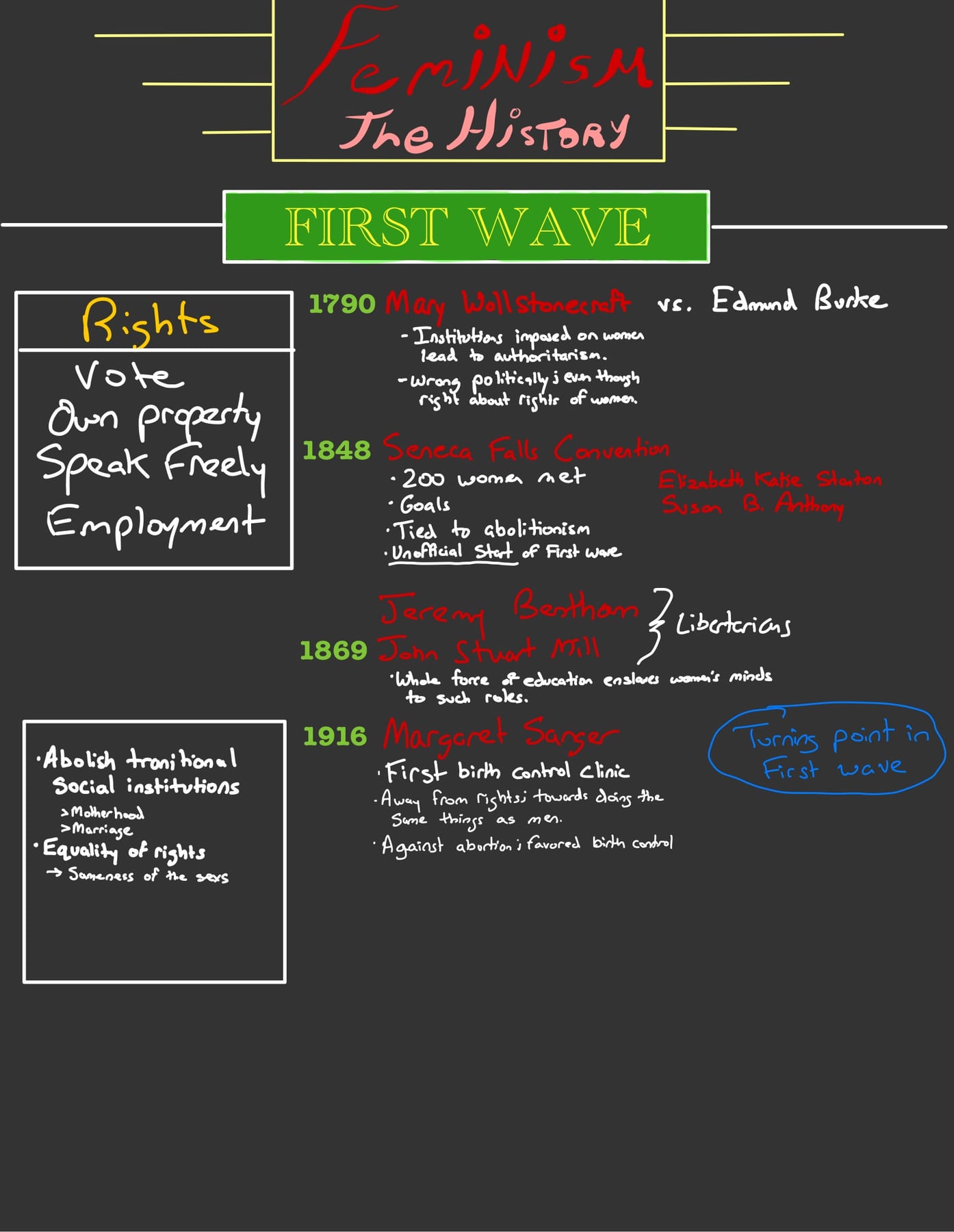
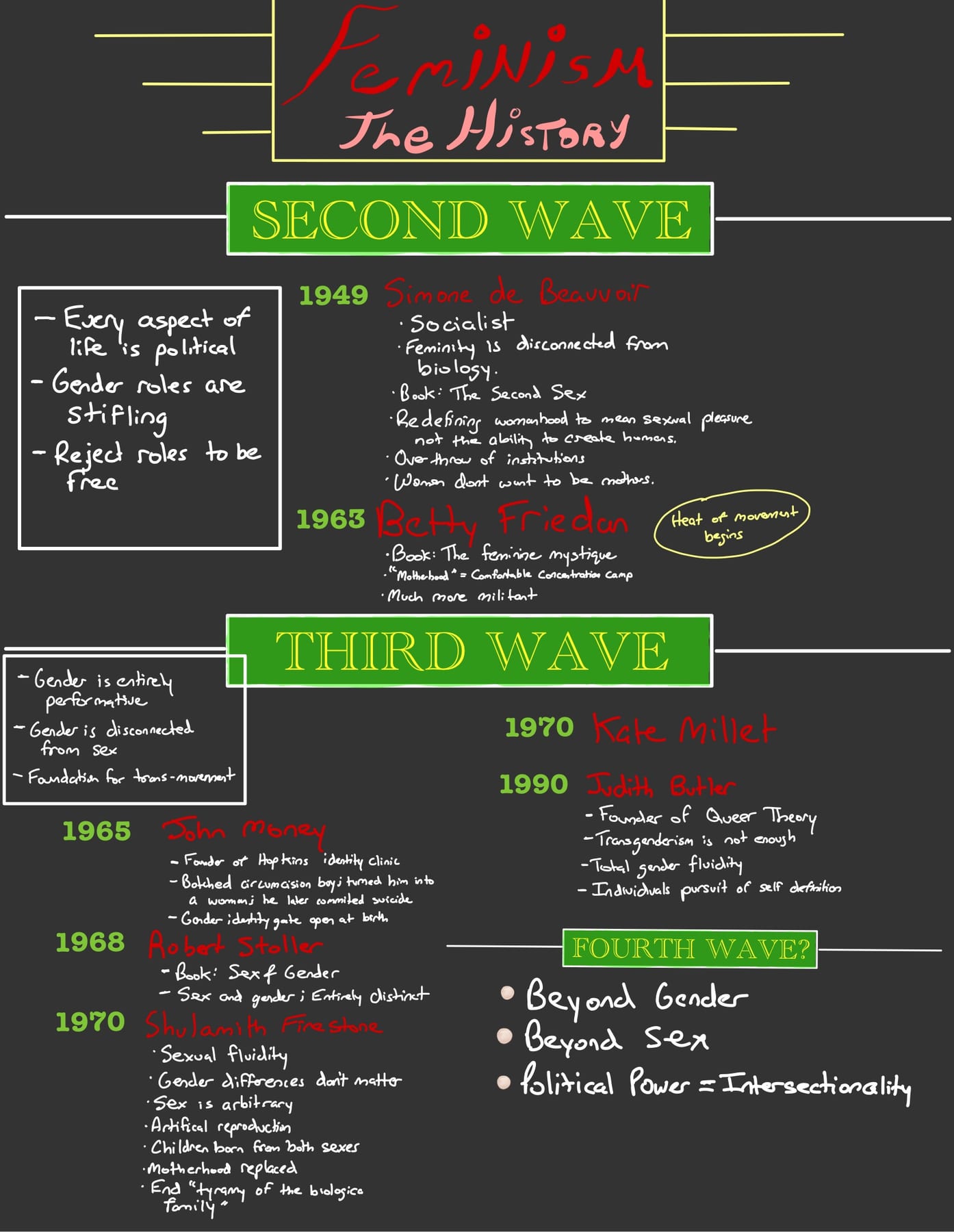
Journal connection: A rendered visual history of feminism’s waves and intellectual influences.
Source boundary: These are captured journal materials; the integration does not independently verify every clipped claim, quotation, or figure.
PDF++ pages: p. 218 (file not included in this release)
Embedded preview:
Zibaldone 2024-2025.pdf (file not included in this release)
Open the complete Zibaldone page index
⬅️ Back to Social Issues MOC · Sisters: Gender Roles · Birth Rate · Queer Theory · Cross: 60.20 The Boy Crisis · Politics MOC · Concept: Patriarchy
The whole file on feminism: what it claims to be, what its critics say it actually is, the reciprocity argument, the girl-boss critique, the major debates I’ve watched, and the strongest material on both sides that lives elsewhere in this vault.
The critique in one line
“Feminism promised liberation but delivered a second job.” — Mary Harrington → the girl-boss section
The frame I actually want
“The Left tells men, ‘Be more like your sister.’ The Right says, ‘Be more like your father.’ Neither invocation is helpful. What is needed is a positive vision of masculinity that is compatible with gender equality.” — Richard Reeves → Of Boys and Men
🗺️ What’s here
- Definitions, waves & theory — the definitional fight that decides every debate downstream
- The reciprocity question — what do women owe men and society?
- The girl-boss critique — against careerism as the pinnacle of womanhood
- Debates — Wilson vs. Charlie in full, plus the rest of the debate shelf
- The ledger — negatives vs. positives, side by side
- Marriage, motherhood & birth rates
- Steelman — know the other side
- Across the vault · Misc
📖 What Feminism Is — Definitions, Waves & Theory
Examines power, gender, and equality.
Thinkers: Wollstonecraft, Butler.
Texts: Vindication of the Rights of Woman, Gender Trouble.
🌊 The three waves (flashcard-level summary)
- Core idea: gender equality and opposition to patriarchy and systemic oppression of women. → Anki card
- Three waves: first (legal rights), second (social and cultural), third (identity and intersectionality). → Anki card
- Intersectionality: a framework that considers overlapping forms of discrimination — race, class, and gender. → Anki card
- Gender as performative: Judith Butler, postmodern feminism. → Anki card
- “The personal is political”: Knowles reads it as a tool to politicize private life and embed political correctness in everyday culture. → Anki card
Where the deeper treatments live in this vault:
- Political Ideologies — feminism as a thin ideology: its is/ought/plan structure, and the liberal · socialist · radical split, wave by wave
- Post-Modern Philosophy - Peterson Academy — §7 Critical Feminist & Race Theory — Wollstonecraft → de Beauvoir → MacKinnon: how first-wave Enlightenment liberalism became third-wave social determinism
- Foundations of Modern Social Thought - Yale — Mill, The Subjection of Women (1869), and Harriet Taylor’s influence
- Patriarchy — a full refutation of the “end of the spear” argument, drawing on de Beauvoir, Butler, hooks, Locke, Kant, Rawls, Nussbaum
- Force Doctrine · Force Doctrine and Patriarchy — Andrew Wilson’s central argument and a point-by-point fact-check of it
- Feminine Virtues — the traditional virtue duality (feminine vs. masculine) and the reciprocal-duties tables in full
- Queer Theory · Critical Race Theory · DEI — the adjacent identity frameworks
⚖️ The Reciprocity Question
What Do Women Bring to the Table?
- Women want a: Protector, Provider, Go to war and sacrifice their life
- Men can be drafted, women can’t.
- What do women provide?
- What are these feminine virtues? They need them to be pursuing masculine virtues. This equates to women’s privilege in society. What do men get?
- What are we getting from women for doing that?
- Virgins on wedding night?
- Women of great virtue?
- Ideal of courtly love is for women of great virtue. Where are they?
- Masculinity is not only punished—it’s taken for granted and not reciprocated
- Men have these duties to protect and provide, what duties do women have towards men?
- Referenced Argument: ‘Feminist Nonsense!’ Netflix ‘Adolescence’ Sparks Toxic Masculinity Debate | Feat Andrew Wilson - YouTube (7min)
- Boy Crisis - Gender Empathy Gap — why male suffering gets less sympathy
- Full tables of the traditional reciprocal duties → Feminine Virtues
The counter-example to have ready
On October 7, 2023, the IDF’s all-female tank company (“Pereh,” inside the Caracal Battalion) drove to the Gaza border on its own initiative and fought for ~17 hours, killing roughly 50 terrorists — reportedly the first all-female armored unit to fight in combat in modern military history. If the argument is “women take the civic benefits without the risk,” this is the case that has to be answered. → the full write-up
Duties for women in society
These are two powerful and often neglected questions that cut to the heart of modern debates about gender, reciprocity, and societal roles. Let’s address both with clarity and philosophical depth.
1. What Duties Do Women Have in Society?
A well-ordered society depends not just on rights, but on reciprocal duties. If we only speak about what society owes women, but never what women owe to society, we produce imbalance and resentment. Women—like men—have responsibilities grounded in both natural roles and moral reciprocity.
A. Moral and Civic Duties (Shared with Men)
- Truthfulness and Integrity – Uphold justice and honesty in public and private life.
- Citizenship – Contribute to the civic life of the community (voting, participating in civil discourse).
- Compassion and Responsibility – Care for others, particularly the vulnerable (children, the elderly).
B. Natural and Relational Duties (Often Unique to Women)
These are not mandates for every woman, but rather honoring the unique potential of womanhood:
- Motherhood – When chosen, it is one of the most essential duties to society. Raising and nurturing future generations is civilization-sustaining work.
- Relational Harmony – Women often shape the tone of the home, relationships, and community through emotional and relational intelligence.
- Modesty and Restraint – Not as submission, but as moral leadership: guiding society by limiting excess, vulgarity, and self-indulgence in culture and family life.
“The greatest work a woman will ever do will be within the walls of her own home.” – Harold B. Lee
2. How Are Men Supposed to Be Treated?
The dominant narrative today often focuses on how men should treat women—with respect, protection, and attentiveness—and rightly so. But there’s striking silence on how women should treat men, which leads to cultural imbalance and resentment.
A. Men Deserve Respect
- Men are not utilities, paychecks, or punching bags.
- They are human beings with emotional and spiritual needs, often unacknowledged.
- Respect includes listening, appreciating their sacrifices, and not assuming malice or toxicity from masculinity.
Respect is to men what love is to women — essential, not optional. — Dr. Emerson Eggerichs
B. Men Need Encouragement, Not Contempt
- A man flourishes in admiration, not in sarcasm or belittlement.
- Constant shaming narratives (e.g., “man up,” “toxic masculinity,” “useless dads”) undermine his role and motivation.
- Women should treat male partners, sons, and fathers with honor and trust.
C. Emotional and Physical Fidelity
- Just as women want loyalty and affection, men need to be wanted, not just tolerated.
- Withholding affection, respect, or sex as manipulation degrades the relationship and diminishes the man.
D. Support Men’s Roles as Providers and Protectors
- Many men are wired to sacrifice for their families—this should be welcomed, not resented.
- Women can support this by expressing gratitude and not undermining or competing destructively with men.
Conclusion: Mutuality, Not One-Sided Duty
- A healthy society is built on reciprocal responsibilities.
- The cultural focus on men’s duties to women must be balanced by articulating women’s duties to society—and to men.
- Men and women are not adversaries but complementary partners whose mutual obligations build the foundation of family, culture, and civilization.
Counter-material worth reading before using this section
Esther Vilar runs the opposite reciprocity argument — that men are the manipulated party in the same exchange → The Manipulated Man. And Brent Lengel argues the protection-for-authority trade is what damages men in the first place → Does Patriarchy Help Or Hurt Most Relationships? Brent Lengel Vs Andrew Wilson.
👩💼 The Girl-Boss Critique
Here is an argument against the idolization of the “girl boss” archetype in favor of re-centering societal admiration around the mother, wife, and caregiver role:
Thesis:
The cultural glorification of the “girl boss” as the pinnacle of female achievement is a shallow and potentially harmful ideal. It devalues the essential role of women as mothers and caretakers—roles foundational to both individual flourishing and social cohesion—and promotes a narrow, materialistic conception of success.
I. The “Girl Boss” Ideal: A Corporate Repackaging of Feminism
- The “girl boss” archetype reduces female empowerment to professional ambition, financial independence, and status within capitalist structures.
- This ideal often mimics traditionally masculine success metrics (titles, hustle, power) while dismissing traditionally feminine virtues like nurturing, relational depth, and long-term investment in family.
- It turns empowerment into consumerism and productivity metrics—careerism becomes the sole measure of worth.
“Feminism promised liberation but delivered a second job.” — Mary Harrington
II. Motherhood and Caregiving: Undervalued but Essential
- Raising children, maintaining a home, and fostering community are not lesser roles—they are civilizational.
- These roles shape the moral, emotional, and social foundation of the next generation.
- Studies show children raised by present, loving mothers do better emotionally, socially, and academically.
- A healthy society requires intergenerational investment—which often comes from mothers and family structures.
“The hand that rocks the cradle rules the world.” — William Ross Wallace
III. The False Promise of Having It All
- The girl boss myth sells an illusion: that women can simultaneously excel at high-powered careers, maintain vibrant social lives, and raise children without sacrifice.
- In reality, many high-achieving women report burnout, infertility, loneliness, or regrets about missing out on family life.
- Career success is time-bound and impersonal; family success is lifelong and intimate.
IV. Cultural Disrespect Toward Mothers
- When “full-time mom” or “homemaker” is seen as a fallback option or failure, society discourages women from choosing the very path that sustains it.
- Public discourse often patronizes motherhood, reducing it to a quaint tradition rather than a critical vocation.
- Contrast: we celebrate a woman becoming CEO, but rarely honor the woman who raises four well-adjusted children.
V. Feminine Fulfillment vs. Feminist Ideology
- Many women find greater meaning in nurturing relationships than in climbing corporate ladders.
- True liberation lies in valuing both paths—not in replacing one idol (housewife) with another (girl boss).
- Promoting motherhood and caregiving as noble roles balances society’s moral economy and stabilizes communities.
Conclusion
The idolization of the “girl boss” prioritizes individual success over communal responsibility, status over sacrifice, and productivity over presence. Instead of shaming or sidelining traditional female roles, we should revere the mother, the wife, the caregiver—for it is through these vocations that a society nurtures its soul.
The empirical cousin of this argument
Pearl Davis’s female-attrition stats (lawyers, engineers, accountants, STEM) are the data version of “the false promise of having it all” — and they’re fact-checked, claim by claim, in Ana Kasparian vs Pearl Davis on Feminism.
🎙️ Debates
🗂️ The debate shelf (everything in the vault)
- Ana Kasparian vs Pearl Davis on Feminism — the most useful note I have: every example both sides used, plus a claim-by-claim fact-check with verdicts
- Andrew Wilson vs. Woke Male Feminist Oliver - Whatever Debates 18 - YouTube — Wilson’s rhetorical toolkit dissected (conditional reversal, reductio, definition-forcing)
- Andrew Wilson vs. Naima (Feminist, Leftist, Anti-Trump) - Whatever Debates 20 - YouTube — the Force Doctrine laid out, plus its fallacies
- Andrew Wilson vs. Naima HEATED Debate Round 2 Whatever Debates 23 — round two
- Does Patriarchy Help Or Hurt Most Relationships? Brent Lengel Vs Andrew Wilson — the best anti-patriarchy case I have on file (Madonna-whore complex, suicide stats)
- Rachel Wilson on Feminism — short, evidence-ranked guide to Wilson’s strongest claims, the feminism-versus-modernity question, and the supporting research notes
- Rachel Wilson vs. Feminist Conservative Driena Sixto Debate — reactionary-traditionalist vs. conservative-feminist; note the de Maistre / Symphonia roots
- The Problem With Feminising Society - Helen Andrews — feminization as institutional demographics, not ideology
- Why Young Women Moved Left While Young Men Stayed Sane — the global gender-ideology gap; women moved 20+ points left, men barely moved
Andrew Wilson vs. Charlie (Feminist, Leftist) | Rachel Wilson CRASHES Show?! | Whatever Debates #22
1. The core clash: What is feminism?
Very early they define the resolution as: “Is feminism good for society?”
- Charlie’s definition (standard/liberal): She accepts a dictionary-style definition: feminism is the advocacy of equality of the sexes and the political, social, and economic rights of women.
- Andrew’s definition (critical/anti-liberal): He rejects that as too sanitized and instead defines feminism as
“the movement towards egalitarian systems and the deconstruction and removal of the patriarchy.”
He argues feminism necessarily presupposes an oppressor–oppressed lens (women vs. patriarchy/men), so built into it is a story where men collectively are the problem.
Why this is interesting:
This isn’t just semantics. Andrew’s reframing lets him argue: - If feminism = anti-patriarchy revolution, then any cost to men, families, or social order can be treated as a “necessary side effect” of dismantling oppression.
- It also lets him accuse feminism of being structurally hostile to male authority, fatherhood, and traditional roles, regardless of what individual feminists say.
Charlie responds by: - Insisting patriarchy also harms men (rigid roles, emotional repression, narrow scripts for masculinity), so dismantling it is a shared liberation project.
- Maintaining that the aim is gender equality, not female supremacy.
This definitional fight silently shapes the rest of the debate: Andrew keeps treating feminism as an inherently adversarial ideology; Charlie keeps treating it as an imperfect but necessary tool to correct historic injustice.
2. “Limiting women’s vote” to stop men being sent to war
One of the sharpest exchanges comes when Andrew openly bites a bullet:
- He says that if we define “good” as outcomes most people would prefer, then limiting women’s political power (specifically their ability to “vote men into wars”) could be “good for society.”
His logic:- Almost all front-line combat is done by men.
- Women vote, but virtually never bear that particular burden.
- So you have a class of people who can impose extreme risks on another class without sharing them.
- Therefore, constraining that group’s political influence can be morally justifiable in a consequentialist calculus.
Charlie (and later the other interlocutor) responds with a very strong reductio:
- If that logic is valid, then historically you could also say:
- “White people shouldn’t be allowed to vote if they can vote to send black people to war while avoiding the draft themselves.”
- She argues Andrew would never accept disenfranchising all white people on that basis, even though the form of the argument is the same.
- Therefore the underlying principle (“any group that can vote burdens onto another group but not themselves should lose the vote”) is either:
- incoherent,
- or selectively applied, in which case it’s just a rationalization for rolling back women’s political rights.
Why this is interesting:
This is a rare moment where the anti-feminist side explicitly endorses curtailing women’s suffrage on “greater good” grounds, and the feminist side answers with a precise analogy that forces you to confront what that principle would mean in racial terms. It’s one of the cleanest philosophical clashes in the whole debate.
3. War, gender, and the “front-line burden” argument
Closely tied to the above is a longer argument about warfare and gender roles:
- Andrew presses the point that, in any serious war, it is overwhelmingly men who fight and die in front-line roles.
- He emphasizes that even when women serve:
- they tend to be a small minority in direct combat,
- or they can leave in cases like Ukraine, where women were allowed to leave the country while men were conscripted.
- He then adds a darker, tactical point:
female soldiers captured by the enemy become “booty” — vulnerable to rape and propaganda — making them strategic liabilities in a way male soldiers are not.
Charlie pushes back: - She notes women do serve in combat roles and reserves, especially in modern militaries.
- She argues that war is increasingly technological and less about raw infantry numbers; the classic “front-line male soldier” picture is less exhaustive than Andrew suggests.
- She strongly rejects the idea that women’s presence in combat is primarily a liability rather than an expression of equal civic responsibility.
Why this is interesting:
This argument exposes a deep philosophical divide: - Andrew sees sex-based asymmetry in risk as morally and politically decisive, justifying different rights and expectations.
- Charlie sees that asymmetry as historical and contingent, not a basis for perpetual civic inequality.
4. The meta-ethics truce: “Good” = outcomes most people prefer
Before they get into the weeds, they explicitly agree not to sink into a meta-ethics swamp.
- They settle on a working definition: “good” = outcomes that are preferable to most people.
- Andrew notes they actually disagree on what “good” is in a deeper sense, but accepts this as a practical definition to keep the debate moving.
Why this is interesting:
It’s a quiet but important move. It: - pushes the debate toward empirical claims (“Do feminist policies produce better or worse outcomes?”)
- and away from purely deontological or theological claims (“God designed sex roles,” “rights are inviolable,” etc.).
Later, you can see both sides implicitly appeal to this truce: - Andrew argues feminism produces worse aggregate outcomes (lower birth rates, lonelier people, unstable families).
- Charlie argues feminism led to massive gains in safety, autonomy, and opportunity that most people would not want to give up.
Even when they’re not saying it out loud, that shared “good = broadly preferable outcomes” frame is doing a lot of work.
5. Feminism, sexual freedom, and the “incel vs. hypergamy” problem
There’s a long segment on sexual liberation, incels, and hypergamy:
- Andrew connects feminism and the broader liberal sexual revolution to:
- more casual sex,
- hypergamy (a minority of high-status men getting a disproportionate share of sexual attention),
- a class of “involuntary celibates” (incels) who are shut out of the mating market.
- He suggests these dynamics:
- increase male resentment,
- lower pair-bonding and family formation,
- and contribute to social instability, including a fringe of incel-motivated violence.
The other side counters:
- Sexual inequality and lonely men existed long before feminism.
- The solution is not to roll back women’s rights but to:
- help men become more attractive partners,
- address economic and social causes of loneliness,
- and maintain women’s sexual autonomy rather than coercing them into relationships.
They also distinguish between:
- identities like “incel,” which can be treated as problems to be solved (via self-improvement, mental health support, etc.),
- and the dangerous conflation of that frustration with legitimizing misogynistic or terroristic violence.
Why this is interesting:
This is one of the few places where both sides are involuntarily talking about the same real crisis (lonely young men, collapsing marriage rates) but giving radically different diagnoses and prescriptions.
Follow the incel thread
Assessing the Threat of Incel Violence · @MeetIncelsAntifeminists2024 · Boy Crisis - Loneliness · Boy Crisis - Toxic Influences · Attractiveness
6. Abortion, unwanted births, and empirical tug-of-war
Another dense exchange centers on abortion bans and their real-world effects:
- Charlie presents abortion as a way to prevent unwanted births and protect women’s bodily autonomy.
- The other side brings in data from post-Dobbs states:
- pointing out that abortions did rise in neighboring states where it remained legal,
- but not enough to fully offset the abortions that would have occurred in the ban states,
- concluding that bans do significantly reduce abortions and unwanted births.
This leads to a subtle argument:
- If the stated goal of abortion rights is fewer unwanted children, and
- if restrictive laws actually produce fewer unwanted births than a permissive regime (because travel doesn’t fully compensate),
- then, on a crude “outcomes” metric, the anti-abortion side might claim to better achieve that narrow goal.
Charlie pushes back by widening the lens: - Counting “unwanted births” alone ignores health risks, economic costs, and the moral weight of forcing pregnancy and childbirth.
- The quality of women’s lives and their agency is part of the outcome calculus, not just raw birth statistics.
Why this is interesting:
It’s one of the few moments where both sides are forced into a data-driven argument under the “good = preferable outcomes” standard, and you can see how much depends on which variables you prioritize.
Abortion material → Abortion · Judith Jarvis Thomson's Violinist Argument for Abortion Rights
7. Feminism, crime, and domestic violence patterns
Near the end, there’s a jagged but revealing detour into crime and domestic violence:
- Andrew points at raw crime statistics suggesting:
- lesbian relationships have particularly high rates of domestic violence,
- and women in power can also be serious abusers or predators.
- His implicit point is that violence and abuse are not exclusively male, undermining a simplistic feminist framing of men as perpetrators and women as victims.
Charlie pushes back by: - questioning whether cherry-picked stats and extreme anecdotes represent the broader truth,
- and stressing that feminist work on domestic violence and sexual assault has overwhelmingly benefitted women, even if abuse is not strictly one-sided.
Why this is interesting:
This exchange exposes a recurring pattern: - Andrew’s critique of feminism often hinges on counter-examples that break the “men = oppressors / women = oppressed” stereotype.
- Charlie’s defense rests on aggregate trends and institutional gains even while acknowledging complexities.
Check the numbers before you use them
The “women commit most child abuse” talking point is a misattribution — actual HHS data is 52% female / 47% male overall, and it flips hard by abuse type (sexual abuse is 90–94% male). → Child Abuse Perpetrator Statistics · Crime
8. Big-picture takeaway
Stepping back, the most important structural arguments in the debate are:
- Framing & definition:
- Is feminism a rights-equality movement that sometimes overreaches, or an inherently adversarial ideology aimed at dismantling male authority?
- Risk and burden asymmetry:
- Do sex-based differences in war, danger, and physical risk justify different political rights and roles?
- Suffrage and moral consistency:
- If you’re willing to limit women’s voting power to protect men from war, do you accept the same logic applied to race or other groups?
- Sexual revolution & social fallout:
- Are loneliness, incels, and low birth rates mainly products of feminist/liberal sexual norms, or of broader economic and cultural shifts?
- Empirical vs. moral metrics:
- When abortion laws reduce unwanted births but harm women’s autonomy, or when domestic violence stats complicate a simple “men bad, women good” story, how do we weigh competing goods?
Those are the fault lines that, if you’re building an argument/debate map, form the main branches.
- When abortion laws reduce unwanted births but harm women’s autonomy, or when domestic violence stats complicate a simple “men bad, women good” story, how do we weigh competing goods?
📊 The Ledger — Andrew vs. Charlie
| Area / Topic | Andrew – Negatives of Feminism | Charlie – Positives of Feminism |
|---|---|---|
| Core Nature of Feminism | Feminism isn’t just “equality”; it’s a revolutionary ideology to dismantle patriarchy, which in practice means hostility to male authority, fatherhood, and traditional roles. It bakes in an oppressor–oppressed lens where men are structurally the oppressor class. | Feminism is fundamentally about social, political, and economic equality for women. Critiquing “patriarchy” is critiquing unjust power structures and rigid roles, not “men as such.” It aims at fair treatment, not female supremacy. |
| Men vs. Women – Zero-Sum? | Feminism turns the sexes into rival political classes. Women are taught to see men as oppressors, so policies and culture shift to privilege women at men’s expense (courts, HR, public rhetoric). | Feminism frames many problems as shared burdens: patriarchy restricts both men and women (e.g., men can’t show emotion; women can’t enter certain roles). Gains for women (voice, safety, opportunity) are compatible with, and often beneficial for, men. |
| Family & Marriage | Feminism destroys the traditional family: normalizes divorce, encourages women to delay or avoid marriage and children, and undermines male headship. Result: fewer stable families, more broken homes, worse outcomes for children. | Feminism gave women exit options from abusive or dead marriages, legal recourse for custody and support, and the ability to choose partners and timing of marriage. That pressure forces men to be better partners and creates more voluntary, mutual marriages. |
| Birth Rates / Demography | Feminism plus sexual liberation leads to low birth rates, later childbearing, and demographic collapse. Cultures that fully embrace it end up with aging populations and no replacement, threatening long-term social stability. | Lower birth rates are partly a function of modern prosperity and education, not feminism alone. Feminism enables women to choose when and how many children to have, improving maternal and child health and making family life more intentional and less coerced. |
| Work & Economic Roles | Feminism pushes women to prioritize careers over family, creating stress, burnout, and regret. It devalues homemaking and motherhood as “oppression” and tells women they’re failures unless they behave like male workers. | Feminism opened education, professions, and economic independence to women. That protects them from being trapped with abusive or negligent husbands, raises household income, and unlocks half the population’s talent for science, business, arts, and politics. |
| Sexual Revolution & Casual Sex | Feminism (combined with liberal sexual norms) leads to promiscuity, hypergamy, and the “incel” problem: a small set of high-status men get most of the sexual access, while many average men are shut out, fueling resentment and social instability. It also normalizes abortion and treats unborn life as disposable. | Feminism insists on consent, bodily autonomy, and freedom from coercion. It challenged double standards where men’s promiscuity was celebrated and women’s punished. It gave women tools and language to say no, demand contraception, and leave exploitative sexual situations. |
| Mental Health / Identity | Feminism encourages women to be perpetually aggrieved victims, obsessing over micro-oppressions. It can foster resentment toward men, fear of commitment, and rejection of traditional scripts that previously gave many people meaning and stability. | Feminism helps women (and men) question rigid gender norms that cause anxiety and shame (e.g., “a man must never cry,” “a woman’s only role is wife/mother”). More flexible roles can improve mental health, self-respect, and authenticity in relationships. |
| Violence & Domestic Abuse | Feminist narratives exaggerate male violence and erase female violence, creating a one-sided picture. Andrew points to stats on domestic violence in lesbian relationships as evidence that violence is not uniquely male, and says feminist framing can demonize men as a class. | Feminism played a central role in naming and fighting domestic violence and sexual assault: shelters, hotlines, marital rape laws, workplace harassment protections, etc. Even if abuse isn’t exclusively male-perpetrated, women have overwhelmingly benefited from these reforms. |
| Law, Rights & Institutions | Feminism has tilted law and institutions into systemic bias against men (family courts, Title IX processes, HR regimes). Claims of “believe all women” and low standards of evidence create unjust procedures and false-accusation risks. | Feminism fought for basic legal rights once denied to women: voting, property ownership, access to higher education, anti-discrimination law, equal pay protections, safeguards against harassment and assault. These are now seen as bedrock liberal-democratic norms. |
| War, Conscription & Civic Burden | Feminism gives women equal political voice without equal risk: they can vote for war while almost exclusively men are conscripted or die in combat. That asymmetry justifies, in Andrew’s view, questioning or limiting women’s political power in some domains. | Feminism argues for shared civic responsibility: opening military roles to women, challenging the assumption that only men must fight and die. The solution to unjust gendered burdens is to align rights and responsibilities, not to revoke women’s political power. |
| Culture & Public Discourse | Feminism feeds a culture where “patriarchy” and “colonizer” become broad smear words, especially against white men, and where male leadership is automatically suspect. It encourages a grievance-based politics that corrodes social trust. | Feminism made it possible to name and challenge real injustices that used to be invisible or dismissed: workplace harassment, marital rape, exclusion from institutions, media stereotypes. It gave women a language and a platform to be heard in public life. |
💍 Marriage, Motherhood & Birth Rates
Hub: Marriage · Marriage Rates · Birth Rate · Age Gap · Sexual Promiscuity · Moving Loses Extended Family
Later Motherhood Predates Modern Feminism
Women in north-western Europe commonly married in their mid-twenties centuries before modern feminism, female professional careers, or political equality. Because births outside marriage were rare, this also delayed first childbirth. The delay was usually not an expression of personal liberation: women often spent their teens and early twenties in exhausting domestic service, accumulating enough money or a dowry to marry and establish an independent household. This complicates claims that later motherhood is solely a modern consequence of women’s emancipation. See Late Marriage and Fertility in Early Modern Europe.
Marriage Timing Functioned as Population Control
Before reliable modern contraception, birth rates were strongly regulated by when—and whether—people married. In north-western Europe, women commonly married around ages 24½–26½, births outside marriage were uncommon, and 10–15 percent of women—and sometimes as many as 25 percent—never married. This shortened or eliminated the reproductive period for a substantial portion of women. → Birth Rate
The baby boom interrupted a much longer U.S. decline
The U.S. crude birth rate fell from roughly 50 births per 1,000 people in 1800 to 19.7 in 1930–1934. It temporarily rose during the baby boom, peaked in 1957, and then declined before the major second-wave feminist victories of the late 1960s and 1970s. This chronology does not settle every causal question, but it rules out the claim that second-wave feminism originated the American fertility decline. → Chart, table, interpretation, and sources
The competing explanations for falling birth rates, as they appear in this vault:
| Explanation | Where it’s argued |
|---|---|
| Feminism + sexual liberation | Wilson’s case, above · Ana Kasparian vs Pearl Davis on Feminism |
| Institutional feminization + the two-income trap | [[The Problem With Feminising Society - Helen Andrews#Birth rates and the “two-income trap” |
| Prosperity, education, internet, economic instability | Kasparian’s counter → Ana Kasparian vs Pearl Davis on Feminism |
| Long-run U.S. demographic transition (pre-second-wave feminism) | [[Birth Rate#U.S. fertility decline in historical perspective |
| Marriage timing (pre-modern, pre-feminist) | Late Marriage, Women's Work, and Fertility in Early Modern Europe |
| Father absence and family breakdown | Boy Crisis - Family, Divorce & Providers · Boy Crisis - Fatherlessness |
🛡️ Steelman — The Best Case For Feminism
- Sexual assault — measurement and legal recognition — U.S. national and campus evidence, historical improvement and recent limits, broader assault versus penetration, male victimization, and survey/reporting differences; updated 16 October 2026.
Know the other side. Everything here is sourced from notes already in this vault.
-
The legal-rights record is not in dispute. Suffrage, property ownership, higher education, marital-rape law, anti-discrimination and harassment protections — these are now bedrock liberal-democratic norms. → the Charlie column above · first-wave feminism as Enlightenment liberalism
-
The “force doctrine” doesn’t survive scrutiny. The claim that patriarchy is inevitable because men monopolize force equivocates between the state’s monopoly on legitimate force and men’s, and its “no woman ever led an armed revolt” premise is factually false (Boudicca, Nzinga, Nanny of the Maroons, Carlota, Tubman). → the logical problems · Patriarchy
-
Patriarchy plausibly harms men too. Brent Lengel’s case: traditional-masculinity beliefs correlate with a 240% higher suicide rate (JAMA Psychiatry), and male-dominance norms correlate with the Madonna-whore complex that wrecks intimacy. → Does Patriarchy Help Or Hurt Most Relationships? Brent Lengel Vs Andrew Wilson
-
The suffrage-restriction argument is a reductio magnet. “Any group that imposes burdens it doesn’t share should lose the vote” applies to race as cleanly as to sex — and nobody bites that bullet. → section 2 above
-
The strongest anti-feminist stats are the weakest ones. OnlyFans prevalence, “an eighth of the world population aborted,” “a third of Gen Z aborted,” “one-third of paternity tests negative” — all unsupported, misleading, or context-stripped. Using them loses the debate. → the fact-check
-
Mill got here first, from the liberal side. The Subjection of Women (1869) argued women’s condition was in some respects worse than slavery, because a master expects obedience but a husband expects love. → Foundations of Modern Social Thought - Yale
-
Women in armor, under fire, worked. The IDF’s all-female tank company fought ~17 hours on Oct 7 and is credited with stopping the attack spreading south — after years of institutional doubt that women could hold up in armor. Several of those officers now train the IDF’s next combat generation. → Caracal's "Pereh" company
Pinker’s Chapter 7 supplement — second-wave reform and changing attitudes
Pinker’s strongest case for feminism is not a claim that every feminist theory was correct. It is the institutional record: rape and domestic assault were reclassified from proprietary or “private” matters into violations of women’s autonomy; marital-rape exemptions were removed; crisis centers, shelters, forensic evidence, and enforcement changed the practical response. He treats this as a rights revolution in which women’s participation also changed the point of view from which law and harm were judged.
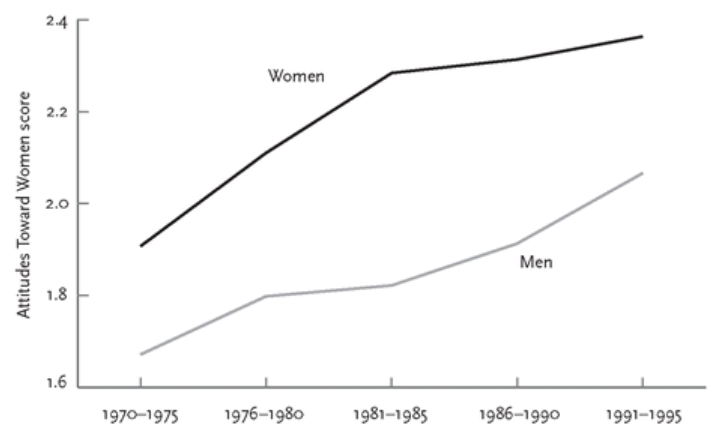
Figure 7-11 — Attitudes toward women among U.S. college-age respondents, 1970–1995. Jean Twenge’s graph averages 71 studies using a standardized questionnaire. Both sexes moved toward more egalitarian answers; in the aggregate, men in the early 1990s scored above women in the 1970s. This is a historical meta-trend in college-age samples, not a representative measure of every American, proof that discrimination ended, or validation of Pinker’s separate and contestable claims about sex differences and rape theory. The outcome also mixes cohort, period, recruitment, and social-desirability effects. Chapter 7 synthesis · Second-wave reform and institutional change, PDF pp. 557–563 (file not included in this release) · Figure 7-11, PDF p. 563 (file not included in this release)
The asymmetry that survives the steelman
Selective Service is still male-only. That is the one legally-encoded, unambiguous sex asymmetry in civic burden — and it’s the load-bearing fact under most of the reciprocity argument above. Everything else needs a citation. Note that the strongest counter-case (the Oct 7 tank crews) is about capability, not burden-sharing — Israel drafts women; the US does not.
🔗 Across the Vault
- The male side of the ledger: 60.20 The Boy Crisis — the stats sheet · Boy Crisis - Gender Empathy Gap · Boy Crisis - Masculinity · Boy Crisis - Loneliness
- Concepts & theory: Patriarchy · Force Doctrine · Egalitarianism · Postmodern · Queer Theory · Critical Race Theory · DEI · Victimhood
- Books: The Manipulated Man — Vilar · The Myth of Male Power — Farrell · Of Boys and Men — Reeves · Strong Fathers, Strong Daughters — Meeker
- Sister social issues: Gender Roles · Income and Wage Gap · Birth Rate · Age Gap · Sexual Promiscuity · Child Abuse Perpetrator Statistics · Abortion
- Dating & polarity: Attractiveness · Male-Female Polarity · Women quotes
- Politics: Politics MOC · Social Issues MOC · Woke · Woke Right · Andrew Wilson · Debate
- Flashcards: Anki Collection — Political Philosophy & Books decks
🗄️ Misc
🖼️ History (image strip)
Anthony Mackie Is A SIGMA MALE
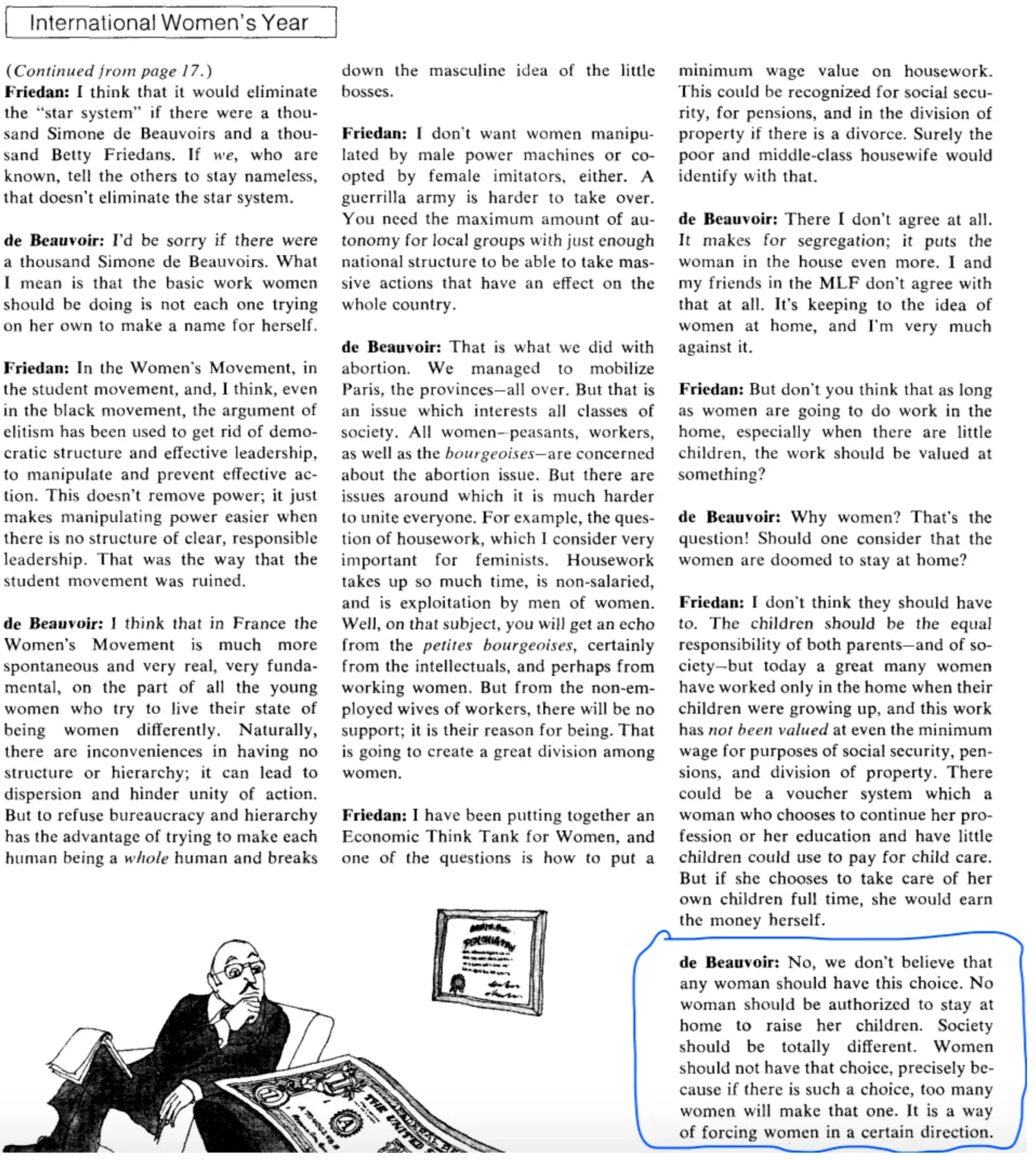
de Beauvoir on women NOT having the choice to stay home
📥 Notes linking here that this note doesn’t link back to
Backlinks.base (file not included in this release)
Handwritten Notebook Pages
Source
Open Feminism notebook pages — start at notebook p. 126 (file not included in this release).